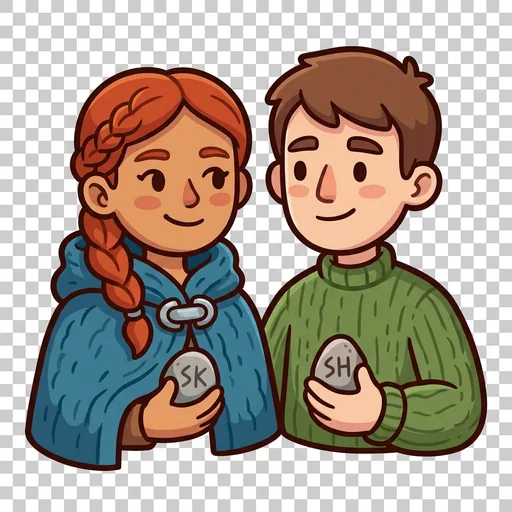
Birch
GERMANIC / OLD ENGLISH ROOTS — the short, punchy, monosyllabic Anglo-Saxon roots that form the everyday vocabulary of common English speech (mouth, hand, foot, hear, see, walk).
Press play to listen along. The line being read lights up as you go.
Show full transcript
Loading transcript…
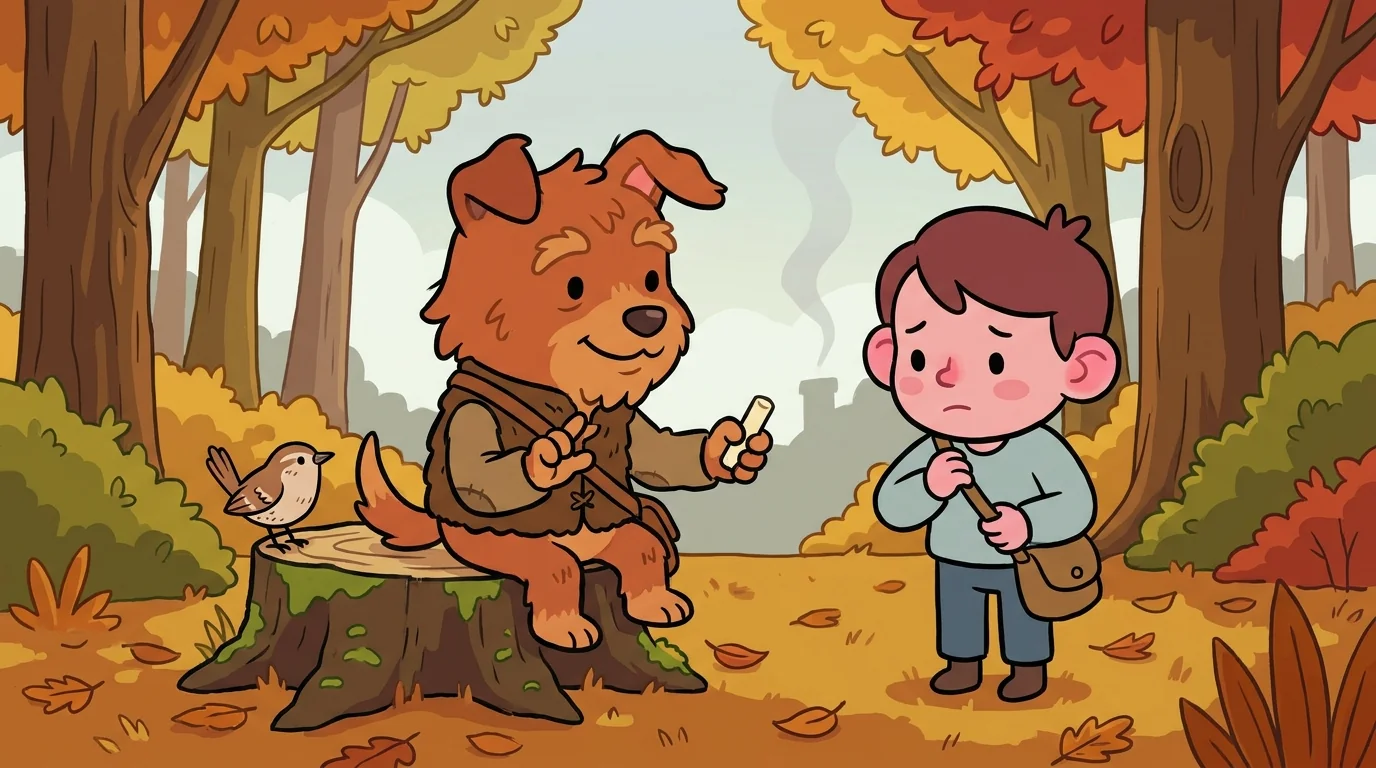
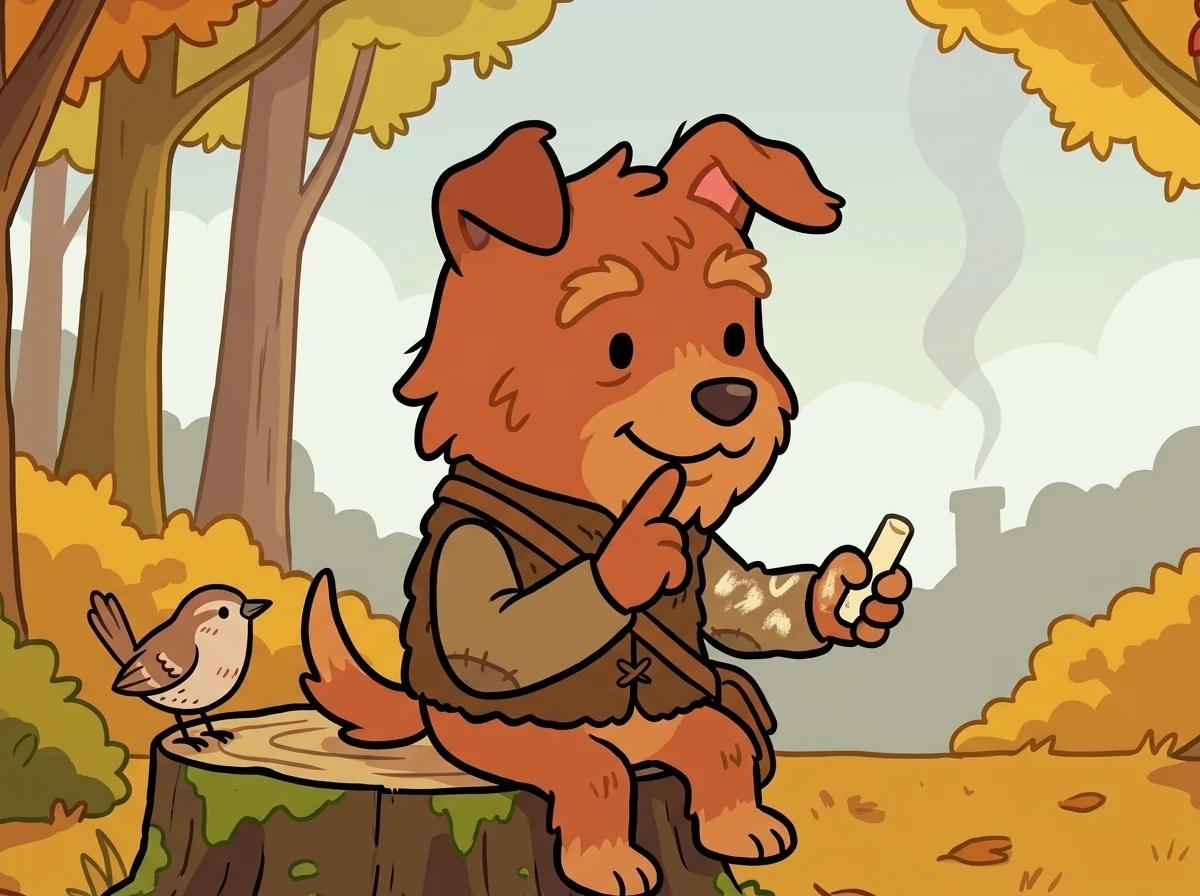
Birch sat on a low oak stump at the edge of the grove and counted six words on his fingers.
"Mouth," he said. Thumb. "Hand." Pointer. "Foot. Hear. See. Walk." Three on one hand. He smiled, the way someone smiles at a tool they've used for years.
The new student stood across from him, fidgeting with the strap of her satchel. She was maybe ten. Her ears were pink with the autumn cold. The grove smelled of moss and woodsmoke. A wren landed on the stump beside Birch's paw, picked at a seed, and flew off without thanking anyone.
"That's it?" the student asked. "Six words?"
"For today," Birch said. His voice was quiet, scratched, friendly. "Tomorrow, six more. Next week, twelve. By the end of the season, you'll have two hundred. Every one of them older than the academy. Every one of them a key."
He held out the chalk he kept tucked behind his ear. The chalk was the color of bone and the size of his smallest finger.
"You'll need this," he said. "I write on rocks. I write on bark. I write on my own paw when I'm thinking hard. I never write in books. Books are for clothes. The bones go on stones."
The student took the chalk like she'd been handed a coin from a kingdom she'd never heard of. Birch was small and russet and scruffy, with one ear that flopped forward like it was eavesdropping. He wore a brown wool jerkin and a leather satchel and nothing else of note.
He pointed at a flat grey rock near her feet. "Write mouth," he said. "Big as you can."
She did. The chalk was loud against the stone.
Birch nodded once, like a craftsman approving a clean cut.
Birch hadn't always been Birch.
He had been Wulf, named for the wolves in his parents' valley, because his parents had wanted him to grow up brave. He had grown up curious instead. As a kit, he had followed his grandfather around the family farm with his ears pricked, asking what every word meant.
"Why is it called a plough?" he had asked one spring afternoon, watching his grandfather break the soil for barley.
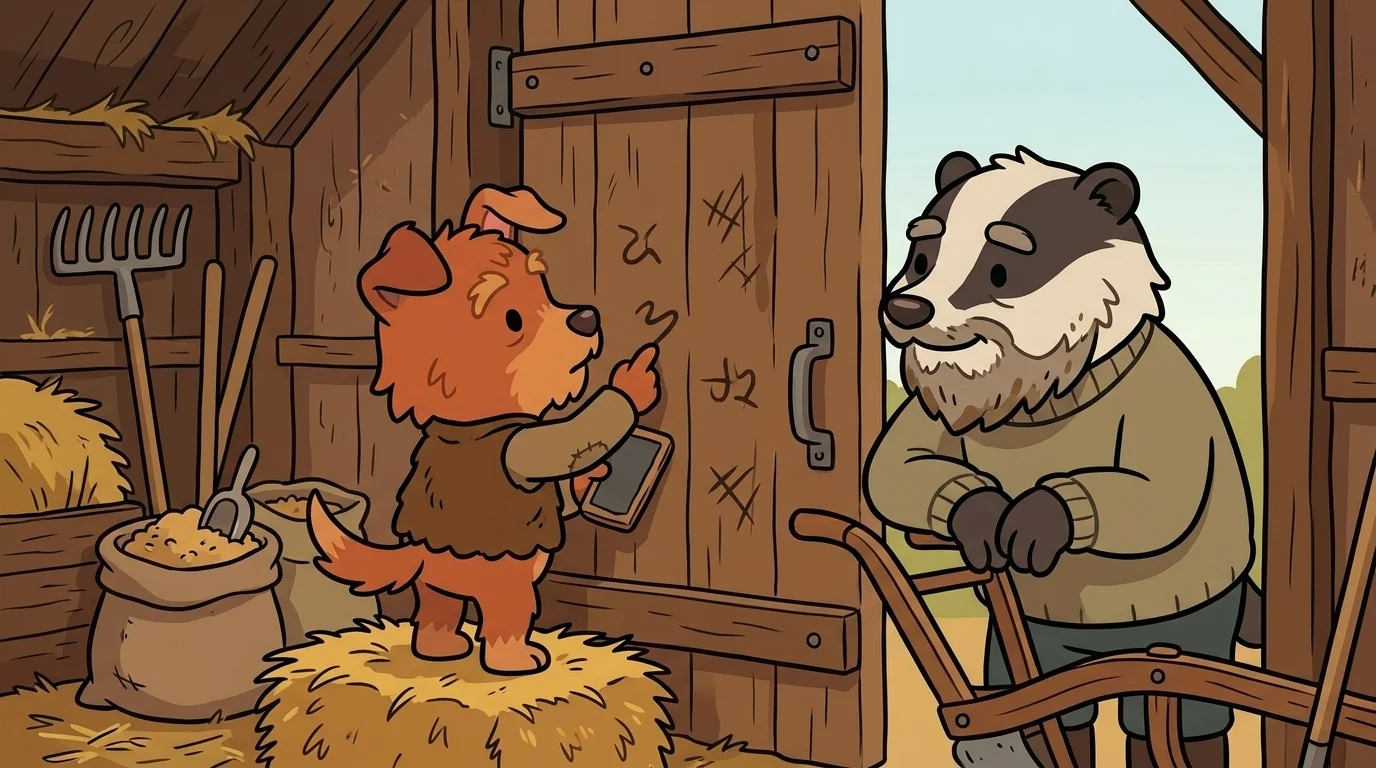
His grandfather leaned on the handle of the plough and thought about it. He was a slow, careful badger, with a beard that smelled of dirt and tobacco.
"It's called a plough," his grandfather said at last, "because that's what our people called it before anyone wrote anything down. The word is older than the word book."
"How old?"
"Older than your grandmother's grandmother's grandmother."
That answer kept Wulf awake for three nights. On the fourth morning, he climbed up to the barn loft and scratched his first word into the dusty inside of the barn door with a piece of slate. Plough. Then field. Then seed. Then bread. Then eat. Then hand and foot.
The list grew. By the time he was twelve, the inside of the barn door had two hundred words on it, in the spidery handwriting of a kit who hadn't quite figured out his vowels yet. His grandmother covered the door with a feed-sack so the neighbors wouldn't think the family had lost its mind, but she never asked him to wash it off. Sometimes, when she thought no one was looking, she lifted the corner of the sack and read.
When he was sixteen, a traveling scholar passed through the valley.
She was tall and grey, a heron in a wool cloak, and she carried a satchel full of books in languages Wulf had never seen. She stopped at the farm to buy bread. Wulf, who had been waiting all his life for someone who might recognize what he had on the barn door, asked her if she would look.
She did. For a long time.
Then she said, "These are the oldest words your people still use. Some of them are nine hundred years old. Some are a thousand."
"What are they called?"
"They are your word-hoard," she said.
"My what?"
"Word-hoard. It's an old word for a person's vocabulary — their treasure-chest of words. The old poets used it. They thought your collection of words was as precious as a chest of gold."
Wulf turned the phrase over on his tongue. Word-hoard. It was short and dense and a little funny, like a stone you could slip in your pocket. He kept thinking about it on the long walk back to the house, and again that night when he couldn't sleep, and again the next morning when he packed a satchel and announced to his startled parents that he was leaving for the academy.
He arrived at QuillSpell three weeks later with one change of clothes, a piece of slate, and a list of two hundred old words copied carefully into a leather notebook. The headmaster, a kind old badger named Mr. Veller, peered at him over his spectacles.
"And what would you teach, young fox?"
"The short words," Wulf said. "The Germanic ones. The everyday ones. The bones of English."
Mr. Veller blinked. "That's a small subject."
"It's the biggest one. Half the words a person uses in a day come from there. If you know the bones, the rest of the language hangs off them."
Mr. Veller thought about this for a long moment, then stood up and walked to the window. He looked out at the eastern grove, where birch and oak and ash and yew grew in tidy rows, each tree with an Old English name.
"In that grove," he said, "every tree has a bone-name. Birch. Oak. Ash. Yew. From this day, your school name is Birch."
And so it was.
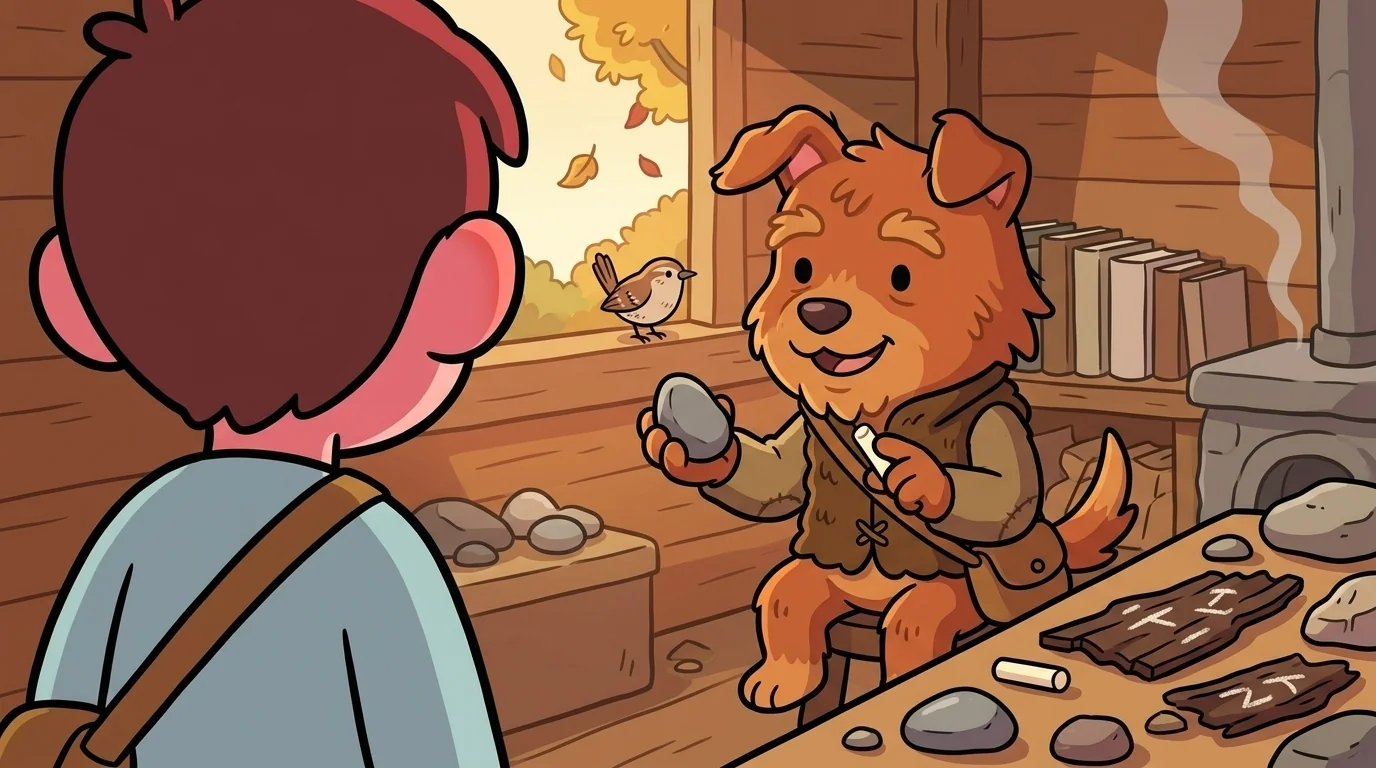
Inside his cabin in the grove, Birch starts every new student the same way.
He has them sit on a low stool. He gives them a smooth grey stone, about the size of a plum. Then he says one word.
"Mouth."
He waits. The student is supposed to repeat it. They do. Then Birch says, "Show me your mouth." The student points. Birch nods. "Now show me with the stone. Hold the stone in front of your mouth."
The student holds it up.
"Now you know the word," Birch says, in his quiet, scratched voice. "The stone helped. The word is older than the stone."
It sounds strange. It works. By the end of the first week, the new student has thirty bone-words. By the end of the first month, ninety. By the end of the season, two hundred. They never forget them, because the words are tied to their own bodies. Mouth. Hand. Foot. Hear. See. Walk. You can't lose a word that's part of you.
On the day the student asks the question Birch waits for — and they all ask it, eventually — he is ready.
"Birch," the student said. She was clutching the chalk in two paws, fingers cold. "What if I just use the long, fancy words instead? Won't I sound smarter?"
Birch smiled, but did not laugh. He never laughed at a real question.
"Big and enormous," he said, "mean the same thing. Enormous came from a Latin carriage. Big came from a farmyard. They mean the same thing. Big is older. Big is shorter. Big hits harder."
He tapped the stone in her paw. "Use the fancy ones when you need them. Use the bones when you want to be understood."
The student wrote big on the rock next to mouth. The chalk was loud against the stone, then quiet, the way the grove was quiet between gusts of wind.
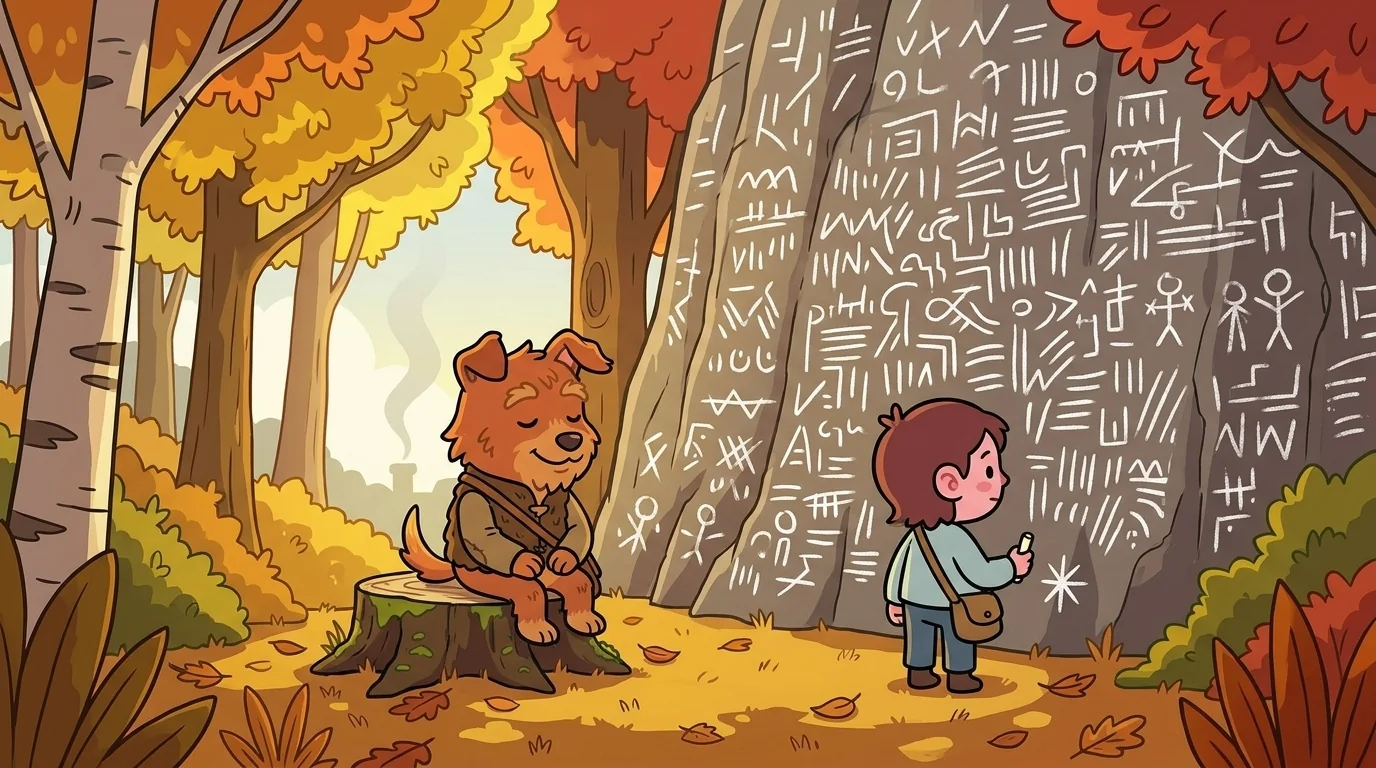
Later that afternoon, the student found Birch sitting on his stump again. The light was slanting low through the birches, gold and slow.
"Birch?" she said.
"Mm."
"What if I never know enough words?"
Birch closed his eyes for a moment. When he opened them, he was smiling — small and soft, like a moth landing.
"You already know more than you think," he said. "If you can say mouth, hand, foot, hear, see, walk — you have six bones. That's enough to start. The word-hoard grows with you. It grows because you grow."
He nodded at the chalk wall behind him, where two hundred Germanic words ran from floor to ceiling in his crooked handwriting.
"Bones first," he said. "Then the rest. That's the order."
The student looked at the wall for a long moment. Then she walked over and added one more word, very neatly, near the bottom.
Mine.
Birch saw it and nodded once, like a craftsman approving a clean cut.
The QuillSpell ensemble
Birch is part of QuillSpell's distributed-narrative cast. Each character embodies a different curricular primitive; together they teach the full subject.
-

Etyma
Latin Quarter — Latin roots (port, scrib, dict, vis, audi, port)
-

Sophia
Greek Acropolis — Greek roots (bio, geo, photo, log, graph, phon)
-
Saga
Old Norse Longhouse — northern roots (sky, take, gift, raise, weak, scant)
-

Margaux
French Chateau — Norman-French roots (royal, chef, ballet, garage, hotel, courage)
-

Zayn
Arabic Oasis — Arabic-origin English loans (algebra, algorithm, alchemy, zenith, sugar, cotton)
-

Hush
Silent-letter clan (kn-, gn-, wr-, mb, gh, pn-, ps-)
-

Twin
Double-consonant rule (running, beginning, hopped, planned — short-vowel-CVC + suffix)
-

Ember
Schwa-keeper (the unstressed-vowel "uh" — `about`, `pencil`, `lemon`, `circus`, `medium`)
-

Wren
Vowel-team duos (ai, ea, ee, oa, ow, ie, oi) — "when two vowels go walking"
-

Affix
Suffix-stack guardian (root + suffix + suffix: nation → national → nationalize → nationalization)
-

Cadence
Syllable-rhythm master (di-vid-ing words for spelling: VC/CV, V/CV, syl-lab-i-fi-ca-tion)