Wren
VOWEL-TEAM DUOS — *ai*, *ea*, *ee*, *oa*, *ow*, *ie*, *oi* (and others). The "when two vowels go walking" rule and its many exceptions.
Press play to listen along. The line being read lights up as you go.
Show full transcript
Loading transcript…
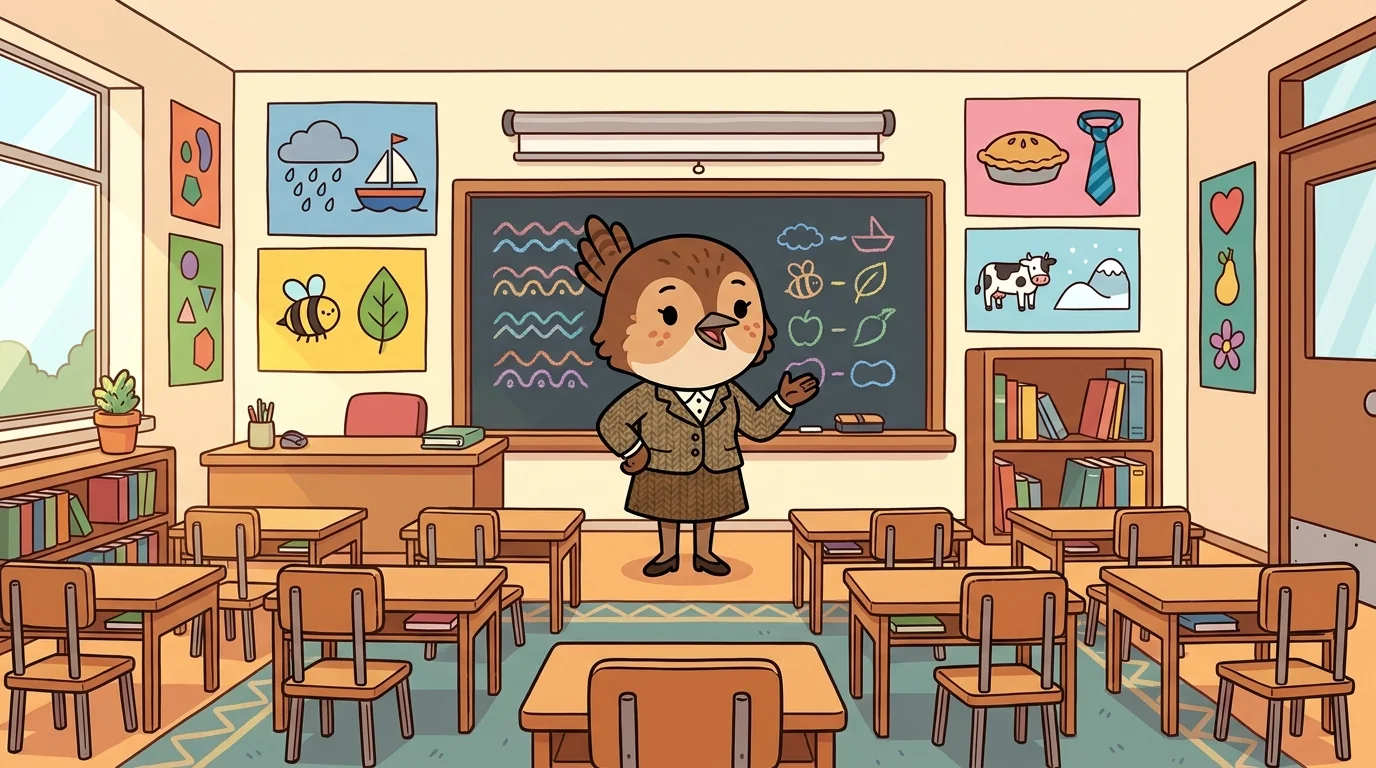
Wren is small and bird-like.
This is a literal description. She is a wren-headed character in the cast portrait style. She has brown feathered hair, a small sharp beak (which she uses, of course, for facial expressions; she has a mouth too), and small dark observant eyes. She is the academy's smallest faculty member by significant measure. She is also, by general agreement, the academy's most musical voice — her speech has a lilting bird-song quality that children find immediately memorable.
Wren teaches vowel-team duos.
A vowel-team duo is two vowel letters working together as a unit to write a single vowel sound. The classic schoolroom rule is: "When two vowels go walking, the first one does the talking, and it says its own name." This rule is broadly true for many vowel teams — ai in rain says long a; ea in eat says long e; ee in bee says long e; oa in boat says long o. But the rule has many exceptions. Ea can also say short e (bread, head, dead) or long a (great, break, steak). Ie can say long e (chief, brief) or long i (pie, tie, lie). Ow can say long o (snow, blow) or the ou-sound (cow, brow). The rule is useful but not absolute.
Wren teaches both the rule and the exceptions by singing.
This was a teaching method she developed herself, based on her own childhood. Wren — whose given name is Awen, an old word meaning poetic inspiration — grew up in a household of singers. Her family had been itinerant musicians for several generations. Her parents had performed at weddings, festivals, and small concerts throughout the kingdom. Awen had been raised on song. She had learned to spell, as a small child, by singing the letters. Her mother had taught her that letters had melodies — that you could sing the spelling of a word as a small song and the song would help you remember the order of letters.
This had been, in Awen's family, a folk-pedagogy method. It had not been formalized. It had been passed down from parents to children for at least four generations.
When Awen was seventeen, she encountered formal spelling-instruction at the village school. She had been amazed to discover that most children were not taught to sing the spelling. They were taught to recite it. R-A-I-N. Rain. B-E-E. Bee. Awen had thought: but if you sing it, you remember it better. Why would you not sing it?
She had begun to teach her classmates to sing. She had taught them small two-vowel-pair melodies. "A-I, A says I" for rain, paint, brain. "E-A, E says I" for eat, beat, neat. "O-A, O says O" for boat, coat, road. The melodies were simple — small four-note phrases that the children could pick up in one repetition.
The classmates had picked them up. The classmates had remembered them. The classmates' spelling-test scores had improved.

The village schoolteacher had noticed. The schoolteacher had asked Awen where she had learned the technique. Awen had explained the family tradition. The schoolteacher had said: "This is a real pedagogy. You should formalize it. There is an academy that would appreciate this."
Awen had walked to the QuillSpell academy when she was eighteen. She had brought no academic credentials. She had brought her singing voice.
The academy master — Lex — had interviewed her. Lex had said: "Demonstrate."
Awen had sung. She had sung the ai song. She had sung the ea song. She had sung the exceptions — the ea of bread is not the same as the ea of eat; here is how you sing the difference. Lex had listened for fifteen minutes. Lex had set down her tea. Lex had said: "You are appointed. Take your academic name. Wren — for the small bird with the loud voice."*
Awen — now Wren — has been the academy's vowel-team teacher for nineteen years.
In her classroom, she begins every first-day lesson the same way. She sings. She does not speak first; she sings. The first song is the ai song:
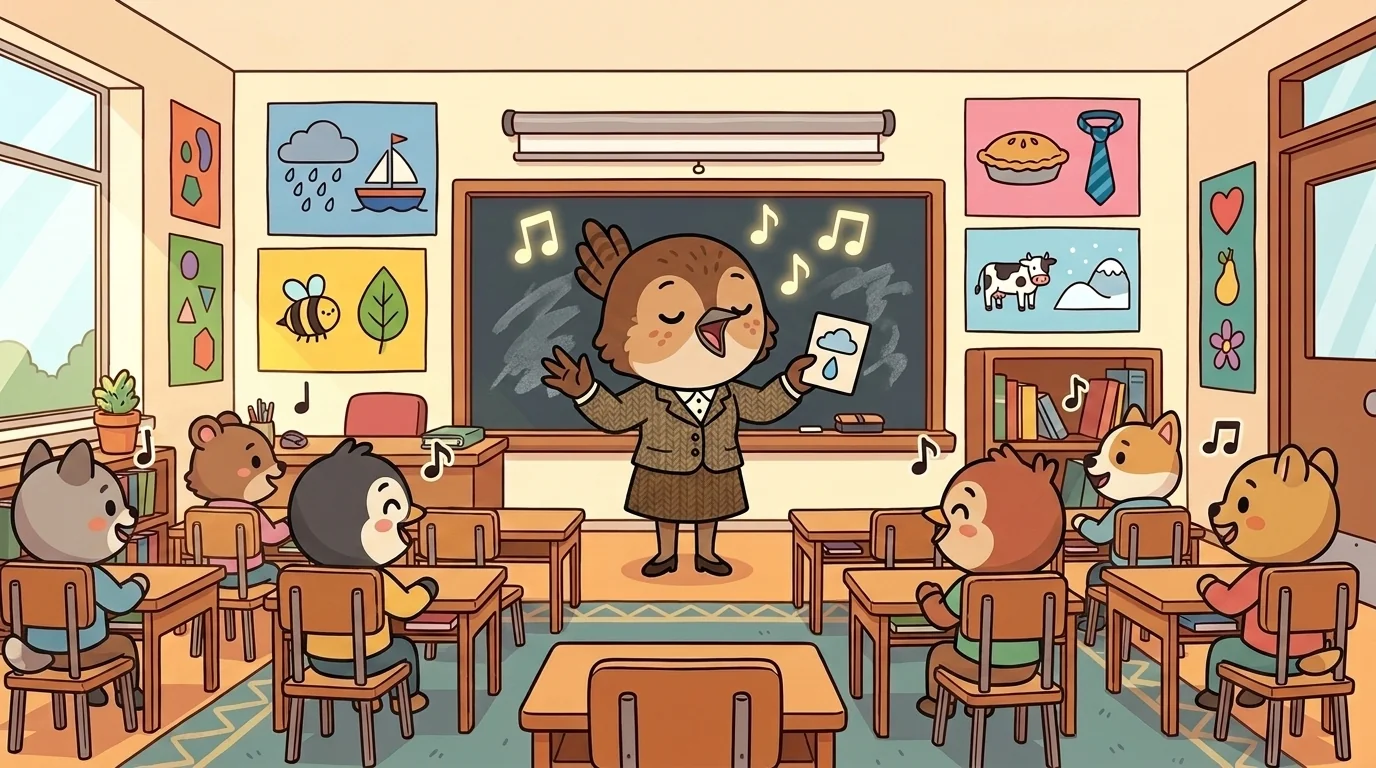
"A-I, A says I; rain, brain, paint, train, A says I."
The melody is simple. Five notes. Repeats with each example-word. The children pick it up immediately. They sing it back to her.
She then teaches the ea song:
"E-A, E says I; eat, beat, neat, seat, E says I."
And then the exception — the ea of bread:
"E-A, E says short; bread, head, dead, lead, E says short. Watch the E. It changes its mind. Some words long. Some words short. Sing both. Remember both."
She continues. Ee (see, bee, tree, free). Oa (boat, coat, road, soap). Ow (snow, blow, low, slow — and the exception: cow, brow, now, allow). Ie (chief, brief, thief — and the exception: pie, tie, lie, die). Oi (coin, boil, soil, moist).
The children, by the end of the first lesson, can sing all seven vowel-team songs. They can pick out, from a list of unfamiliar words, which vowel-team is which. They have the songs in their heads and the songs will not leave them for years.
When children ask whether vowel-team patterns are hard, Wren always says the same thing — in song:
"They are not hard; they are songs; sing the pair, sing it loud, sing it again — and the spelling stays."
She still sings the songs at the start of every lesson. The children sometimes ask her to sing new songs for newly-learned vowel-teams. She always obliges. She has, in nineteen years, composed perhaps two hundred small vowel-team melodies — most of which are now sung by children in classrooms across all twelve language-neighborhoods.
Sometimes, on a quiet afternoon, Wren walks the academy paths and hears a faint, off-key little tune drifting from an open window — A-I, A says I — sung by a child who has no idea she is the one who made it up. And her small chest fills with a warm, quiet happiness, soft as a bird settling into a nest. That, she thinks, is the whole point: not that the children remember her, but that they carry a little song that makes a hard thing feel like joy.
The QuillSpell ensemble
Wren is part of QuillSpell's distributed-narrative cast. Each character embodies a different curricular primitive; together they teach the full subject.
-

Etyma
Latin Quarter — Latin roots (port, scrib, dict, vis, audi, port)
-

Sophia
Greek Acropolis — Greek roots (bio, geo, photo, log, graph, phon)
-

Birch
Germanic / Old English Grove — short, punchy Anglo-Saxon roots (mouth, hand, foot, hear, see, walk)
-

Saga
Old Norse Longhouse — northern roots (sky, take, gift, raise, weak, scant)
-

Margaux
French Chateau — Norman-French roots (royal, chef, ballet, garage, hotel, courage)
-

Zayn
Arabic Oasis — Arabic-origin English loans (algebra, algorithm, alchemy, zenith, sugar, cotton)
-

Hush
Silent-letter clan (kn-, gn-, wr-, mb, gh, pn-, ps-)
-
Twin
Double-consonant rule (running, beginning, hopped, planned — short-vowel-CVC + suffix)
-

Ember
Schwa-keeper (the unstressed-vowel "uh" — `about`, `pencil`, `lemon`, `circus`, `medium`)
-

Affix
Suffix-stack guardian (root + suffix + suffix: nation → national → nationalize → nationalization)
-

Cadence
Syllable-rhythm master (di-vid-ing words for spelling: VC/CV, V/CV, syl-lab-i-fi-ca-tion)