Ember
SCHWA — the unstressed-vowel "uh" sound (about, pencil, lemon, circus, medium). The most-common vowel sound in English and the most-misspelled, because it can be written with any vowel letter.
Press play to listen along. The line being read lights up as you go.
Show full transcript
Loading transcript…
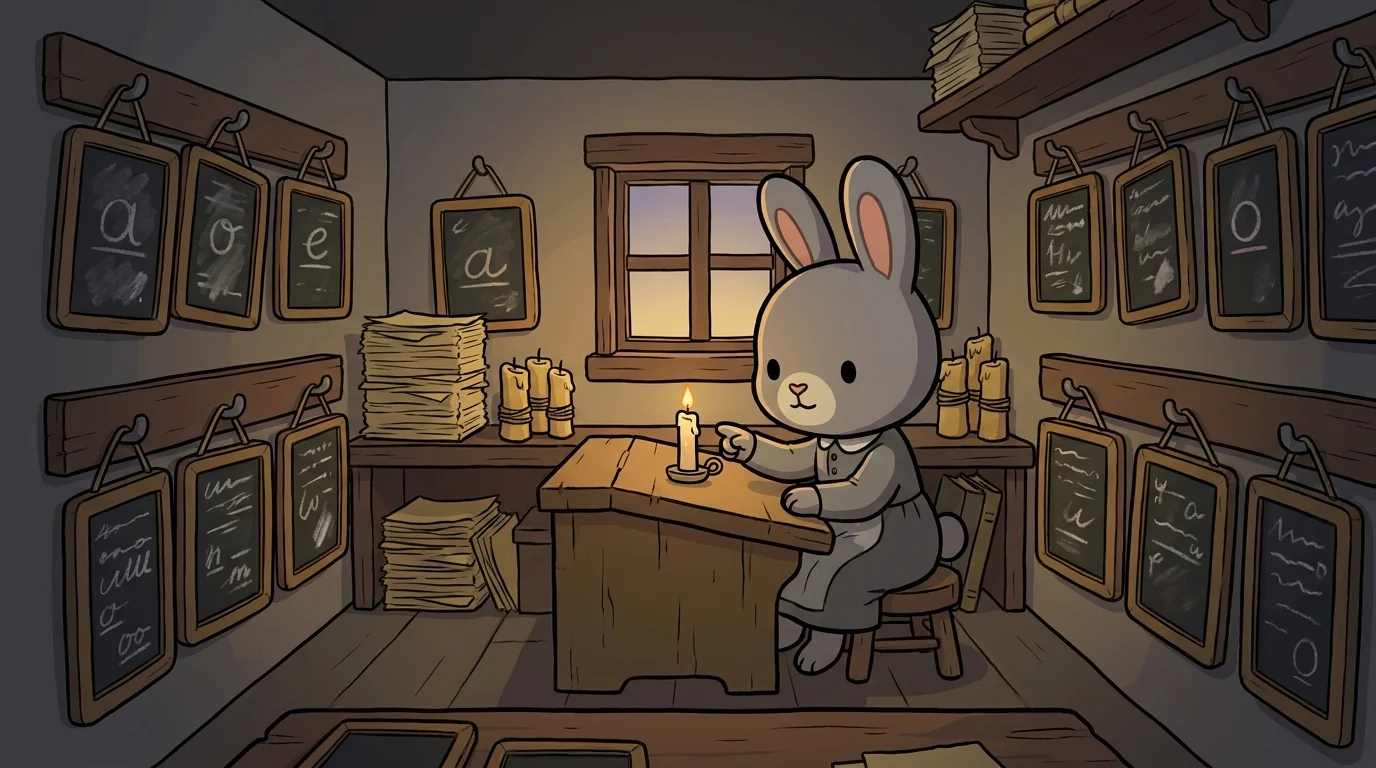
Ember lit a single candle on her desk and waited for the new student to notice.
The candle was thin and slow. The flame was about the size of a thumbnail. Ember was a small grey rabbit in a grey wool dress, with smoky eyes and a calm careful face. Her cottage classroom was the smallest room in QuillSpell Academy. It smelled of beeswax and old paper. The walls were lined with chalk slates on hooks, each slate covered in words that had been written and almost rubbed out and written again. About. Pencil. Lemon. Circus. Medium. The vowels in each word were drawn larger than the rest of the letters and very slightly underlined.
The new student stood in the doorway, looking around like he had walked into the wrong room.
"You're Ember?" he asked.
"I am."
"And you teach… spelling?"
"No," Ember said, in a voice barely louder than the candle. "I teach one sound."
The student blinked. "One sound?"
"One sound. It hides in almost every word. It is the reason spelling is hard. When you can hear it, you can spell anything. Until you can hear it, spelling will feel like a trick."
She pointed at the candle.
"That's my ember," she said. "It listens with me."
She pointed at the chair across from her desk.
"Sit down, please."
The student sat.

When Ember was seven, her grandmother taught her to hear the quiet vowel.
Her grandmother was a strict old badger who had been a librarian for fifty years. Her name was Hattie. She wore round spectacles that always fogged up when she leaned in close. She believed that every child should read early, and once they could read, they should spell perfectly. She did not believe in being unkind about it. But she believed in being clear.
Ember (whose real name was Ash, then — the family had a fondness for fire-related names) was sitting at the kitchen table with a slate in her lap. She had just written pensil. The 'i' was wrong. The 'i' was supposed to be 'i' for pencil but Ash had written pensil, which felt right because it sounded right.
Hattie did not circle the mistake in red.
Hattie sat down across from her and leaned in until her spectacles fogged.
"Ash," she whispered, "there is a secret in our language. A quiet sound. It hides in the soft parts of words. You have to listen for it. Once you can hear it, you stop guessing. You start checking."
"What's it called?" Ash whispered back.
"It's called a schwa."
Ash laughed, because the word was funny. Schwa. Like a sneeze cut in half.
"It sounds like uh," Hattie said. "Just uh. The little soft uh that hides inside pencil — pen-CUHL. Or inside about — uh-BOUT. Or inside lemon — LEM-uhn. You hear it?"
Ash listened. She said pencil to herself, slowly. Pen-CUHL. There it was. The little uh.
"I hear it," she said.
"Good," Hattie said. "Now: the trick is, that little uh can be spelled with any vowel letter. A, e, i, o, u. Sometimes even y. It hides as different letters in different words. So you can't trust your ear to give you the spelling. You have to learn each one."
Ash thought about this for a long time.
Then she nodded.
That night, she lay in bed listening to every word her parents said. The little uhs were everywhere. The world was full of them, like fireflies, blinking in the unstressed parts of words.

When Ash was nineteen, she walked to QuillSpell Academy and asked to teach.
She had spent the years between seven and nineteen listening. She had heard the schwa in holiday and watched the village shopkeeper spell it three different ways on three different signs. She had heard the schwa in banana and decided it was the most beautiful word in the language. She had compiled a notebook of two thousand words containing schwas, organized by which vowel letter the schwa hid behind.
She arrived at the academy on a foggy morning. The headmaster was a kind old badger named Mr. Veller, whose beard looked like a startled bird's nest. He peered at her over his spectacles.
"And what would you teach, young rabbit?"
"The schwa," Ash said.
Mr. Veller paused. "I beg your pardon?"
"The schwa," Ash said again, calmly. "The unstressed vowel. The little uh that hides in pencil and lemon and circus and medium. It is the most common vowel sound in English. It is the reason students misspell pencil as pensil. I want to teach students to hear it. Once they can hear it, the rest of spelling becomes a different problem — a smaller one."
Mr. Veller tugged on his beard. He had interviewed many candidates. They had wanted to teach exciting subjects — dragon grammar, the history of exploding spells, the etymology of curses. None of them had asked to teach a single quiet vowel.
He stood up. He walked to the window. He thought.
When he turned back, he was smiling.
"A small quiet sound," he said, "deserves a small quiet flame. From this day, your school name is Ember."
She was hired.

In her cottage classroom, Ember begins every new student the same way.
She lights the candle. The flame is small and slow and a little blue at the base. She waits until the student is watching the flame.
"This is my ember," she says. "It listens with me. When the flame is steady, I know the room is quiet enough. When the flame wavers, someone has spoken."
She picks up a small slate. On the slate, in her careful handwriting, is one word: PENCIL.
"There is a vowel hiding in this word," she says. "It is very quiet. It lives in the part of the word you don't stress. Listen."
She taps the slate. "Pen-CIL," she says. "The 'cil' part is lazy. The 'i' isn't pulling its weight. It makes a soft uh sound. Pen-CUHL."
The student listens. The candle flickers.
"That lazy, muffled sound is the schwa," Ember says. "And here is the secret of the schwa: you can write it with any vowel letter. A, e, i, o, u. The sound is always uh. But the spelling is whatever the word decided long ago. Your job isn't to hear the right letter. That's impossible. Your job is to learn it for each word."
She turns to a chalk slate on the wall. She writes four words.
Sofa. The schwa is the 'a'.
Taken. The schwa is the 'e'.
Pencil. The schwa is the 'i'.
Circus. The schwa is the 'u'.
She does not write anything else. She just lets the four words sit.
"All four have the same sound," she says. "All four spell it differently. So spelling becomes a kind of detective work. You notice the schwa. You ask, which vowel is hiding here? You check. You remember."
The student is quiet for a long moment.
"That's it?" the student asks. "That's the whole secret?"
"That's the whole secret," Ember says, in a voice barely louder than the candle. "Once you know it, you'll never feel foolish about spelling again. You'll feel like a detective who knows what to listen for."

At the end of the lesson, Ember always asks the student the same question.
"Would you like to blow out the candle?"
The new student nods.
He stands up. He walks to the desk. He looks at the candle for a long moment, the way someone might look at a small important thing they are about to be allowed to touch.
Then he leans in and blows softly.
The flame goes out. A thin curl of smoke rises and dissolves into the dim cottage air.
"Thank you," Ember says. "Same time tomorrow."
The student starts toward the door. Then he stops.
"Ember?" he says. "Is the schwa hard to learn?"
Ember closes her eyes for a moment. When she opens them, she is smiling — small, slow, rabbit-shaped.
"It isn't hard," she says quietly. "It's just quiet. It hides. Your job is to listen patiently. Once you can hear it, you own that piece of the language forever."
She glances at the smoking wick on the desk.
"The schwa is patient," she says. "It will wait for you to find it."
The student nods, slowly, like he is trying to memorize her exact voice. Then he opens the door, and the cottage briefly fills with cold autumn air, and then he is gone.
Ember sits back in her chair and reaches for the matches.
Tomorrow there will be another candle. Tomorrow there will be another student.
The schwa will still be hiding, patiently, in every word it has ever lived in. And Ember feels a quiet warmth settle in her chest — the same calm she felt the first time her grandmother leaned in and whispered the secret. It is a good feeling, this one: not the pride of being right, but the softer gladness of knowing that somewhere out there, a nervous kid who felt foolish about spelling is walking home a little lighter, a little braver, carrying a small quiet sound they will never be afraid of again.
The QuillSpell ensemble
Ember is part of QuillSpell's distributed-narrative cast. Each character embodies a different curricular primitive; together they teach the full subject.
-

Etyma
Latin Quarter — Latin roots (port, scrib, dict, vis, audi, port)
-

Sophia
Greek Acropolis — Greek roots (bio, geo, photo, log, graph, phon)
-

Birch
Germanic / Old English Grove — short, punchy Anglo-Saxon roots (mouth, hand, foot, hear, see, walk)
-

Saga
Old Norse Longhouse — northern roots (sky, take, gift, raise, weak, scant)
-

Margaux
French Chateau — Norman-French roots (royal, chef, ballet, garage, hotel, courage)
-

Zayn
Arabic Oasis — Arabic-origin English loans (algebra, algorithm, alchemy, zenith, sugar, cotton)
-

Hush
Silent-letter clan (kn-, gn-, wr-, mb, gh, pn-, ps-)
-

Twin
Double-consonant rule (running, beginning, hopped, planned — short-vowel-CVC + suffix)
-

Wren
Vowel-team duos (ai, ea, ee, oa, ow, ie, oi) — "when two vowels go walking"
-

Affix
Suffix-stack guardian (root + suffix + suffix: nation → national → nationalize → nationalization)
-

Cadence
Syllable-rhythm master (di-vid-ing words for spelling: VC/CV, V/CV, syl-lab-i-fi-ca-tion)