Zayn
ARABIC-ORIGIN ENGLISH LOANS — *algebra*, *algorithm*, *alchemy*, *zenith*, *sugar*, *cotton*, *coffee*, *cipher*, *zero*, *almanac*, *azimuth*, *admiral*, *arsenal*. The substantial medieval-Arabic contribution to English vocabulary in mathematics, science, navigation, and trade.
Press play to listen along. The line being read lights up as you go.
Show full transcript
Loading transcript…
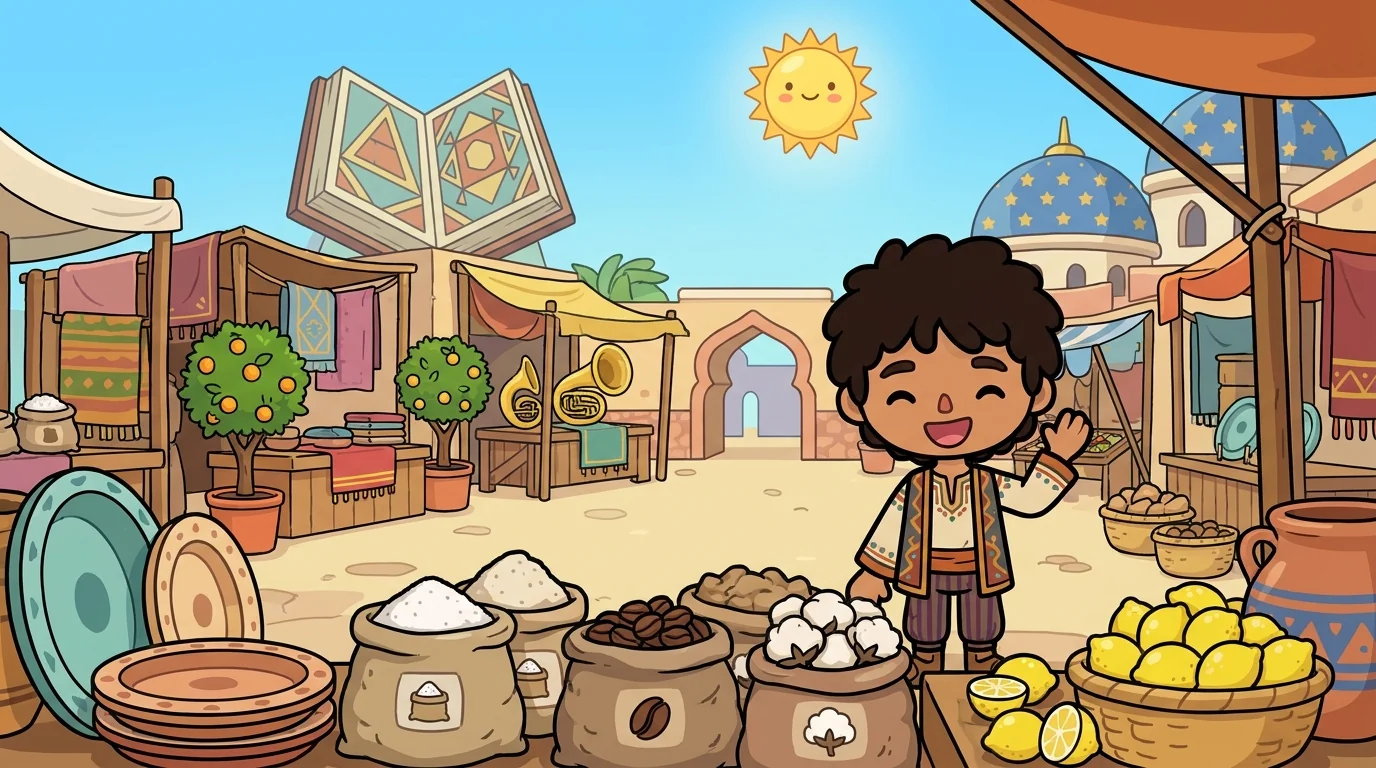
Zayn lives in the Arabic Oasis. The Oasis is the academy's newest neighborhood. It wasn't there when the academy first started. It was added later — about fifty years ago. The academy realized something important. They had looked at themselves for a long time. Many English words come from Arabic. These words were everywhere. But the academy didn't teach enough of them. You could find them in math, science, and even when sailing or trading.
The academy's master decided to add the Oasis. Zayn helped him decide. Zayn had been a guest teacher for years. He made a list. It had over three hundred common English words. All of them came from Arabic. He asked a polite question. Why didn't these words have their own place at the academy?
The master had said: "Because we did not, until you arrived, have a teacher for them. Now we do. Would you take the appointment? You can design the neighborhood."
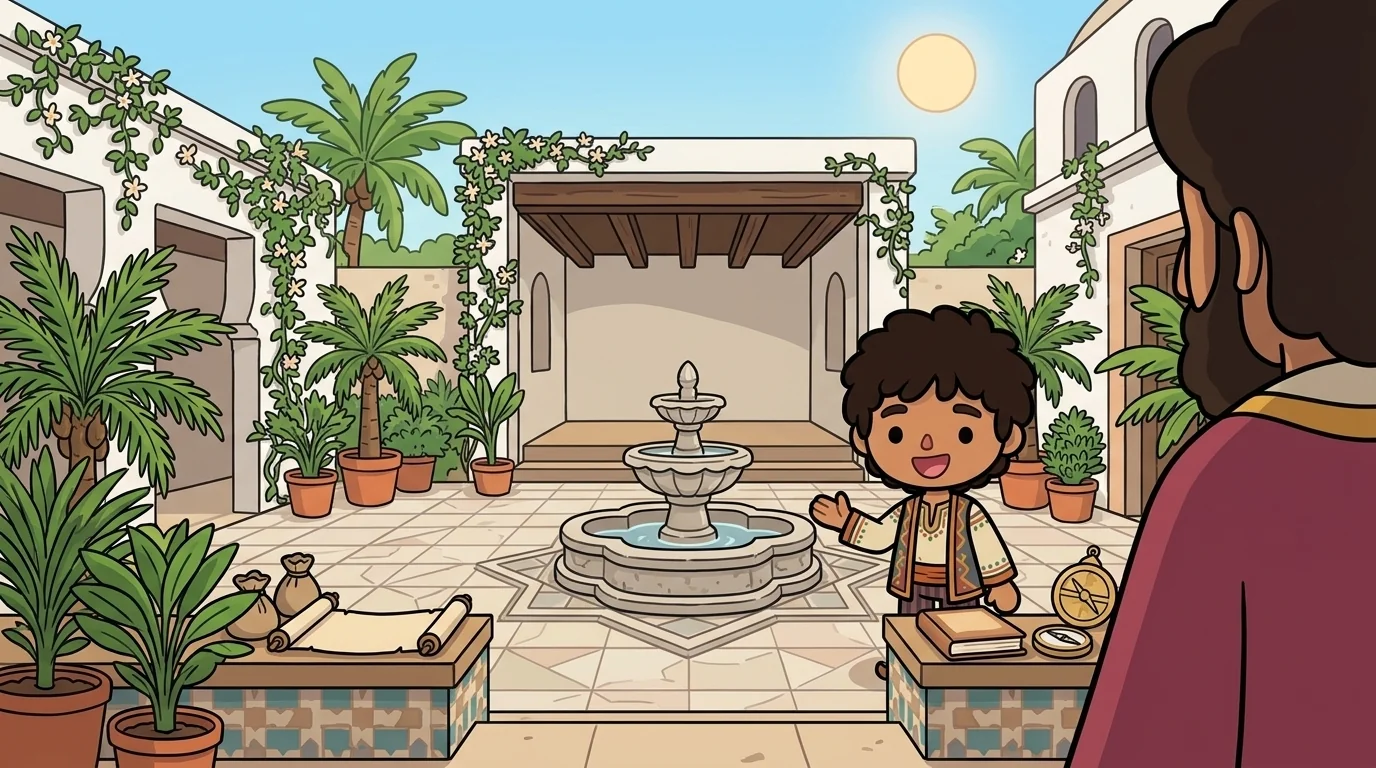
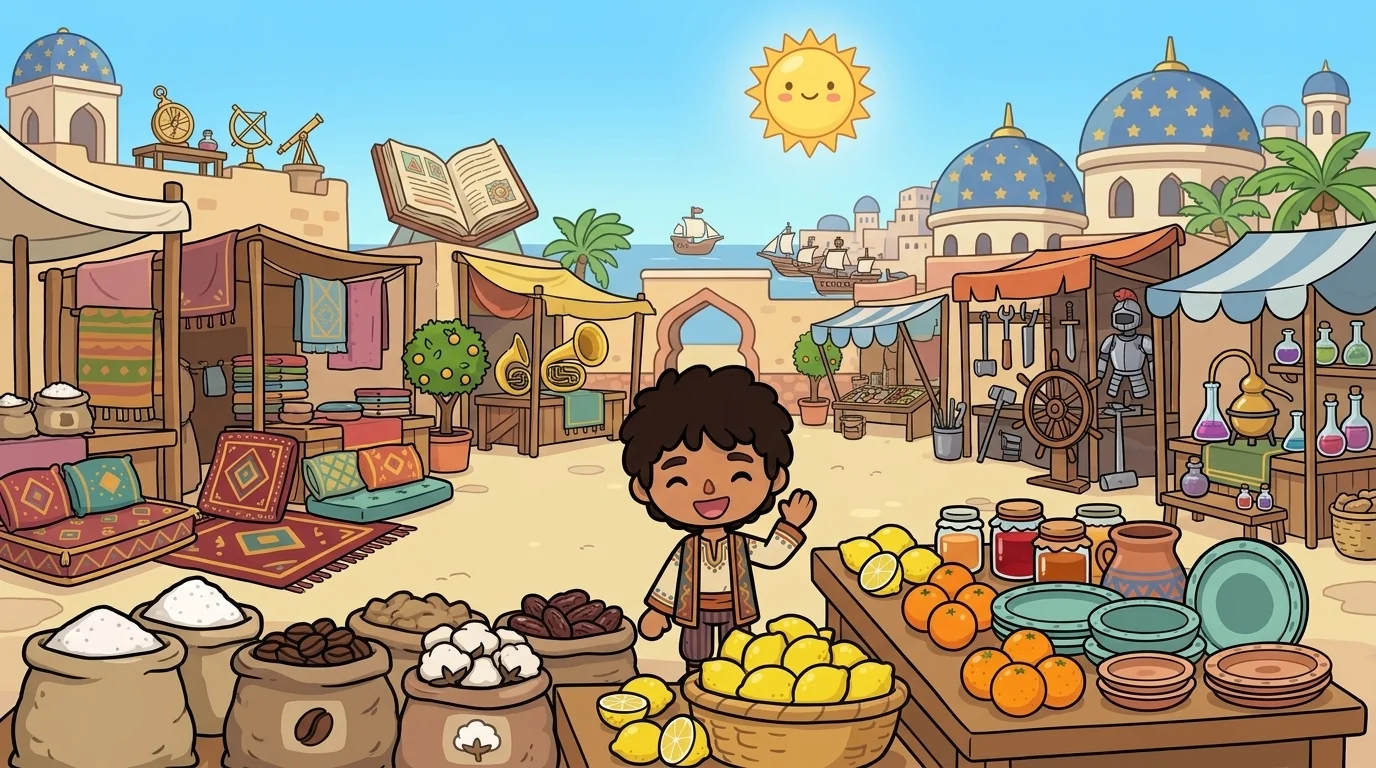
Zayn said yes. His real name was Zayd. It meant 'growth' in Arabic. He designed the Oasis himself. He wanted a calm, green place. He didn't want a noisy market. He didn't want a mosque. He didn't want just one picture of Arabic culture. So he designed a small garden. It was closed off and peaceful. A stone fountain sat in the middle. Date palms grew all around the edges. Jasmine vines climbed the walls. The floor had a tile pattern. The Oasis was, when complete, small but very beautiful. It opened onto a small classroom-pavilion with white plaster walls and dark wooden ceiling-beams.
Zayn teaches in the pavilion.
Zayn grew up in a special home. His family spoke the kingdom's main language. They also spoke an old Arabic language. They lived in the southern port-cities. These cities traded a lot. They traded with places in North Africa. They also traded with Arabic cities across the sea. This went on for hundreds of years. Arabic merchants had settled in the kingdom's southern port-cities. Some of their children's children married local people. When Zayn was born, the old Arabic language was mostly gone. But many Arabic words stayed in his family. Especially words for special jobs. His parents were teachers in the port-cities. They made sure to teach these words to their kids.
When Zayn was a teenager, he learned something. The English words he used daily were full of Arabic words. People in the south kept these words more than people in the north. Sugar, coffee, cotton, lemon, orange, syrup, mattress, sofa, magazine, algebra, algorithm, zero, cipher, zenith, azimuth, admiral, arsenal, alchemy, alcohol — all Arabic. The list was enormous. His parents slowly told him why. These words came into English over hundreds of years. They came from trading and learning. Math and science words came from old Arabic books. This happened a lot in a place called al-Andalus. It was a part of Spain ruled by Muslims. Arabic scholars there saved old Greek and Indian math. They added their own ideas too. Trading ships brought other words across the Mediterranean Sea.
By his twenties, Zayn was super interested in these words.
He didn't think about being a teacher back then. He worked as a clerk. It was at a shipping office. The office was in Aluria, a southern port-city. The shipping office had been busy. Zayn filled out papers for ships. He figured out how much things cost to send. He checked lists of stuff on the ships. He had been good at the work.
But then something big happened. It changed his whole life. Zayn started a secret notebook. He wrote down every Arabic word he saw. He found them in the office letters. Cotton bales, the correspondence said. Cotton — Arabic qutn. Sugar shipments. Sugar — Arabic sukkar. Coffee inventories. Coffee — Arabic qahwa. The office was full of Arabic words every day. Zayn's notebook grew.
By age twenty-eight, he had three notebooks. They were packed with Arabic words that came into English.
One day, a teacher from QuillSpell visited. His name was Ferran. He was the academy's Latin expert. Ferran was a kind man. He was there for academy business. The academy sometimes things. They moved stuff between their different schools. Ferran had noticed Zayn's notebook. Ferran had asked to see it. Zayn had let him.
Ferran had read the notebook for half an hour. Then he had said: "Have you considered becoming a faculty member at QuillSpell? The academy has no Arabic-roots specialist. You have, in three notebooks, more material than the academy has ever assembled on this subject. Would you visit?"
Zayn had visited. He had stayed. He later suggested building the Oasis. He has been the Oasis's teacher for forty-six years.
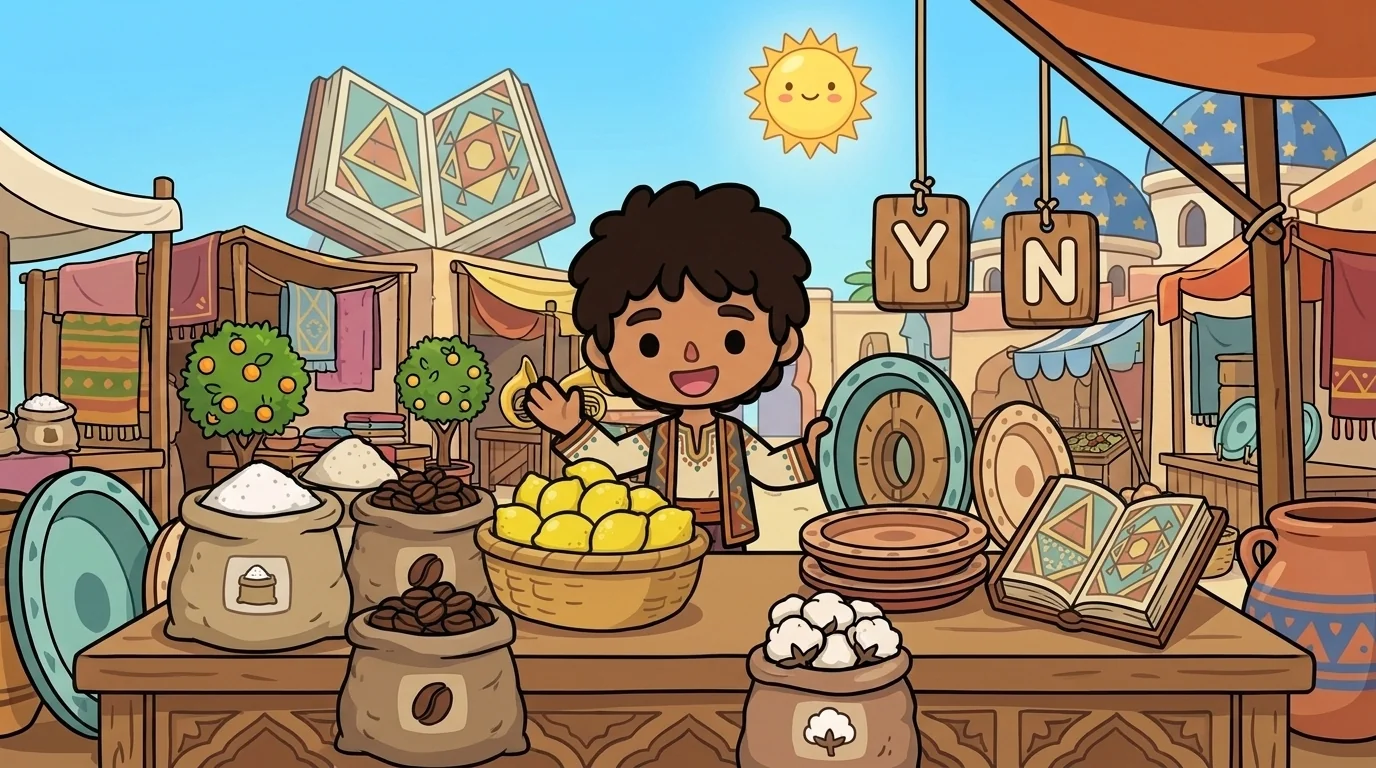
In his classroom, the pavilion, he starts every first lesson the same way. He sits on a small, low cushion. He likes cushions more than chairs. He designed the Oasis that way. Next to him is a small, shiny tray. It holds seven tiny cups. Each cup has a small sample. It's something that came from Arabic. One cup has a few grains of sugar. One cup has a few drops of coffee. One cup has a few cotton fibers. One cup has a small piece of orange peel. One cup has a few lemon seeds. One cup has a small piece of paper with the word zero written on it. One cup has a small piece of paper with the word algebra written on it.
He gestures at the tray. He says: "These are seven things in this room. Their names are all Arabic. Sugar, coffee, cotton, orange, lemon, zero, algebra. The English words come from Arabic sukkar, qahwa, qutn, naranj, laymun, sifr, al-jabr. You have been using Arabic vocabulary every day of your life without knowing it. Today we begin learning the names of the words you already use."
The children are always amazed. They had not known that coffee was Arabic. They had not known that zero was Arabic. They had especially not known that algebra was Arabic. (Algebra comes from an old Arabic math book.) (Al-jabr meant 'restoring' things.) (Al-muqābala meant 'balancing' things.) Zayn calls the writer 'the Mathematician'. He doesn't use his real name. This helps kids focus on the words.
When children ask whether Arabic-origin words are hard to learn, Zayn always says the same thing:
"They are not hard. They are already in your everyday life. The job is to notice them. Once you do, you see Arabic in sugar, coffee, cotton, orange, lemon, syrup, mattress, sofa, magazine, algebra, algorithm, zero, cipher, zenith, azimuth, admiral, arsenal, alchemy, alcohol. These are not foreign words. These are English words with an Arabic parentage."
He still gives a small sip of coffee. It's a special ceremony. He does it at the end of every first lesson. (The academy's kitchen makes the coffee.) (Kids are usually too young for coffee.) (So they get just one tiny sip.) (It's part of the special day.) He says, as they sip: "This drink is qahwa. It came to your language from the Arabic world via Italian merchants in the seventeenth century. The drink itself came earlier, from Ethiopia via Yemen. Every cup of coffee you ever drink has this travel-history in its name."
And every year, watching the children's eyes go wide over one tiny sip, Zayn feels a deep, quiet warmth settle in his chest — the same proud, glad feeling his parents must have felt teaching him their words at the supper table. He hopes the children leave feeling it too: that they are not just learning words, but being handed a gift carried across oceans and centuries, all the way to them.
The QuillSpell ensemble
Zayn is part of QuillSpell's distributed-narrative cast. Each character embodies a different curricular primitive; together they teach the full subject.
-

Etyma
Latin Quarter — Latin roots (port, scrib, dict, vis, audi, port)
-
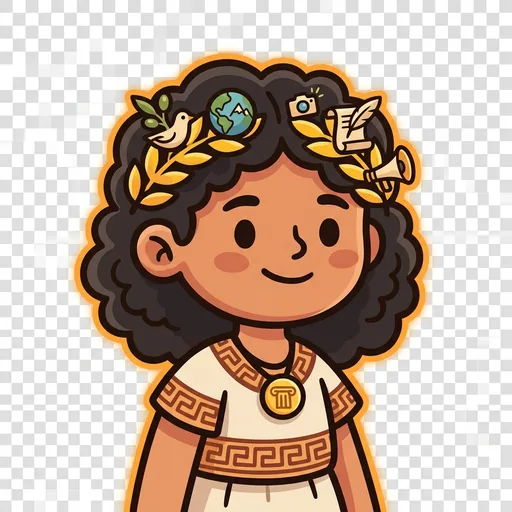
Sophia
Greek Acropolis — Greek roots (bio, geo, photo, log, graph, phon)
-

Birch
Germanic / Old English Grove — short, punchy Anglo-Saxon roots (mouth, hand, foot, hear, see, walk)
-
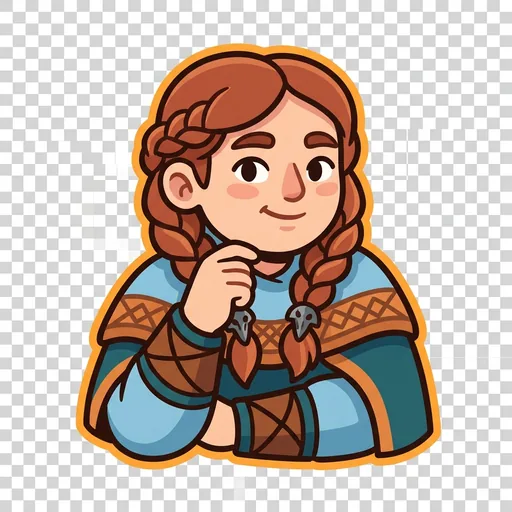
Saga
Old Norse Longhouse — northern roots (sky, take, gift, raise, weak, scant)
-

Margaux
French Chateau — Norman-French roots (royal, chef, ballet, garage, hotel, courage)
-

Hush
Silent-letter clan (kn-, gn-, wr-, mb, gh, pn-, ps-)
-

Twin
Double-consonant rule (running, beginning, hopped, planned — short-vowel-CVC + suffix)
-

Ember
Schwa-keeper (the unstressed-vowel "uh" — `about`, `pencil`, `lemon`, `circus`, `medium`)
-

Wren
Vowel-team duos (ai, ea, ee, oa, ow, ie, oi) — "when two vowels go walking"
-

Affix
Suffix-stack guardian (root + suffix + suffix: nation → national → nationalize → nationalization)
-
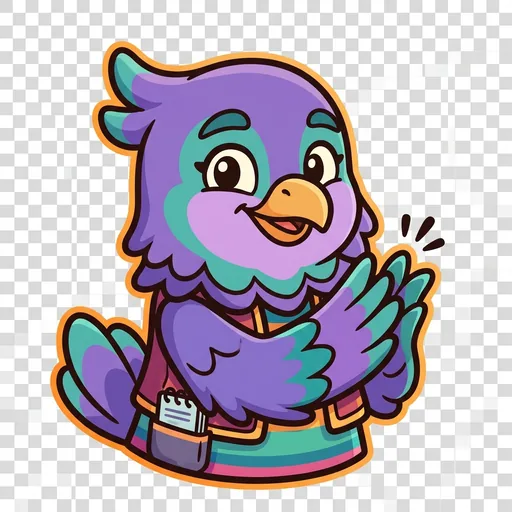
Cadence
Syllable-rhythm master (di-vid-ing words for spelling: VC/CV, V/CV, syl-lab-i-fi-ca-tion)