Sophia
GREEK ROOTS — *bio* (life), *geo* (earth), *photo* (light), *log* (word/study), *graph* (write), *phon* (sound). Greek roots combine elegantly into scientific and technical vocabulary.
Press play to listen along. The line being read lights up as you go.
Show full transcript
Loading transcript…
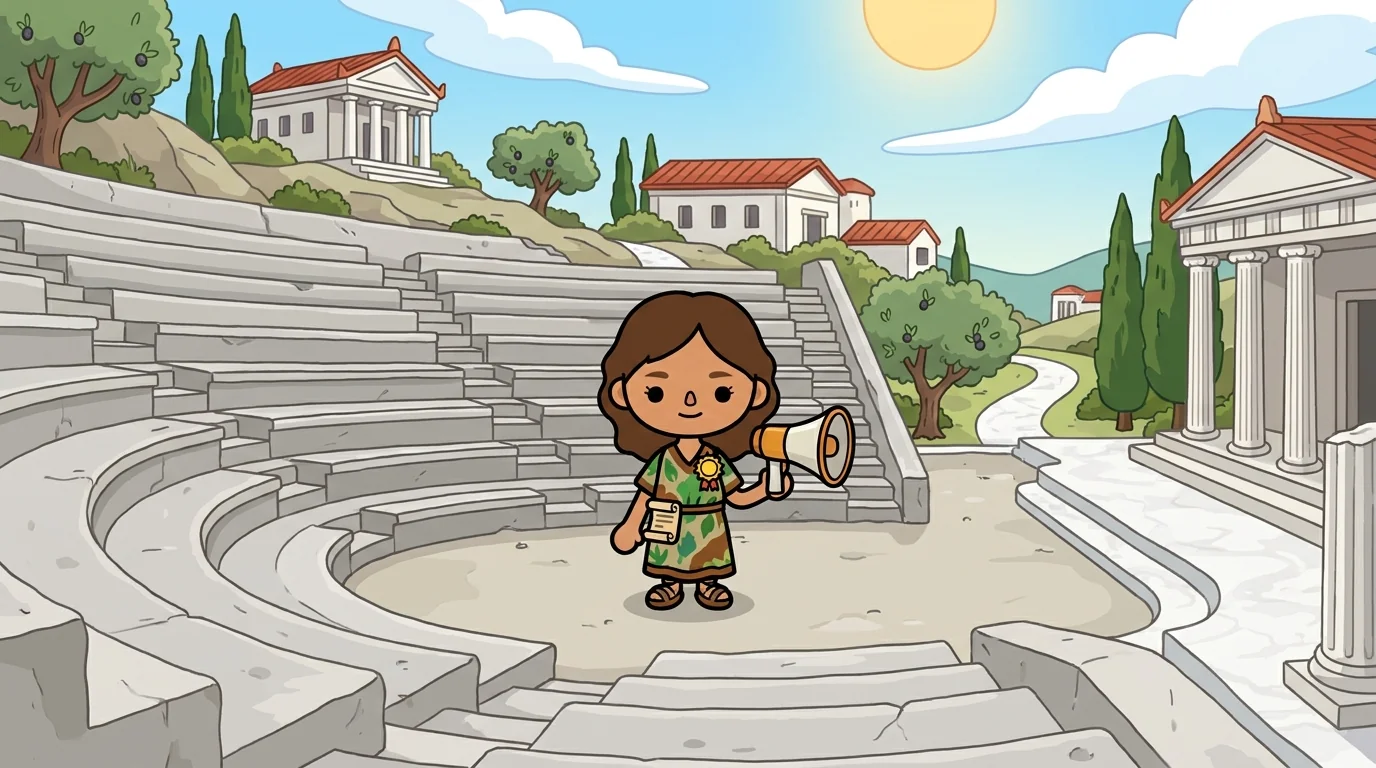
Sophia lives in the Greek Acropolis.
The Acropolis is a neighborhood. It's like the Latin Quarter where Etyma lives. This is where Greek roots for English words live. It's not a real Greek acropolis. The kingdom doesn't have those. The academy chose this look on purpose. A hundred and twenty years ago, the first teachers built it. They put the Greek-roots neighborhood on a small hill. It has white marble paths. There's an open-air theater too. Academy historians say why. They wanted to honor old Greek ways. Greeks taught outside, under the sky.
Sophia teaches in the amphitheater.
She teaches there in almost any weather. Sun, mist, even light snow. Stone benches fill the theater. They are soft gray now. They got that way over a hundred years. The sound here is amazing. Everyone knows it. Sophia can stand in the middle. She speaks in a normal voice. Every word reaches kids in the very top row.
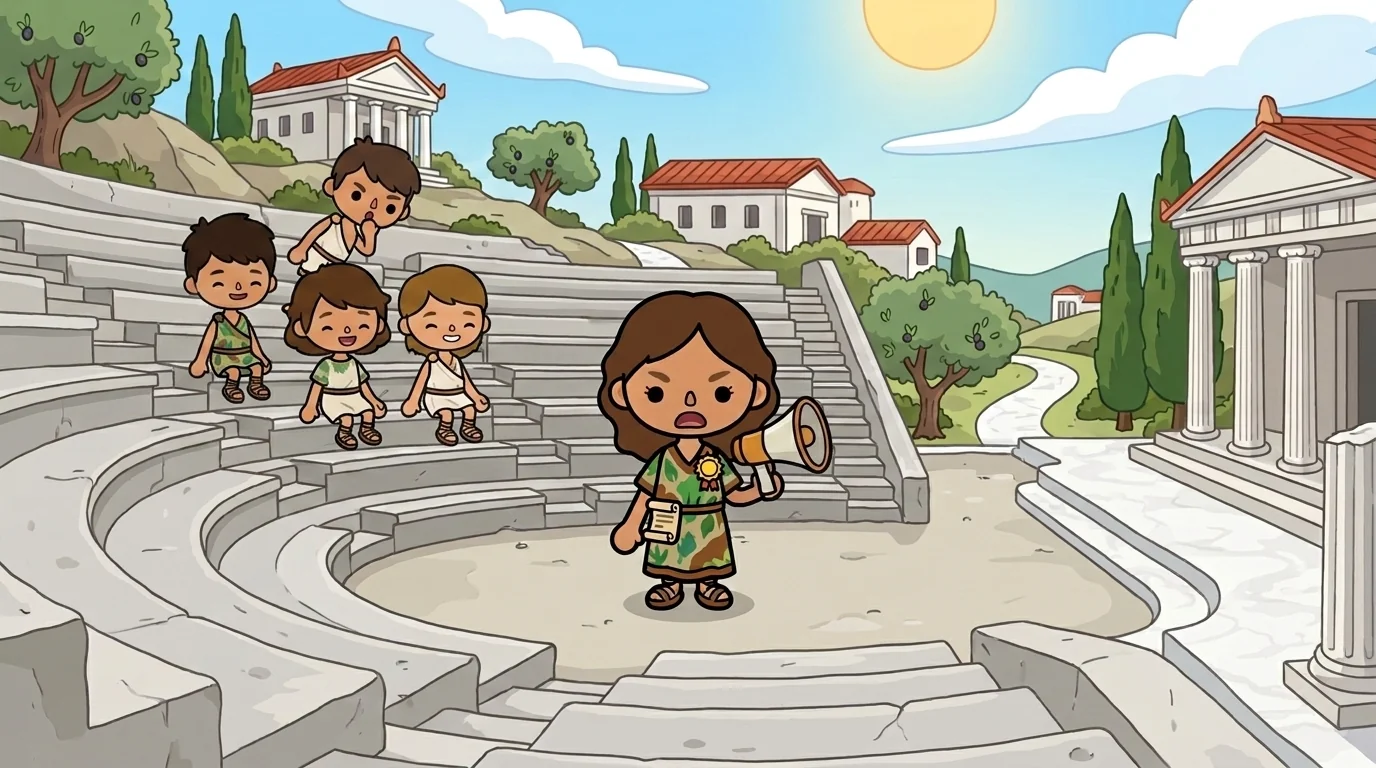
Over the years, she has taught kids a trick. They whisper from the back row. This shows how good the sound is. It always works. The whisper comes to her perfectly. The kids love it every time.
Sophia's real name is Theodora. But everyone calls her Sophia. That means wisdom in Greek. She grew up like Etyma. Her family spoke an old language at dinner. For Sophia, it was Greek. Her parents were both very smart. They studied old languages. Her grandma taught at a small school. Her grandpa translated Greek poems. He put them into the kingdom's language. They appeared in special books.
Theodora learned Greek very early. She learned it before she could even walk. As a little kid, she didn't know the difference. She just used both languages. When she was nine, she started to notice something. It was like Etyma with Latin. Many English words came from Greek. They were just a little bit changed. Take biography. It came from Greek bios (life) and graphein (write). Photograph came from photos (light) and graphein (write). Telephone came from tele (far) and phone (sound). These patterns were everywhere.
Theodora saw something Etyma hadn't yet. Greek roots fit together better than Latin ones. In English, Greek roots just plug right in. Take two Greek roots. Stick them together. You get a new word. Bio + graph makes biography. Geo + log makes geology. Phon + graph makes phonograph. They were like building blocks.
Latin roots were different. They often needed extra letters. Or changed endings to fit. (Like port + able makes portable. The -able part helps it connect.) Greek roots just snapped together.
This made eleven-year-old Theodora very happy.
She started making her own word lists. She would pick two Greek roots. Like bio and log. Then she wrote down every English word she knew that used them. Biology, biologist, biological, biologically. Then she tried to guess new words. What about bio and graph? Biography! What about bio and phone? Biophone? Not a real word. Bio and sphere? Biosphere! That was a real word. A very useful one.
By age thirteen, she could invent words. They looked like real Greek words. She could do it anytime. (She made up hypsograph. She also made up thermophone. Later, she found old books. Her grandma's books. Hypsograph was already real! Thermophone had been a word for a short time. It was about sound.) She invented words very fast. Even old language experts thought it was amazing.
When Theodora was eighteen, she went to QuillSpell academy. She wanted to teach Greek roots there. No one had taught Greek roots for two years. Lex was the academy master. She interviewed Theodora. Lex was the same woman who later hired Etyma.
Lex said: "What is the root log?"
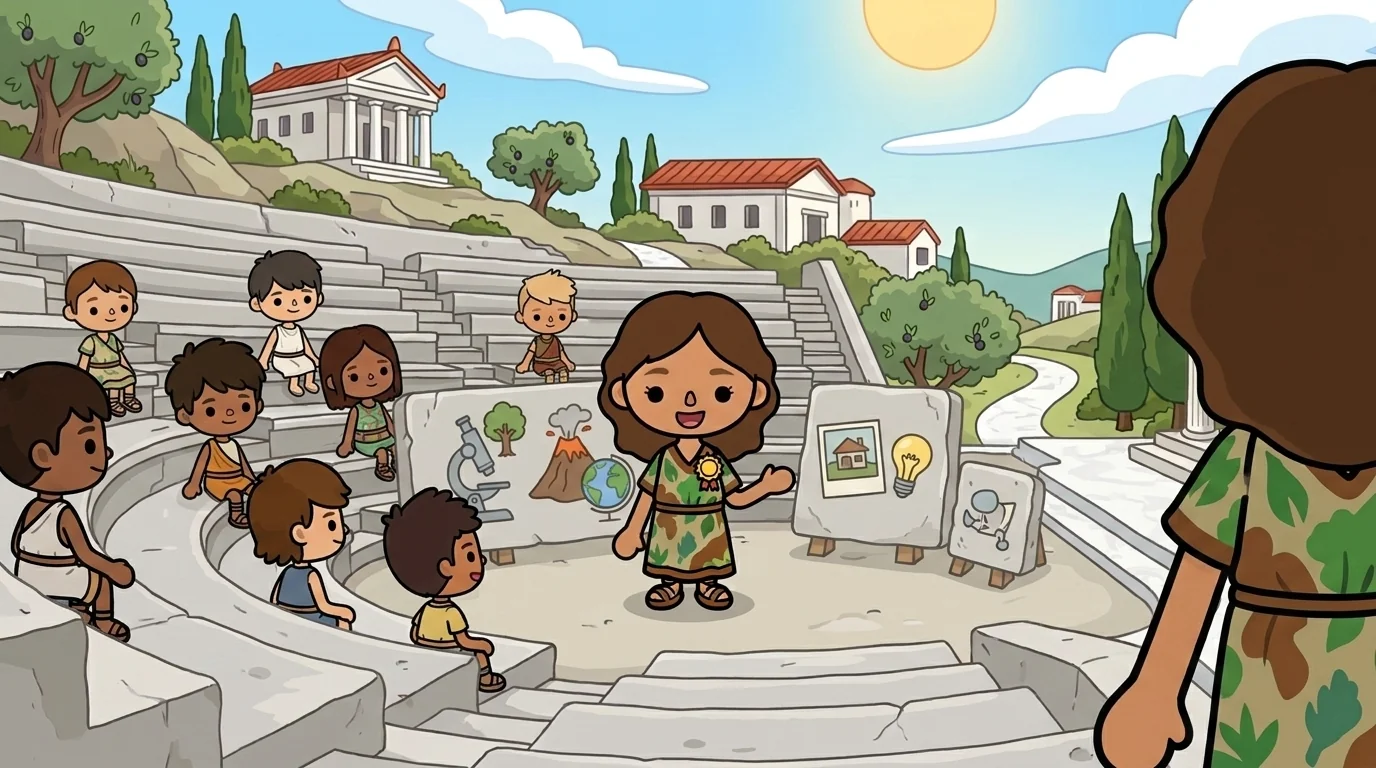
Theodora said: "Greek logos. It means word, study, or principle. You see it in: biology (study of life). And geology (study of earth). Also psychology (study of mind). And mythology (study of myths). Even philology (study of words). It's also in: dialogue (speaking across). And monologue (speaking alone). Prologue (speaking before). Epilogue (speaking after). And words like logic. Or logician. Or illogical. It's the same root. It has many faces."
Lex said: "What is the root graph?"
Theodora said: "Greek graphein. It means to write or to draw. You see it in: biography. And autograph. Also photograph. And telegraph. Even paragraph. And graph. Also graphite. Graphite is pencil lead. It comes from this root. Because it's what you write with. The pencil shows the link. The root is the action. The words that come from it are the tools. Or the places where you do that action."
Lex put down her tea cup. She had interviewed three other people for this job. She said no to all of them. She knew Theodora was special. She knew it in the first thirty seconds.
Lex said: "You're hired! The Acropolis has needed you. For two years. Take your new name. Sophia — wisdom. It fits you perfectly."
Theodora became Sophia. She has taught in the Acropolis for twenty-six years.
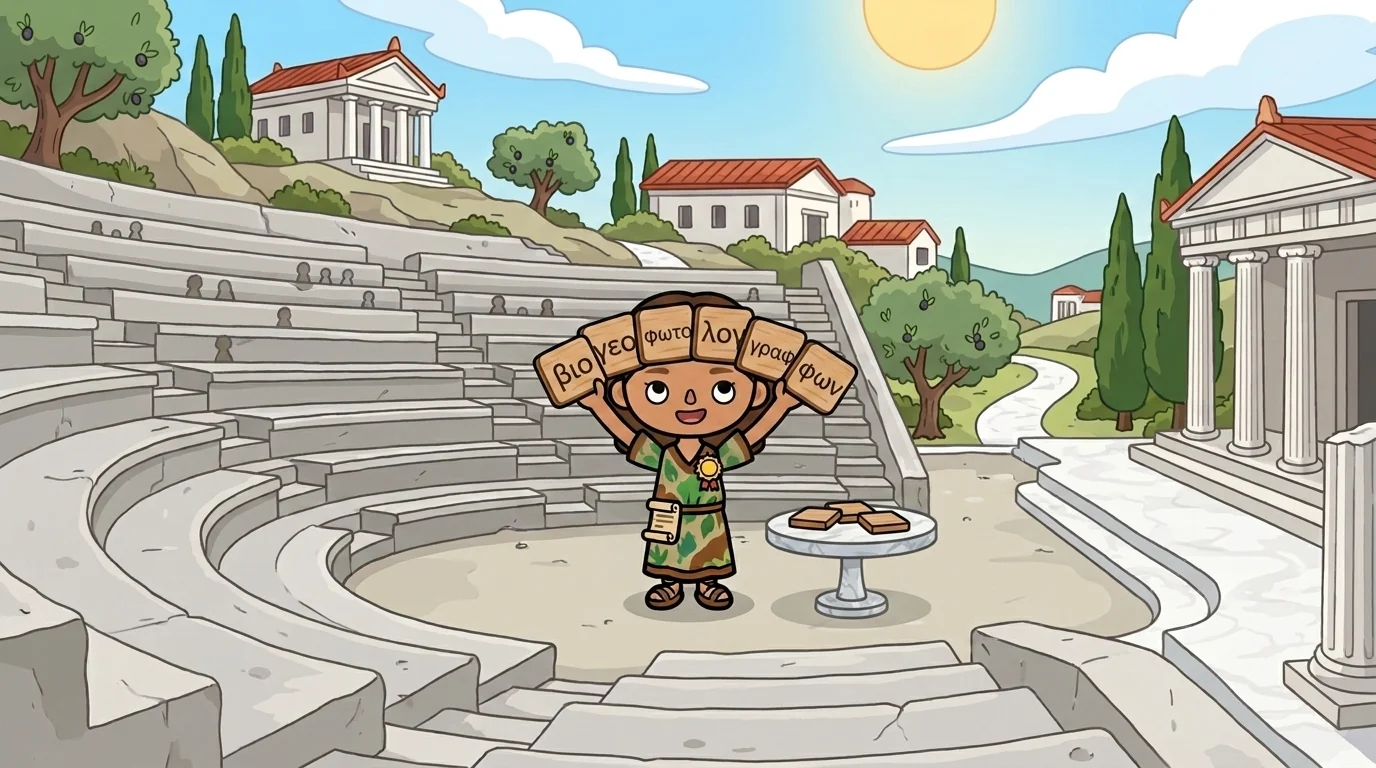
In her classroom, the amphitheater, she starts every first day the same way. She stands in the middle. On a small marble table, she has six small wooden tiles. Each tile has a Greek root. Bio, geo, photo, log, graph, phon. She picks them up one by one. She holds each one high. Her voice rings out in the theater. "Bios — life. Geo — earth. Photo — light. Logos — word or study. Graphein — write. Phone — sound." She says, "These six roots are very common. They are in many English words. Once you know them, you can unlock thousands of words."
She shows them how. She puts the bio tile next to the graph tile. She says: "Biography. Life-write. It's the story of someone's life. Made from two roots. You can figure it out right away." She puts photo next to graph. She says: "Photograph. Light-write. It's a picture made by light. Built from two roots." She puts geo next to log. "Geology. Earth-study." Bio next to log. "Biology. Life-study."
The kids are always thrilled. They thought big science words were just random. Sophia shows them they make sense. They are like puzzles that fit together.
Kids sometimes ask if Greek roots are hard. Sophia always gives the same answer:
"They are not hard," she says. "They are like building blocks. Greek roots snap together. Learn the roots. The words build themselves. Most science words are Greek. So are words for medicine, thinking, and tech. Once you know the roots, a whole world of words opens up."
She still keeps the six wooden tiles. They stay on the marble table. Kids sometimes ask to mix them up. To make new words. She always lets them. The kids invent new words. Photo + geo? Photogeology! That's a real word. It means studying earth from pictures. Phon + log? Phonology! That's studying speech sounds. Bio + graph + log? Biographology! Not a real word. But they know what it would mean. And when a child laughs at their own invented word — that bright, delighted, unafraid laugh — something in Sophia's chest goes warm and glad. That laugh, she thinks, is the best part of her job. Not the roots. The feeling of a kid who used to be scared of long words, now playing with them like toys.
The QuillSpell ensemble
Sophia is part of QuillSpell's distributed-narrative cast. Each character embodies a different curricular primitive; together they teach the full subject.
-

Etyma
Latin Quarter — Latin roots (port, scrib, dict, vis, audi, port)
-

Birch
Germanic / Old English Grove — short, punchy Anglo-Saxon roots (mouth, hand, foot, hear, see, walk)
-

Saga
Old Norse Longhouse — northern roots (sky, take, gift, raise, weak, scant)
-

Margaux
French Chateau — Norman-French roots (royal, chef, ballet, garage, hotel, courage)
-

Zayn
Arabic Oasis — Arabic-origin English loans (algebra, algorithm, alchemy, zenith, sugar, cotton)
-

Hush
Silent-letter clan (kn-, gn-, wr-, mb, gh, pn-, ps-)
-

Twin
Double-consonant rule (running, beginning, hopped, planned — short-vowel-CVC + suffix)
-

Ember
Schwa-keeper (the unstressed-vowel "uh" — `about`, `pencil`, `lemon`, `circus`, `medium`)
-

Wren
Vowel-team duos (ai, ea, ee, oa, ow, ie, oi) — "when two vowels go walking"
-

Affix
Suffix-stack guardian (root + suffix + suffix: nation → national → nationalize → nationalization)
-

Cadence
Syllable-rhythm master (di-vid-ing words for spelling: VC/CV, V/CV, syl-lab-i-fi-ca-tion)