
Saga and Birch
DOUBLETS — one ancient root that entered English TWICE (once through Old Norse, once through Old English) and split into two related words with different shades of meaning (shirt/skirt, no/nay, ship/skiff). Recognizing the shared ancestor explains the spelling AND the meaning of both.
Press play to listen along. The line being read lights up as you go.
Show full transcript
Loading transcript…
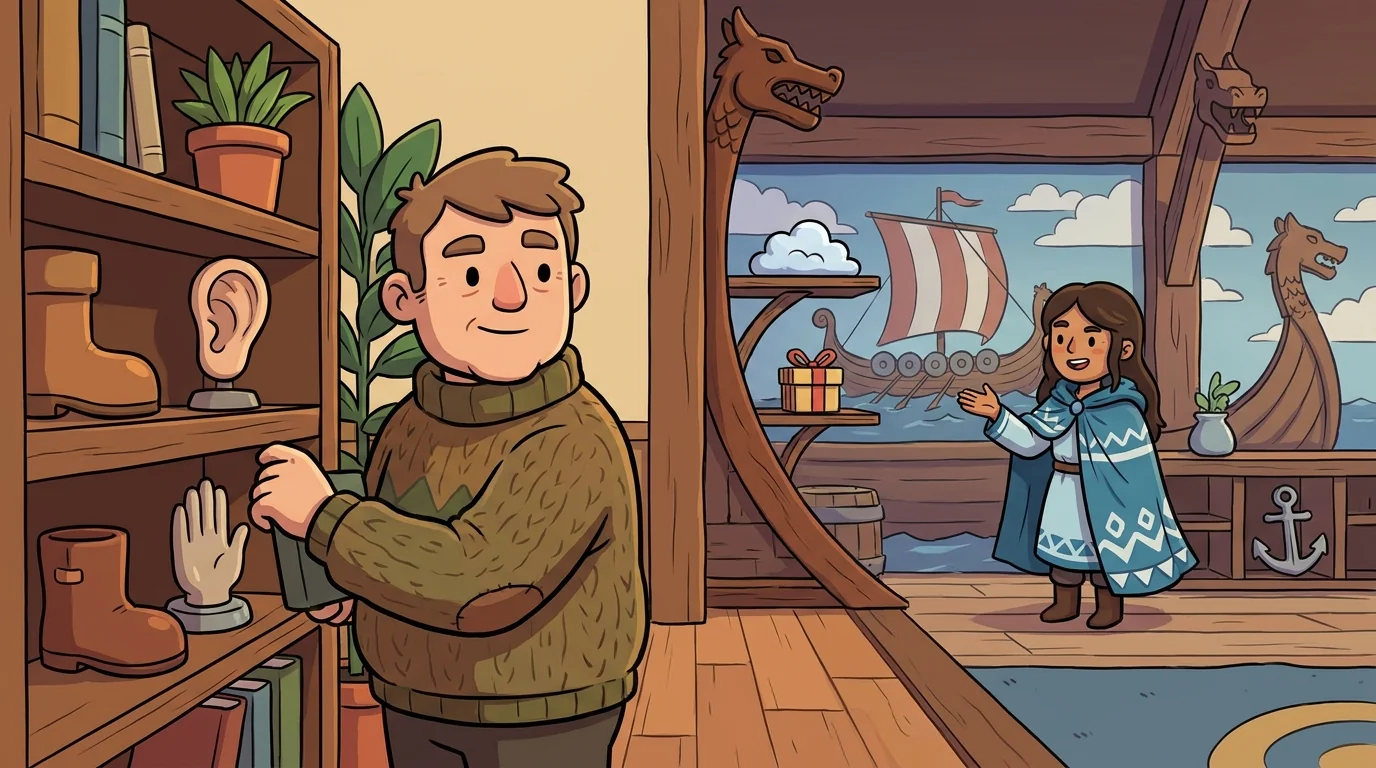
The word-library at quillspell was really two libraries pretending to be one, and everyone who worked there had quietly picked a side.
On the near shelves lived Birch's words — short, sturdy, everyday things worn smooth by a thousand years of ordinary mouths. Hand. Foot. Mouth. Hear. Walk. Birch himself was much like his words: solid, unshowy, a homebody in a knitted jumper who had never once left the valley and did not especially want to. He liked a word you could say with your feet on the ground.
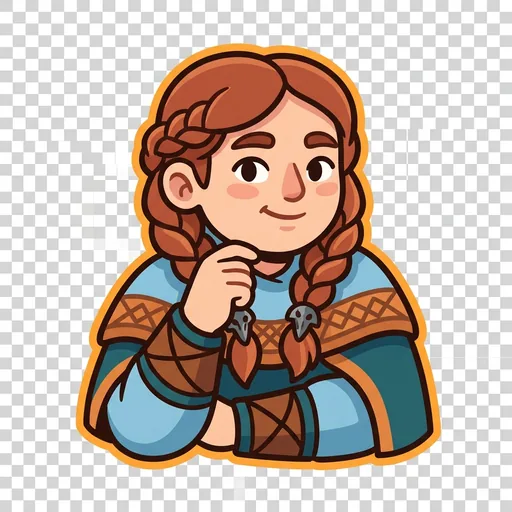
On the far shelves lived Saga's words — the ones that had arrived, carried in on longships a very long time ago. Sky. Gift. Take. They. Them. Saga wore a travelling cloak even indoors and told stories about the cold northern sea as though she'd sailed it herself, which she had not, but her words had, and that was close enough for Saga.
They were friendly enough. They just didn't think they had much in common.
The trouble started, as trouble in libraries does, with a tidy-up.
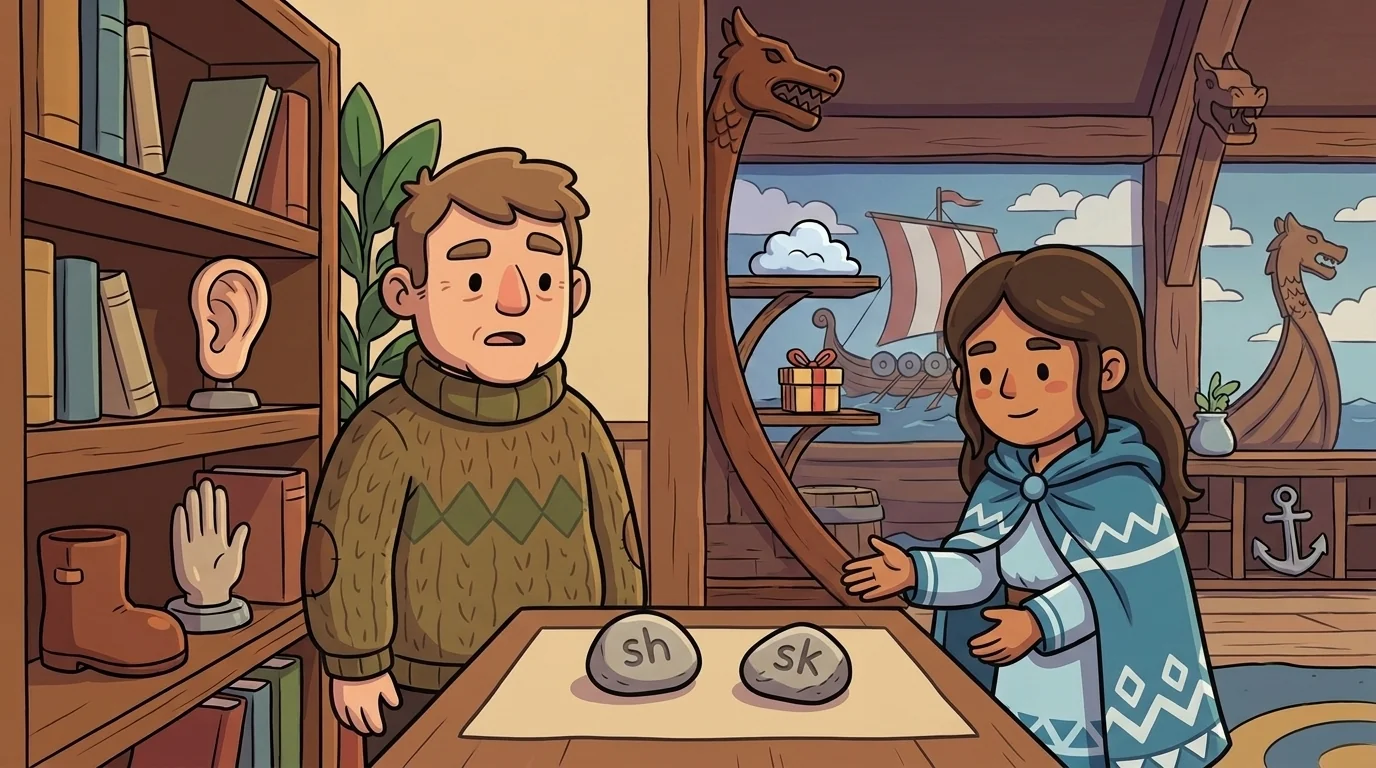
"These are shelved wrong," Birch said, holding up a word-stone that read skirt. "This is one of yours — it's got your northern sound on it, that sk at the front. But it was filed next to one of mine." He held up his own stone: shirt.
Saga wandered over, cloak swishing. She looked at the two stones lying side by side on the sorting table. Shirt. Skirt. And she felt something odd prickle at the back of her neck — the feeling you get when a stranger turns around and has your grandmother's exact nose.
"Birch," she said slowly. "Say yours. Say it slow."
"Shirt," said Birch.
"Skirt," said Saga.
They looked at each other. Take away the little difference at the front — his soft sh, her hard sk — and underneath, the two words were the same word. The same bones. The same length, the same ending, the same tired old meaning about a piece of cloth you pull over yourself.
"That's not possible," said Birch, who distrusted anything exciting on principle.
But once they'd seen it, they couldn't stop seeing it.
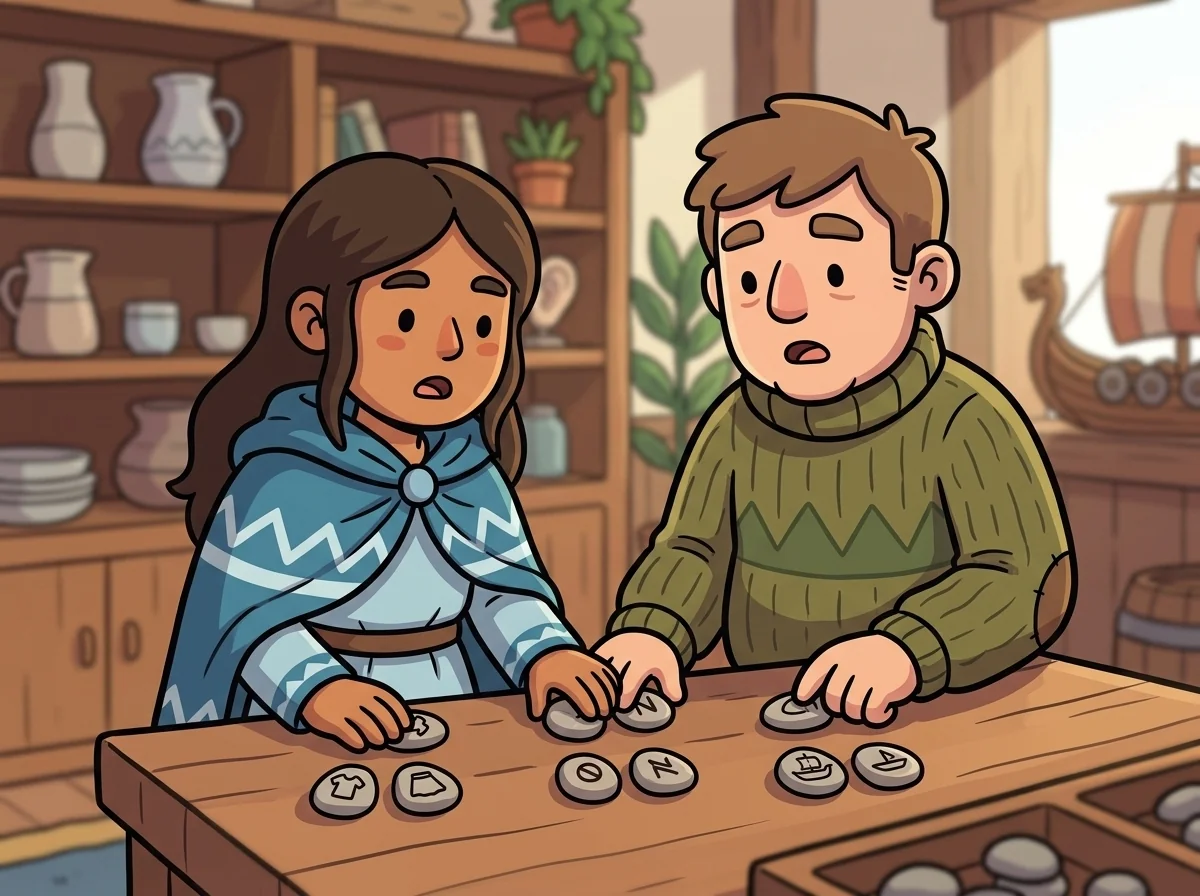
They started laying their words down in pairs on the long sorting table, his beside hers, hunting for the prickle-at-the-neck feeling. And it kept coming.
Birch set down no. Saga set down nay. — Same word.
Birch set down ship. Saga set down skiff. — Same word, split in two, one grown big and one stayed small.
Each time, the two stones would give a faint chime when they touched, the way two tuning forks will hum if they're tuned to the very same note. Chime after chime after chime, all down the table.
"How?" Birch finally said, sitting down hard. "How are half my plainest words secretly related to your fancy travelled ones?"
Saga, for once, wasn't performing. "Because they started in the same place," she said quietly. "One very old word, older than either of us. It just — left home twice. One copy stayed with your people and softened into shirt. One copy sailed north with mine and hardened into skirt. Same ancestor. Two roads. Two words." She touched the pair of stones. "They're not strangers who happen to look alike. They're family who got separated."
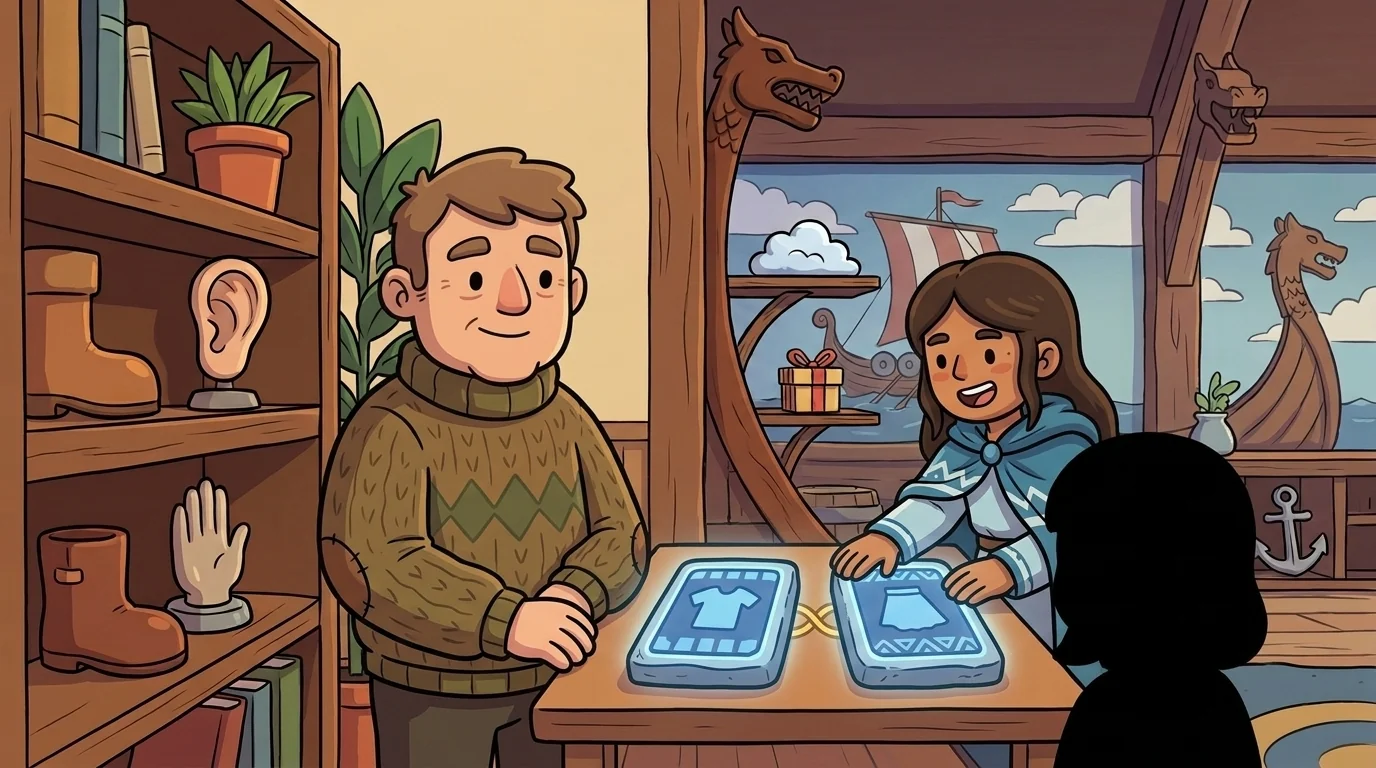
A student named Wren had been watching, chin on the table, fascinated.
"So if I get stuck spelling one," Wren said, "I can look at its — its long-lost twin?"
"Try it," said Saga, delighted. She slid a fresh stone over. "You keep spelling skirt with an e, Birch tells me. So look at its family." She set shirt beside the blank. "How's the family spelled — the ir in the middle?"
"Sh-i-r-t," Wren read. Then, carefully: "So — sk-i-r-t. Same middle. I-r. Because they're the same word underneath."
The blank stone chimed and filled itself in, correct. Wren sat back, amazed. "The spelling was hiding in the cousin the whole time."
"That's the trick of us," said Birch, and for the first time in the whole chapter he looked a little bit proud of his plain little words. "You don't have to memorize two hard spellings. You learn the family, and both of them come free."
"A matched pair," said Saga, laying her hand over the two humming stones. "One root. Two roads. We call them doublets — the words that are secretly twins."
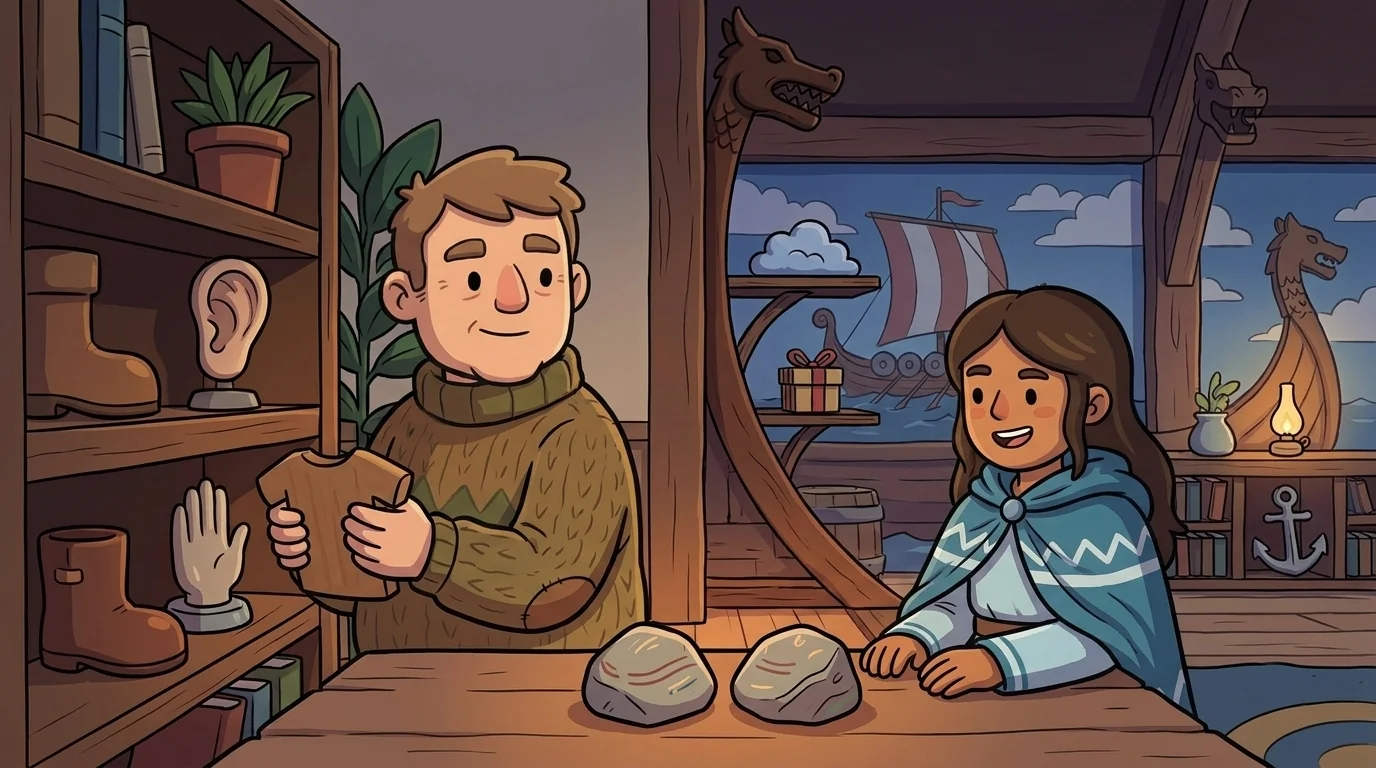
Later, when Wren had gone and the library had dimmed to its evening hush, Saga and Birch sat together at the sorting table, the paired stones still faintly warm between them.
"I always felt a bit plain next to you," Birch admitted, turning shirt over in his broad hands. "Your words had been places. Mine just stayed home and got used." He was quiet a moment. "Funny to find out half of mine are the same as half of yours. Like discovering the cousin who stayed on the farm and the cousin who ran off to sea had the same face all along."
"I felt the opposite," Saga said. "All that travelling, and it turns out the words I was proudest of are just — yours, wearing a different coat." She smiled, and it was a warm, unguarded smile, not a performing one. "I don't feel less special. I feel less alone. Like the library got smaller and cosier without losing a single word."
Birch nodded slowly. Outside, the wind that had once carried longships breathed against the windows, and the two of them sat in the good, settled quiet of people who have just found out they were related the whole time.
"Long-lost family," Birch said. "It's a nice thing to be."
And it was — the nicest thing either of them had felt in a thousand years of being words.
The QuillSpell ensemble
Saga and Birch is part of QuillSpell's distributed-narrative cast. Each character embodies a different curricular primitive; together they teach the full subject.
-
Etyma
Latin Quarter — Latin roots (port, scrib, dict, vis, audi, port)
-
Sophia
Greek Acropolis — Greek roots (bio, geo, photo, log, graph, phon)
-
Birch
Germanic / Old English Grove — short, punchy Anglo-Saxon roots (mouth, hand, foot, hear, see, walk)
-
Saga
Old Norse Longhouse — northern roots (sky, take, gift, raise, weak, scant)
-

Margaux
French Chateau — Norman-French roots (royal, chef, ballet, garage, hotel, courage)
-
Zayn
Arabic Oasis — Arabic-origin English loans (algebra, algorithm, alchemy, zenith, sugar, cotton)
-

Hush
Silent-letter clan (kn-, gn-, wr-, mb, gh, pn-, ps-)
-
Twin
Double-consonant rule (running, beginning, hopped, planned — short-vowel-CVC + suffix)
-

Ember
Schwa-keeper (the unstressed-vowel "uh" — `about`, `pencil`, `lemon`, `circus`, `medium`)
-

Wren
Vowel-team duos (ai, ea, ee, oa, ow, ie, oi) — "when two vowels go walking"
-

Affix
Suffix-stack guardian (root + suffix + suffix: nation → national → nationalize → nationalization)
-
Cadence
Syllable-rhythm master (di-vid-ing words for spelling: VC/CV, V/CV, syl-lab-i-fi-ca-tion)