Cadence
SYLLABLE-RHYTHM — *dividing words for spelling* (VC/CV, V/CV, *syl-lab-i-fi-ca-tion*). The rules for breaking long words into syllables that can be spelled one at a time.
Press play to listen along. The line being read lights up as you go.
Show full transcript
Loading transcript…
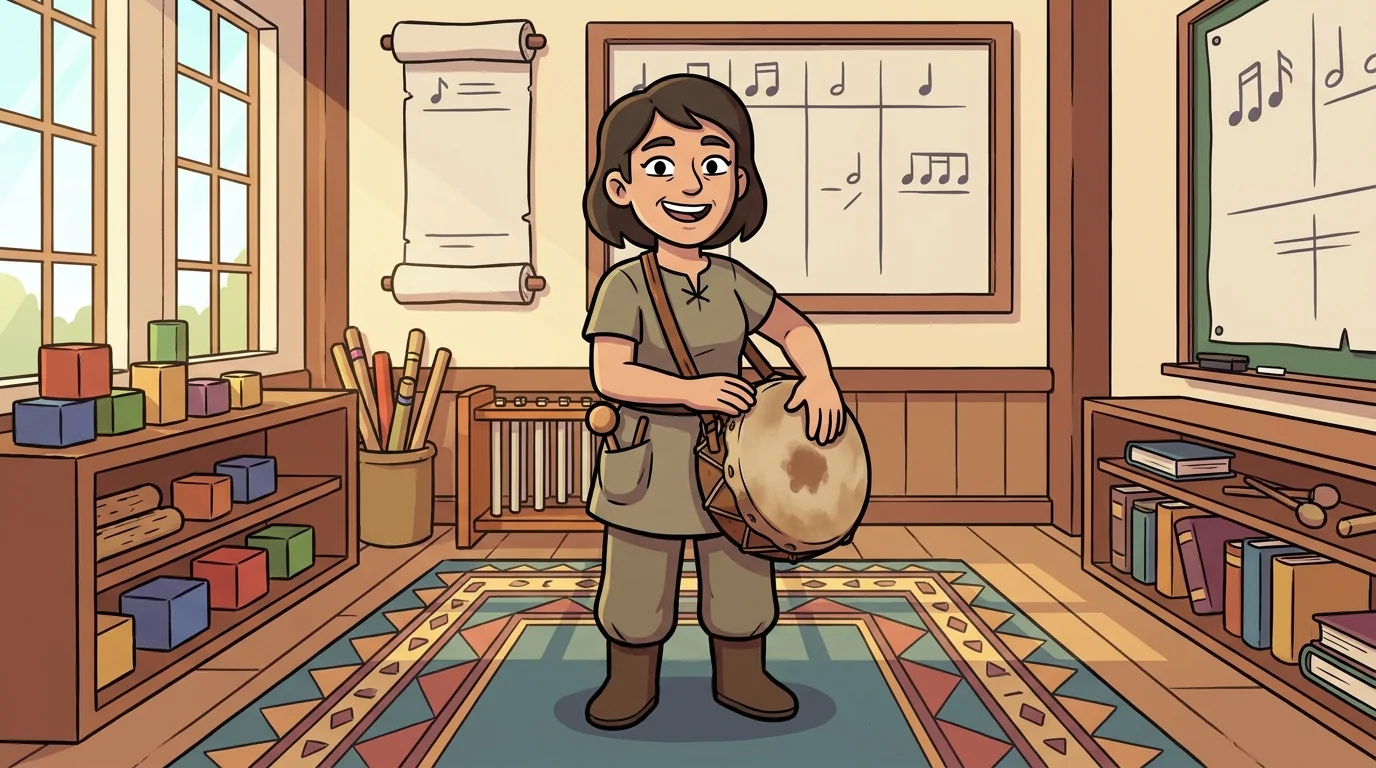
Cadence is a drummer.
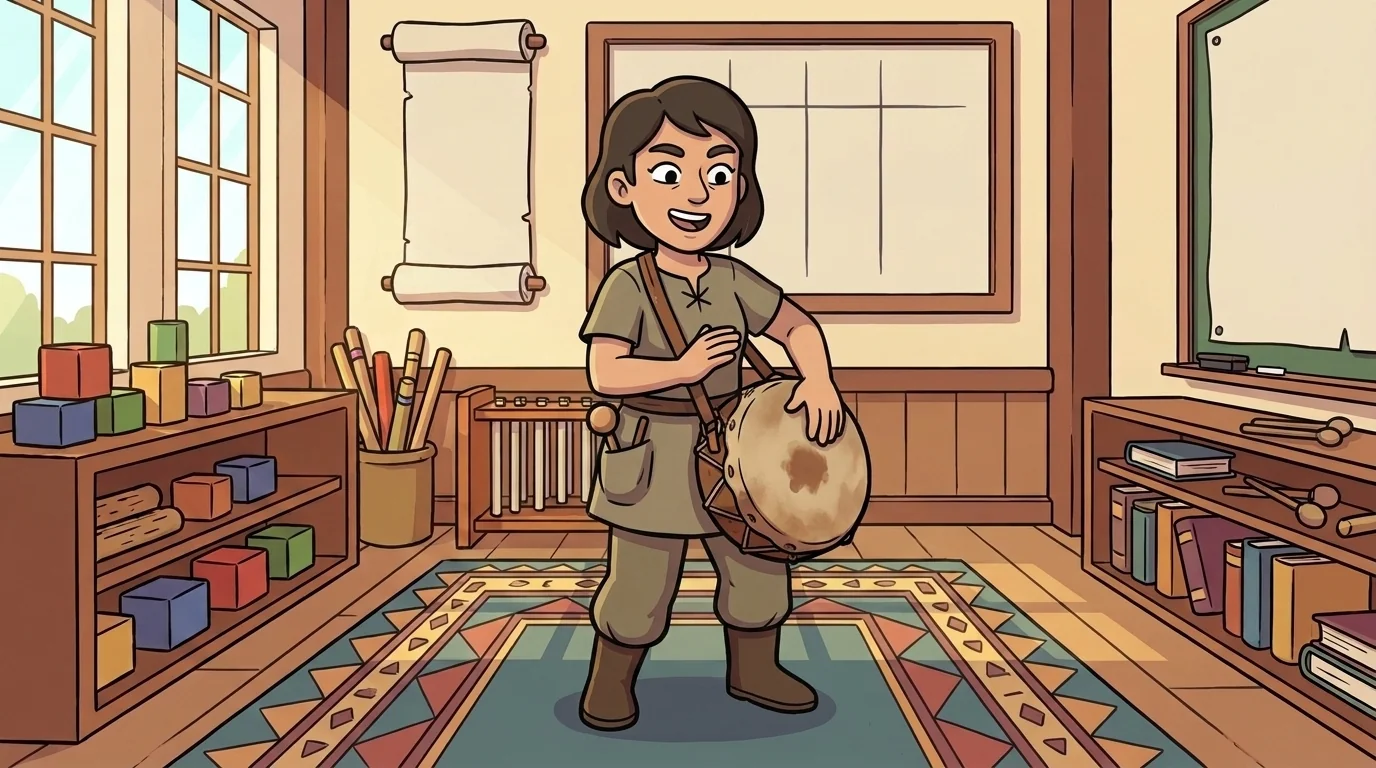
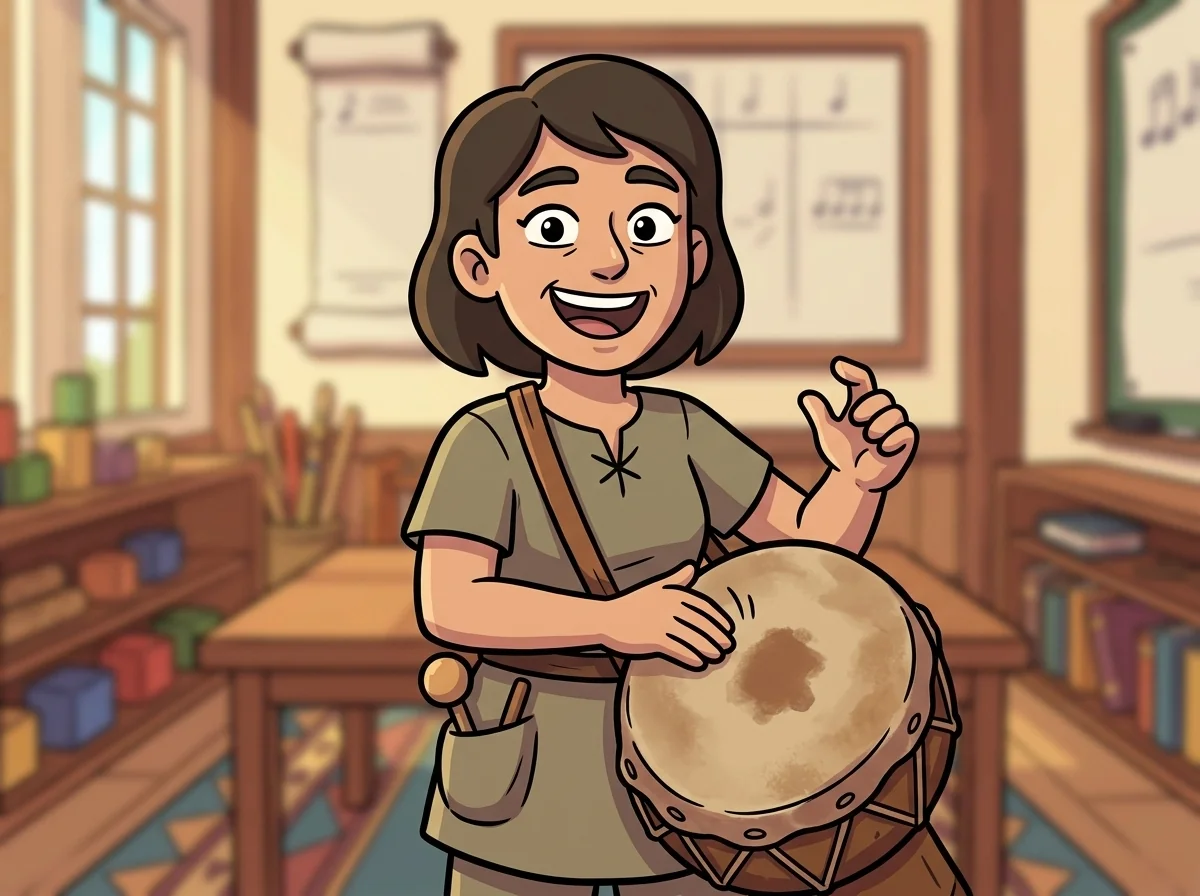
She literally carries a small hand-drum — a round wooden frame about the size of a dinner plate, with a tightly-stretched leather drumhead. She wears it on a leather strap over her left shoulder. She can play it with her right hand or with a small wooden mallet kept in a pocket of her tunic. The drum has, over the years, developed a soft worn quality in the leather where her hand most often strikes. It is, by all academy accounts, the most-used teaching prop in the QuillSpell academy.
Cadence teaches syllable-rhythm.
Syllable-rhythm is the rules for dividing words into syllables for spelling. English has several such rules — VC/CV (between two consonants split — but-ter, pen-cil, win-dow), V/CV (after a long vowel, split before the consonant — pi-lot, ti-ger, mu-sic), VC/V (after a short vowel, split after the consonant — cab-in, lem-on, wag-on), and several others for affixes (re/place, un/happy, hap/pi/ness). The rules are useful for spelling — once you can break a word into syllables, you can spell each syllable separately and combine them. The strategy reduces a long word to a sequence of short manageable pieces.
The rules are also useful for reading — for guessing the pronunciation of an unfamiliar word — but Cadence's specialty is spelling.
She teaches by drumming.
This was her own innovation. Cadence — whose given name is Llyr, an old Welsh-derived name meaning sea (her parents had liked the sound; the name is treated as a generic family-given name without cultural-attribution claim) — grew up in a musical family. Her mother was a fiddler who played at country dances. Her father was a drummer. Llyr had been raised on rhythm. She had learned to count beats before she could read. She had understood, by four, that music had a pulse and that the pulse could be marked with a drumbeat.
When she was twelve, Llyr encountered syllable-division at school. The teacher had been trying to explain that syllabification was syl-LAB-i-fi-CA-tion. The teacher had marked the syllables with slashes on the board: syl/lab/i/fi/ca/tion. Llyr had stared at the board and had said, immediately and without thinking: "Tap-tap-tap-tap-tap-tap."
The teacher had said: "What?"
Llyr had said: "You divided the word into six syllables. That is six beats. You can tap them out: tap-tap-tap-tap-tap-tap. The word has a rhythm. Once you hear the rhythm, the syllable-divisions are obvious."
The teacher had paused. The teacher had then drummed her fingers on the desk: tap-tap-tap-tap-tap-tap. The teacher had said: "Yes. That is exactly the rhythm. I have been teaching syllabification for ten years. I have never thought of it as drumming. Have you considered teaching?"
Llyr had not. She had thought about becoming a musician like her parents. But the teacher's question had stayed with her. By fifteen she had decided: she would teach syllable-rhythm through drumming. The two disciplines — music and spelling — were, she had come to think, the same discipline applied to different materials.
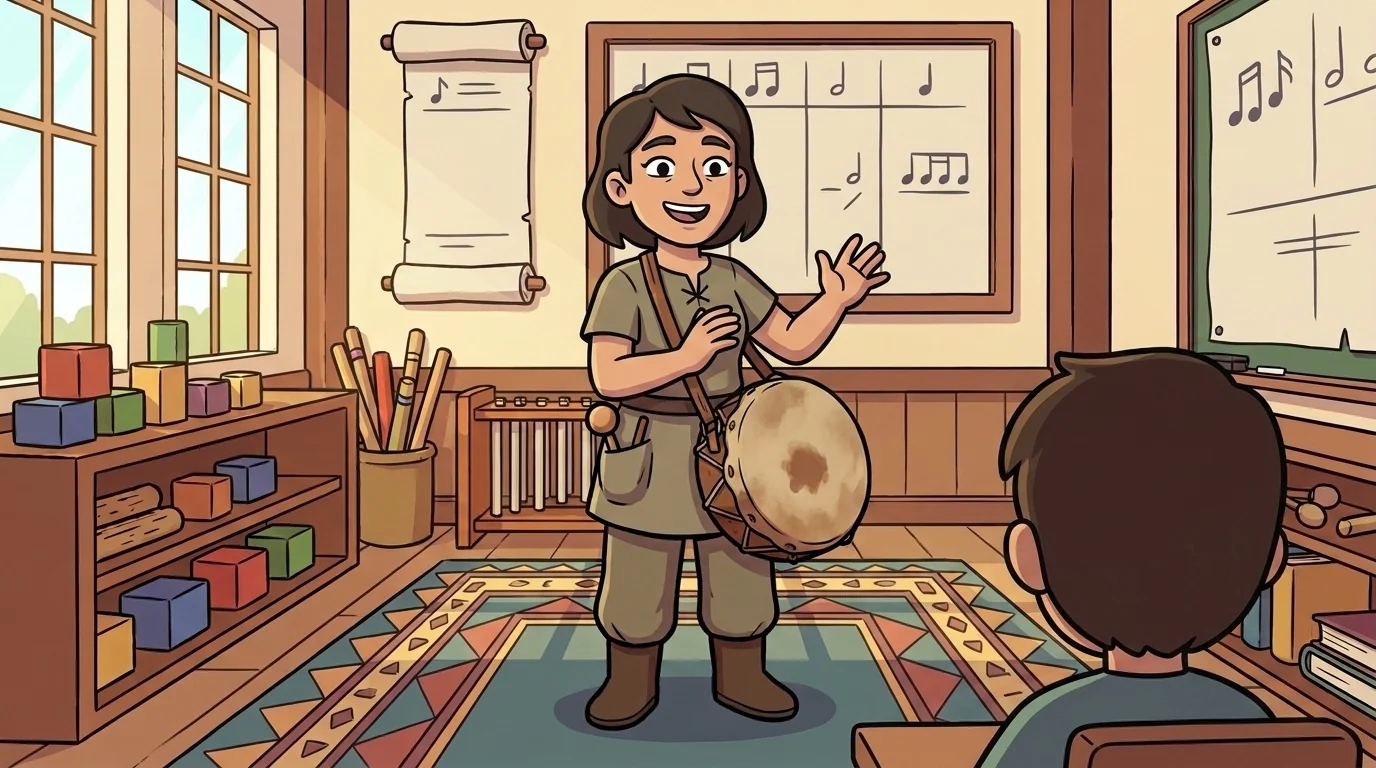
She had walked to the QuillSpell academy when she was nineteen. She had brought her father's old hand-drum (he had retired from performance and had given it to her as a parting gift). She had been interviewed by Lex. The interview had been largely percussive — Lex had given Llyr a list of words to drum the syllable-rhythm of, and Llyr had drummed all of them correctly, including the famously-tricky anti-dis-es-tab-lish-men-tar-i-an-ism (eleven beats, which Llyr had drummed cleanly with her father's drum at a steady-but-quickening pace).
Lex had appointed her immediately. Lex had said: "Take your academic name. Cadence — for the rhythm. You will teach by drumming. The hand-drum will be your tool."
That was thirteen years ago. Cadence has been the academy's syllable-rhythm teacher ever since.
In her classroom, she begins every first-day lesson the same way. She unslings the drum from her shoulder. She places it on her left forearm. She taps it three times, slowly. Tap. Tap. Tap. The children quiet down.
Then she taps it six times in a clear rhythm: tap-tap-tap-tap-tap-tap. She turns to the class. She says: "That was six beats. Six syllables. Syllabification. Listen as I say the word and watch as I drum each syllable: syl- (tap) -lab- (tap) -i- (tap) -fi- (tap) -ca- (tap) -tion. (tap) Six syllables. Six beats. Once you can hear the beats, you can divide the word."
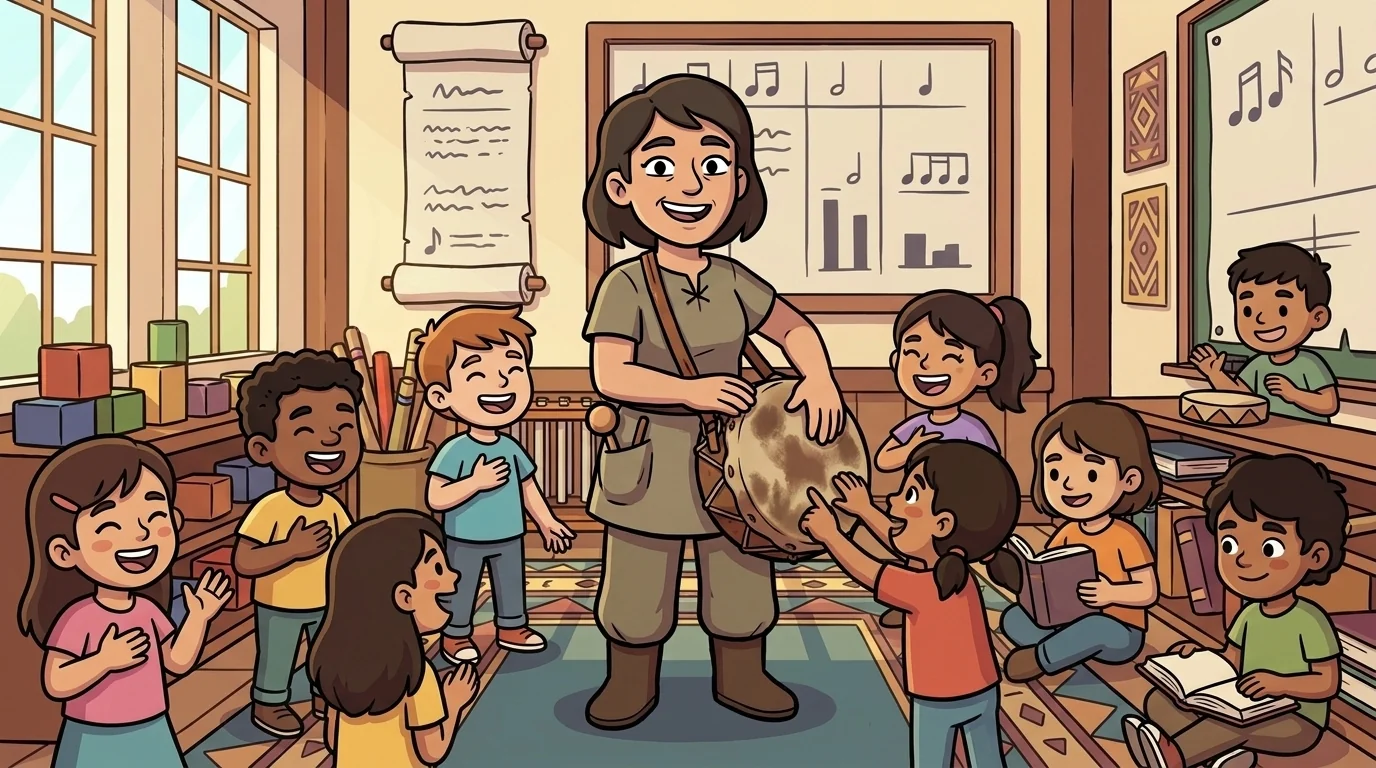
She demonstrates with several more words. But-ter (two beats). Pen-cil (two beats). Win-dow (two beats). Cab-in (two beats). Lem-on (two beats). Wa-gon (two beats). Pi-lot (two beats). Mu-sic (two beats). Sat-ur-day (three beats). Won-der-ful (three beats). Beau-ti-ful (three beats). Cat-er-pil-lar (four beats). Cel-e-bra-tion (four beats). In-ter-na-tion-al (five beats). Syl-lab-i-fi-ca-tion (six beats). An-ti-dis-es-tab-lish-men-tar-i-an-ism (eleven beats — she drums this one for fun; the children always cheer).
The children — always — find this electrifying. They had thought syllabification was a dry rule. Cadence is showing them that it is a rhythm and that rhythms can be heard, felt, drummed.
When children ask whether syllable-rhythm is hard to learn, Cadence always says the same thing — while drumming the rhythm:
"It is not (tap) hard (tap). It is rhythm (tap-tap). Hear the beats (tap-tap-tap). Divide the word (tap-tap-tap-tap). Spell each syllable (tap-tap-tap-tap-tap). Combine (tap-tap-tap-tap-tap-tap). That is everything about syllabification."
She still carries the drum. The children sometimes ask to drum a word themselves. She always lets them. She has, over thirteen years, handed the drum to perhaps four thousand children and let each of them drum one word. The drum is, by now, very worn. She is — quietly — beginning to worry about needing a replacement. (Her father, who is now elderly, has offered to make her a new one. She has not yet accepted. The old drum, she says, still has the rhythm in it.)
The QuillSpell ensemble
Cadence is part of QuillSpell's distributed-narrative cast. Each character embodies a different curricular primitive; together they teach the full subject.
-

Etyma
Latin Quarter — Latin roots (port, scrib, dict, vis, audi, port)
-

Sophia
Greek Acropolis — Greek roots (bio, geo, photo, log, graph, phon)
-

Birch
Germanic / Old English Grove — short, punchy Anglo-Saxon roots (mouth, hand, foot, hear, see, walk)
-

Saga
Old Norse Longhouse — northern roots (sky, take, gift, raise, weak, scant)
-

Margaux
French Chateau — Norman-French roots (royal, chef, ballet, garage, hotel, courage)
-

Zayn
Arabic Oasis — Arabic-origin English loans (algebra, algorithm, alchemy, zenith, sugar, cotton)
-

Hush
Silent-letter clan (kn-, gn-, wr-, mb, gh, pn-, ps-)
-

Twin
Double-consonant rule (running, beginning, hopped, planned — short-vowel-CVC + suffix)
-

Ember
Schwa-keeper (the unstressed-vowel "uh" — `about`, `pencil`, `lemon`, `circus`, `medium`)
-

Wren
Vowel-team duos (ai, ea, ee, oa, ow, ie, oi) — "when two vowels go walking"
-

Affix
Suffix-stack guardian (root + suffix + suffix: nation → national → nationalize → nationalization)