Twin
DOUBLE-CONSONANT RULE — when a short-vowel CVC word takes a suffix, the final consonant doubles. *Run + ing → running.* *Hop + ed → hopped.* *Plan + ed → planned.* The rule preserves the short-vowel pronunciation by signaling "this consonant is the boundary."
Press play to listen along. The line being read lights up as you go.
Show full transcript
Loading transcript…
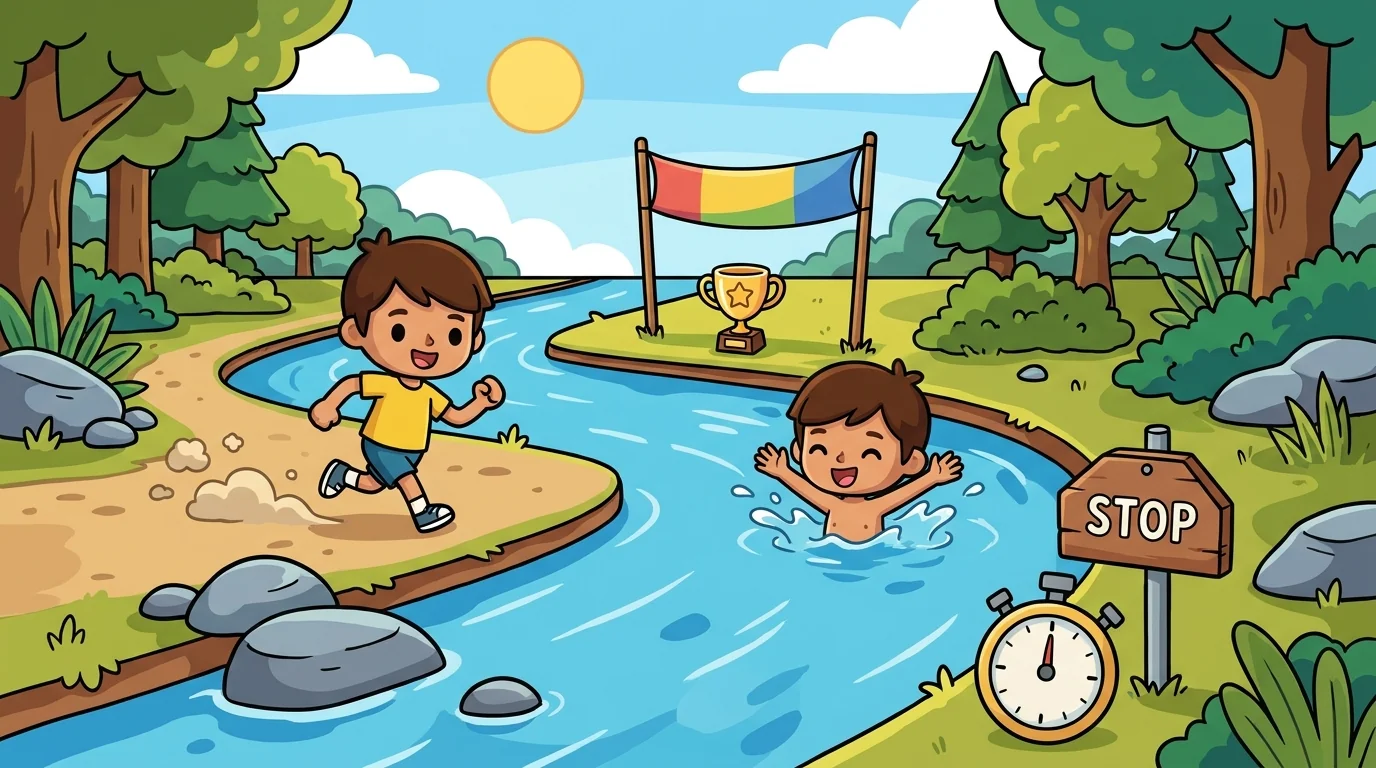
- PAIR-BY-THE-RIVER - running - swimming - winning - stopping - RUN - SWIM - WIN - STOP - ing - ed - er - est

- 1-1 - 2-2 - doubling gate-allow-text-pattern: '^-?[A-Za-z]+-?[A-Za-z0-9-]$|^\d+-?\d$' ---
Twin grew up one of identical twins. Her sister's name was Twyn. They were born on the same morning. Their village was called Pair-by-the-River. Official papers say it was a real place. The river it was "paired-by" moved away long ago. So the village isn't on the river anymore.
Their mother was a poet. She named them to echo each other. The names are one letter different. They sound exactly the same aloud. On paper, they show the simplest way a double consonant works.
Twin and Twyn were always together. They shared a cradle. They shared a cot. Later, they shared a bed. Their parents made sure they shared almost everything. They had the same toys and books. The family seamstress made their clothes. She made one set in two sizes. Twin and Twyn were the same size for a long time. Then, as teens, they grew differently. The seamstress had to start making two sets.
Slowly, as they grew up, Twin and Twyn found out something big. They were not the same person.
When they were little, this was a huge surprise. Everyone in their family and village treated them the same. They acted like Twin and Twyn were one unit with two bodies. But Twin was chatty. Twyn was quiet. Twin loved to tell everyone what was happening. Twyn liked to listen and think before she spoke.
If Twin saw rain, she would say: "It is raining."
Twyn would pause. She would look at the sky. She would look at the plants. Then she would say: "It is. The leaves were facing up earlier. Now they are drooping."
The two girls fit together. They were complementary. They weren't exactly alike.
They made this official when they turned thirteen. They had a long, quiet talk. They decided Twin would be the speaker. Twyn would be the listener. When they were together, Twin did most of the talking. Twyn did the listening and the thinking. If Twin said something that needed a small fix, Twyn would give a soft signal. Maybe a light touch on Twin's arm. Or a tiny shake of her head. Twin would change what she said.
When Twin was eighteen, she learned about the double-consonant rule. This was at the village school. The teacher explained it.
"When a short word has one syllable," the teacher said, "and it ends with one consonant after one vowel, you double the consonant." She wrote on the board. "Run plus -ing makes running. Hop plus -ed makes hopped. Plan plus -ed makes planned."
She tapped the board. "The doubling keeps the vowel sound short."
Twin raised her hand. "Like me and Twyn," she said.
The teacher looked puzzled. "What?"
Twin explained. "Twyn and I are doubled. Our names are one letter apart. We work like a pair." She pointed to the word running. "Run becomes running because the running needs to keep the short u sound."
She went on. "English shows a short vowel by doubling the consonant after it. The double n in running keeps the u short. If there was no double n, you would have runing. Most people would say roon-ing."
The teacher slowly put down her chalk. She had taught the double-consonant rule for fifteen years. No student had ever explained it as "spelling's way of saying short vowel." And no student had ever compared the doubled consonant to a pair of twin sisters.
"That is exactly right," the teacher said. "That's why we double. And your twin comparison? Honestly, it's one of the best ways to remember this rule I've ever heard." She paused. "Have you ever thought about teaching?"
Twin had not. She had thought about staying home with Twyn. She wanted to help her parents on the family farm. But the teacher's question made her think. She talked to Twyn about it. Twyn, who never said much, even in private, thought about it for a whole week.
Then Twyn said: "You should go. I will visit you. We have always done things together. But we don't have to do everything together."
So Twin went. Twyn stayed. In the twenty-eight years since, they have written each other long letters every single week. Twyn has visited the academy more than thirty times. All the children at the academy know about Twyn. They think of her as Twin's silent partner. Even though they almost never see her in person.
In Twin's classroom, she starts every first-day lesson the same way. She holds up one finger from each hand. She brings them together.
"This is a single consonant," she says. "Run ends in a single n. To turn run into running, I need to add an ending with a vowel. An -ing." She shows the fingers again. "But the n needs to double. If I don't double it, the spelling looks like runing. Most readers will try to say roon-ing. I want the short u sound. I double the n to show you: short vowel, the consonant is the wall."
The QuillSpell ensemble
Twin is part of QuillSpell's distributed-narrative cast. Each character embodies a different curricular primitive; together they teach the full subject.
-

Etyma
Latin Quarter — Latin roots (port, scrib, dict, vis, audi, port)
-

Sophia
Greek Acropolis — Greek roots (bio, geo, photo, log, graph, phon)
-

Birch
Germanic / Old English Grove — short, punchy Anglo-Saxon roots (mouth, hand, foot, hear, see, walk)
-
Saga
Old Norse Longhouse — northern roots (sky, take, gift, raise, weak, scant)
-

Margaux
French Chateau — Norman-French roots (royal, chef, ballet, garage, hotel, courage)
-

Zayn
Arabic Oasis — Arabic-origin English loans (algebra, algorithm, alchemy, zenith, sugar, cotton)
-

Hush
Silent-letter clan (kn-, gn-, wr-, mb, gh, pn-, ps-)
-

Ember
Schwa-keeper (the unstressed-vowel "uh" — `about`, `pencil`, `lemon`, `circus`, `medium`)
-

Wren
Vowel-team duos (ai, ea, ee, oa, ow, ie, oi) — "when two vowels go walking"
-

Affix
Suffix-stack guardian (root + suffix + suffix: nation → national → nationalize → nationalization)
-

Cadence
Syllable-rhythm master (di-vid-ing words for spelling: VC/CV, V/CV, syl-lab-i-fi-ca-tion)