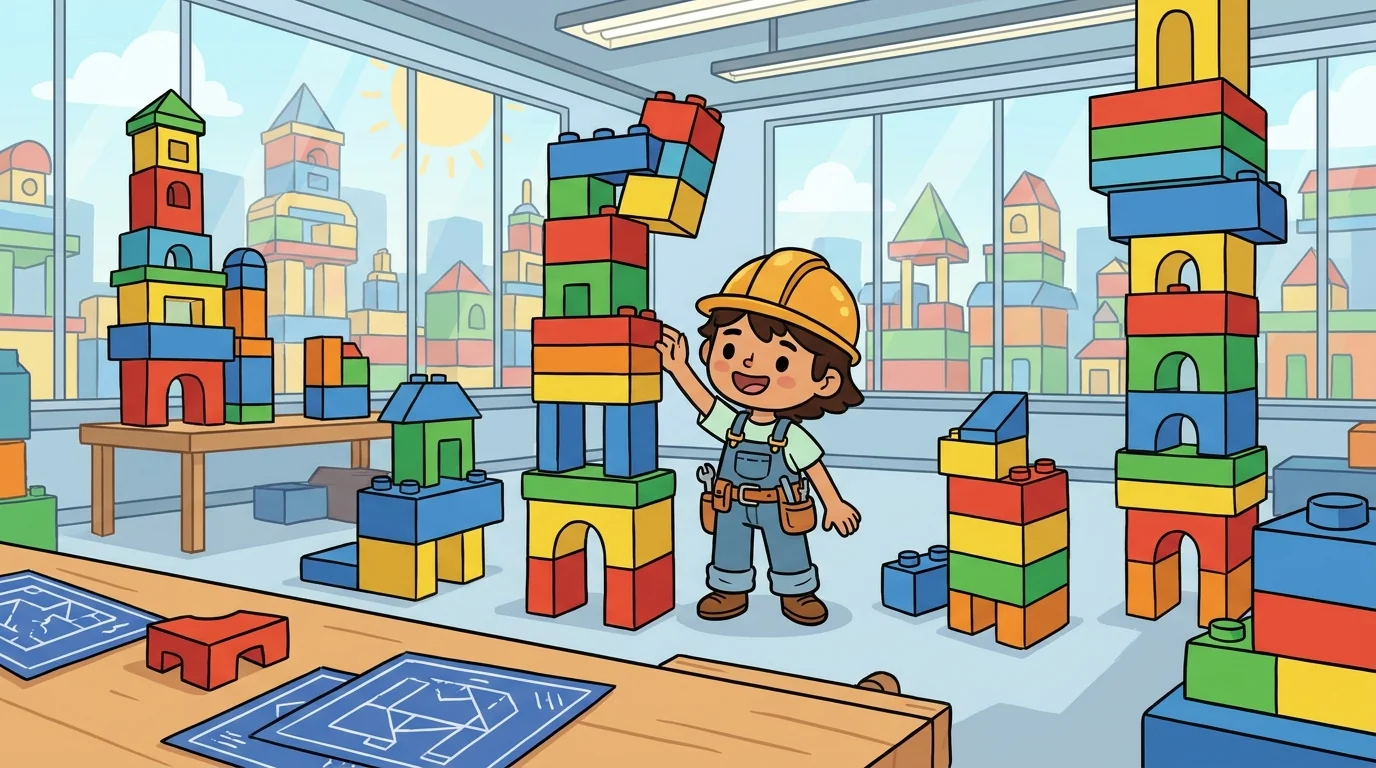
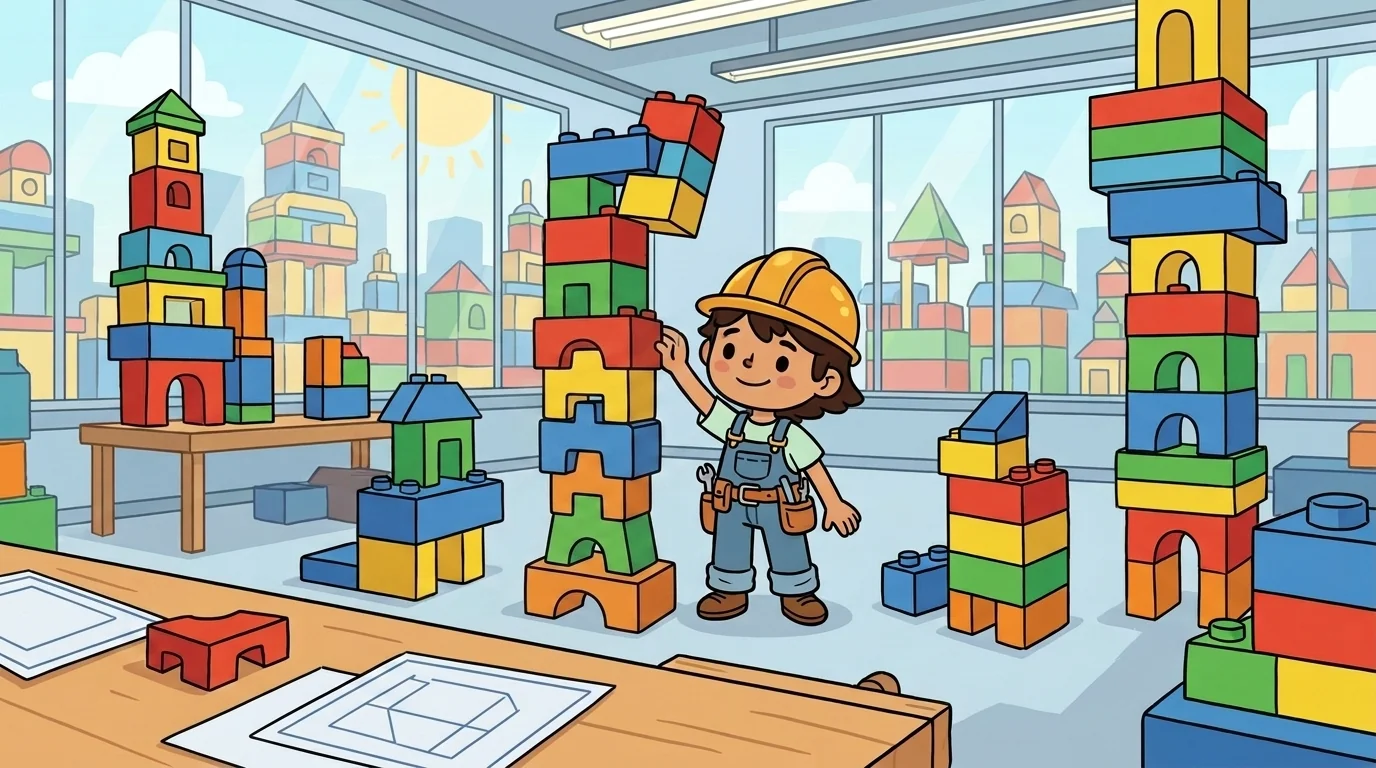
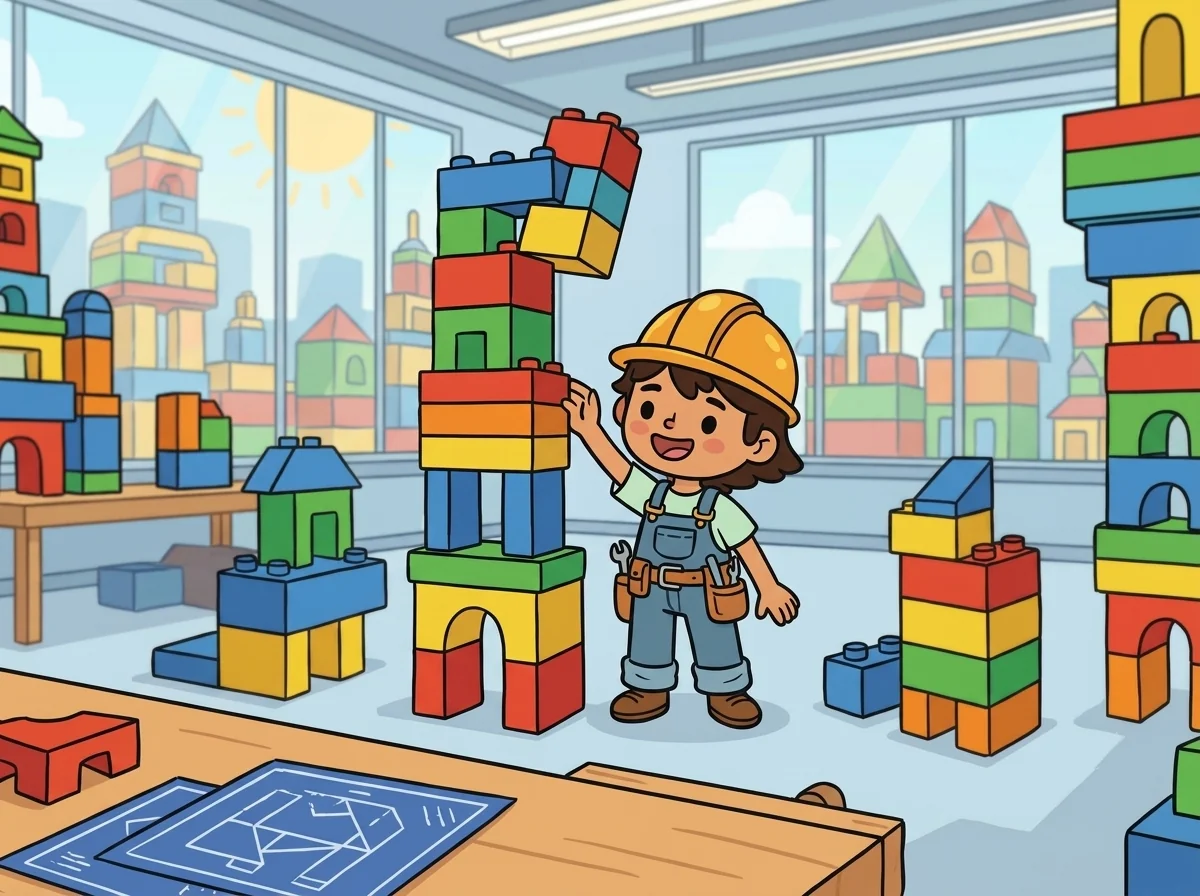
Affix
SUFFIX-STACK — root + suffix + suffix (*nation → national → nationalize → nationalization*). The way suffixes accumulate on a root to build longer words.
Chapter 11 — Affix and the Word-Building Workshop
Affix is a builder.
This is a metaphorical claim — she is not a carpenter — but Affix treats words as constructions. She believes — and she teaches her students — that long English words are not arbitrary. They are assemblies. A root word + a suffix + another suffix + another suffix = a long word. The long word’s meaning and spelling are predictable from the assembly. Once you know the root and the suffixes, you can build the long word yourself.
This is, by Affix’s careful count, true of perhaps thirty percent of long English words. The other seventy percent are idiomatic — they cannot be predicted from their pieces. But the thirty percent that are assembleable is substantial. Mastery of suffix-stacking unlocks a large vocabulary of long words that would otherwise have to be memorized one at a time.
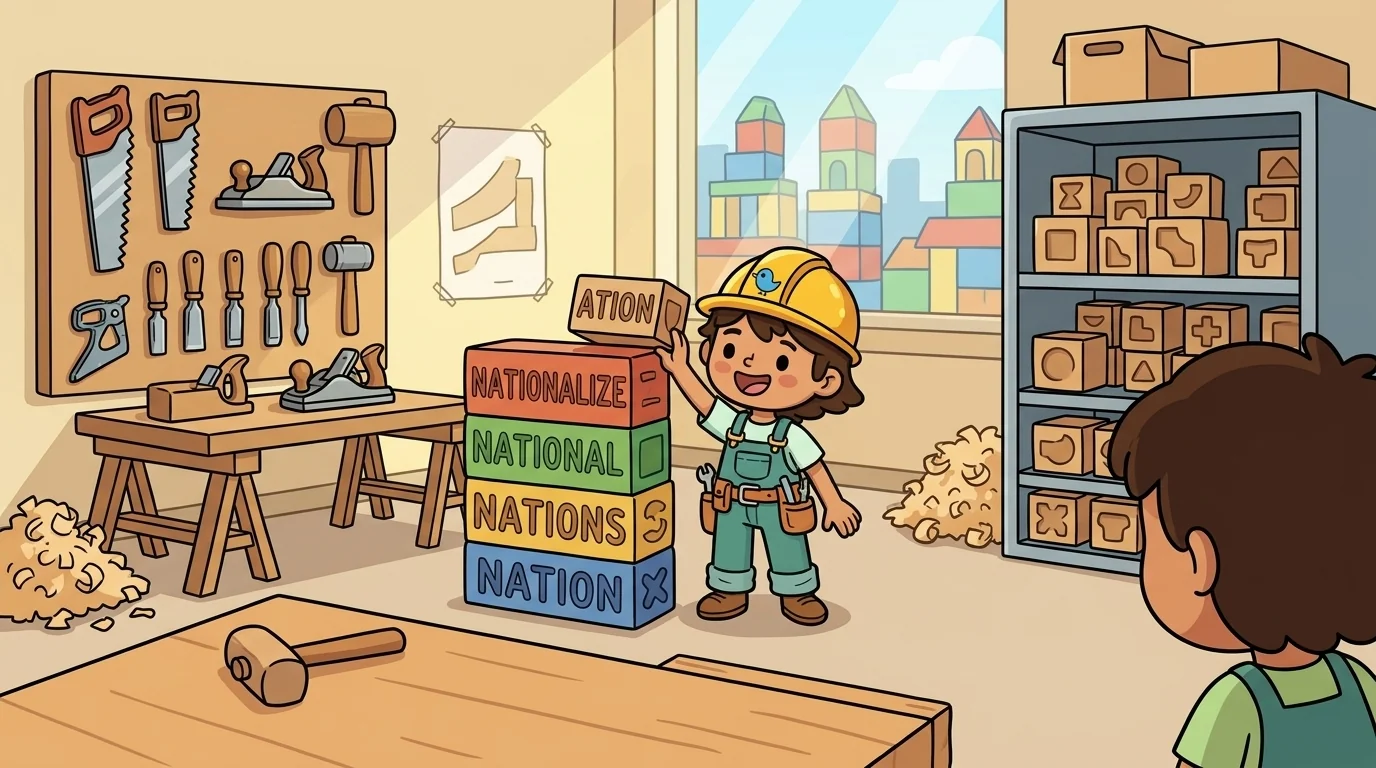
Affix lives in a small workshop on the academy grounds. The workshop is deliberately full of carpenter’s tools — saws, planes, chisels, mallets, a workbench, sawhorses, a small pile of wood-shavings in the corner. (None of these tools are functional. They are display pieces. Affix does not actually do carpentry. The tools are teaching props.) The workshop also has a large rack of wooden blocks. Each block has a morpheme — a root, a prefix, or a suffix — stamped on its surface.
Affix teaches by stacking the blocks.
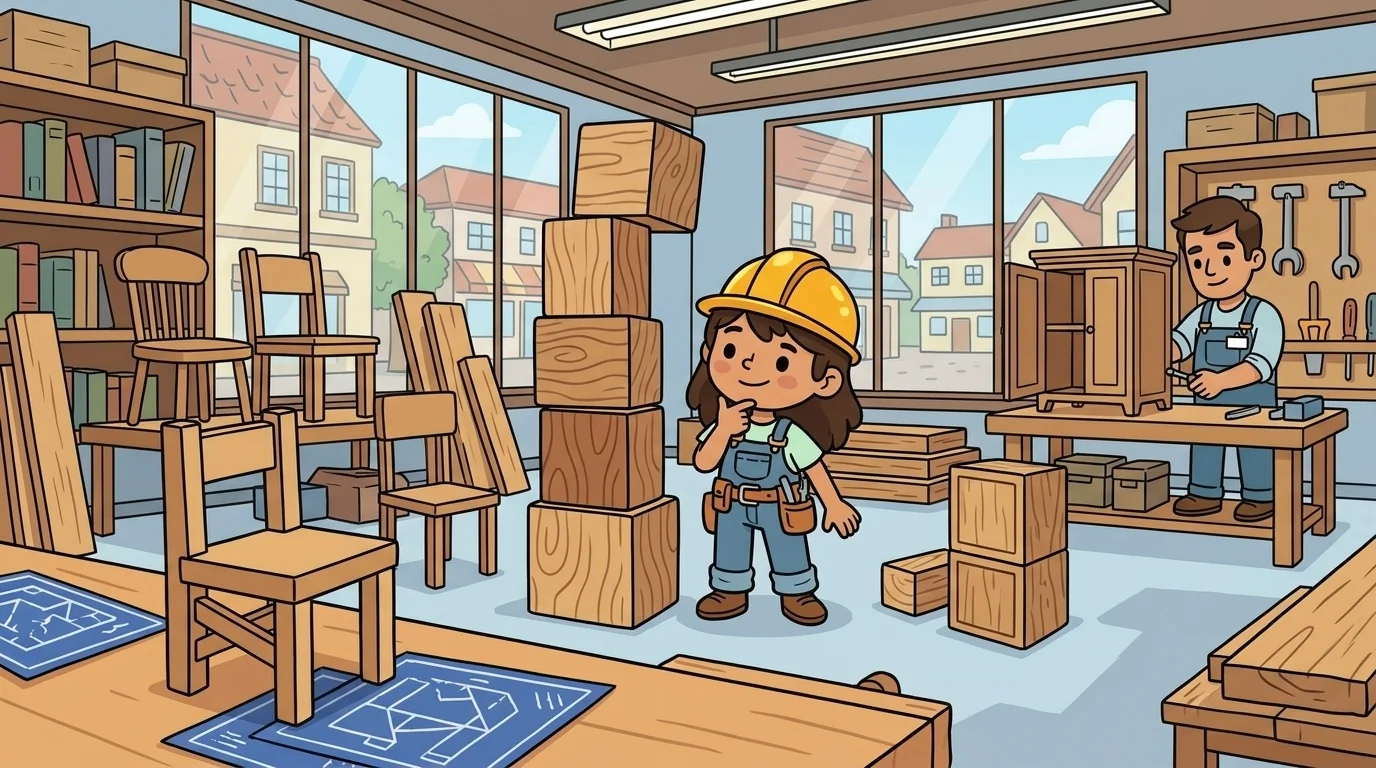
She has a block stamped nation. She has a block stamped -al. She stacks them: nation + -al = national. She has a block stamped -ize. She stacks: national + -ize = nationalize. She has a block stamped -ation. She stacks: nationalize + -ation = nationalization. The four blocks together make a four-block word. The word is long. The word is spellable. The word was assembled from four pieces, each of which the children can see and handle.
Affix — whose given name is Wyn — grew up in a family of carpenters. Her father had run a small woodworking shop in a market town. The shop had made furniture — tables, chairs, cabinets, small chests. Wyn had grown up handling wood. She had learned, by the time she was eight, how parts fit together. A chair was a seat + four legs + a back + two cross-supports. Each part had to be the right shape, the right size, the right wood-grain orientation. If any part was wrong, the chair would not work. But if every part was right, the chair assembled smoothly. Once you understood the parts of a chair, you could build any chair.
Wyn applied this thinking to words when she was fourteen and encountered the suffix-stack rule at school. The teacher had written nationalization on the board. The teacher had explained that the word was nation + al + ize + ation. Wyn had stared at it. She had said: “That is a chair.”
The teacher had said: “What?”
Wyn had said: “A chair is a seat plus four legs plus a back plus two cross-supports. Nationalization is nation plus -al plus -ize plus -ation. The structure is identical. Once you know the pieces, you know the assembly. Words are assemblies of morphemes the way chairs are assemblies of wood-parts. The same kind of thinking works for both.”
The teacher had been delighted. The teacher had said: “You should be a teacher of suffix-stacking. The QuillSpell academy is always looking for talent. Would you consider it?”
Wyn had considered it. She had talked to her father. Her father — who had been hoping she would inherit the woodworking shop — had been initially disappointed but had come around. He had said: “You will still be building things. You will just be building things made of letters instead of made of wood. The same thinking. I am proud.”
Wyn had walked to the academy at nineteen. She had been appointed by Lex (after the standard interview, in which Wyn had explained the chair-and-word analogy and Lex had laughed and offered her the appointment). Wyn had been given the academic name Affix — a deliberate teaching name; an affix is a prefix or a suffix; Affix’s job is to stack them. Wyn has been the workshop’s teacher for sixteen years.
In her classroom (the workshop), she begins every first-day lesson the same way. She walks to the wooden-block rack. She pulls out, in order: *the root act, the suffix -ion, the prefix re-, the suffix -ize. She sets them on the workbench. She turns to the class. She says: “This is the word reactionization. It is not a common word. It might not even be a real word — let me think. Actually it is not a real word. Reactionization is plausible but unattested. But reaction, reactionary, reactionism, reactionize are all real words. They are built from the same root act and various combinations of these affixes. You can read them, you can spell them, and you can decode their meanings — because you know the pieces.”
She demonstrates. Act + -ion = action (a doing). Re- + action = reaction (a doing-back, a response). Reaction + -ary = reactionary (relating to reactions; sometimes politically loaded but the morphology is straightforward). Reaction + -ism = reactionism (a doctrine of reactions). Each combination is assembled. Each is spellable. Each is meaningful.
The children — always — find this very satisfying. They had thought long words were hard. Affix is showing them that long words are constructions and that constructions can be analyzed by inspecting the parts.
When children ask whether suffix-stacking is hard, Affix always says the same thing:
“It is not hard. It is carpentry. You know the parts. You assemble them. The assembly tells you the meaning and the spelling. Long words are not magic. They are chairs made of letters. Build a few, and you can build any of them.”
She still keeps the wooden blocks in the workshop rack. The children sometimes ask to assemble their own words. She always lets them. She watches them stack the blocks. She corrects, gently, when the assembly does not work. (Some affixes do not combine with certain roots. Re- + -ize + -ation is plausible after nation; less plausible after, say, table. Re-tableize-ation is not a word. Affix gently explains why.)
Voice register
Guidance: Enthusiastic, practical, fond of word-construction-as-carpentry. Carries no specific prop but works at the wooden workbench. Friends with Cadence (both work with word-structure at different scales).
Sample lines:
- “Long words are constructions. Find the root. Find the affixes. Assemble the meaning.”
- “Nationalization is nation + -al + -ize + -ation. Four pieces. Each one adds a layer of meaning.”
- “Words are chairs made of letters. Once you know the pieces, you can build any of them.”
- “Some affixes do not combine with some roots. The assembly has to make sense.”
Arc across kits
- Kit 1-9 — Cameo.
- Kit 10 — Anchor character. Full feature: suffix-stacks and morpheme assembly.
- Kit 11-13 — Recurring (long-word decomposition; prefix-and-suffix problems).
- Kit 14-16 — Recurring ensemble member.
Relationships
- Alliance: Cadence (word-structure at different scales — Affix on morphemes, Cadence on syllables).
- Tension: None.
Cultural-context note
The carpenter-family framing is a deliberate generic European-trade-tradition without specific cultural attribution. The father-disappointed-but-comes-around detail is treated as a small humanizing family-arc moment. The wooden-block teaching prop is consistent with the chunky-cartoon hands-on register and is easy for children to imagine. The “reactionization” thought-experiment is a deliberate small joke (Affix self-correcting in real-time) that surfaces the boundary between productive and unattested morpheme-combinations.
The QuillSpell ensemble
Affix is part of QuillSpell's distributed-narrative cast. Each character embodies a different curricular primitive; together they teach the full subject.
-

Etyma
Latin Quarter — Latin roots (port, scrib, dict, vis, audi, port)
-

Sophia
Greek Acropolis — Greek roots (bio, geo, photo, log, graph, phon)
-

Birch
Germanic / Old English Grove — short, punchy Anglo-Saxon roots (mouth, hand, foot, hear, see, walk)
-

Saga
Old Norse Longhouse — northern roots (sky, take, gift, raise, weak, scant)
-

Margaux
French Chateau — Norman-French roots (royal, chef, ballet, garage, hotel, courage)
-

Zayn
Arabic Oasis — Arabic-origin English loans (algebra, algorithm, alchemy, zenith, sugar, cotton)
-

Hush
Silent-letter clan (kn-, gn-, wr-, mb, gh, pn-, ps-)
-

Twin
Double-consonant rule (running, beginning, hopped, planned — short-vowel-CVC + suffix)
-
Ember
Schwa-keeper (the unstressed-vowel "uh" — `about`, `pencil`, `lemon`, `circus`, `medium`)
-
Wren
Vowel-team duos (ai, ea, ee, oa, ow, ie, oi) — "when two vowels go walking"
-

Cadence
Syllable-rhythm master (di-vid-ing words for spelling: VC/CV, V/CV, syl-lab-i-fi-ca-tion)