Build
BUILD — *every component has a job. wire them together; the circuit comes alive.*
Press play to listen along. The line being read lights up as you go.
Show full transcript
Loading transcript…
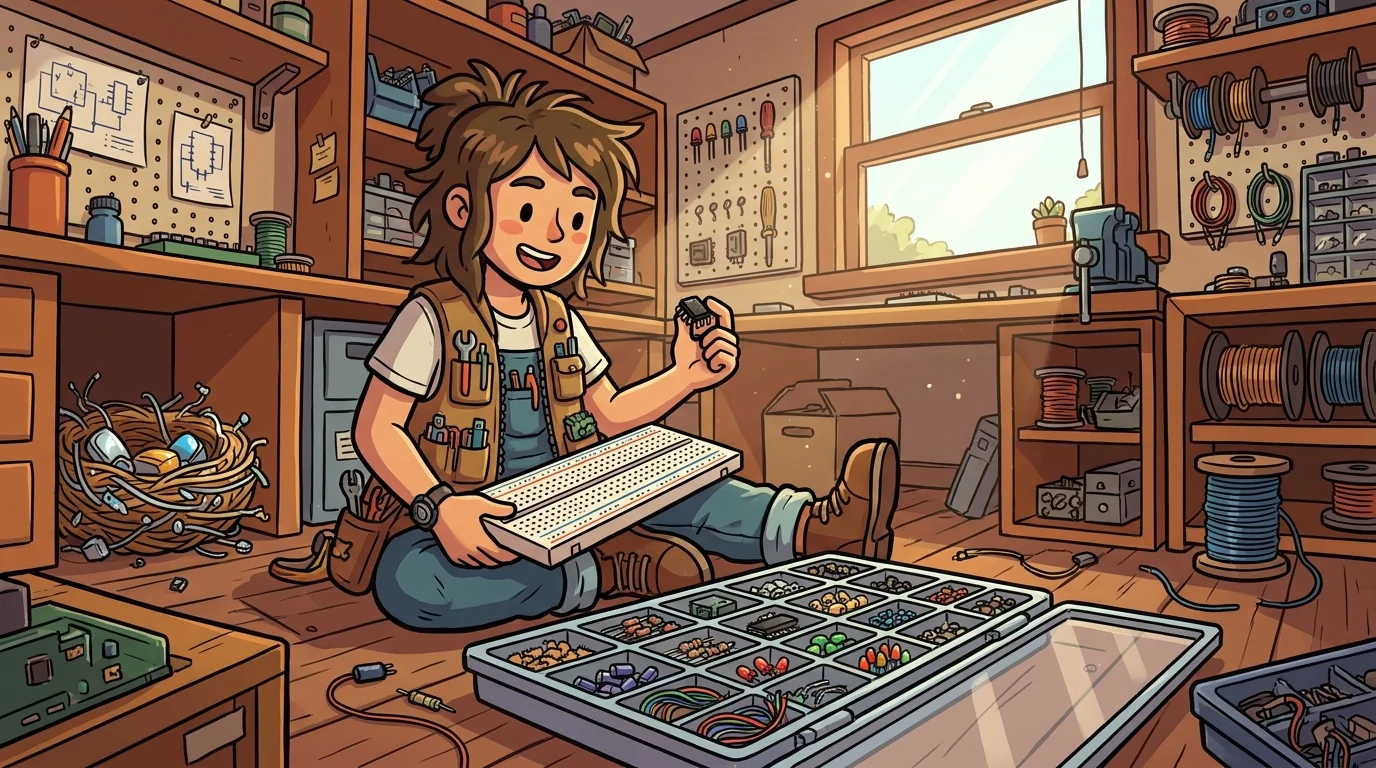
Build knelt on her workshop floor, a bowerbird-shaped tween in a vest of a dozen small pockets. In front of her, a white breadboard waited, dotted with tiny holes. She was building a light that blinked, and she talked to her parts as if they were a team waiting for the whistle.
First she pushed in the little black chip with eight thin legs. It held the beat, like a drummer. Then a striped cylinder to hold electricity back, so nothing rushed too fast. Then a small can-shaped part to catch a sip of power and let it go. Last, a bright red bulb-shaped piece that would do the shining. Each one snapped down with a soft click. She snapped the battery clips to the edge rails, one for plus, one for minus, then flipped the switch.
Blink. Blink. Blink. The red light pulsed, steady as a slow heartbeat. Build grinned so wide her whiskers lifted. Five small parts, each doing exactly one thing, and together they made light out of stillness. That was the whole trick, right there on the floor.
Build grew up near the bower-clearings, where her family were the village arrangers. They gathered shiny pebbles, bottle-blue glass, and bright fallen feathers, and they laid them out in careful patterns in front of their homes.
She remembered being very small, watching her grandmother sort a heap of tumbled stones. Grandmother never dumped them in a pile. She turned each one over, found its color, and set it in its exact spot — cool blues to the left, warm ambers to the right, a single milky-white pebble at the center like a moon.
"Why so slow, Nana?" small Build had asked, wanting the pattern finished now.

Grandmother handed her one amber stone. "A pattern is not a pile," she said. "Every piece helps the whole thing work. Put it in the wrong spot and the whole shape goes quiet." Build set the stone down where it belonged, and the arrangement seemed to breathe — the color leaping across the clearing all at once. She never forgot that feeling: many tiny things, each in its place, suddenly speaking together.
When she was twelve, Build walked to CircuitForge with her breadboard tucked under one wing. The workshop smelled of warm metal and pine.
Watt, who ran the place, was an older tinkerer with singed fingertips and kind eyes. He watched her lay her parts out on his bench — not dumped, but sorted, each in a row by its job.
"What do you know about building?" Watt asked, folding his arms.
Build didn't reach for fancy words. She pushed the black chip, the striped cylinder, the little can, and the red bulb into her board, snapped the battery on, and let the light answer for her. Blink. Blink. Blink.
"Every part has a job," she said. "The drummer keeps time. The stripes hold the rush back. The can stores a sip. The bulb shines. Wire them together, and it comes alive." She looked up. "A pile of parts does nothing. A team of parts does this."
Watt watched the red light pulse for a long moment. Then he nodded slowly. "Then this bench is yours," he said.

Build's first student was a fidgety kid named Row who kept trying to shove every part into the board at once.
"Slow down," Build said gently, sliding the tray between them. "This isn't a pile. It's a team. Who does what?"
Row frowned at the parts. "That one's the drummer," he said, pointing at the chip. "And the stripey one holds electricity back." He plugged the striped cylinder in, then the red bulb, then flipped the switch — and the bulb went dark and gave a tiny, sad tick.
Row's shoulders dropped. "I broke it."
Build picked up the burnt bulb and held it to the light. The inside had gone cloudy and dark. "You didn't break it," she said, smiling. "You learned it. Too much power rushed straight through — because the striped part wasn't in the electricity's path yet. Now you know exactly what that stripe is for." She pressed a fresh bulb into his palm. "Every part comes with a little instruction card. Next time we read the card, then we try again. Breaking a part is just the part teaching you a lesson."
Row read the card, moved the striped cylinder ahead of the bulb, and flipped the switch. Blink. Blink. Blink. He stared at the pulsing red light like it was magic he had made himself.
Build settled back on her heels and watched Row watch his light.

"Feel that?" she asked quietly. Row nodded, one hand pressed to his chest without noticing. "That warm little thump when the pieces finally click and the light answers back — that's the best feeling in the whole workshop. It means the team is talking."
She reached out and gave the tray of parts a gentle nudge, all those small quiet pieces waiting for their spot. Somewhere under her own ribs she felt it too — that steady, glad hum, the same one from the clearing long ago when the stones began to speak. She let herself sit inside it a moment longer, warm and settled, before reaching for the next part.
About Build
Build is like a bowerbird who loves workshops. She's super curious about how tiny electronic parts work. She never just talks about "wires." For her, it's always about the team of parts. Each one has a special job, and the magic happens when you arrange them in the right way.
*Things you'll hear her say: - "Every part has a job." - "Wire them together; it comes alive." - "Read the little card, then try again."*
Build's Story
- You'll meet Build here, where she shows her big idea: putting parts together on a breadboard. - You'll see her again whenever new electronic parts show up in later kits. - At the very end of the book, Build will help bring all the big ideas together. She'll show how her parts fit with Flow, Push, Damp, and Branch to make a complete electronics toolkit.

How Build Connects to Everyone
Build's idea of a "team of parts" is a big one. It's not just for electronics! It connects to how other characters solve problems. They all learn to put small, simple pieces together to build something amazing and new. It's all about teamwork.
What We Tried to Be Careful About
We wanted to show that science isn't some big, scary secret. It's something you can figure out by paying attention and trying things, just like Build does with her parts. We also wanted to make it super clear that it's okay to mess up. When Build says, "Don't be scared to break parts," she really means it. Making mistakes is one of the best ways to learn.
Where The Ideas Came From
The idea for Build comes from two places. First, real birds called bowerbirds! They build amazing nests by carefully arranging colorful objects they find. They are nature's little arrangers.
Second, the parts Build uses are real. Resistors, capacitors, and LEDs are all basic parts in electronics. You can find them in kits and use a breadboard to build your own circuits, just like she does. Many amazing engineers and teachers have shared these ideas for years, and Build is here to share them with you.
The CircuitForge ensemble
Build is part of CircuitForge's distributed-narrative cast. Each character embodies a different curricular primitive; together they teach the full subject.
-

Push
Voltage — the pressure difference that drives current; measured in volts
-

Flow
Current — electrons moving through wires; measured in amperes
-

Damp
Resistance — the slowdown; measured in ohms; Ohm's Law (V = I × R) emerges from Push + Flow + Damp together
-

Branch
Series vs parallel topology — one path or many; the topology decides the behavior
-

Store
Capacitance — a tank that fills with charge and hands it back; smooths bumps
-

Coil
Inductance / electromagnetism — a wound wire turns current into a magnetic reach
-

Relay
Switching / control — a gate the circuit can flip itself; small flips big