Tally the Pattern-Counter
COUNTING PRINCIPLES + COMBINATORICS — *multiplication rule, permutations, combinations.* The discrete-math primitive of *counting how many ways something can happen WITHOUT enumerating each way.*
A story read by Tally the Pattern-Counter
Press play to listen along. The line being read lights up as you go.
Show full transcript
Loading transcript…
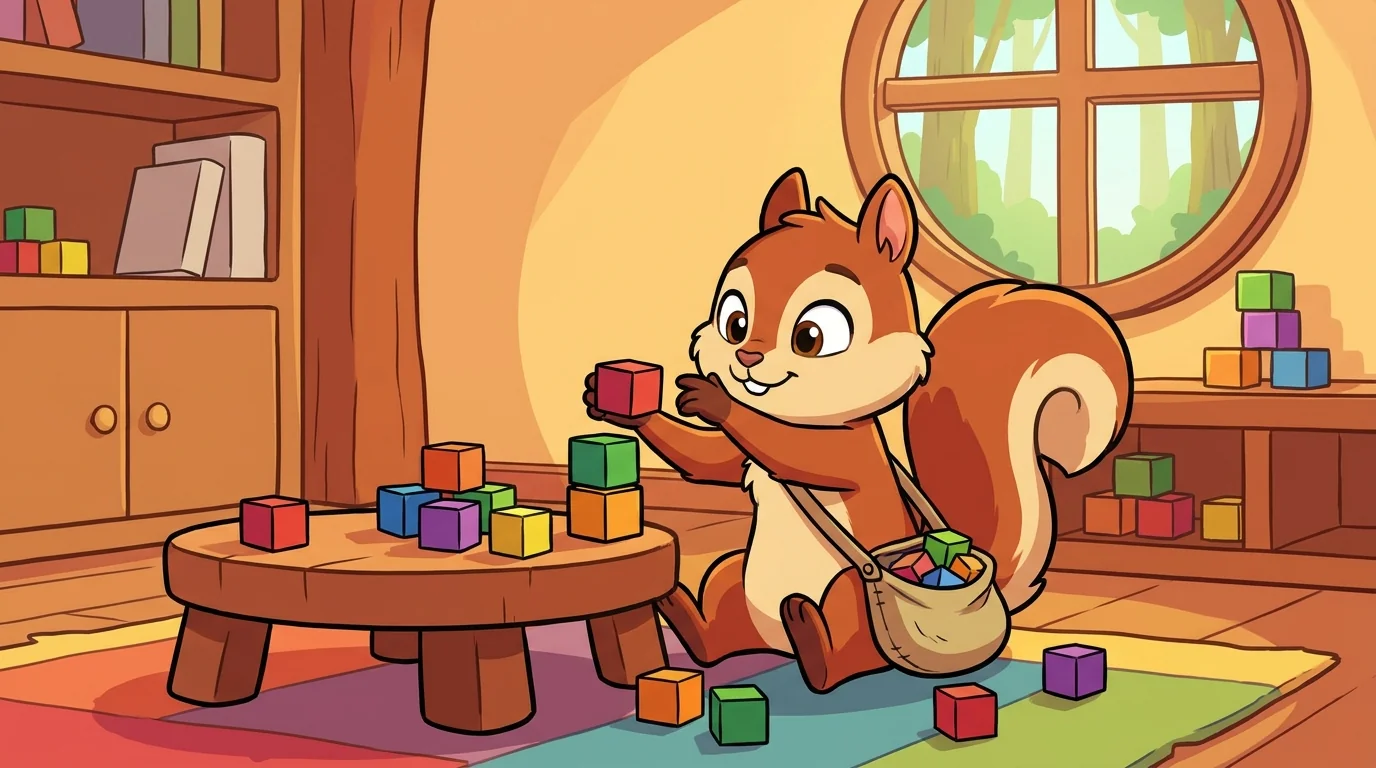
Tally was a squirrel. She was small, but quick. Her fur was warm russet and cream. She always carried a little pouch. Inside were small wooden cubes. Each cube was a different color. Tally loved to stack them. She stacked them in all sorts of ways. Her eyes moved fast. She was always figuring things out.
She used her cubes to show how to count. Not just one, two, three. She showed how to count arrangements. She built a small stack of cubes. Each stack was a different way to arrange things. This was her special power. It was called *combinatorics*. It meant counting all the ways things could be put together. You didn't have to list every single way. The math did the counting for you.

Tally held up two tiny shirts. One was blue. One was red. "Okay," she chirped. "Two shirts." She set them down carefully. Then she showed four tiny pairs of pants. Green, yellow, purple, orange. "Four pants!" she said. "How many outfits can we make?"
She didn't start listing them. She just tapped her paw. "Two shirts times four pants. That's eight outfits total." She smiled. "This is the *multiplication rule*. If you have choices for a first step, and choices for a second step, you multiply them. That tells you all the ways."
She picked up three cubes. Red, blue, green. "What if order matters?" she asked. She lined them up: Red, Blue, Green. Then Red, Green, Blue. Then Blue, Red, Green. She kept going. She made six different lines. "See? The order changed each time."

"This is a *permutation*," she explained. "It's when the order of things is important." She stacked the cubes again. "For three different things, there are three times two times one ways to arrange them. That's six ways." She made a quick stack. "We call that 'three factorial.' It's written as 3!."
Tally then picked up five cubes. Red, blue, green, yellow, purple. She put them in a tiny basket. "Now, what if order doesn't matter?" she asked. "We just want to choose three cubes from these five."
She pulled out red, blue, green. "Okay, one choice." She put them back. Then she pulled out blue, green, yellow. "Another choice." She kept choosing groups of three. She didn't care if she picked red first or green first. Just which three cubes ended up together. "These are *combinations*," she said. "The order doesn't matter here. You just pick a group." She showed ten different groups of three cubes. "There are ten ways to choose three cubes from five. Even though the order doesn't matter, there's still a way to count it."

Tally never made counting sound hard. She never made it sound like only smart people could do it. "It's not hard," she always said. "It's just systematic multiplication. You don't have to list every single way."
She taught simple rules: Multiplication rule: Choices for step one times choices for step two. *Permutations: Order matters. Use factorials. *Combinations: Order doesn't matter. Use adjusted factorials. *Factorial: Like 3! means 3 × 2 × 1. *Pascal's triangle: A neat pattern that helps with combinations. *Counting via cases*: Sometimes you break a big problem into smaller parts. Then you add them up.
Tally grew up in a small village. Her family had a special job. They were the market-arrangers. They set up all the market stalls. They didn't just dump things out. Oh no. They thought about how many ways to show things. How many ways could the nuts be stacked? How many ways could the berries be lined up? Tally watched them. She learned their ways. She saw patterns everywhere.
When she was older, she walked to DiscreteQuest. It was a long journey. She finally met the mentor. The mentor was very wise. "What is *combinatorics*?" the mentor asked.

Tally held up her pouch of cubes. She made a quick stack. "It's counting arrangements," she said. "But you do it in a smart way. You use the *multiplication rule. You use permutations. You use combinations*." She tapped the stack. "The math does the counting. You don't have to list them all."
The mentor smiled. "You are appointed," the mentor said.
Tally still says it often. "It is not hard. It is systematic multiplication. You don't have to list each way."
The cubes stack in another arrangement.
The DiscreteQuest ensemble
Tally the Pattern-Counter is part of DiscreteQuest's distributed-narrative cast. Each character embodies a different curricular primitive; together they teach the full subject.
-

Sortie the Set-Curator
Sets, subsets, set operations (union, intersection, difference)
-

Verity the Truth-Tester
Propositional logic, truth tables, AND/OR/NOT operators
-

Wander the Bridge-Walker
Graph theory — Eulerian paths, Hamiltonian paths, connectivity
-

Coil the Self-Reference
Recursion and sequences (Fibonacci, factorials, recursive patterns)
-

Prime the Indivisible
Number theory — primes, factorization, modular arithmetic
-

Cubby the Cubby-Keeper
The pigeonhole principle — when there are more things than places, at least one place must hold two
-

Swatch the Border-Painter
Graph coloring — coloring connected things so no two neighbors match, with the fewest colors
-

Marshal the Line-Arranger
Permutations — counting arrangements where order matters (factorials, ordered choices)
-

Twoby the Pair-Matcher
Parity and invariant arguments — even/odd pairing that proves what's possible
-

Surge the Growth-Racer
Order of growth — how the work scales as a problem gets bigger