Twin Knights of Fork Hill
The FORK — attacking two pieces at once with a single move; the knight's signature double-threat
Press play to listen along. The line being read lights up as you go.
Show full transcript
Loading transcript…
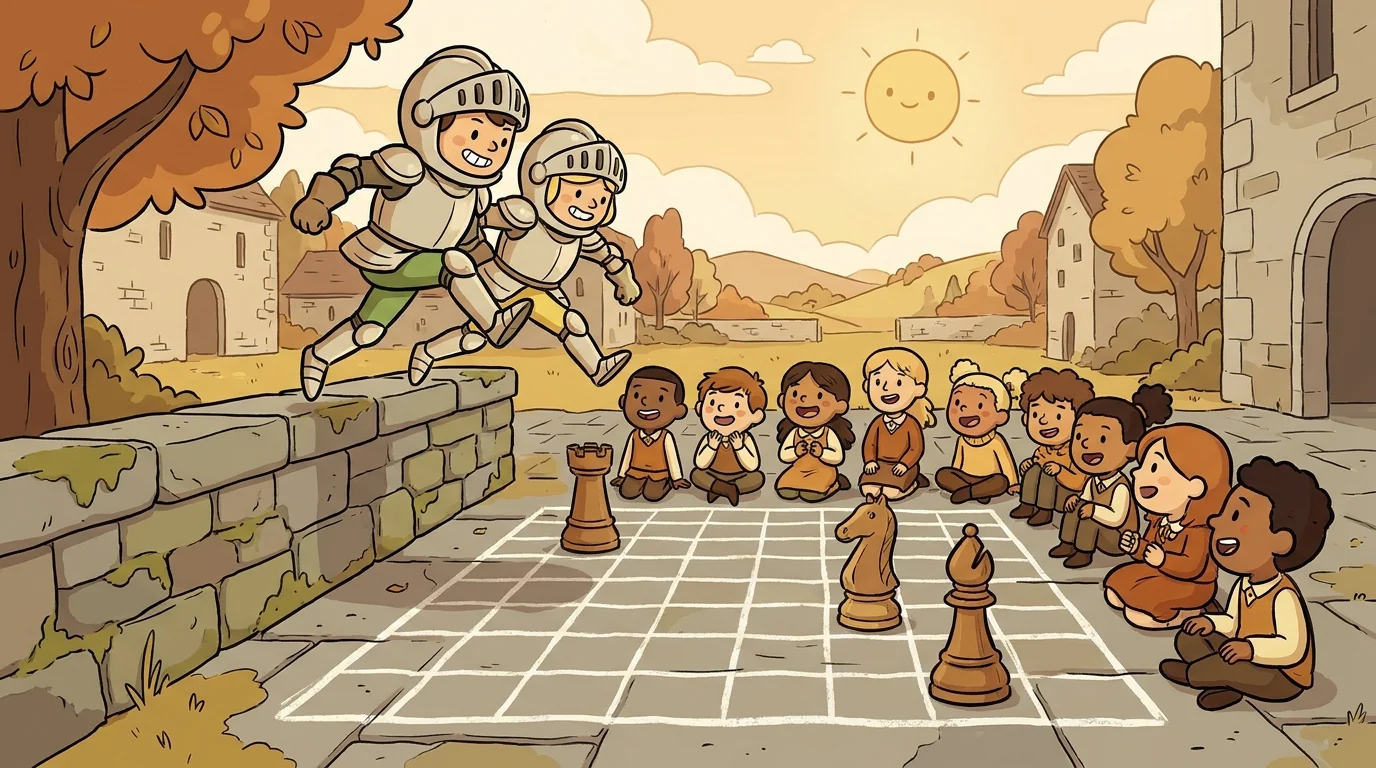
The academy training-yard has a low stone wall along one side, about waist-high to the children. The twin knights of Fork Hill are standing on top of it. They are not supposed to be standing on top of it. Captain Castle has, at some point, told them this. They have, with great politeness and great enthusiasm, ignored him.
Down on the flagstones below them, a class of nine children is sitting in a half-circle, looking up. On the flagstones, between the children and the wall, somebody has chalked an enormous chessboard. There are two wooden pieces on it — a rook on one corner, a bishop on the other. The knights are surveying the board from the wall the way two cats survey a kitchen.
"You see one target," says Knight One.
"We see two," says Knight Two.
"You walk," says Knight One.
"We jump," says Knight Two.
"Watch."
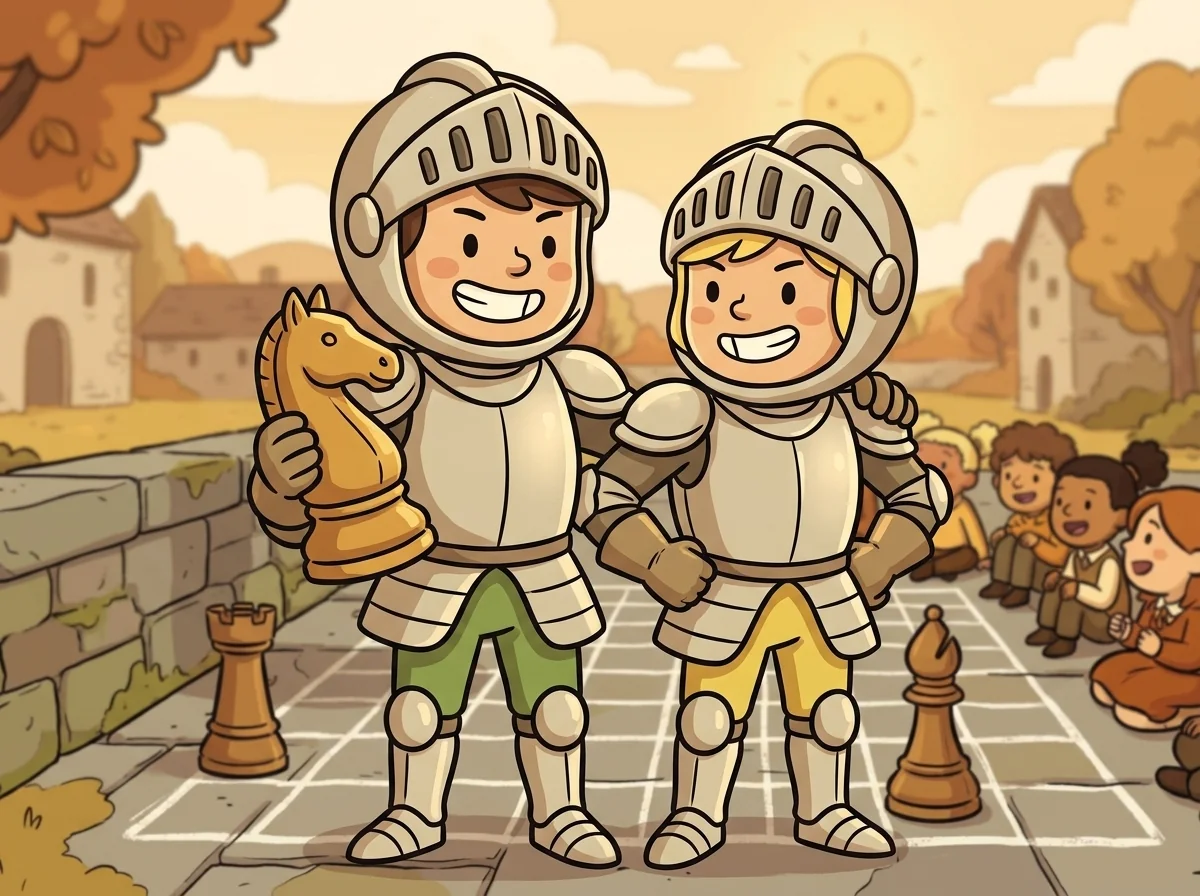
They jump. Both at once. The same instant. The same height. They land, lightly, on the same chalk-drawn square in the middle of the board — a perfect knight-move from both the rook and the bishop. They land so close together that the children, watching, cannot at first tell that there are two of them. One of them, slightly taller, is in armoured leggings the colour of summer leaves. The other, slightly shorter, is in armoured leggings the colour of summer pears. Both of them are grinning.
A child in the front row says, "Did you — both —"
"Yes," say the knights, together.
"That's the fork," says Knight One. He gestures behind himself, without looking, towards the rook. "We are attacking the rook."
"And the bishop," says Knight Two. He gestures behind himself, also without looking, towards the bishop. "We are attacking the bishop."
"At the same time."
"With one move."
"It's a fork!" they say together, as if they cannot help themselves. "It's always a fork!"
Captain Castle, watching from a safe distance, sighs. He has been watching them deliver this line for two years now. It has not stopped being effective. The children are leaning forward. The children always lean forward when the knights leap.
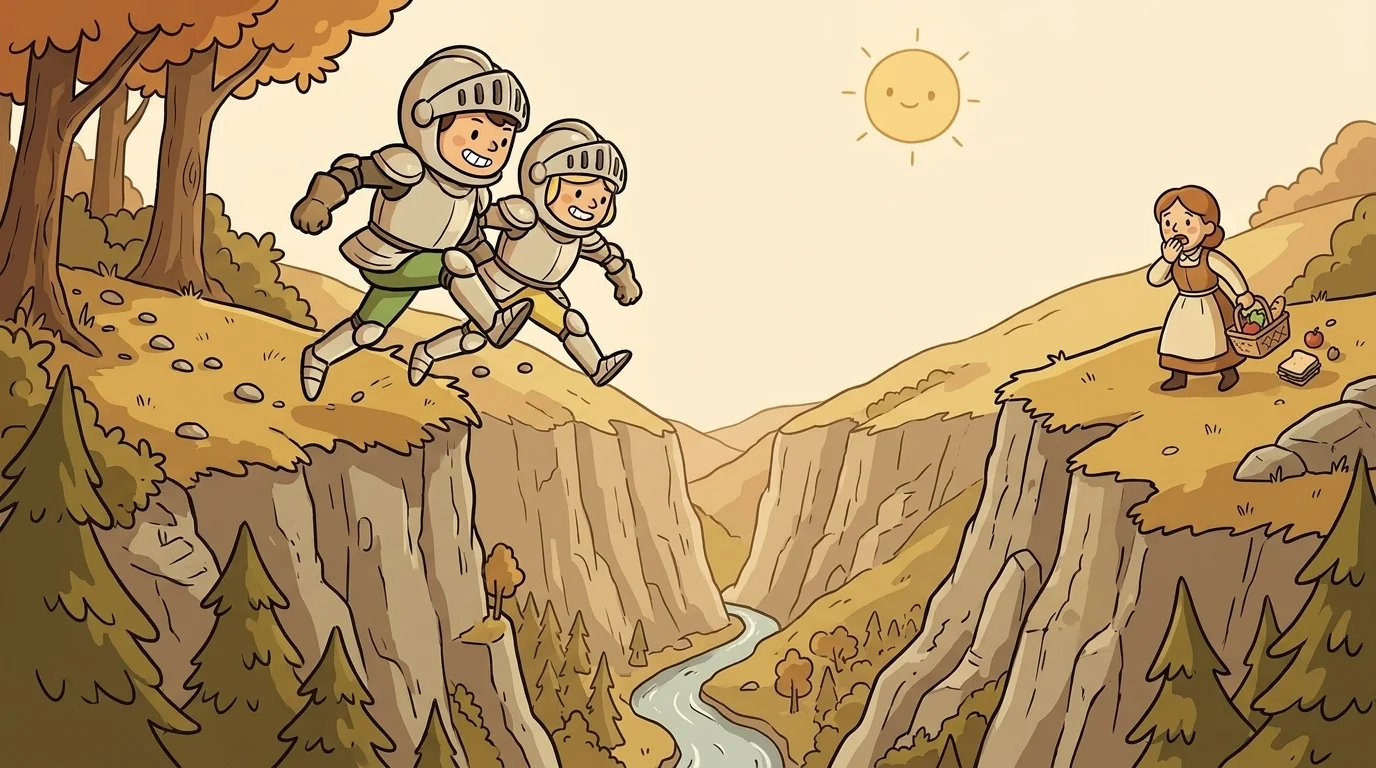
They were not always at the academy. They were, for a long time, on Fork Hill.
Fork Hill is a hill in the eastern part of the white-board kingdom that is shaped, when seen from the air or from a low-flying bird's perspective, like a kitchen fork. Two prongs, a stretch of saddle between them, and a long handle leading down to the valley. The prongs are about a kilometre apart. The saddle between them dips sharply in the middle, with a stream at the bottom that runs cold even in summer.
The road went around the hill, naturally. Anybody sensible who wanted to get from one prong to the other walked the long way. It took an hour. It was, as walks go, fine.
The twin knights did not walk the long way. They learned, before they learned anything else useful, how to jump.
The story their mother tells (it is her favourite story; she has told it many times) goes like this. They were six years old. They climbed the eastern prong with their lunches in their hands, took a long look across the saddle, and just went. Not a leap of faith; the hill had taught them how. They had spent every day for a year throwing stones and watching them arc. They knew the distance. They knew the wind. They knew that the brook at the bottom of the saddle had a smooth flat rock that you could land on if you came down at exactly the right angle.
Their mother did not learn about the jump until the twins came home for dinner. She was peeling apples.
The first knight said, "We went to the west prong today."
The second knight said, "We did not take the road."
Their mother set down the knife. She asked, very calmly, how they had gotten there.
The first knight said, "We jumped."
The second knight said, "It was very fast."
She did not, to her credit, faint.
She did, however, make them sit down at the table and walk her through, very slowly, every part of the jump. The takeoff. The arc. The landing. (The rock in the brook.) She asked them, when they were done, if they could promise to do it the same way every time. They both said yes. She believed them. She had to.
By the time they were ten, the twin knights could jump from one prong to the other in either direction. They could jump over obstacles in between — a low-flying bird, a wandering goat, a very tall person walking through the saddle. They could jump from a standing start. They could jump while carrying lunch. They could land on the rock without scuffing it.
By the time they were fifteen, they had figured out something more interesting.
They had figured out that, on certain days, when the wind was just right, they could jump in two directions at once.
They had been practising it, in secret, for nearly a year before the scout came.
The trick required two people leaping at the exact same moment from the exact same spot, going to two different landing places, and not landing in the brook by mistake. It required practice. It required communication. It required, more than anything, twins.
What they realised, over hundreds of practice jumps, was a quiet thing.
If you take off from the right place, you can threaten two places at once.
You don't need to be in both places. You only need to be able to reach both. The threat — the readiness — is the thing.
They called it, with the kind of teenage seriousness that doesn't survive into adulthood, the fork. (You can see, perhaps, where this is going.)
The kingdom's chess scouts came around at the start of the next spring. This was during the reign of King Pumble, who had just instituted a youth programme for unusual movers. The scout was a polite older woman named Brindle, who wore a long grey travelling-coat and carried a small folded chessboard in her bag. She arrived at Fork Hill on foot and asked, at the cottage door, whether the children of the house might be available to demonstrate whatever it was they were said to be doing on the prongs.
Their mother, peeling apples again, said yes. She always said yes by now. The twins were sixteen.
They took Brindle up to the eastern prong. They asked her where she wanted them to land. She pointed to two flat stones on the western prong — one each, about ten paces apart. The knights nodded. They took off together. They landed on the two stones. They turned, in unison, and waved.
Brindle did not speak for a moment.
Then she said, "Have either of you ever played chess?"
The first knight said, "No."
The second knight said, "Is that the one with the board?"
Brindle said, quietly, "Yes. It is the one with the board."
She brought them down to the capital that month. She walked with them the whole way, on foot, and at the gates of the city she handed them off to the academy master, who watched them play their first three games and then said, to nobody in particular, what he had said about so many of them: "Oh. Good. Another pair."
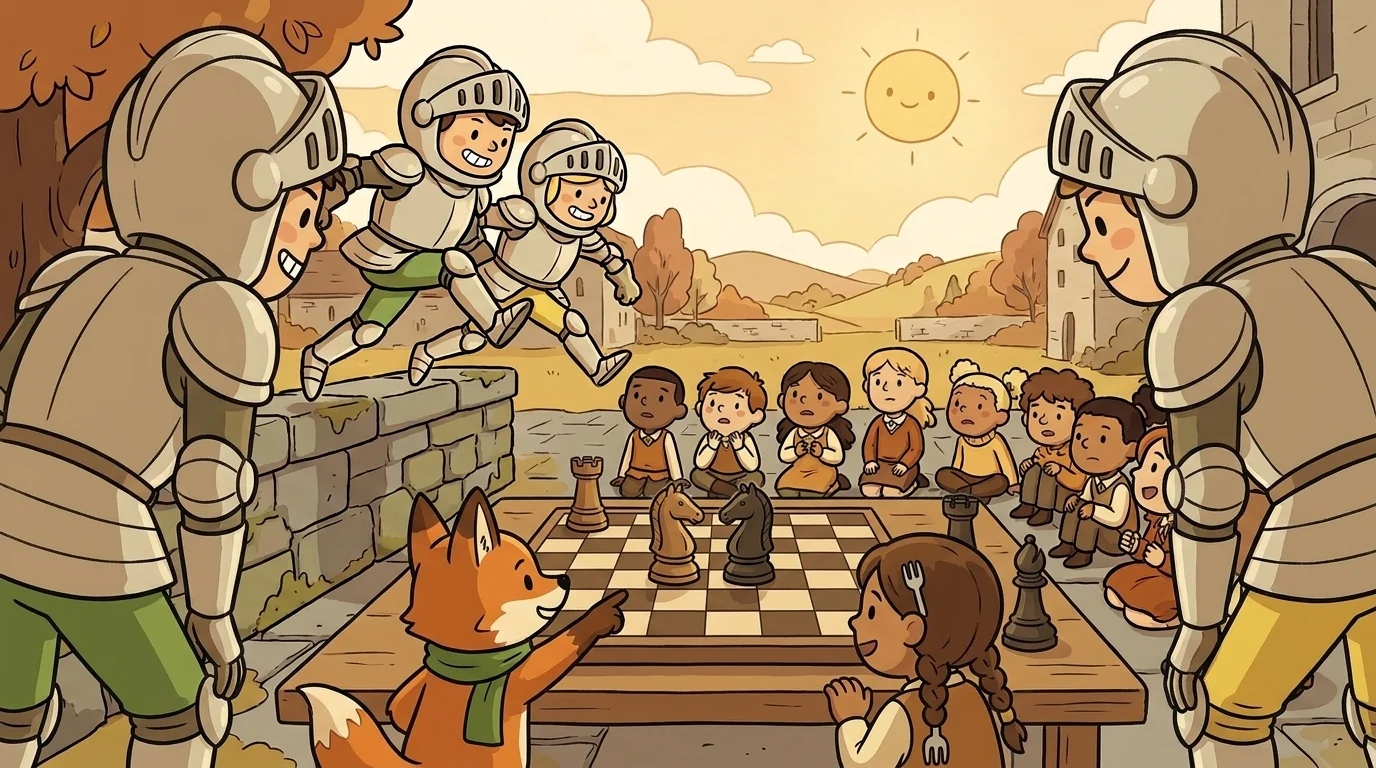
They have been at the academy for two years now and they have, in that time, taught more students to spot a fork than the entire previous decade managed. They teach in alternating sentences. They never trip over each other. They never confuse the children. (The children figure out the pattern within the first lesson, and from then on they expect it, and it works for them.)
This afternoon, after the demonstration on the wall, they walk among the children. They have set up a smaller board on a low table. Two knights — wooden ones, this time — are placed on the board. A rook and a bishop sit nearby.
The fox in the green scarf — Inkling, who is everybody's favourite — looks at the position. She points, very carefully, to a square in the middle of the board.
"If a knight moves there," she says, "it attacks the rook and the bishop."
"Yes," says Knight One.
"Both at once," says Knight Two.
"You can only save one."
"Pick the one you can save."
"Don't pick the one to defend."
A girl with a fork-pin in her hair (this is Adela Marrowstone's niece, though nobody yet knows that) asks, "What if the rook just moves? Doesn't that solve it?"
The knights look at her. They look at each other. They look back at her.
"Yes," says Knight One.
"That solves it," says Knight Two. "Then we take the bishop."
"You traded a defending move for a captured piece."
"You did not get away free."
"That is how a fork works."
Sir Pinwell, in the doorway, watches without comment. The knights have, twice now during this lesson, jumped over his neat row of demonstration pieces on the side table — they did not need to, the table was not in their way, they did it because they could. Pinwell has straightened the row twice. He has not said a word. The knights know he has straightened the row. They appreciate him. (They have, in fact, recently learned his name, which they took as a sign of growing maturity. They are still proud of this.)
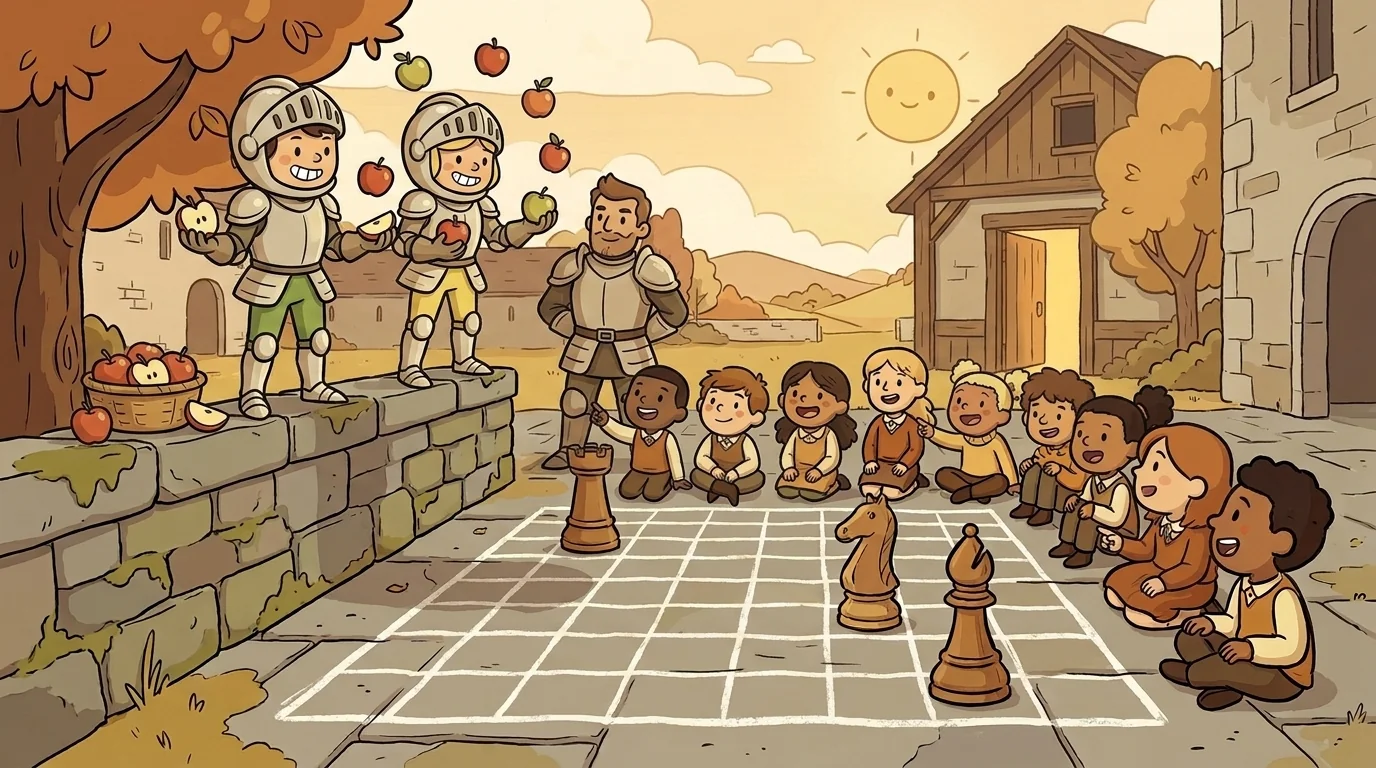
After the lesson, Captain Castle finds the twin knights eating lunch on top of the kitchen-yard wall. They are eating apple slices, which is what the academy chef gives them every day at this hour, because (as the chef has explained) apples are the only food the knights cannot juggle while jumping.
Castle stands below them, hands clasped behind his back, looking up.
"Well done with the demonstration," he says.
"Thank you," says Knight One.
"It was easy," says Knight Two.
"Most things are."
"For us."
Castle nods. He has heard this before. He says, after a moment, "Pinwell mentioned. The row."
"We knew," say the knights, together.
"He did not mind?"
"He minded."
"He always minds."
"He straightens it again."
"He likes straightening it."
"He should not be deprived of the joy."
Castle considers this. He has, over the past two years, learned that arguing with the twin knights is like arguing with the wind on Fork Hill: technically possible, but unproductive. He says, instead, "There is a student who wants to learn the fork. She is eight years old. She has been waiting all morning. Will one of you come?"
The knights look at each other.
"Both of us," says Knight One.
"Always both," says Knight Two.
"You see one target."
"We see two."
They jump down from the wall in perfect unison. They land lightly on the flagstones. They walk together towards the academy hall, in step, the way they have walked together since they were old enough to walk. Castle follows behind, shaking his head, smiling.
Far away — and they do not know this, but they would be pleased to know — the eastern prong of Fork Hill is, at this hour, catching the afternoon light. The brook is running cold even in summer. The rock at the bottom of the saddle is, as always, smooth and flat and waiting. The twin knights have not been home in fourteen months.
They visit, twice a year, on the anniversary of their first jump. And every time they stand on that eastern prong again, side by side, they feel it rise up in them together — the same fizzing, fearless happiness they felt as six-year-olds, the day they looked across the gap and simply, joyfully, went.
The GambitTales ensemble
Twin Knights of Fork Hill is part of GambitTales's distributed-narrative cast. Each character embodies a different curricular primitive; together they teach the full subject.
-

Sir Pinwell
Pin pattern — freezes pieces along a line
-
Lady Skewer
Skewer pattern — force a valuable piece out of the way
-

Veil & Vow
Discovered attack — step aside to reveal a hidden threat
-
Captain Crossfire
Double attack — one move threatens two targets
-

The Glass Lantern
X-ray attack — light pierces through to the piece behind
-

King Pumble & King Sable
Two kings — librarian and gardener; one step at a time
-
Queen Vesper
Queen — ranger-messenger; any direction, any distance
-

Captain Castle
Mentor + narrator — rook archetype; the mascot who introduces the cast + scaffolds the lesson
-

The Pawn Cohort
Ensemble piece — the four pawn-paired sets (Pawn Patrol + Sienna & Bran + Trotter & Trundle + Gable & Garrett) acting as one in the world layer