
Ember and Cadence
SOUND-SPELLING PAIR — *Cadence breaks the word into beats. Ember names which vowels are quiet. Together they spell the hardest words by ear.*
Press play to listen along. The line being read lights up as you go.
Show full transcript
Loading transcript…
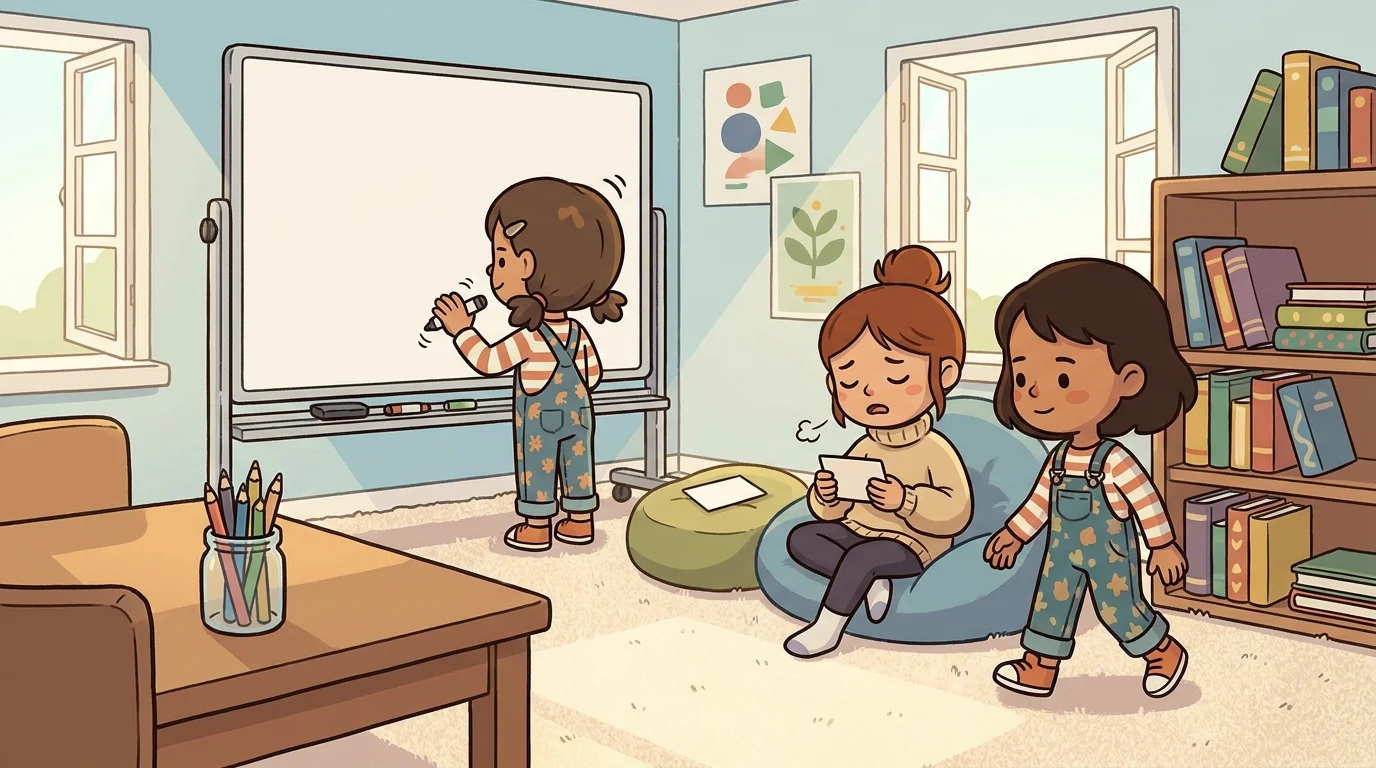
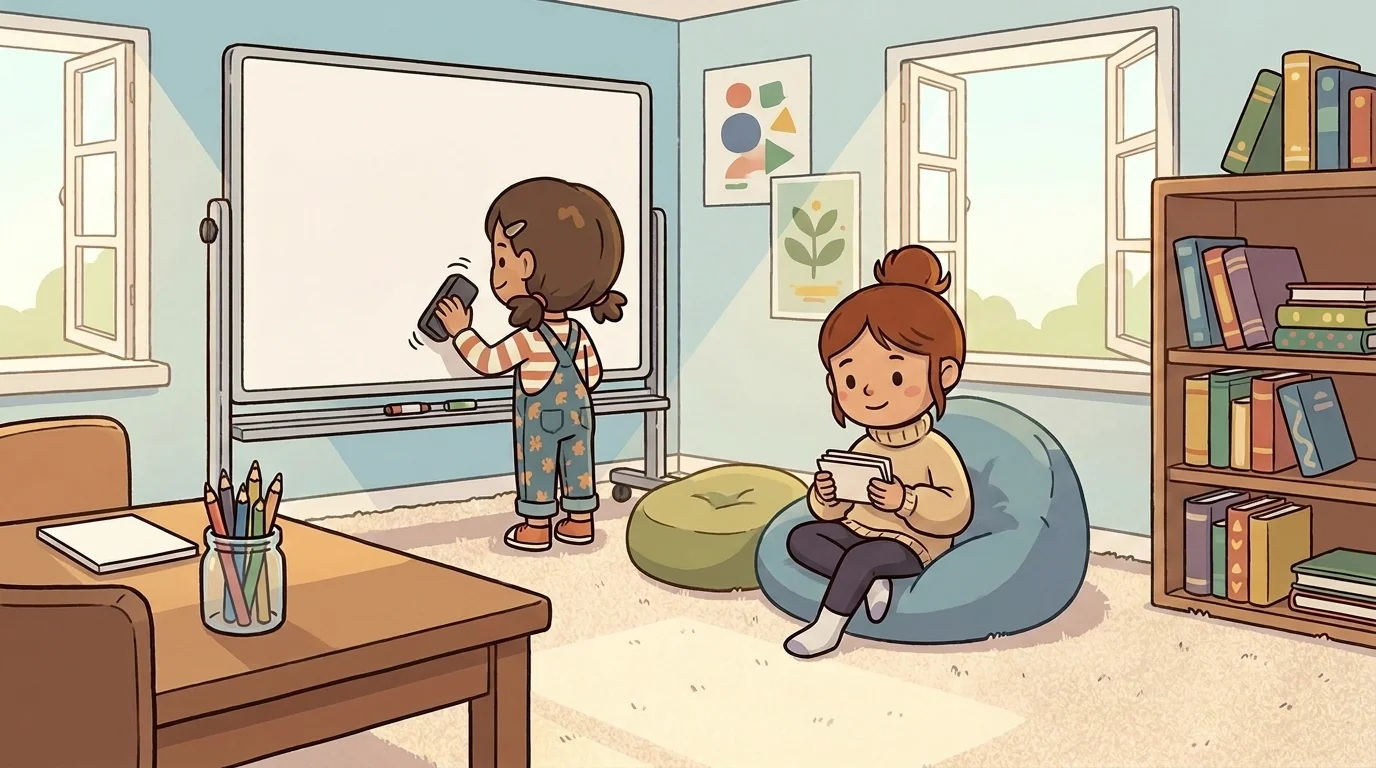
The spelling-bee study room held a particular kind of quiet that morning. It was a soft, deep quiet, the kind that allowed thoughts to settle. Sunlight streamed through the open windows, illuminating dust motes dancing above the plush carpet. A ceramic jar, brimming with sharpened pencils, stood sentinel on the table. Cadence, ever-restless, stood at the whiteboard, tapping a dry-erase marker against her palm. The rhythm seemed to pulse from an internal beat, audible only to her. Ember, meanwhile, sat cross-legged on a beanbag, her gaze fixed on a small index card.
The card bore a single word.
> separate
Ember let out a soft sigh, almost a whisper. "This one," she murmured, a hint of respect in her tone.
Cadence’s tapping ceased. She drifted over, her eyes scanning the word. A small, knowing "ah" escaped her lips. "Ah, yes. This one."
For a month now, these study mornings had been their shared ritual. Cadence was the rhythm-keeper, the one who could break any word into its component syllables, revealing its internal pulse. Ember was the schwa-namer, an expert at finding the elusive, quiet vowels that often hid within unstressed beats. Separate was, without question, their favorite case. It was a word notorious for tripping up spellers, precisely because most people tried to spell it exactly as they heard it.
What most people heard sounded something like: SEP-rit. Two distinct sounds, a quick dash between them. That was the common, mistaken spelling: Seprit. Incorrect, every time.
The true word, they knew, contained three syllables. And one of them was a master of disguise.
Cadence pulled the whiteboard closer, the marker now poised. "Want to do it?" she asked, a spark in her eyes.
"Always," Ember replied, pushing herself up from the beanbag.
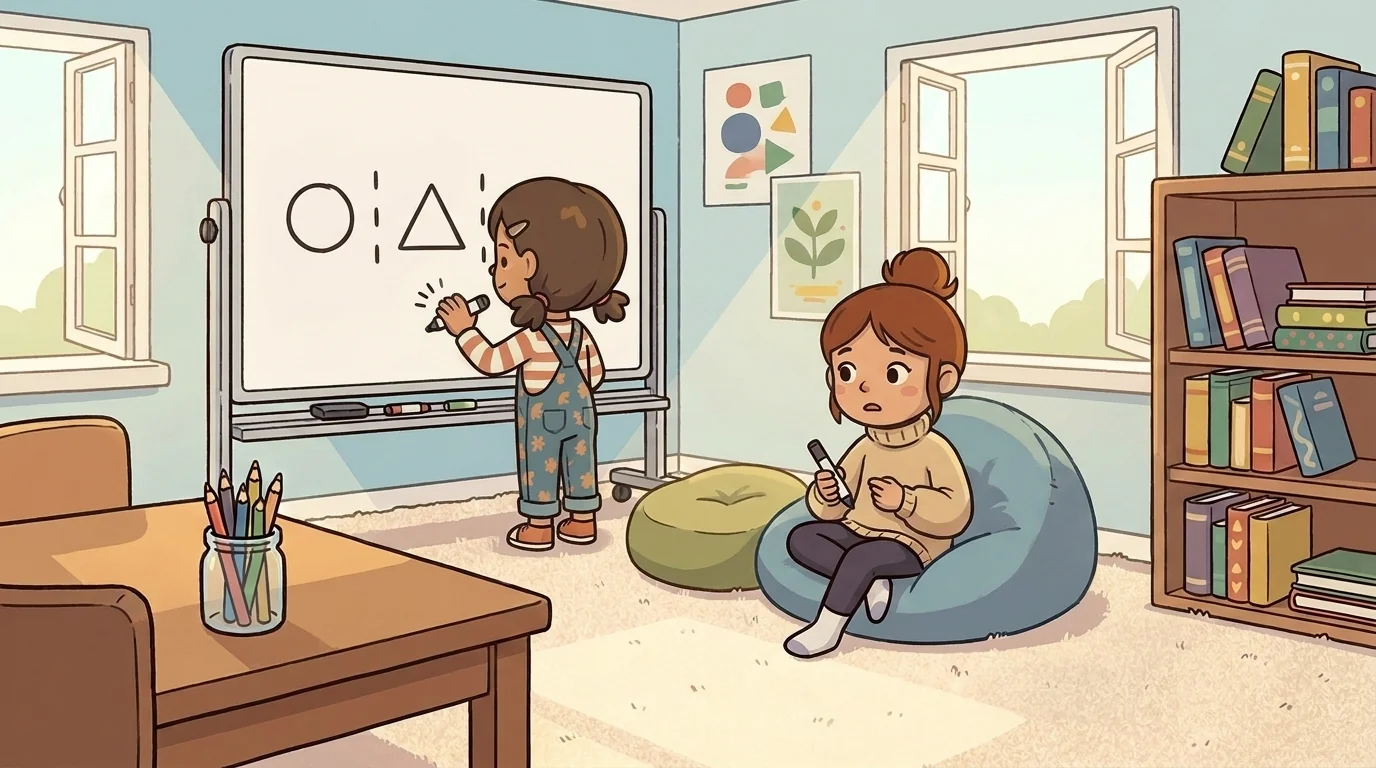
With a flourish, Cadence wrote the word on the board, large and unmistakable: *SEPARATE.* Then she stepped back, tilting her head. The marker resumed its soft, percussive tap against her palm as she counted the invisible beats.
"Three syllables," she stated, her voice firm. "Always three. People want to say two because that middle one is so quiet. But it’s there. Always three."
She drew tiny, precise vertical lines through the word, dividing it visually.
*SEP | A | RATE*
"Beat one — SEP," she articulated, tapping SEP with the marker. "That’s the strong beat. The one your mouth naturally leans on." Her finger moved. "Beat two — A. The almost-silent beat. The *schwa." She tapped the isolated A. "Beat three — RATE. The closing beat." Her marker landed on RATE.*
She turned to Ember, a gesture of handing over the baton. "Three beats. That’s my part. Anyone can hear the rhythm if they just slow down. The trouble is, most people don't slow down. They say it fast — sep-rit — and the middle beat simply falls away. It gets lost in the rush."
Ember nodded, a small, knowing smile playing on her lips. She picked up a smaller marker, the kind used for adding annotations. "And that's where I come in."
"Exactly," Cadence confirmed. "That's where you come in."
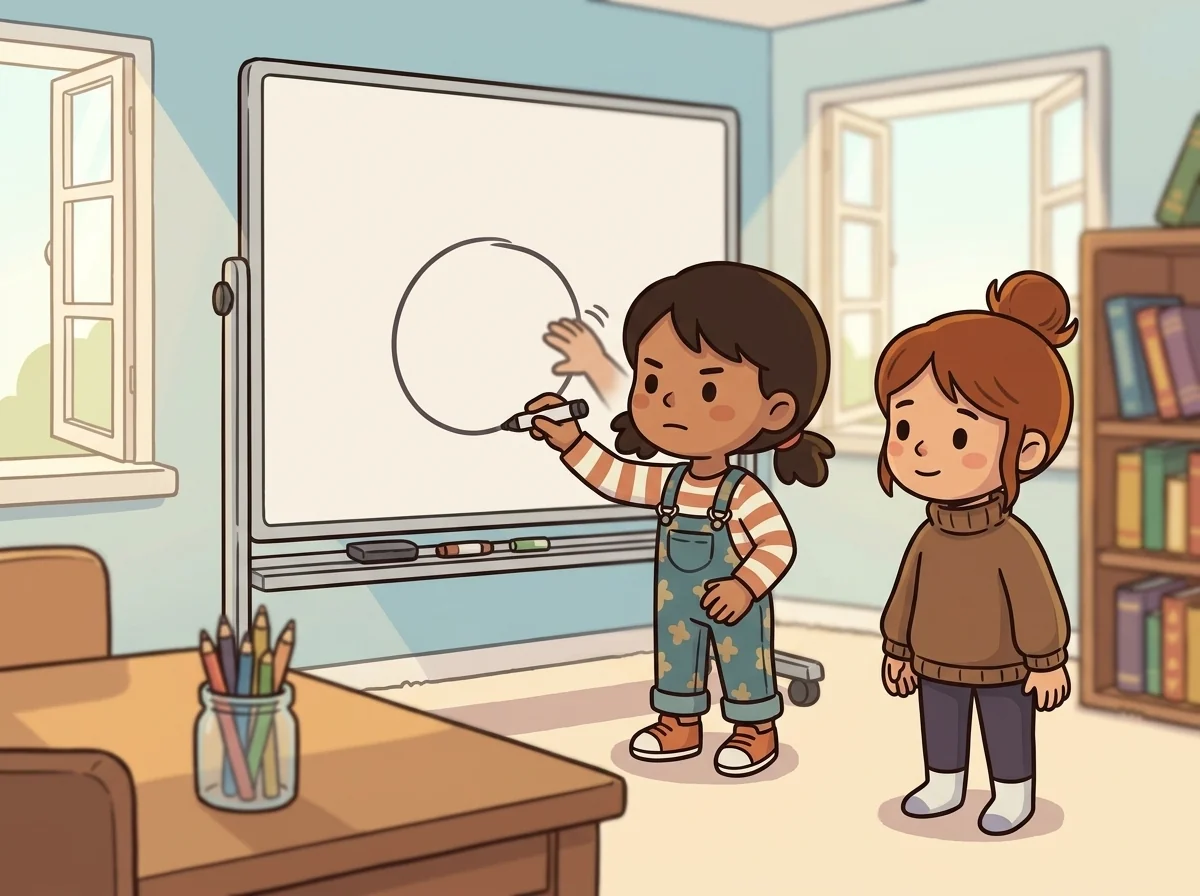
Ember moved to the board. Her hand went directly to the middle letter, the one Cadence had already isolated: the *A.* She circled it with a deliberate motion.
"This letter," Ember began, her voice soft but clear, "is a trickster. It’s the spirit of the English language itself, sometimes. We call it a schwa. It looks like an 'a' here, but it sounds like 'uh.' And the truly tricky part? It can be spelled with any vowel letter — a, e, i, o, or u — depending on the word."
She wrote a small, ethereal *uh in the air just above the A* with her marker. The letter A remained on the board, steadfast. The little 'uh' seemed to float, a transient ghost of sound, in her gesture just above it.
"The schwa is always unstressed. The strong beat in separate is SEP. The middle beat is so quiet your mouth barely registers it. That’s why people misspell separate. They don't perceive that middle vowel as a vowel at all. They hear it as nothing, so they simply leave it out."
She paused, allowing the implication to settle. "But the middle vowel isn't nothing. It’s a schwa. It’s a quiet 'uh.' And in this particular word, that 'uh' sound is spelled with the letter *A.*"
"How do you know which letter?" a new voice asked from the doorway.
Ember and Cadence looked up in unison. A young student stood there, clutching a quiz sheet, her expression a mixture of nervousness and curiosity. She was new to their study mornings, clearly hesitant but drawn by the unfolding lesson.
Ember waved the student in, a welcoming gesture. "Come in. We'll show you."
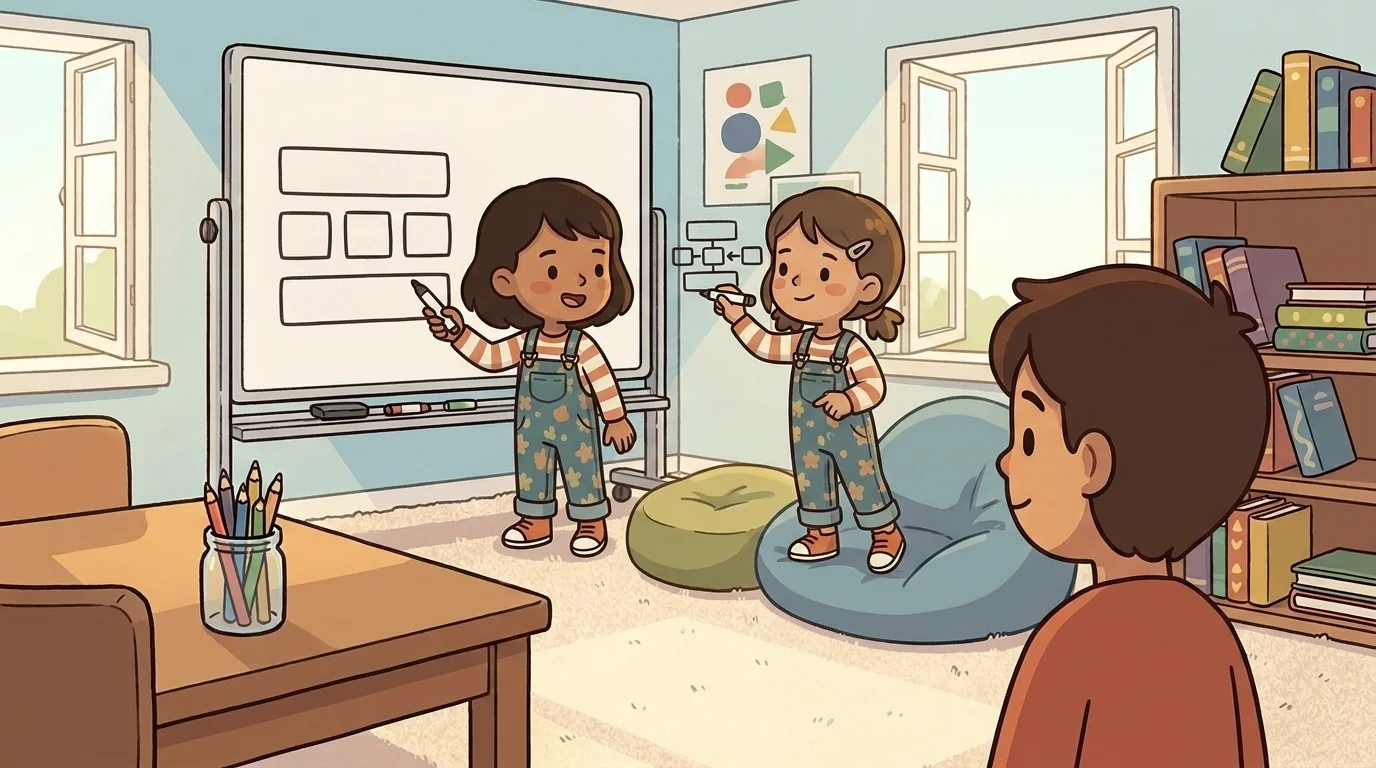
The student took a seat beside the whiteboard, eyes wide. Cadence set her marker down. Ember and Cadence both turned to face her, a practiced, synchronized movement. They had a well-worn routine for when a new student joined mid-case.
"Cadence breaks it down," Ember explained. "I name the schwa. Then, together, we go to the dictionary or the word's root."
Cadence pointed at the three distinct pieces on the board: *SEP | A | RATE.* "I tell you it's three syllables. You can hear it now, right? SEP — A — RATE. Slow it down."
The student tried, her lips forming the sounds carefully. "SEP — A — RATE." Her mouth opened just a tiny bit on the middle beat, a subtle but crucial movement.
"Yes!" Cadence exclaimed, a genuine smile lighting her face. "You heard it. That’s the part most people miss entirely."
Ember took over smoothly. "Now — the middle vowel is a schwa. It sounds like 'uh.' But it absolutely has to be spelled with some vowel letter. The question is which one. That's the part you can’t hear. You have to know it. And you know it from the word's family."
She wrote on the board, a clear demonstration:
*separate ← separation, separator, separable*
"Look at the family," Ember instructed. "In separation, the middle vowel is stressed. You can hear it clearly: sep-uh-RAY-shun. That middle vowel becomes a strong *A sound. That's your vital clue. The schwa in separate is spelled with the letter that's loud* and clear in the rest of the word's family. So, here, the schwa is an A."
The student’s gaze moved from separate to its related words. Her eyes widened slightly as the connection clicked. "So the loud cousin tells you what the quiet one looks like."
Ember grinned, a flash of shared understanding. "That's exactly it. The loud cousin tells you what the quiet one looks like."
Cadence nodded in agreement. "And once you have both — three syllables from me, the loud cousin from her — the word is yours. It can't hide anymore."
The student reached for a pencil from the jar, her movements now more confident. She wrote slowly, carefully forming each letter: *S — E — P — A — R — A — T — E. She whispered the syllables under her breath as she wrote them. SEP — A — RATE.* The middle A landed on the page precisely where it belonged, no longer a ghost.
"Separate," she articulated, a sense of triumph in her voice. "Three syllables. The middle vowel is a schwa. Spelled A because of separation."
Ember clapped softly, a quiet acknowledgment of a lesson well learned. Cadence tapped her marker against her palm, a rhythmic approval.
The student looked at the whiteboard, then at her own paper, then finally at the two of them — the rhythm-keeper and the schwa-namer, the architect of beats and the connoisseur of quiet vowels.
"Can I take the card with me?" she asked, her voice small but hopeful.
"Take it," Cadence said, a generous wave of her hand.
"Practice it tonight," Ember advised. "Say it slow. Tap the beats. Name the schwa. By tomorrow, it'll be in your fingers, a part of you."
The student nodded, a serious expression on her face. She carefully slid the index card into her notebook. She offered a quiet thank you and slipped back out into the hallway, already murmuring SEP — A — RATE to herself, the rhythm taking hold.
The study room settled back into its familiar quiet. Cadence picked up an eraser, beginning to clean the whiteboard with methodical strokes. Ember returned to her beanbag, pulling another card from a small stack. The next case was waiting.
The new card held a single word.
> chocolate
Cadence and Ember exchanged a look. Both of them grinned, a shared understanding passing between them.
"Three syllables," Cadence declared, a familiar cadence in her voice. "And a schwa. Of course."
"Of course," Ember echoed, her eyes already tracing the word's hidden sounds.
They had work to do. The morning was just getting started. The rhythm-keeper and the schwa-namer were ready to spell anything, together.
The QuillSpell ensemble
Ember and Cadence is part of QuillSpell's distributed-narrative cast. Each character embodies a different curricular primitive; together they teach the full subject.
-

Etyma
Latin Quarter — Latin roots (port, scrib, dict, vis, audi, port)
-

Sophia
Greek Acropolis — Greek roots (bio, geo, photo, log, graph, phon)
-

Birch
Germanic / Old English Grove — short, punchy Anglo-Saxon roots (mouth, hand, foot, hear, see, walk)
-

Saga
Old Norse Longhouse — northern roots (sky, take, gift, raise, weak, scant)
-

Margaux
French Chateau — Norman-French roots (royal, chef, ballet, garage, hotel, courage)
-

Zayn
Arabic Oasis — Arabic-origin English loans (algebra, algorithm, alchemy, zenith, sugar, cotton)
-

Hush
Silent-letter clan (kn-, gn-, wr-, mb, gh, pn-, ps-)
-

Twin
Double-consonant rule (running, beginning, hopped, planned — short-vowel-CVC + suffix)
-

Ember
Schwa-keeper (the unstressed-vowel "uh" — `about`, `pencil`, `lemon`, `circus`, `medium`)
-

Wren
Vowel-team duos (ai, ea, ee, oa, ow, ie, oi) — "when two vowels go walking"
-

Affix
Suffix-stack guardian (root + suffix + suffix: nation → national → nationalize → nationalization)
-

Cadence
Syllable-rhythm master (di-vid-ing words for spelling: VC/CV, V/CV, syl-lab-i-fi-ca-tion)