
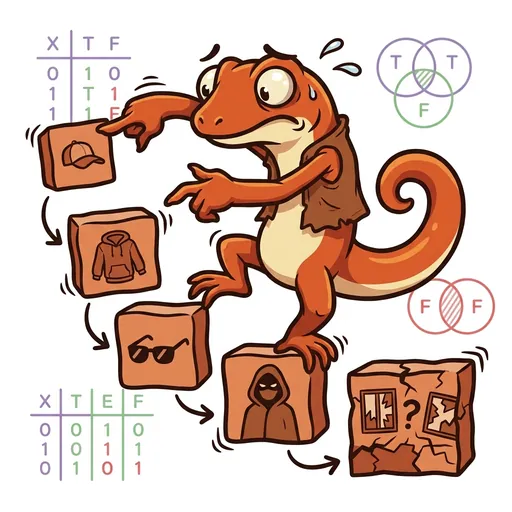
Slippery-Slope Sam
SLIPPERY SLOPE — *chaining dire consequences from a small first step.* The fallacy of *claiming that a small initial action will inevitably lead to extreme outcomes via a chain of consequences, without justification for the inevitability.*
Listen along — Slippery-Slope Sam
Loading audio…
Press play to listen along. The line being read lights up as you go.
Show full transcript
Loading transcript…
Chapter 7 — Slippery-Slope Sam and the Domino-Chain
The classroom buzzed with the usual Friday afternoon energy, a low hum of anticipation for the weekend. Ms. Anya, their social studies teacher, tapped her pen against the whiteboard. “Alright, class,” she said, her voice cutting through the noise like a bell. “Let’s talk about the new school policy proposal. The student council is considering allowing hats in class.”
A ripple of excitement went through the room. A few kids cheered. Others exchanged quick, hopeful glances. But Sam, a small salamander with bright-orange-and-cream skin, sat stiffly at his desk. His quick, anxious eyes darted around the room, taking in every face, every reaction. He was smaller than most of his classmates, and his movements were always precise, almost twitchy. He clutched his pencil so tightly his knuckles looked white.
“Now, before we vote,” Ms. Anya continued, “let’s hear some arguments for and against. Maya, you first.”
Maya, a tall, confident girl, spoke clearly. “It’s about expression, Ms. Anya. And comfort. If we’re allowed to wear hats, it doesn’t hurt anyone. It just makes us feel more ourselves.”
A few more students chimed in, mostly agreeing with Maya. The atmosphere felt light, optimistic. Then, Sam’s hand shot up, trembling slightly.
Ms. Anya smiled gently. “Yes, Sam?”
Sam cleared his throat. His voice, usually a quiet murmur, came out a little louder than he intended, edged with a frantic urgency. “But… but if we allow hats,” he began, his eyes wide, “then everyone will want to wear hoodies. And then they’ll pull the hoods up, right? And then, because they’re hiding their faces, they’ll want to wear sunglasses too.” He paused, taking a shallow breath. “And then, before you know it, everyone will be wearing fully concealing clothing. We won’t be able to identify anyone!”
A few kids chuckled, but Sam didn’t notice. He was lost in his own terrifying vision. “And then,” he pressed on, his voice rising, “because no one can be identified, they’ll start committing crimes! Like stealing lunch money, or cheating on tests without getting caught! It’ll be chaos! Total disaster!”
The room went quiet. Sam sagged back in his seat, breathless, convinced he had just saved them all from anarchy. His small body trembled.
Ms. Anya walked to Sam’s desk. She didn’t scold him or laugh. Her voice was calm, steady. “Sam,” she said, “I hear how worried you are. It sounds like you’re picturing a whole chain of events, one leading to the next, until things get really bad.”
Sam nodded, still wide-eyed. “It’s just obvious, isn’t it? If we let one thing happen, everything else just follows.”
“It can certainly feel that way,” Ms. Anya agreed. She turned to the class. “Sam has just shown us something important. Sometimes, when we’re scared, our minds can take a small change and imagine it spiraling into a huge disaster. It’s like a line of dominoes, where knocking over the first one means all the rest will fall.” She picked up a marker. “Let’s look at Sam’s domino chain. What was the first step he mentioned?”
“Hats in class,” Maya offered.
“Good,” Ms. Anya wrote it on the board: 1. Hats in class. “And what was the very next domino, Sam?”
Sam swallowed. “Then hoodies.”
Ms. Anya wrote: 2. Then hoodies. “Now,” she said, looking at the class, “here’s the skill we need. We don’t just assume the next domino will fall. We check each link. Is it actually likely that if we let students wear hats, everyone will immediately want to wear hoodies?”
A few students shook their heads. “Not necessarily,” Leo said. “Lots of kids wear hats outside and don’t wear hoodies.”
“Exactly,” Ms. Anya said. “What evidence do we have that wearing a hat causes someone to want a hoodie? Or that wearing a hoodie causes someone to want sunglasses?” She looked at Sam. “When I get scared, Sam, my brain does this too. It connects things that aren’t really connected, just because it wants to warn me about danger. But most of the time, those imagined chains break at the first or second step when you look for evidence.”
Sam looked down at his desk, his anxiety easing just a fraction. “So… it’s not a guarantee?”
“No, it’s not,” Ms. Anya confirmed. “The skill is checking each link. Is this step inevitable? Why? What evidence supports that inevitability?” She pointed to the board. “Does allowing hats mean sunglasses are inevitable? Or fully concealing clothing? Or, worst of all, crimes?”
The class murmured, now seeing the gaps in Sam’s chain.
“Sometimes,” Ms. Anya added, “a chain is real. Sometimes, one thing really does lead to another, and setting a precedent matters. But even then, we need evidence for that inevitability, not just an assumption.” She looked at Sam. “You’re not a villain for thinking this way, Sam. You’re just someone who gets scared, and your brain tries to protect you by predicting the worst. We all do this when we’re scared.”
Sam nodded slowly. The idea that his fear was the engine, not some logical certainty, was new. He still felt a little anxious, but the crushing weight of impending disaster had lifted. He understood now. It wasn’t about blaming himself or others. It was about carefully checking each step with evidence. Most chains, he realized, really did break.
The LogicQuest ensemble
Slippery-Slope Sam is part of LogicQuest's distributed-narrative cast. Each character embodies a different curricular primitive; together they teach the full subject.
-
Ad Hominem Hannibal
Attacking the arguer, not the argument
-
Strawman Stella
Misrepresenting the opponent's argument
-
Appeal-to-Authority Auntie
Citing irrelevant / unqualified authority as proof
-

Red-Herring Reggie
Deflecting to an irrelevant topic
-

Circular-Reasoning Cici
Assuming the conclusion in the premise
-
False-Dichotomy Fia
Presenting only two options when more exist
-

Bandwagon Bran
Truth-by-popularity
-
Sunk-Cost Cyril
Refusing to change course because of past investment
-

Whataboutism Wanda
Deflecting criticism via someone else's wrongdoing
-

Equivocator Eva
Sliding a word's meaning mid-argument
-

Tu-Quoque Tessa
"You too!" — dismissing criticism by accusing the critic of the same thing
-

Modus-Ponens Mo
If P then Q; P; ∴ Q
-

Modus-Tollens Tara
If P then Q; ¬Q; ∴ ¬P
-

Syllogism Solon
All M are P; all S are M; ∴ all S are P
-
Disjunctive-Syllogism Dior
P ∨ Q; ¬P; ∴ Q