
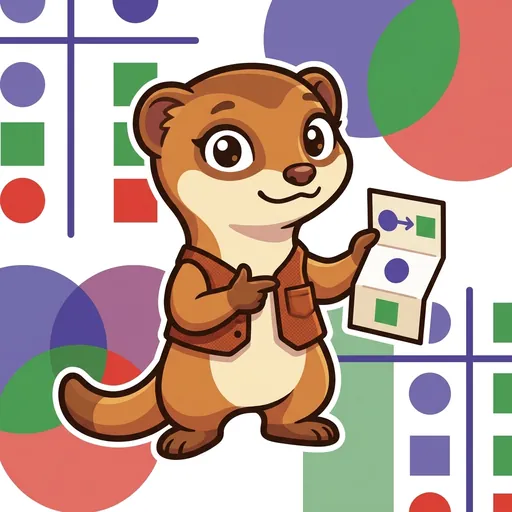
Modus-Ponens Mo
MODUS PONENS — If P then Q; P; therefore Q. The most foundational valid inference form in propositional logic — the structure of "if-then" reasoning when the antecedent is true.
Listen along — Modus-Ponens Mo
Loading audio…
Press play to listen along. The line being read lights up as you go.
Show full transcript
Loading transcript…
Chapter 1 — Modus-Ponens Mo and the If-Then Card
The muddy paw-print by the door told Mo everything before she’d even set down her satchel.
She crouched, looked at it, and smiled. A younger student named Bree was watching from the bench, arms folded, unimpressed.
“It’s just a footprint,” Bree said.
“It’s a promise coming true,” Mo said. She unfolded a small worn card from her vest-pocket, three sections written in careful ink. “Here’s a promise this whole village keeps. If it rains, the front path turns to mud. Everybody knows it. It’s just true here.” She tapped the top of the card, then the middle. “And here’s what I can see — mud, on a paw, walked in through that door.” She tapped the bottom line. “So?”
Bree squinted. “So… it rained.”
“So it rained,” Mo agreed. “I didn’t guess. I didn’t hope. The rain had to have happened — because the promise is true and the mud is real, and once both of those are sitting on the table, the ending arrives on its own. You couldn’t stop it if you tried.”
Bree looked at the paw-print, then out the window at the dry, bright morning, and her mouth fell open a little. It had rained before dawn. Mo hadn’t been awake to see it. She’d read it straight off the floor.
“That,” Mo said, tucking the card away, “is the oldest, plainest move there is. Two true things click together and a third one falls out the bottom, whether anybody’s looking or not.”
Mo had learned the click when she was very small, and it had frightened her at first.
Her family were the village’s deal-keepers — the mongooses who wrote down every agreement so nobody could squabble over it later. If you mend the fence, you get three baskets of grain. Plain trades, honored by everyone. Mo used to sit under the table while the grown-ups talked, and one evening a man came to the door swinging three empty baskets, coming to collect.
Little Mo felt something snap into place in her chest — a cold, certain, I-already-know feeling — before a single word was spoken.
“He mended the Harrow fence,” she blurted.
The room went quiet. Her grandmother looked down at her. “Nobody told you that, little one.”
“The card says whoever mends a fence gets three baskets,” Mo said, and her voice wobbled, because being that sure was scary. “He’s carrying three empty baskets to fill. So he must have done the mending. It just… it has to be.”
Her grandmother didn’t laugh, and didn’t say what a clever girl. She knelt down instead. “You feel that? That heavy, sure feeling, like the answer’s already yours and you’re just catching up to it?”
Mo nodded, wide-eyed.
“That’s the deal keeping itself. Not you being special. The rule was true, the man was real, and the two of them together made the third thing — same as they’ll make it for anybody who lines them up. You didn’t invent the answer. You just followed the two true things to where they were always going to end.”
The scary feeling turned warm. Mo had a name for it now, even if she wouldn’t learn the fancy words for years: if the rule is true and the thing is real, the ending belongs to you.
She walked to LogicQuest when she was grown, because a place that studied reasoning ought to understand the move everyone already made without noticing.
Inspector Logos met her at the gate and asked her only one thing. “Show me the plainest true reasoning you know.”
Mo didn’t answer with a speech. She looked at the mud on Logos’s own boots, then up at the grey clouds pressing over the far hills, and then she pointed — not saying a word — at the drip still sliding off the gate’s edge.
“You walked here through rain that’s only just stopped,” she said. “The clouds are true, your boots are true. I didn’t have to watch you do it.”
Logos was quiet for a moment. Then, slowly: “You didn’t guess.”
“Guessing is when you hope the ending. This isn’t hope,” Mo said. “When both true things are on the table, the ending isn’t up to me anymore. I just read it.”
Logos handed her a key to a workshop. “Then you’ll go first,” they said. “Before anyone here learns to spot the crooked reasoning, they’ll come to you and learn what the straight kind feels like.”
Bree came back the next week, frustrated, and slumped onto the bench.
“I can’t do logic,” she said. “It’s for clever people. My cousin does it. I just… think.”
Mo pulled out the card again and set it between them. “Tell me one thing you know is always true about your dog.”
Bree shrugged. “If Biscuit hears the treat tin, he comes running. Every time.”
“Good. That’s a true if-then — yours, not mine.” Mo wrote it on the top line. “Now. This morning, was Biscuit running to the kitchen?”
“Yeah, he nearly knocked me over.”
“So,” Mo said, and left the word hanging, tapping the bottom of the card.
Bree opened her mouth to say I don’t know — and then stopped. ”…Someone shook the treat tin.”
“You didn’t see them do it.”
“No, but — he only runs like that for the tin. And he was running like that. So somebody…” Bree trailed off, and her frown melted into something startled. “I just did the thing. Didn’t I.”
“You just did the thing,” Mo said. “You’ve done it a thousand times. Every if the door’s locked, Mum’s home. Every if my toast smells like that, it’s burning. You never once thought I am now performing a valid inference. You just knew.” She folded the card shut. “Naming it doesn’t make it clever. Naming it just means the next time somebody hands you a crooked version, you’ll feel the difference.”
Bree turned the card over in her hands. “The clever cousin does the exact same move I do?”
“The exact same move,” Mo said. “There isn’t a fancier one. There’s just this — done carefully, or done sloppy.”
That evening, after the workshop had emptied, Bree lingered at the door.
“When I don’t see it happen,” she said quietly, “like the rain, or the treat tin — how do I know I’m right and not just making it up?”
Mo thought of being small under the table, of three empty baskets, of the cold-then-warm feeling in her chest.
“You listen for the click,” she said. “There’s this moment when two things you’re sure of touch, and the answer just — arrives, heavy and settled, like it was always yours and you only just noticed. That’s not you tricking yourself. That’s the two true things doing what true things do.” She looked at Bree kindly. “It won’t feel like being clever. It’ll feel more like being told a secret you somehow already knew.”
Bree nodded slowly, and Mo watched the stiffness go out of her shoulders — the I-can’t-do-this slump loosening into something quieter.
Mo didn’t say the last part out loud, but she felt it, warm and sure the way she had under the table all those years ago: the plainest reasoning in the world isn’t cold at all. When it clicks, it feels like coming home to something true.
The LogicQuest ensemble
Modus-Ponens Mo is part of LogicQuest's distributed-narrative cast. Each character embodies a different curricular primitive; together they teach the full subject.
-

Ad Hominem Hannibal
Attacking the arguer, not the argument
-
Strawman Stella
Misrepresenting the opponent's argument
-

Slippery-Slope Sam
Chaining dire consequences from a small first step
-
Appeal-to-Authority Auntie
Citing irrelevant / unqualified authority as proof
-

Red-Herring Reggie
Deflecting to an irrelevant topic
-

Circular-Reasoning Cici
Assuming the conclusion in the premise
-

False-Dichotomy Fia
Presenting only two options when more exist
-

Bandwagon Bran
Truth-by-popularity
-

Sunk-Cost Cyril
Refusing to change course because of past investment
-

Whataboutism Wanda
Deflecting criticism via someone else's wrongdoing
-

Equivocator Eva
Sliding a word's meaning mid-argument
-

Tu-Quoque Tessa
"You too!" — dismissing criticism by accusing the critic of the same thing
-

Modus-Tollens Tara
If P then Q; ¬Q; ∴ ¬P
-

Syllogism Solon
All M are P; all S are M; ∴ all S are P
-
Disjunctive-Syllogism Dior
P ∨ Q; ¬P; ∴ Q