
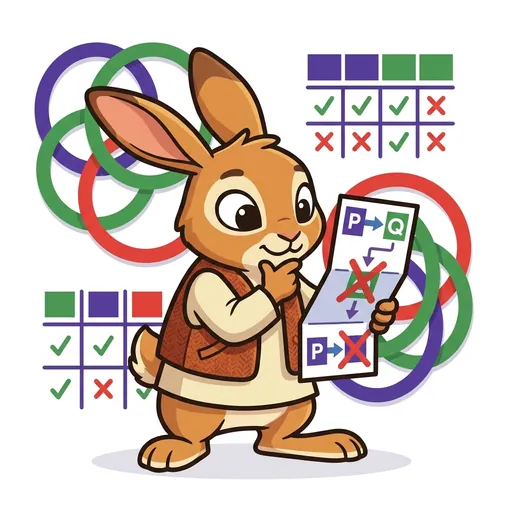
Modus-Tollens Tara
MODUS TOLLENS — If P then Q; not Q; therefore not P. The valid inference form for denying the consequent — used heavily in scientific reasoning (Popper's falsifiability).
Listen along — Modus-Tollens Tara
Loading audio…
Press play to listen along. The line being read lights up as you go.
Show full transcript
Loading transcript…
Chapter 2 — Modus-Tollens Tara and the Dry Street
Rain hammered the market square, and Tara the hare stood under an awning with her ears pinned back, staring hard at a puddle that had no business being there.
“The fountain’s been off since Tuesday,” she muttered. A friend beside her, a squirrel named Pip, huddled deeper into his scarf and asked what she was going on about. Tara pointed one paw at the wet cobbles under the closed fountain. “If the fountain were running,” she said slowly, “these stones would be soaked all the way to the wall. They’re only wet in a patch.” She narrowed her quick brown eyes. “So the fountain is not running. Somebody spilled a bucket.” She trotted off toward the fruit stall, and sure enough, a tipped-over pail sat behind it, still dripping. Pip blinked. Tara hadn’t touched the fountain, hadn’t asked anyone. She’d just noticed what wasn’t there — and it told her exactly what was.
Tara learned to reason that way in her family’s stall, years before LogicQuest.
Her family were the village contract-witnesses — the hares farmers trusted to watch a promise and say whether it held. When Tara was small, a berry-grower swore he’d deliver ten baskets by market-day. Her grandmother sat her down at the counting-table with a slate. “A promise is a rule,” Gran said. “If he keeps it, ten baskets arrive. So we watch for the ten.”
Market-day came. Eight baskets arrived. Little Tara counted them twice, her paws trembling. “Only eight, Gran.”
“And what does eight tell you?” Gran asked, not unkindly.
Tara’s stomach dropped, because she liked the grower, and she didn’t want it to be true. But the slate didn’t care what she wanted. “If he kept the promise, ten baskets come,” she said. “Ten didn’t come. So — he didn’t keep it.” Saying it out loud felt heavy and clear at once, like setting down something she’d been carrying wrong. Gran tapped the slate. “You didn’t accuse him. You didn’t guess. You noticed what was missing, and it did the rest.” Tara never forgot that the missing thing could speak the loudest.
The gate of LogicQuest was tall and stern, and the owl behind the desk was taller and sterner. Inspector Logos peered down at the small, rain-damp hare and asked her one question.
“Show me how you rule a thing out.”
Tara didn’t recite anything. She pointed out the window at a garden where a hose lay coiled and dry. “If someone had watered the beds this morning, the soil would be dark and heavy,” she said. “Look — it’s pale and cracking. Nobody watered.” She looked back up. “I didn’t have to catch them not-watering. I only had to see the dry soil. The dryness proves it.”
The owl was quiet for a long moment, feathers unruffled. Then something in his stare eased, just slightly. “You reason backward from a thing that didn’t happen,” he said. “Few do it without tangling themselves.” He slid the gate open. Tara walked through, ears up, feeling the small warm thrill of having said exactly the true thing.
Her workshop filled fast, because young thinkers loved a good ruling-out. One afternoon Pip and three others crowded her table while she set a plate of dry cobblestones — real ones, from the square — in the middle.
“Somebody tell me a promise,” Tara said.
“If it’s raining, the streets get wet,” Pip offered.
“Good. Now watch.” She held up a cobble, bone-dry. “The street is not wet. So?”
Pip’s whiskers twitched as he worked it. “So it’s — not raining!”
“There it is,” Tara said, and grinned. “You didn’t look at the sky once. The dry street did the telling.” A younger rabbit at the back frowned and raised a paw. “But what if it stopped raining a minute ago and the street just dried?” Tara nodded seriously. “Then your promise was sloppy — ‘raining right now’ versus ‘rained at all.’ A ruling-out is only as clean as the promise you start with. Sharpen the promise, and the dry street can’t lie to you.”
Then she turned the plate around, wetting one cobble with a dropper. “Now the tricky one. It is not raining. Does that mean the street is dry?” Pip opened his mouth, hesitated. Tara let the wet cobble gleam. “The sprinklers. A spilled pail. A splashing cart. ‘Not raining’ doesn’t force ‘dry.’ If you flip it around and deny the first thing instead of the second, you fall in the puddle.” The room laughed, and Pip laughed hardest, staring at the one wet stone that had almost fooled him.
Later, when the workshop had emptied, Pip lingered by the door. “You like it,” he said. “Being the one who says no.”
Tara set her dry cobble down and thought about it honestly. “I used to hate it,” she said. “The berry baskets — telling Gran the grower fell short — that felt awful. Like I was breaking something.” She turned the stone over in her paws. “But I wasn’t breaking it. It was already broken. I just found it.” She looked up, and her quick eyes were soft. “Now when a wrong idea drops away, it doesn’t feel like a door slamming. It feels like a window opening — cool and sudden and a little bit brave. There’s more room after. There’s the real thing, waiting where the wrong thing used to be.”
Pip nodded slowly, and the two of them sat a while in that clean, quiet, opened-up feeling, watching the rain finally stop.
The LogicQuest ensemble
Modus-Tollens Tara is part of LogicQuest's distributed-narrative cast. Each character embodies a different curricular primitive; together they teach the full subject.
-

Ad Hominem Hannibal
Attacking the arguer, not the argument
-

Strawman Stella
Misrepresenting the opponent's argument
-

Slippery-Slope Sam
Chaining dire consequences from a small first step
-

Appeal-to-Authority Auntie
Citing irrelevant / unqualified authority as proof
-

Red-Herring Reggie
Deflecting to an irrelevant topic
-

Circular-Reasoning Cici
Assuming the conclusion in the premise
-

False-Dichotomy Fia
Presenting only two options when more exist
-

Bandwagon Bran
Truth-by-popularity
-

Sunk-Cost Cyril
Refusing to change course because of past investment
-

Whataboutism Wanda
Deflecting criticism via someone else's wrongdoing
-

Equivocator Eva
Sliding a word's meaning mid-argument
-

Tu-Quoque Tessa
"You too!" — dismissing criticism by accusing the critic of the same thing
-

Modus-Ponens Mo
If P then Q; P; ∴ Q
-

Syllogism Solon
All M are P; all S are M; ∴ all S are P
-

Disjunctive-Syllogism Dior
P ∨ Q; ¬P; ∴ Q