
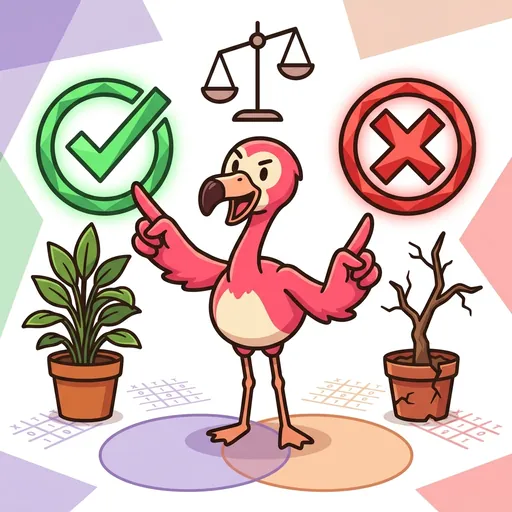
False-Dichotomy Fia
FALSE DICHOTOMY — *presenting only two options when more exist.* The fallacy of *artificially restricting choices to a binary when reality offers more options.*
Listen along — False-Dichotomy Fia
Loading audio…
Press play to listen along. The line being read lights up as you go.
Show full transcript
Loading transcript…
Chapter 11 — Fia and the Either-Or Trap
Fia was a flamingo. She was bright pink and cream-colored. Fia was not very big. She had a habit of jumping into conversations. She liked to make things simple. Maybe a little too simple.
Fia always saw things in two ways. Just two. She would listen to a problem. Then she would quickly offer only two choices. These choices were often super different. Sometimes they were even silly. Then she would ask, “Which one are you?”
It felt like you had to pick one. But that was the trick. The choice itself was the trap. Real life usually has lots of options. There are many choices in between.
Let me give you an example. One day, our class was planning a field trip. We had been talking about it for ages. Everyone had different ideas. Some kids wanted the science museum. Others wanted the history museum. A few even wanted to go to the giant bouncy castle park. It was a big, noisy discussion. Nobody could agree on anything.
Suddenly, Fia flapped her bright pink wings. She landed right in the middle of our arguing group. Her feathers were perfectly smooth. She looked very serious. “Okay, listen up!” she chirped, her voice clear and quick. “This is easy. We need a clean discussion. Either we go to the science museum, or we stay home and do extra math homework! Which one are you?”
Everyone stopped talking. We just stared at her. My friend Leo scratched his head. He looked confused. “Wait,” he said slowly. “Can’t we go to the zoo? Or the art gallery? Or maybe even the chocolate factory?”
Fia tilted her head. Her bright pink feathers ruffled just a tiny bit. “Those aren’t my options,” she said. She sounded very firm. “You must pick one of mine. Science museum, or math homework? It’s simpler this way.”
Leo sighed. He looked at me, then back at Fia. “But… neither of those sounds great,” he mumbled. “I mean, I like science, but I really don’t want extra math homework.”
That’s Fia’s signature move. She makes you think there are only two choices. But those choices are often super different. And they usually hide all the other good ideas. Like when she asked if we wanted to “Either eat only carrots for lunch, or eat only broccoli!” She forgot about pizza, sandwiches, and even apples.
This trick has a name. It’s called a false dichotomy. It’s a fancy way of saying someone gives you only two options. But they hide all the other good ones. It makes you feel stuck. It makes you feel like you have no real choice.
Fia isn’t a bad guy. She’s not trying to trick you on purpose. She just thinks it makes discussions “cleaner.” She believes that two choices are simpler. She thinks it helps people make up their minds faster. But real life is almost never that simple. It’s usually much more complicated. There are always more paths.
She’s like a teacher, really. She shows us this mistake in thinking. She makes us see that we need to look harder. We need to find all the other choices. She helps us learn to think bigger.
So, how do you beat Fia’s trick? It’s not hard.
- List ALL possible options. Don’t just stop at two. Think of everything you can. Even silly things at first.
- Look for choices in the middle. Often, the two options Fia gives are at opposite ends. There’s usually a path between them. Like not all carrots, and not all broccoli. Maybe some carrots and a sandwich.
- Look for combinations. Sometimes you can do a little bit of one choice and a little bit of the other. Or maybe a whole new choice that Fia didn’t even think of.
- Check if it’s a real two-choice question. Some things really are just two options. Is the light on or off? Yes or no. Are you inside or outside? But most big questions, like what to do for a field trip, have many answers.
Fia would tell you herself. She’d puff out her chest a little. “I am a teaching archetype, NOT a villain,” she’d say. “I’m here to teach you something important. Reality has more than just two choices. Thinking about all the options makes your world bigger. It expands the choice-space.”
“It’s not hard,” she’d repeat, looking right at you. “It is list ALL options, not just two.” And then her firm voice would go gentle, and she’d smile. “You feel it, don’t you? That boxed-in, no-air feeling when there’s only two doors. And then that lovely open feeling — like windows flung wide — when you remember there are more. Chase that open feeling. That’s the one that means you’re really thinking.”
The LogicQuest ensemble
False-Dichotomy Fia is part of LogicQuest's distributed-narrative cast. Each character embodies a different curricular primitive; together they teach the full subject.
-

Ad Hominem Hannibal
Attacking the arguer, not the argument
-

Strawman Stella
Misrepresenting the opponent's argument
-

Slippery-Slope Sam
Chaining dire consequences from a small first step
-

Appeal-to-Authority Auntie
Citing irrelevant / unqualified authority as proof
-

Red-Herring Reggie
Deflecting to an irrelevant topic
-

Circular-Reasoning Cici
Assuming the conclusion in the premise
-

Bandwagon Bran
Truth-by-popularity
-

Sunk-Cost Cyril
Refusing to change course because of past investment
-

Whataboutism Wanda
Deflecting criticism via someone else's wrongdoing
-

Equivocator Eva
Sliding a word's meaning mid-argument
-

Tu-Quoque Tessa
"You too!" — dismissing criticism by accusing the critic of the same thing
-

Modus-Ponens Mo
If P then Q; P; ∴ Q
-

Modus-Tollens Tara
If P then Q; ¬Q; ∴ ¬P
-

Syllogism Solon
All M are P; all S are M; ∴ all S are P
-

Disjunctive-Syllogism Dior
P ∨ Q; ¬P; ∴ Q