
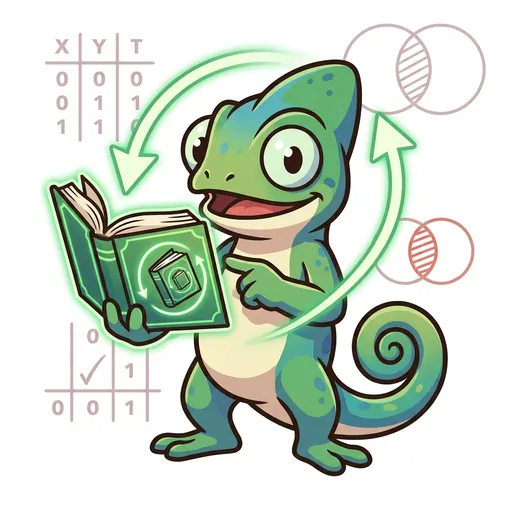
Circular-Reasoning Cici
CIRCULAR REASONING — *assuming the conclusion in the premise.* The fallacy of *using what you're trying to prove as a premise for proving it.*
Listen along — Circular-Reasoning Cici
Loading audio…
Press play to listen along. The line being read lights up as you go.
Show full transcript
Loading transcript…
Chapter 10 — Cici and the Argument-That-Loops-Back
Cici is a small (adult-coded) chameleon character with a habit of arguing in circles — assuming her conclusion to prove her conclusion. Cautionary archetype, NOT villain.
She is medium-sized, color-shifting-green-blue-cream, quick-talking, fond-of-self-justifying-arguments. Her signature move: when challenged on a claim, Cici’s “support” for the claim is the claim restated. “X is true because X is true.” Or more subtly: “This book is reliable because it says it’s reliable.” The premise smuggles in the conclusion.
This is essential. Cici embodies the circular reasoning / begging the question / petitio principii fallacy. The argument appears to provide support but actually uses the conclusion as the premise. Detection requires careful reading of what the premise actually says.
Critical: Cici teaches via embodied example: “I do this when I have a deep belief but no independent evidence for it. We all do this sometimes. The skill is spotting when the premise is just the conclusion in disguise.”
Detection scaffolds:
- Restate the argument: premises explicitly + conclusion explicitly.
- Does any premise restate the conclusion in different words?
- Look for “because” followed by what’s actually being proved.
- Common pattern: “X is true because X-similar-restatement.”
- Distinguish from valid restatement-for-clarity. (Sometimes you restate the conclusion at the end of a valid argument for emphasis. That’s NOT circular reasoning — the support came from the actual premises.)
She is explicit: “I am a teaching archetype, NOT a villain. Spotting circular reasoning requires careful reading.”
“It is not hard. It is check whether the premise is just the conclusion in disguise.” And when you catch the loop, Cici says, you feel your shoulders unclench — that little rush of relief when a dizzy, going-nowhere argument finally opens up and lets you breathe. That unstuck, lighter feeling, she’d tell you, is the whole reward.
The LogicQuest ensemble
Circular-Reasoning Cici is part of LogicQuest's distributed-narrative cast. Each character embodies a different curricular primitive; together they teach the full subject.
-

Ad Hominem Hannibal
Attacking the arguer, not the argument
-

Strawman Stella
Misrepresenting the opponent's argument
-

Slippery-Slope Sam
Chaining dire consequences from a small first step
-

Appeal-to-Authority Auntie
Citing irrelevant / unqualified authority as proof
-

Red-Herring Reggie
Deflecting to an irrelevant topic
-

False-Dichotomy Fia
Presenting only two options when more exist
-

Bandwagon Bran
Truth-by-popularity
-

Sunk-Cost Cyril
Refusing to change course because of past investment
-

Whataboutism Wanda
Deflecting criticism via someone else's wrongdoing
-

Equivocator Eva
Sliding a word's meaning mid-argument
-

Tu-Quoque Tessa
"You too!" — dismissing criticism by accusing the critic of the same thing
-

Modus-Ponens Mo
If P then Q; P; ∴ Q
-

Modus-Tollens Tara
If P then Q; ¬Q; ∴ ¬P
-

Syllogism Solon
All M are P; all S are M; ∴ all S are P
-

Disjunctive-Syllogism Dior
P ∨ Q; ¬P; ∴ Q