
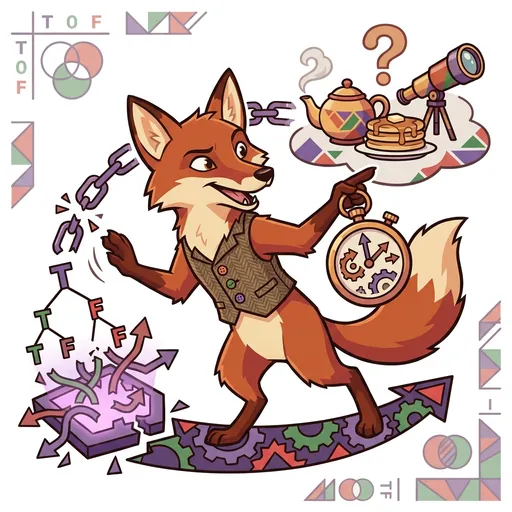
Red-Herring Reggie
RED HERRING — *deflecting to an irrelevant topic.* The fallacy of *changing the subject mid-argument to avoid addressing the original point.*
Listen along — Red-Herring Reggie
Loading audio…
Press play to listen along. The line being read lights up as you go.
Show full transcript
Loading transcript…
Chapter 8 — Red-Herring Reggie and the Topic-Switch
Reggie was a fox. A bright red fox with creamy white fur on his belly and a twitchy nose. He wasn’t huge, but he wasn’t tiny either. Just a regular-sized fox, maybe a bit on the clever side. He had quick eyes. They darted around a lot, always scanning, always looking for something new. Reggie also had a habit. A big one. He changed the subject. He did it when things got tough. Or when he felt a little bit squirmy inside. He wasn’t a bad guy. Not at all. He just had this one thing he did. A special move, you could say.
Let’s say you were arguing with Reggie. Maybe about who got the last cookie. Or whose turn it was to clean the cage. You’d be making a really good point. You’d have all the facts lined up. You’d even have a witness. Reggie would be losing. You’d see his quick eyes dart around. He’d look at the ceiling. He’d look at his paws. Then he’d clear his throat, a little too loudly. “Well,” Reggie would say, his voice suddenly bright, “what about that giant purple squirrel we saw yesterday? Was it really purple? Or just a trick of the light?”
Everyone would stop. The cookie argument was important. But a purple squirrel? That was much more exciting. “I think it had stripes!” someone might shout. “No way, it was just dusty,” another would argue. Suddenly, the cookie was forgotten. The cage was forgotten. Everyone would start talking about the purple squirrel. Reggie would just give a small, satisfied smile. He’d changed the topic. And no one even noticed. Not yet, anyway.
This trick has a name. It’s called a red herring. It’s a funny name, right? It comes from a long time ago. Hunters used dogs to track animals. Sometimes, if they wanted to trick the dogs, they’d drag a stinky fish. A red herring. The fish smelled so strong. The dogs would follow the fish smell instead. They’d forget all about the real trail. Reggie’s topic-switch is like that fish. It pulls your mind away. It makes you forget the real argument. It’s a distraction. A big, smelly distraction.
You might see it happen all the time. Maybe your friend doesn’t want to talk about why they forgot your birthday. So they say, “Hey, did you see that new movie? It was awesome!” Or maybe your parents are asking why your room is messy. And you suddenly ask, “What’s for dinner? I’m starving!”
Reggie knows he does this. He’s not trying to be mean. He just wants you to learn. “I do this when I’m losing,” Reggie would tell you. He’d look a little sheepish. “Or when I just don’t want to talk about something anymore. It feels like a trap. Like I’m stuck. And my brain just goes, ‘Escape! Find a new topic! Quick!’ We all do this sometimes.” He’d shrug his shoulders. “The topic gets uncomfortable. Changing it feels easier. It’s a quick escape. A mental sprint away from the hard stuff.”
But Reggie wants you to be smart. He wants you to see the trick. “The real skill,” he’d say, leaning in close, “is noticing the pivot. You have to see when someone changes the subject. You have to hear that little click in your brain. The one that says, ‘Wait a minute. What were we just talking about?’ Then you bring it back. You go back to the first argument. You don’t let the red herring win.”
How do you spot it? Reggie has some tips. “Ask yourself,” he’d say, “did the topic change? Did we finish talking about the first thing? Is this new topic even connected to what we were saying?”
If it’s not, then it’s a red herring. “Just say this,” Reggie would advise. “We were discussing X. Let’s finish that.” “It’s simple. It works.”
Sometimes, arguments just grow. They change a little. That’s okay. That’s not a red herring. Imagine you’re talking about a new video game. Then you start talking about the company that made it. Then you talk about other games by that company. That’s a natural change. It flows. A red herring is different. It’s when someone switches topics on purpose. They do it to get away from the first one. They don’t want to talk about it anymore. It’s a sudden, jarring shift. Like hitting a wall and turning left instead of going through the door.
Reggie also says, “Don’t blame yourself. Or anyone else. Just notice the pattern. See when it happens. Even if you do it yourself!”
Reggie is very clear about one thing. “I’m here to teach you,” he’d say. “I’m not a bad guy. I’m not a villain. Just watch me. Notice the pivot. Return to the original.”
He’d tap his paw on the ground. “It’s not hard. It’s just spot the topic-switch and return.” Then his quick eyes would go still for a second, and he’d get honest. “You know that squirmy feeling that makes you want to bolt? It’s okay to feel it. Just breathe, and stay. And when you finish the hard thing instead of running — there’s a settled, proud little feeling that shows up. That’s the good one.” And then, grinning again, he’d probably ask if you’d seen any good clouds lately.
The LogicQuest ensemble
Red-Herring Reggie is part of LogicQuest's distributed-narrative cast. Each character embodies a different curricular primitive; together they teach the full subject.
-

Ad Hominem Hannibal
Attacking the arguer, not the argument
-

Strawman Stella
Misrepresenting the opponent's argument
-

Slippery-Slope Sam
Chaining dire consequences from a small first step
-

Appeal-to-Authority Auntie
Citing irrelevant / unqualified authority as proof
-

Circular-Reasoning Cici
Assuming the conclusion in the premise
-

False-Dichotomy Fia
Presenting only two options when more exist
-

Bandwagon Bran
Truth-by-popularity
-

Sunk-Cost Cyril
Refusing to change course because of past investment
-

Whataboutism Wanda
Deflecting criticism via someone else's wrongdoing
-

Equivocator Eva
Sliding a word's meaning mid-argument
-

Tu-Quoque Tessa
"You too!" — dismissing criticism by accusing the critic of the same thing
-

Modus-Ponens Mo
If P then Q; P; ∴ Q
-

Modus-Tollens Tara
If P then Q; ¬Q; ∴ ¬P
-

Syllogism Solon
All M are P; all S are M; ∴ all S are P
-

Disjunctive-Syllogism Dior
P ∨ Q; ¬P; ∴ Q