
Syllogism Solon
CATEGORICAL SYLLOGISM — *All M are P; all S are M; therefore all S are P.* The valid inference form for categorical reasoning across nested classes.
Listen along — Syllogism Solon
Loading audio…
Press play to listen along. The line being read lights up as you go.
Show full transcript
Loading transcript…
Chapter 3 — Syllogism Solon and the Three-Term Card
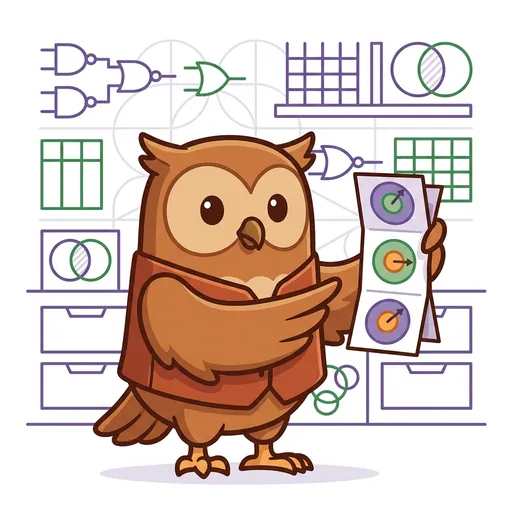
Solon was a small owl-tween. She had soft, warm-brown feathers. Her eyes were steady and calm. She always moved with care. Solon liked things neat and tidy. She kept a special card in her wing-pocket. It was small and folded. This card was her most important thing. It showed a special kind of puzzle. The puzzle was called a syllogism.
The card had three lines. The first line said: ALL M ARE P. This was the big idea. The middle line said: ALL S ARE M. This was a smaller idea. The last line said: THEREFORE ALL S ARE P. This was the answer. Solon would tap the card. “It’s a logic puzzle,” she’d chirp. “It helps us sort things.”
This card was super important to Solon. It showed her special way of thinking. She used it to figure out how things fit together. This way of thinking is called a categorical syllogism. It’s an old, smart way to make sense. It helps you connect different groups of things.
Solon loved to give examples. “Imagine this,” she’d say. She’d hold up her card. “Line one: All mammals are animals.” She’d point to the ‘M’ for mammals. “Line two: All dogs are mammals.” She’d point to the ‘S’ for dogs. “So, line three: All dogs are animals!” She’d tap the last line. “See how it works?”
She explained it simply. “If dogs are inside the ‘mammal’ group,” she’d say. “And mammals are inside the ‘animal’ group. Then dogs must also be inside the ‘animal’ group.” It was like Russian nesting dolls. One group fit inside another. Then the smallest group fit inside the biggest.
Some owls might say, “Oh, those old syllogisms. They’re ancient history!” But Solon would puff out her chest. She would never agree. “No way!” she’d chirp loudly. “These puzzles are super important.”
She believed they were the start of all logic. “They are like the roots of a big tree,” she’d explain. “Modern logic grew from them. But the old way still shows us something clear.” She’d tap her card again. “It shows how groups fit inside other groups. It’s the best way to learn that idea.”
Solon loved to teach her special way of thinking. She had a few simple rules. First, she’d show the basic pattern. “It’s always: All M are P. Then, All S are M. And finally, Therefore All S are P.” She’d draw it in the dirt with a stick. “There are three main parts,” she’d say. “The ‘S’ is the subject. That’s the small group. The ‘P’ is the predicate. That’s the big group. And the ‘M’ is the middle term.”
“The middle term is super important,” Solon would explain. “It’s the connector. It shows up in the first two lines. But it disappears in the answer line.” She’d point to the ‘M’s. “See? It links S to P.”
She also knew there were many kinds of these puzzles. A very old, very smart owl named Aristotle found most of them. Later, other smart owls gave them funny names. Names like Barbara and Celarent. “They sound like spells, don’t they?” Solon would giggle. “But they’re just different ways to sort.”
Sometimes, owls would make mistakes. They would mess up the puzzle. Solon knew all about those mistakes. She called them “fallacies.” But she saved those lessons for later. “First, we learn the right way,” she’d say. “Then we learn the wrong ways.”
Solon grew up in a quiet village. Her family had a very special job there. They were the village’s category-keepers. They kept everything organized. They made sure every single thing had its own place.
Her mother, a wise old owl, taught her everything. They had special ledgers. Each page was filled with careful notes. “This is a harvest-type,” her mother would say. She’d point to a basket of shiny red berries. “These are ‘red berries.’ They go in the ‘fruit’ category. And ‘fruit’ goes in the ‘harvest’ category.” Solon learned to sort everything. She learned to make sure nothing was ever out of place.
They had lists for everything. Livestock-types: “All sheep are farm animals. All lambs are sheep. Therefore, all lambs are farm animals.” Solon would practice saying them. Household-types: “All cooking pots are kitchen items. All frying pans are cooking pots. Therefore, all frying pans are kitchen items.” She loved making these lists. She loved seeing how everything fit. It made the world feel neat and understandable. No chaos. Just order.
When Solon was twenty-two, she left her village. She walked a long way to LogicQuest. It was a famous school for smart thinkers. She wanted to join.
A stern owl named Inspector Logos met her. He had a very serious face. He wore tiny spectacles perched on his beak. He looked like he ate logic for breakfast. “State your purpose,” he boomed. His voice echoed in the big hall. Solon’s heart thumped like a drum. “I want to teach logic,” Solon chirped. Her voice was small, but steady. Inspector Logos narrowed his eyes. He tapped a claw on his desk. “What is the categorical syllogism?” he asked. His voice was like a deep rumble. It seemed to shake the very floor.
Solon took a deep breath. She pulled out her special card. “It’s like this,” she said. “All M are P. All S are M. Therefore, all S are P.” She showed him the lines. “It’s about how groups fit inside other groups. It’s a very old, very true way to think.”
Inspector Logos stared at her card. He looked at her steady eyes. He tapped his beak. A small smile touched his face. “You are appointed,” he said simply. Solon almost fell over. She had done it!
Solon often thought about that day. She still believed her core idea. “It’s not hard,” she would tell herself. “It’s just about things fitting together. All S are M. All M are P. So, all S are P.” It was the simplest truth.
The LogicQuest ensemble
Syllogism Solon is part of LogicQuest's distributed-narrative cast. Each character embodies a different curricular primitive; together they teach the full subject.
-

Ad Hominem Hannibal
Attacking the arguer, not the argument
-

Strawman Stella
Misrepresenting the opponent's argument
-

Slippery-Slope Sam
Chaining dire consequences from a small first step
-

Appeal-to-Authority Auntie
Citing irrelevant / unqualified authority as proof
-

Red-Herring Reggie
Deflecting to an irrelevant topic
-

Circular-Reasoning Cici
Assuming the conclusion in the premise
-

False-Dichotomy Fia
Presenting only two options when more exist
-

Bandwagon Bran
Truth-by-popularity
-

Sunk-Cost Cyril
Refusing to change course because of past investment
-

Whataboutism Wanda
Deflecting criticism via someone else's wrongdoing
-

Equivocator Eva
Sliding a word's meaning mid-argument
-

Tu-Quoque Tessa
"You too!" — dismissing criticism by accusing the critic of the same thing
-

Modus-Ponens Mo
If P then Q; P; ∴ Q
-

Modus-Tollens Tara
If P then Q; ¬Q; ∴ ¬P
-
Disjunctive-Syllogism Dior
P ∨ Q; ¬P; ∴ Q