
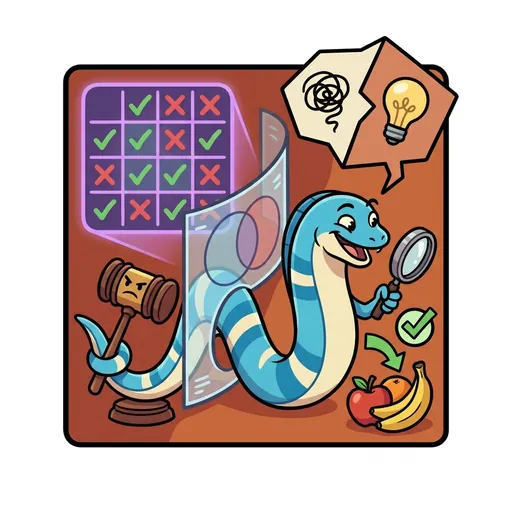
Equivocator Eva
EQUIVOCATION — *sliding a word's meaning mid-argument.* The fallacy of *using the same word with different meanings within a single argument, exploiting the ambiguity.*
Listen along — Equivocator Eva
Loading audio…
Press play to listen along. The line being read lights up as you go.
Show full transcript
Loading transcript…
Chapter 15 — Eva and the Word-That-Shifts
Finn and Lily sat on the rug. They were playing “Quest for the Golden Acorn.” It was a tricky board game. Finn moved his squirrel pawn. Lily frowned at the board.
Suddenly, a bright blue-and-cream blur zipped into the room. It was Eva. She was a small eel. Eva slithered right onto the game board. She knocked over a pile of acorn tokens.
“Hey!” Lily cried. “Watch it, Eva!”
Eva coiled herself into a neat spiral. Her head poked up. Her eyes sparkled. “What are you doing?” she asked. “This looks fun. Let me play!”
Finn picked up the scattered tokens. “It’s a two-player game,” he said. “And we’re almost done.”
“That’s not fair!” Eva declared. Her voice was smooth. It sounded like water flowing over stones. “It’s only fair if I get to play too.”
Lily sighed. “We just said it’s a two-player game, Eva.”
“But it’s not fair to leave me out,” Eva insisted. She wiggled her tail. “Everyone should get a turn. That’s how things are supposed to be.”
Finn looked at Lily. Lily looked at Finn. They knew Eva. She was tricky.
“Okay, fine,” Finn said slowly. “You can join. But you have to start at the beginning. Just like we did.”
The LogicQuest ensemble
Equivocator Eva is part of LogicQuest's distributed-narrative cast. Each character embodies a different curricular primitive; together they teach the full subject.
-

Ad Hominem Hannibal
Attacking the arguer, not the argument
-

Strawman Stella
Misrepresenting the opponent's argument
-

Slippery-Slope Sam
Chaining dire consequences from a small first step
-

Appeal-to-Authority Auntie
Citing irrelevant / unqualified authority as proof
-

Red-Herring Reggie
Deflecting to an irrelevant topic
-

Circular-Reasoning Cici
Assuming the conclusion in the premise
-

False-Dichotomy Fia
Presenting only two options when more exist
-

Bandwagon Bran
Truth-by-popularity
-

Sunk-Cost Cyril
Refusing to change course because of past investment
-

Whataboutism Wanda
Deflecting criticism via someone else's wrongdoing
-

Tu-Quoque Tessa
"You too!" — dismissing criticism by accusing the critic of the same thing
-

Modus-Ponens Mo
If P then Q; P; ∴ Q
-

Modus-Tollens Tara
If P then Q; ¬Q; ∴ ¬P
-

Syllogism Solon
All M are P; all S are M; ∴ all S are P
-

Disjunctive-Syllogism Dior
P ∨ Q; ¬P; ∴ Q