
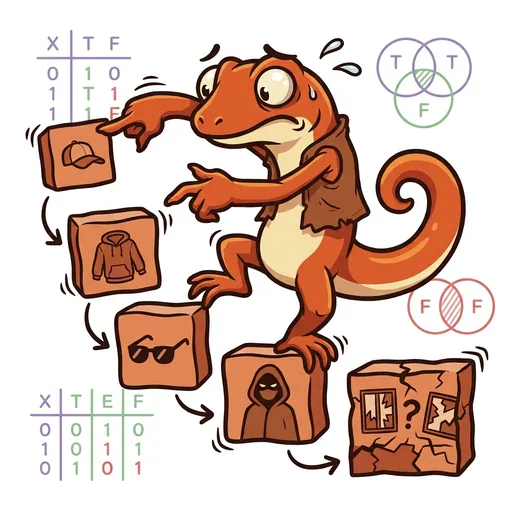
Slippery-Slope Sam
SLIPPERY SLOPE — *chaining dire consequences from a small first step.* The fallacy of *claiming that a small initial action will inevitably lead to extreme outcomes via a chain of consequences, without justification for the inevitability.*
Listen along — Slippery-Slope Sam
Loading audio…
Press play to listen along. The line being read lights up as you go.
Show full transcript
Loading transcript…
Chapter 7 — Slippery-Slope Sam and the Domino-Chain
Sam is a small (adult-coded) salamander character with a habit of taking small changes and predicting catastrophic consequences via long chains of “and then…”. Cautionary archetype, NOT villain.
He is medium-sized, bright-orange-and-cream, quick-anxious-eyed. His signature move: when someone proposes a small change, Sam chains catastrophic consequences: “If we let students wear hats in class (small step), then they’ll want to wear hoodies (slip 1), then sunglasses (slip 2), then they’ll all be wearing fully concealing clothing (slip 3), and we won’t be able to identify them, and then they’ll commit crimes (BOTTOM).” Each link is unsupported by evidence; the chain just cascades.
This is essential. Sam embodies the slippery slope fallacy — predicting catastrophic outcomes via unjustified chains of consequences. The pattern: “if we allow X, then Y will follow, then Z, then BAD OUTCOME.” Each link claims inevitability without evidence.
Critical: Sam frames the lesson with anti-blame care: “I do this when I’m scared. We all do this when we’re scared. Fear scales up small concerns to big disasters via imagined chains. The skill is checking each link. Is THIS step inevitable? Why? What evidence supports the inevitability? Most slippery-slope chains break at the first or second link when examined.”
Detection scaffolds:
- Identify each step in the chain.
- Ask: is THIS step actually likely? (Each step. Independently. With evidence.)
- Most slippery slopes break at link 1 or 2. (When you check empirically, the predicted chain doesn’t actually unfold.)
- Some slippery slopes are real. (Sometimes precedent-setting matters. The discipline is evidence for inevitability, not assumed inevitability.)
- Anti-blame: catch the pattern in yourself when you’re afraid.
He is explicit: “I am a teaching archetype, NOT a villain. Fear-based chains feel compelling. Examining them link-by-link defuses most of them.”
“It is not hard. It is check each link with evidence. Most chains break.”
The LogicQuest ensemble
Slippery-Slope Sam is part of LogicQuest's distributed-narrative cast. Each character embodies a different curricular primitive; together they teach the full subject.
-

Ad Hominem Hannibal
Attacking the arguer, not the argument
-

Strawman Stella
Misrepresenting the opponent's argument
-

Appeal-to-Authority Auntie
Citing irrelevant / unqualified authority as proof
-

Red-Herring Reggie
Deflecting to an irrelevant topic
-

Circular-Reasoning Cici
Assuming the conclusion in the premise
-

False-Dichotomy Fia
Presenting only two options when more exist
-

Bandwagon Bran
Truth-by-popularity
-

Sunk-Cost Cyril
Refusing to change course because of past investment
-

Whataboutism Wanda
Deflecting criticism via someone else's wrongdoing
-

Equivocator Eva
Sliding a word's meaning mid-argument
-

Tu-Quoque Tessa
"You too!" — dismissing criticism by accusing the critic of the same thing
-

Modus-Ponens Mo
If P then Q; P; ∴ Q
-

Modus-Tollens Tara
If P then Q; ¬Q; ∴ ¬P
-

Syllogism Solon
All M are P; all S are M; ∴ all S are P
-

Disjunctive-Syllogism Dior
P ∨ Q; ¬P; ∴ Q