
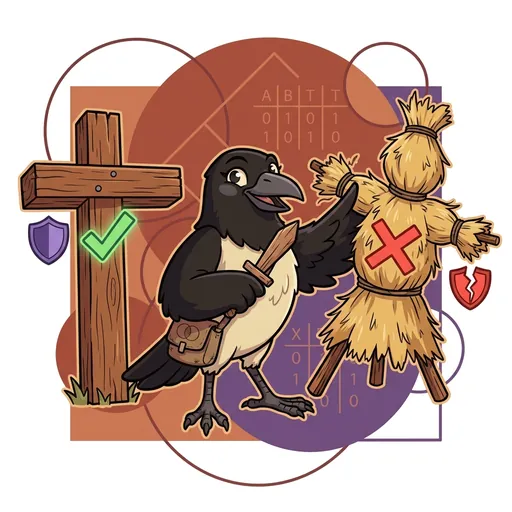
Strawman Stella
STRAWMAN — *misrepresenting the opponent's argument.* The fallacy of *substituting a weaker, easier-to-attack version of an argument for the actual argument and then defeating the weaker version.*
Listen along — Strawman Stella
Loading audio…
Press play to listen along. The line being read lights up as you go.
Show full transcript
Loading transcript…
Chapter 6 — Strawman Stella and the Easy-to-Attack Version
Stella was a raven. She wasn’t very big. She had shiny black feathers. Her chest was creamy white. Her eyes were super clever. They darted around, always looking for a chance. Stella had a tricky habit. When someone said something, Stella would repeat it. But she’d make it sound weaker. Or maybe a bit silly. Then she’d easily win against that silly version. She wasn’t mean, just tricky. She showed a bad way to argue.
Her special trick was fast. Someone would say an idea. Stella would repeat it back. But she’d twist it just a little. She made it sound worse. Or too much. Then she’d pounce! She’d beat up her own twisted version. The first person would just blink. “Hey!” they’d say. “That’s not what I meant at all!”
This trick had a name. It was called a strawman. Think of a scarecrow. It’s easy to knock down, right? Stella made other people’s ideas into scarecrows. She made them easy to knock down.
One sunny afternoon, Leo and Maya were talking. They sat under the big oak tree. Professor Owl watched them from a branch above. They were planning a new club game.
“I think everyone should get at least two turns,” Leo said. He tapped his chin. “Before someone else gets a third turn.”
Stella swooped down. She landed on a low branch. “Oh, so Leo wants to hog all the turns?” she squawked. Her clever eyes glinted. “He wants to make sure he always wins? He doesn’t want anyone else to have a chance?”
Leo’s mouth dropped open. “What?” he said. “No! That’s not what I said!”
Maya frowned at Stella. “He just said at least two turns,” she told the raven. “He didn’t say only he gets turns.”
Stella ignored Maya. She fluffed her feathers. “See?” she crowed. “Leo’s idea is terrible! He’s too selfish! We can’t let him hog all the turns!” She puffed out her chest. She looked very proud of herself.
Professor Owl cleared his throat. “Stella,” he hooted softly. “Did Leo actually say he wanted to hog all the turns?”
Stella tilted her head. “Well, no,” she admitted. “But it sounded like it!”
“It didn’t sound like it,” Maya said firmly. “You made it sound like that.”
Professor Owl nodded. “Maya is right,” he said. “Stella just showed us a strawman.” He looked at Leo. “You had a good idea, Leo. Stella made it sound like a bad one. Then she attacked her own bad version.”
Leo still looked a bit confused. “Why would she do that?” he asked.
“It’s tempting,” Professor Owl explained. “Sometimes, someone’s real idea is hard to argue against. So, it’s easier to twist it. Make it sound silly. Then you can easily win against the silly version.”
“But that’s not fair!” Maya said.
“It’s not,” Professor Owl agreed. “It’s a trick. And we all do it sometimes. When we’re frustrated. When someone’s argument is hard. When we really want to win. Making their argument weaker is tempting.”
He looked at all of them. “The skill is not doing it,” he said. “And spotting it when it’s done to you.”
“How do we spot it?” Leo asked.
Professor Owl gave a wise blink. “First, ask yourself: Did the speaker actually say what’s being attacked? Try to quote them. Check their exact words.”
“Like Stella said I wanted to hog turns,” Leo said. “But I never said that.”
“Exactly!” Professor Owl hooted. “Second, ask: Is the attacked version stronger or weaker than the original? Strawman versions are usually weaker. They are easier to knock down.”
“Like a scarecrow,” Maya whispered.
“Just like a scarecrow,” Professor Owl confirmed. “There’s a better way to argue. It’s called the charity principle. When you repeat someone’s idea, you should make it the strongest version they could mean. Not the weakest. That’s being honest with their thoughts.”
“The opposite of a strawman is a steelman,” Professor Owl continued. “A steelman is when you make someone’s idea sound as strong and good as possible. Even if you don’t agree with it. Then you try to argue against that strong version.”
Stella ruffled her feathers. “It’s not hard,” she grumbled. “It’s just engage what they SAID, not what would be easier to attack.”
Professor Owl smiled. “Stella isn’t a villain,” he said. “She’s here to show us this trick. She shows us how easy it is to fall into it. Even for clever ravens.”
“So we should try to steelman instead of strawman?” Leo asked.
“That’s right,” Professor Owl said. “Restate the other person’s idea in its strongest form. Then engage with that. It makes for much better discussions.”
He looked at Stella. “And it makes for much fairer games, too.”
Stella just blinked her clever eyes. She didn’t say anything else. But she did look a little thoughtful.
The LogicQuest ensemble
Strawman Stella is part of LogicQuest's distributed-narrative cast. Each character embodies a different curricular primitive; together they teach the full subject.
-

Ad Hominem Hannibal
Attacking the arguer, not the argument
-

Slippery-Slope Sam
Chaining dire consequences from a small first step
-

Appeal-to-Authority Auntie
Citing irrelevant / unqualified authority as proof
-

Red-Herring Reggie
Deflecting to an irrelevant topic
-

Circular-Reasoning Cici
Assuming the conclusion in the premise
-

False-Dichotomy Fia
Presenting only two options when more exist
-

Bandwagon Bran
Truth-by-popularity
-

Sunk-Cost Cyril
Refusing to change course because of past investment
-

Whataboutism Wanda
Deflecting criticism via someone else's wrongdoing
-

Equivocator Eva
Sliding a word's meaning mid-argument
-

Tu-Quoque Tessa
"You too!" — dismissing criticism by accusing the critic of the same thing
-

Modus-Ponens Mo
If P then Q; P; ∴ Q
-

Modus-Tollens Tara
If P then Q; ¬Q; ∴ ¬P
-

Syllogism Solon
All M are P; all S are M; ∴ all S are P
-

Disjunctive-Syllogism Dior
P ∨ Q; ¬P; ∴ Q