
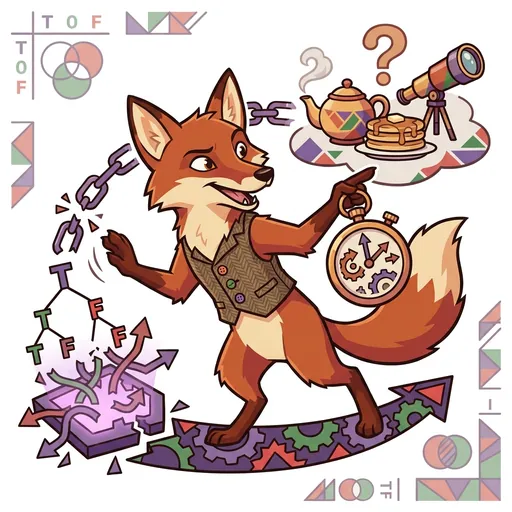
Red-Herring Reggie
RED HERRING — *deflecting to an irrelevant topic.* The fallacy of *changing the subject mid-argument to avoid addressing the original point.*
Listen along — Red-Herring Reggie
Loading audio…
Press play to listen along. The line being read lights up as you go.
Show full transcript
Loading transcript…
Chapter 8 — Red-Herring Reggie and the Topic-Switch
Reggie, a small red fox, had a peculiar habit. When conversations turned uncomfortable, especially if he was losing an argument, his quick eyes would dart, and the topic would vanish. He wasn’t a villain, not truly. Instead, Reggie functioned as a cautionary archetype, a living example of a common, frustrating pattern.
He was medium-sized, his fur a striking blend of bright red and creamy white. His movements were fluid, his gaze sharp, always ready to pivot. This quick-pivoting was his signature move. When a discussion started going against him, Reggie would smoothly interject, “Well, what about [unrelated topic]?” Just like that, attention would shift. The new subject, often interesting and unexpected, would captivate everyone, and the original question would simply be forgotten.
Today, the group was huddled around a worn map spread across a mossy log. Barnaby, a sturdy badger with a practical mind, pointed to a section marked “The Whispering Woods.” “The path through here is overgrown,” he grumbled, his paw tracing a faint line. “It’s impassable for the supply carts. We need to clear it.”
Pip, a perpetually energetic squirrel, chattered agreement. “It took me twice as long to get to the berry patch yesterday! My nuts almost got lost in the brambles!”
Reggie, however, had a different idea. “Clearing it is too much work. We should just use the old river route. It’s longer, but already clear.”
Barnaby shook his head. “The river route adds a full day to the journey. And the bridge near the rapids is unstable. We discussed this last week, Reggie.”
“Unstable, but not broken,” Reggie countered, a flicker of defensiveness in his bright eyes. “It’s a faster solution than weeks of clearing.”
“Weeks?” Barnaby scoffed. “With all of us working, it’s a few days, maybe a week. The river route is risky. What if the bridge collapses with a cart on it?”
The protagonist, a young fox named Alex, watched Reggie. His ears twitched as Barnaby laid out the facts. Reggie’s proposed solution was clearly less practical, even dangerous. Alex could see the logic in Barnaby’s argument. The air around Reggie seemed to tighten, his tail giving a small, almost imperceptible twitch. He shifted his weight, his gaze sweeping over the map, then past it, towards the distant treeline.
Then, Reggie smiled, a quick, charming flash of teeth. “Speaking of bridges,” he said, his voice a little louder, “did anyone else notice that new family of beavers building a dam upstream? Their engineering is truly remarkable. I saw them using some incredibly large logs.”
Pip’s eyes widened. “Beavers? Really? Are they the ones with the really flat tails? Do they have little kits?” The squirrel practically bounced, the previous conversation about the impassable path already fading from his mind.
Barnaby let out a slow, exasperated sigh. He looked at Reggie, then at Pip, then back at the map, which now seemed to hold little interest for anyone but him. The discussion about the path, the carts, and the unstable bridge had evaporated. It was as if a sudden gust of wind had swept it away.
Alex felt the shift, a subtle but definite change in the conversation’s direction. The original problem, pressing and unsolved, still hung in the air, yet everyone was now thinking about beavers. This was Reggie’s move, a masterclass in misdirection. It was like a strong-smelling kippered fish, once used to throw hunting dogs off a scent trail. The fish, though irrelevant to the original quarry, was so potent it commanded all attention. This rhetorical trick, the red herring, worked much the same way. It wasn’t malicious, but it was incredibly effective at derailing progress.
Alex looked at Barnaby, whose shoulders slumped slightly. The badger knew they had been sidetracked. But how did you get back? How did you pull the conversation away from the fascinating beavers and back to the mundane, difficult path? It felt rude, almost, to interrupt Pip’s excitement. Yet, the path remained overgrown. The carts still couldn’t pass.
Reggie, meanwhile, was happily describing the beavers’ dam, gesturing with his paws. He wasn’t trying to be mean. He simply found it easier to talk about something pleasant, something he knew about, rather than face the flaws in his own suggestion. Alex realized that Reggie wasn’t just doing this to others; he was doing it to himself, too. It was a way to avoid discomfort, a quick escape from an argument he was losing.
The skill, Alex thought, wasn’t just about spotting Reggie’s pivot. It was about finding a way to gently, but firmly, return to the original point. It was about saying, “That’s interesting, Reggie, but we were discussing the path. Let’s finish that first.” It wasn’t about blaming Reggie, but about noticing the pattern, in him and, perhaps, even in oneself. Everyone, at times, found an uncomfortable topic easier to avoid than to resolve.
The LogicQuest ensemble
Red-Herring Reggie is part of LogicQuest's distributed-narrative cast. Each character embodies a different curricular primitive; together they teach the full subject.
-

Ad Hominem Hannibal
Attacking the arguer, not the argument
-

Strawman Stella
Misrepresenting the opponent's argument
-

Slippery-Slope Sam
Chaining dire consequences from a small first step
-
Appeal-to-Authority Auntie
Citing irrelevant / unqualified authority as proof
-

Circular-Reasoning Cici
Assuming the conclusion in the premise
-

False-Dichotomy Fia
Presenting only two options when more exist
-

Bandwagon Bran
Truth-by-popularity
-

Sunk-Cost Cyril
Refusing to change course because of past investment
-

Whataboutism Wanda
Deflecting criticism via someone else's wrongdoing
-

Equivocator Eva
Sliding a word's meaning mid-argument
-

Tu-Quoque Tessa
"You too!" — dismissing criticism by accusing the critic of the same thing
-

Modus-Ponens Mo
If P then Q; P; ∴ Q
-

Modus-Tollens Tara
If P then Q; ¬Q; ∴ ¬P
-

Syllogism Solon
All M are P; all S are M; ∴ all S are P
-
Disjunctive-Syllogism Dior
P ∨ Q; ¬P; ∴ Q