
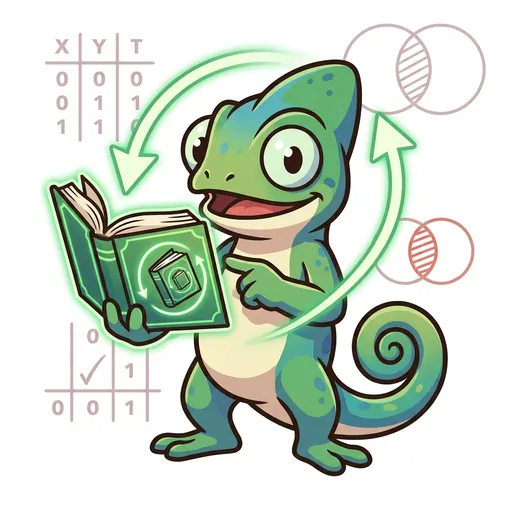
Circular-Reasoning Cici
CIRCULAR REASONING — *assuming the conclusion in the premise.* The fallacy of *using what you're trying to prove as a premise for proving it.*
Listen along — Circular-Reasoning Cici
Loading audio…
Press play to listen along. The line being read lights up as you go.
Show full transcript
Loading transcript…
Chapter 10 — Cici and the Argument-That-Loops-Back
Cici was a small chameleon, quick-talking and always shifting colors from green to blue to cream. She had a habit of arguing in circles, a way of talking that always seemed to loop back to where it started. She wasn’t a villain, not really. More like a cautionary tale, walking around on two feet.
Her favorite move, her signature, was to make a claim, then defend it with the very same claim. If you challenged her, asking why something was true, her “support” would be the claim itself, just dressed up a little differently. “This book is reliable,” she might say, holding up a dusty volume. “It’s reliable because it says it’s reliable right here on page one.” The premise, the starting point of her argument, always smuggled in the conclusion.
This was Cici’s special talent, and it was important to notice. Cici embodied what grown-ups called circular reasoning, or sometimes begging the question. The fancy Latin term was petitio principii, which just meant “asking for the starting point.” It sounded like an argument, like she was giving you reasons, but she was really just using her conclusion as the reason for her conclusion.
One afternoon, Cici found herself in a lively debate with a group of other characters. They were discussing the best way to get to the Whispering Woods.
“The old map is the only trustworthy guide,” Cici insisted, tapping a rolled-up scroll. Her colors shifted from a confident forest green to a calm sky blue.
“Why do you say that, Cici?” asked Pip, a character known for asking too many questions. “It looks pretty faded.”
Cici puffed out her chest slightly. “It’s trustworthy because it’s the old map. Everyone knows the old map is the one you can trust.”
Pip frowned. “But why is it trustworthy? What makes it better than, say, the compass?”
Cici’s colors deepened to an intense emerald. “It’s trustworthy because it’s the only map that tells the truth about the Whispering Woods. If it wasn’t true, it wouldn’t be the old map, would it?” She looked around, satisfied, as if she’d just delivered a brilliant speech.
A moment of silence followed. The other characters exchanged glances. Cici’s argument felt solid to her, but to anyone listening closely, it was like a dog chasing its own tail. She said the map was trustworthy because it was trustworthy. She said it was the only map that told the truth because it was the old map, and the old map was the one that told the truth.
This was Cici’s way. She did this when she had a strong belief but no independent evidence to back it up. We all do this sometimes, clinging to an idea without real proof. The trick, the skill, was spotting when the reason given was just the conclusion in disguise.
It wasn’t hard to spot, once you knew what to look for. You could try to restate the argument: what was the claim, and what were the reasons Cici gave for it? Then, did any of those reasons just repeat the claim in different words? Often, you’d hear “because” followed by the very thing that was supposed to be proved.
For instance, Cici’s argument about the map could be broken down:
- Claim: The old map is trustworthy.
- Reason 1: It’s the old map.
- Reason 2: Everyone knows the old map is the one you can trust.
- Reason 3: It’s the only map that tells the truth. (Which, for Cici, was the same as being trustworthy).
Notice how Reason 2 and Reason 3 essentially just repeated the claim that the map was trustworthy. There was no new information, no outside proof. It was just the same idea, looping back on itself.
It was important to tell the difference between this kind of loop and a valid argument that just restated its conclusion for emphasis. Sometimes, after a good argument with real evidence, you might say the conclusion again at the end. That wasn’t circular reasoning. That was just making your point clear. Cici’s arguments, though, offered no real support at all.
Cici was a teaching archetype, not a villain. Her purpose was to show everyone how easily a mind could get caught in a loop. Spotting circular reasoning required careful listening and reading. It wasn’t about being mean to Cici, but about understanding how arguments worked. It was about checking if the premise, the starting point, was just the conclusion wearing a clever disguise.
The LogicQuest ensemble
Circular-Reasoning Cici is part of LogicQuest's distributed-narrative cast. Each character embodies a different curricular primitive; together they teach the full subject.
-

Ad Hominem Hannibal
Attacking the arguer, not the argument
-

Strawman Stella
Misrepresenting the opponent's argument
-

Slippery-Slope Sam
Chaining dire consequences from a small first step
-

Appeal-to-Authority Auntie
Citing irrelevant / unqualified authority as proof
-

Red-Herring Reggie
Deflecting to an irrelevant topic
-

False-Dichotomy Fia
Presenting only two options when more exist
-

Bandwagon Bran
Truth-by-popularity
-

Sunk-Cost Cyril
Refusing to change course because of past investment
-

Whataboutism Wanda
Deflecting criticism via someone else's wrongdoing
-

Equivocator Eva
Sliding a word's meaning mid-argument
-

Tu-Quoque Tessa
"You too!" — dismissing criticism by accusing the critic of the same thing
-

Modus-Ponens Mo
If P then Q; P; ∴ Q
-

Modus-Tollens Tara
If P then Q; ¬Q; ∴ ¬P
-

Syllogism Solon
All M are P; all S are M; ∴ all S are P
-

Disjunctive-Syllogism Dior
P ∨ Q; ¬P; ∴ Q