Lasso
the single closed loop — each number uses exactly that many of its four edges; the drawn edges form one loop with no branches
Press play to listen along. The line being read lights up as you go.
Show full transcript
Loading transcript…
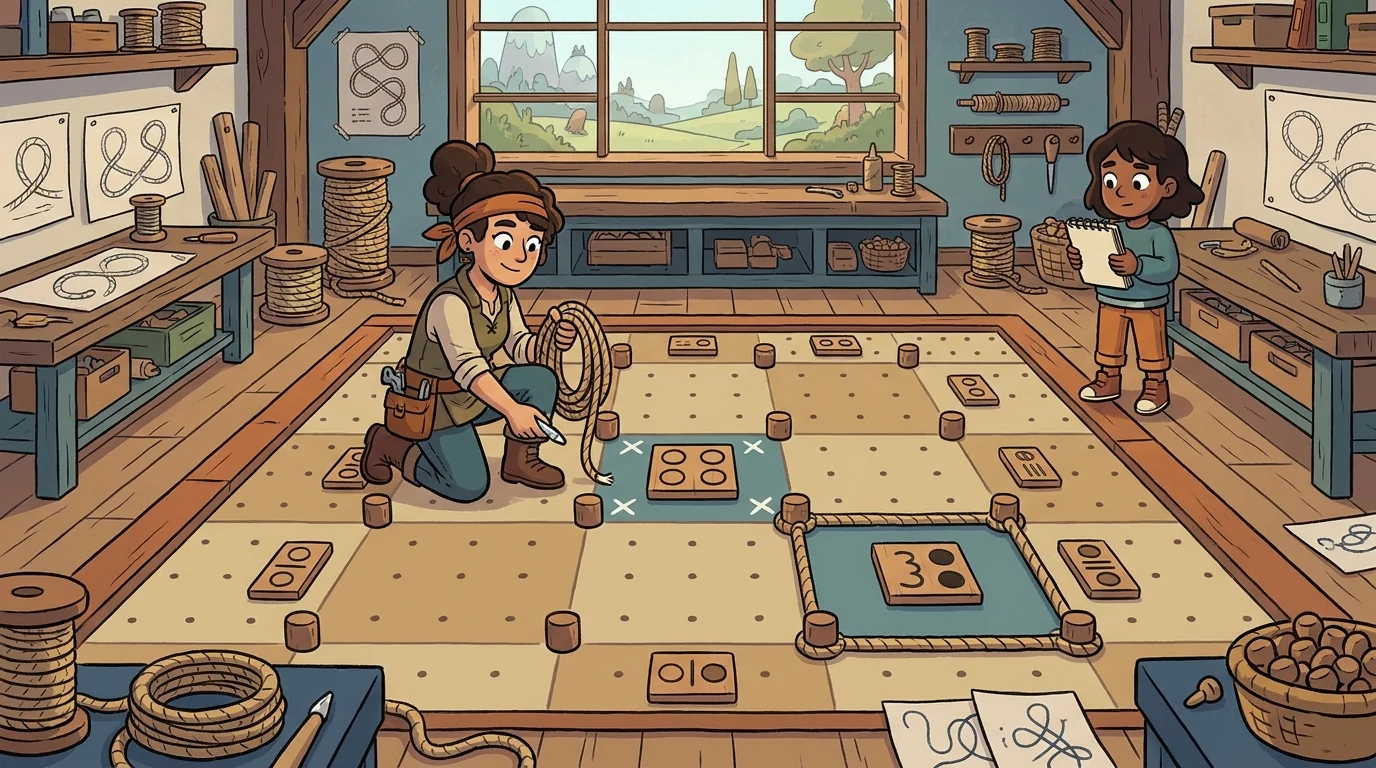
Lasso worked with rope — a single length of it — on a field of dots. Between the dots she could draw an edge or leave it blank. Scattered across the field were numbers, each sitting in a little square between four possible edges, and each number said the same strict thing: *exactly this many of my four edges are part of the rope. A 0 meant none — all four edges blank. A 3 meant three of four drawn. And when she was done, the drawn edges had to form one single closed loop*: no loose ends, no crossings, no side-branches, no second separate loop. One rope, tied to itself.
"A zero is the easy one, right?" Maya said. "Nothing around it."
"A zero is a gift," Lasso said, and firmly marked all four edges around a 0 as blank — little X's, not lines. "But here's the secret: the blanks are worth as much as the lines. Knowing an edge is not part of the loop forces its neighbours just as hard as knowing one is. A three beside a zero? The zero already blanked the shared edge, so the three must use its other three edges — all of them, no choice." She drew them, three sure strokes.
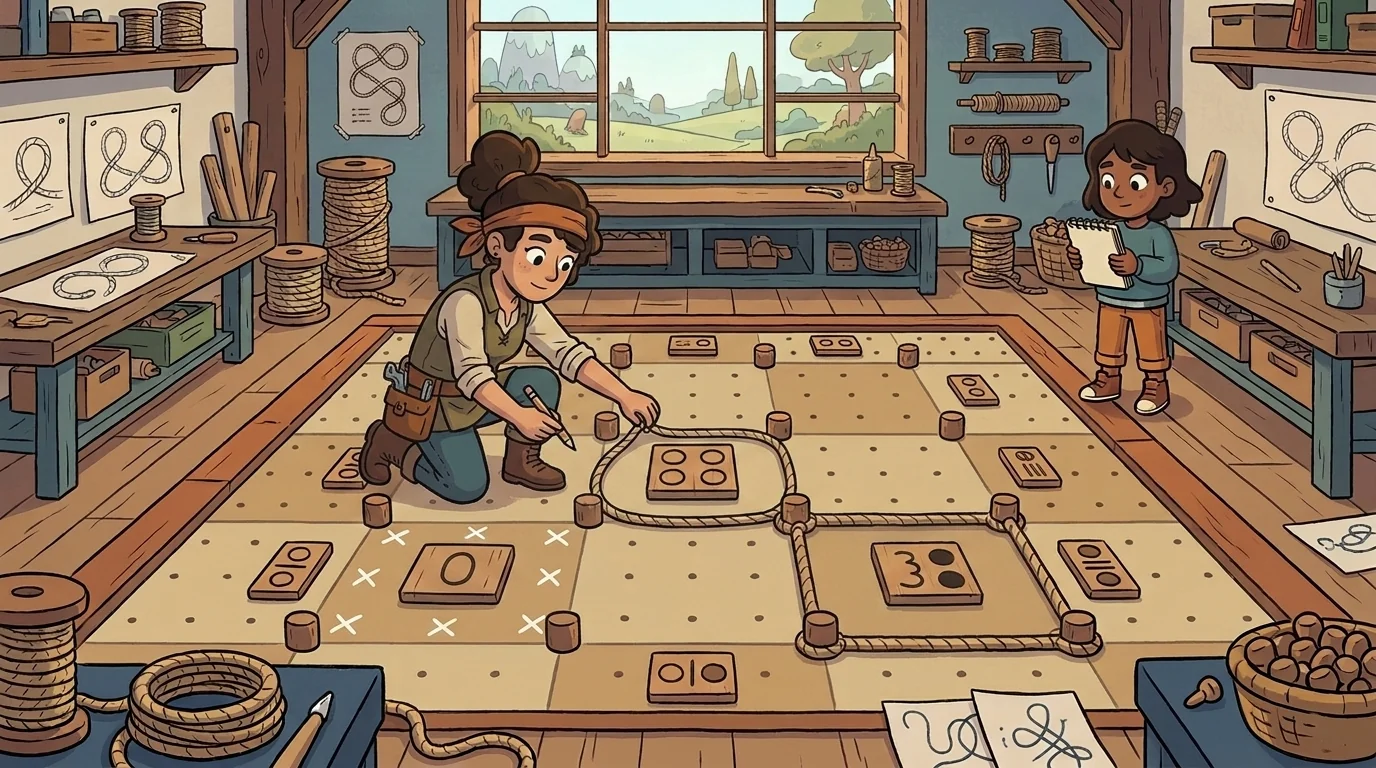
Lasso had been a ropewright on the docks, splicing lines for ships. A loop with a loose end was worse than no loop — it looked done and then failed under load. She'd learned to check not just where the rope went but everywhere it didn't: a cleat with no line, a ring left empty. "The gaps tell the story," the old ropewright told her. "A splice fails at the place you didn't look. Mark your blanks as carefully as your lines."
The lesson that stuck hardest was about branches. Once she let a rope split — two paths from one point — and a whole rig fouled. A loop can pass through a dot, in one edge and out another, but never three edges at a dot; that's a branch, and a branch means it isn't one clean loop anymore. She never let a dot sprout three edges again.
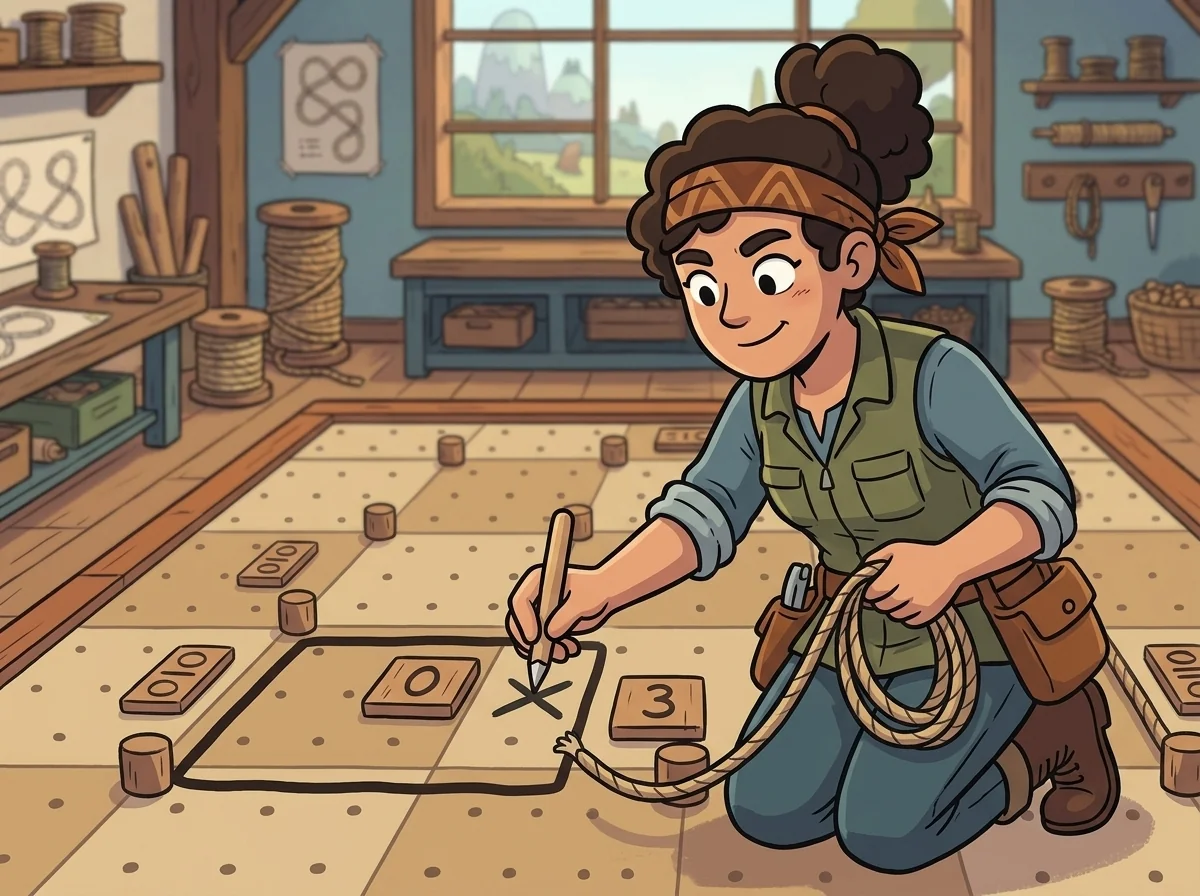
Ada recruited her after watching her fill a Slitherlink half with X's before drawing barely any lines. "You're solving it backwards," Ada said, delighted.
"I'm solving it both ways," Lasso said. "Every dot has a rule too: the rope either passes through it — exactly two edges — or misses it entirely, zero edges. Never one, never three. So if a dot already has two lines, I X-out its other two. If a dot has three X's, its last edge must be a line to make two. The numbers and the dots argue, and I just draw what they force."
Her craft is the interplay of the little clues. A *3 and a 3 side by side force the edge between them and the two outer edges. A 0 blanks its neighbourhood. A corner 1* can only use edges pointing inward. She threads certainty around the grid — line here because a dot demands it, X there because a number is already satisfied — until the rope has only one way to close.
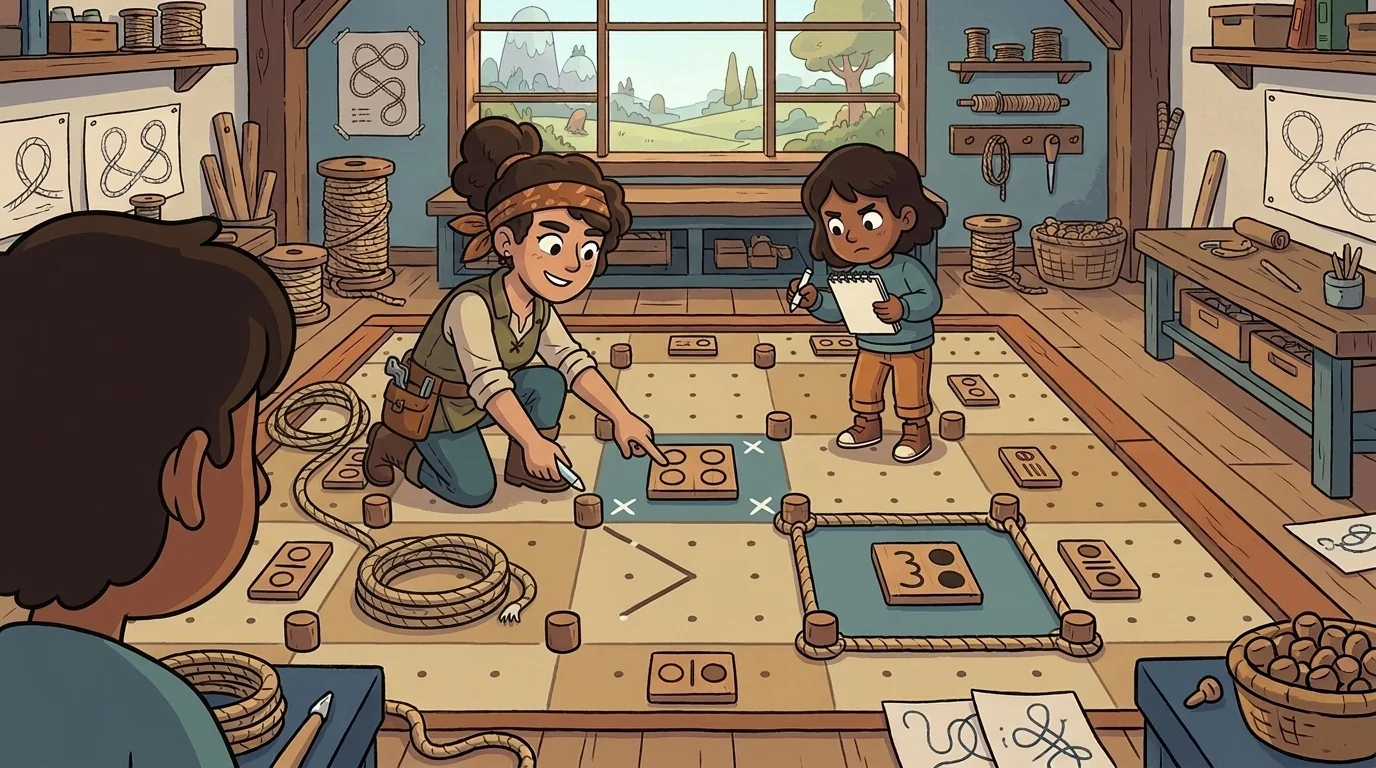
A boy kept drawing lines that dead-ended.
"Where does that line go next?" Lasso asked, pointing at a stroke ending at a bare dot.
"Um. Nowhere yet."
"A dot with one line isn't allowed — the rope can't stop in midair. Either a second edge continues it, or that first line was wrong. Which of the dot's other edges can't be blank?" He counted the X's already around the dot. Only one edge remained open. "So it has to continue there," he said, and drew it — and the forced continuation ran straight into a *3* that snapped three more edges into place.
"You didn't guess the path," Lasso said. "The 'no loose ends' rule drew it for you."
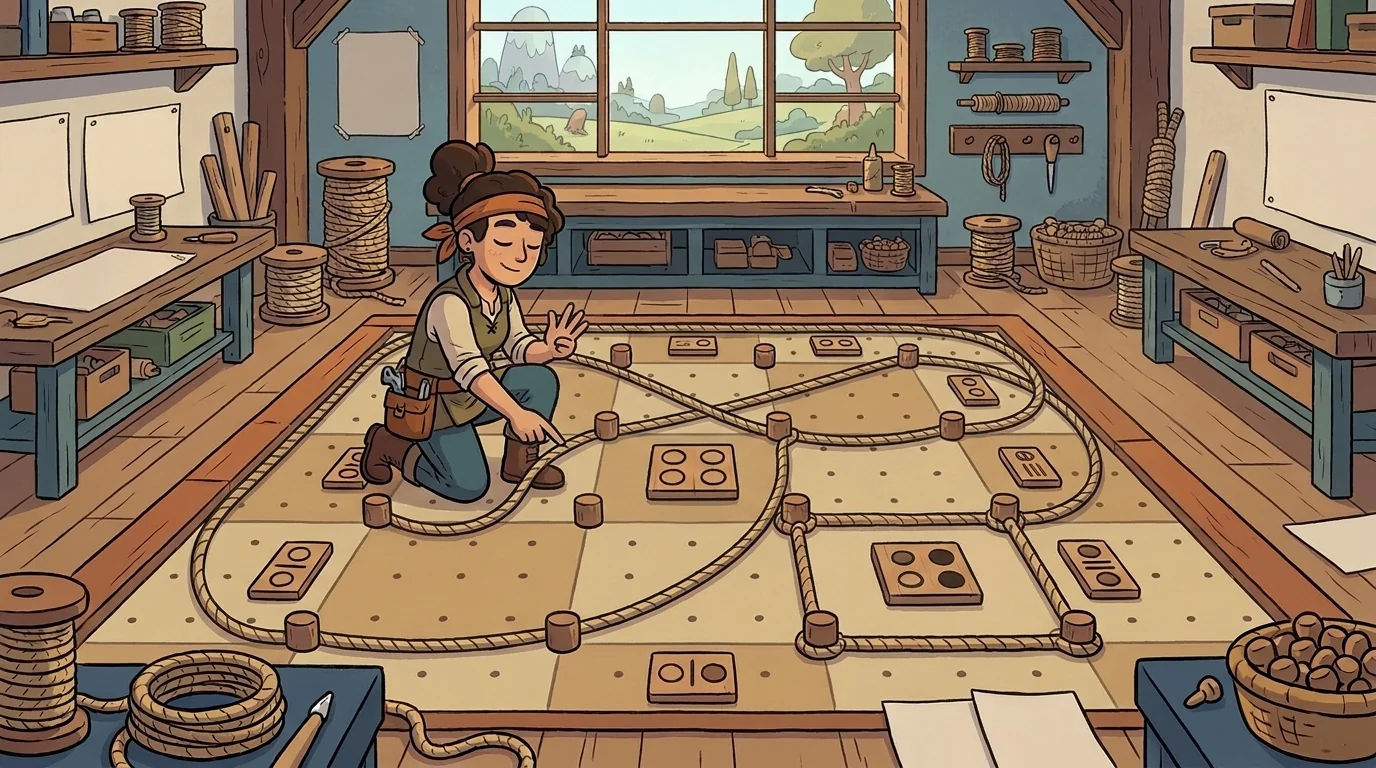
When the last edge falls, Lasso runs a fingertip along the whole rope — start anywhere, and you come back to where you began, passing every drawn edge once, never branching, never breaking. One loop. She counts each number's edges one final time: the 3 has three, the 0 has none, the 2 has two. All kept.
There's a deep satisfaction in a loop that closes — the ropewright's certainty that this one won't fail under load. The half-held tension of an open path, the worry of a loose end, releases the instant her finger completes the circuit and arrives home. Her hands, which tighten a little over an unfinished loop, go easy. "The gaps told the story," she says, the old dock-line under her voice, "and the rope came back to itself." One length, closed and true.
The LatticeForge ensemble
Lasso is part of LatticeForge's distributed-narrative cast. Each character embodies a different curricular primitive; together they teach the full subject.
-

Onlie
Sudoku — Latin-square uniqueness: sets her lantern on the only place a number can go in its row, column, and box
-
Cage
KenKen — arithmetic-cage: fills a fenced region so its numbers hit the plaque's target under its operation
-
Kaku
Kakuro — cross-sum: fills a run so it sums to its clue with no digit repeated; the total names its parts
-
Pica
Nonogram/Picross — run-length deduction: reads the edge numbers and fills the overlap that must be filled
-
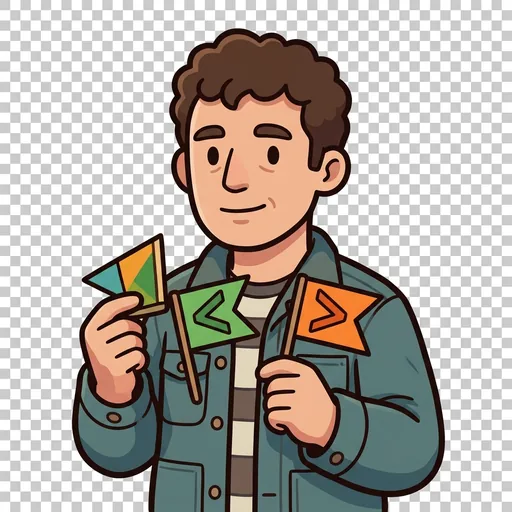
Chevron
Futoshiki — inequality/ordering: obeys the < / > flags between neighbours to force the numbers into order
-
Umbra
Hitori — elimination + connectivity: shades out duplicates so none touch and the rest stays whole
-

Serra
Skyscrapers — visibility count: places towers so each edge clue counts how many can be seen, taller hiding shorter
-
Vega
Star Battle — partition + non-adjacency: places the stars so each row, column, and region holds its quota and none touch
-

Ada
Mentor host — keeps the puzzle guild; teaches 'every grid hides one rule — find the forced cell, never guess'