Kaku
the cross-sum — a run of cells sums to its clue with no digit repeated in the run
Press play to listen along. The line being read lights up as you go.
Show full transcript
Loading transcript…
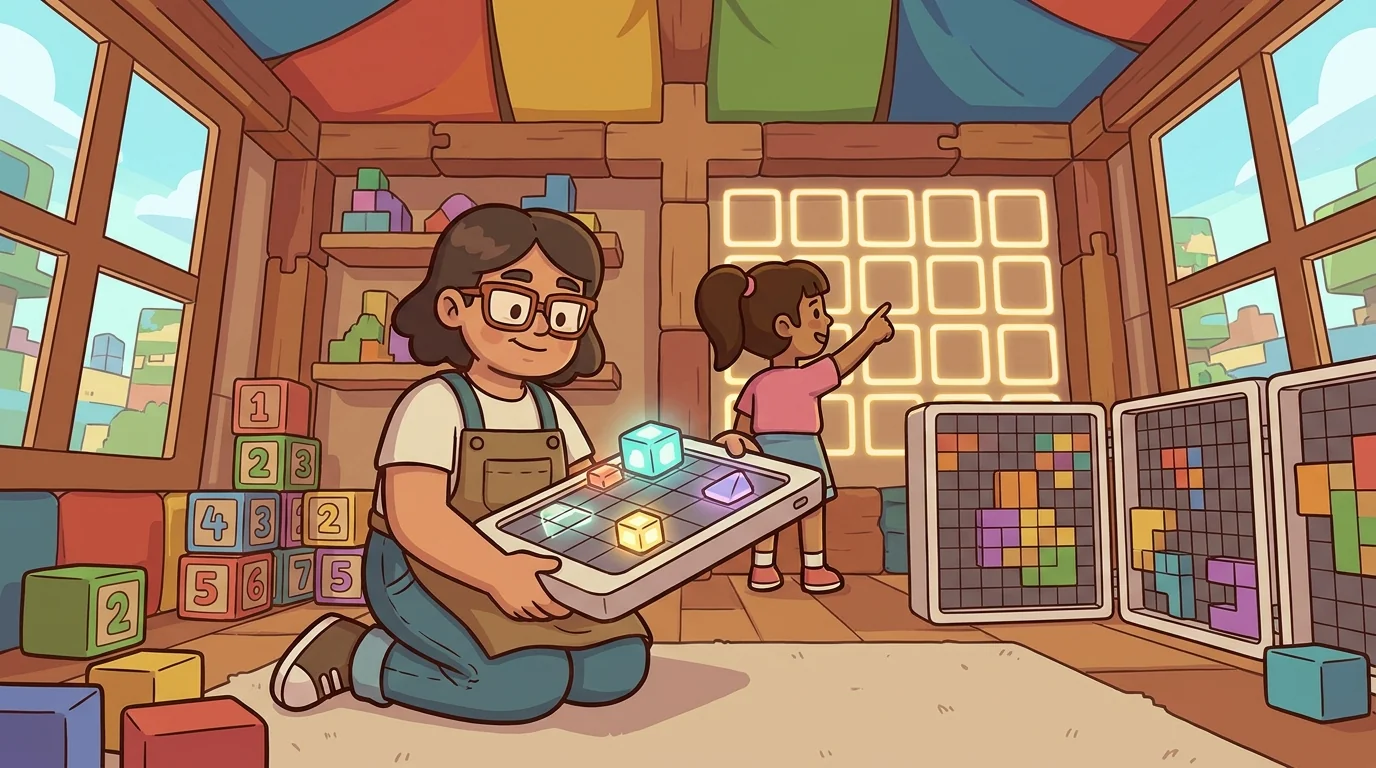
Kaku kept a ledger. Not of money — of runs. In her grids, the numbers marched in short horizontal and vertical runs, and above each run sat a clue: a total. The run had to add up to that total, using digits one through nine, and no digit could show up twice in the same run.
"So a run of two cells with a clue of three," Maya said, testing it.
"One and two," Kaku said without looking up from her ledger. "Only that. There's no other pair of different digits that adds to three." She wrote it in her book: 3-in-2 → {1,2}. "And a run of two with a clue of seventeen?"
Maya thought. "Eight and nine?"
"Eight and nine. The only pair. The clue named its parts. It just didn't tell you the order yet." Kaku turned the ledger so Maya could see the columns of tidy handwriting. Every entry was a total and the exact set of digits that total forces.
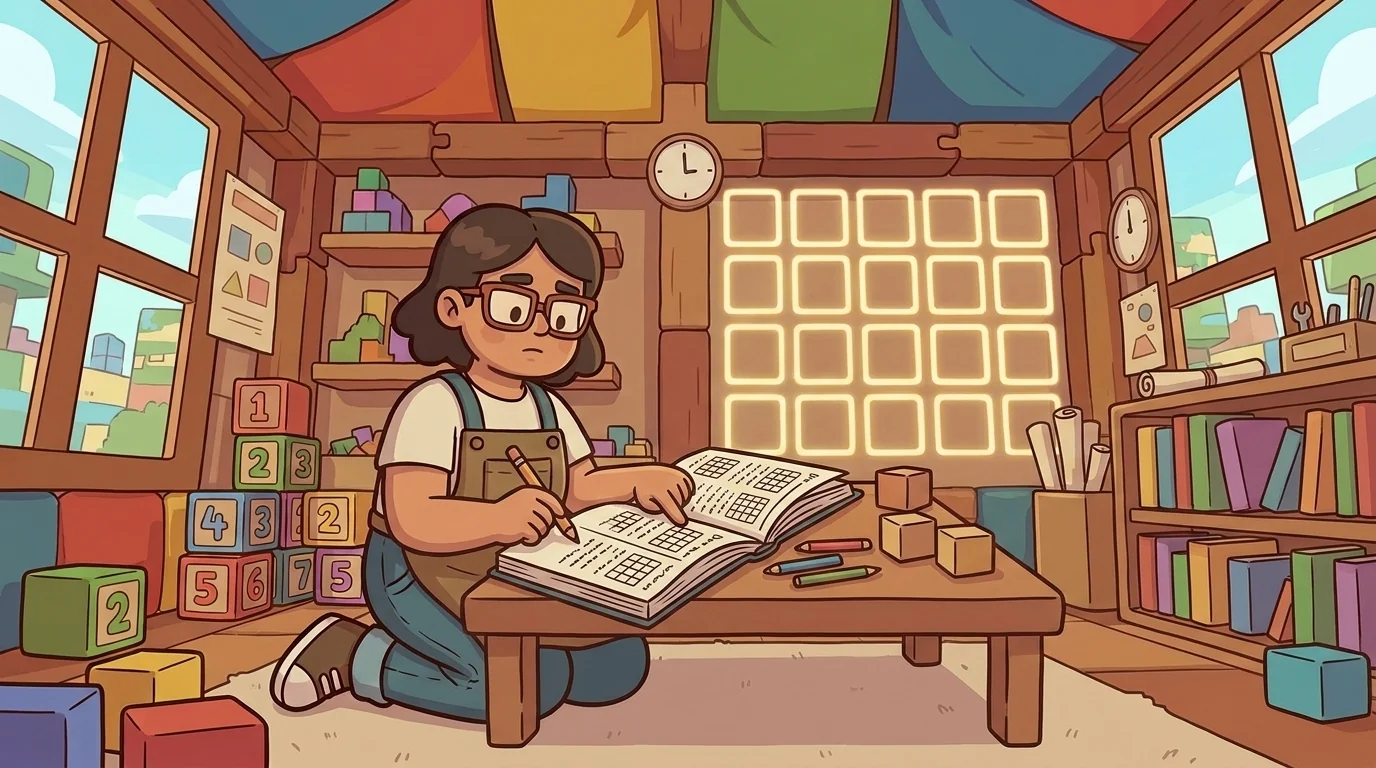
Before the Guild, Kaku had been an accounts-keeper who could never sleep until the books balanced. One night a whole page went wrong — a column of sums that refused to match her running total. She didn't guess which entry was off. She worked the extremes. The smallest the column could possibly be, if every cell held its lowest legal digit. The largest, if every cell held its highest. The true total had to sit between those, and where it didn't, she knew instantly which cell was lying.
She found the error by nine in the evening and slept like a stone. In the morning she realized she'd stumbled onto a whole way of thinking: a sum tells you not just what fits, but what can't. A run of three cells summing to six can only be one, two, three — the smallest three different digits there are. There's no slack. The total pins them.
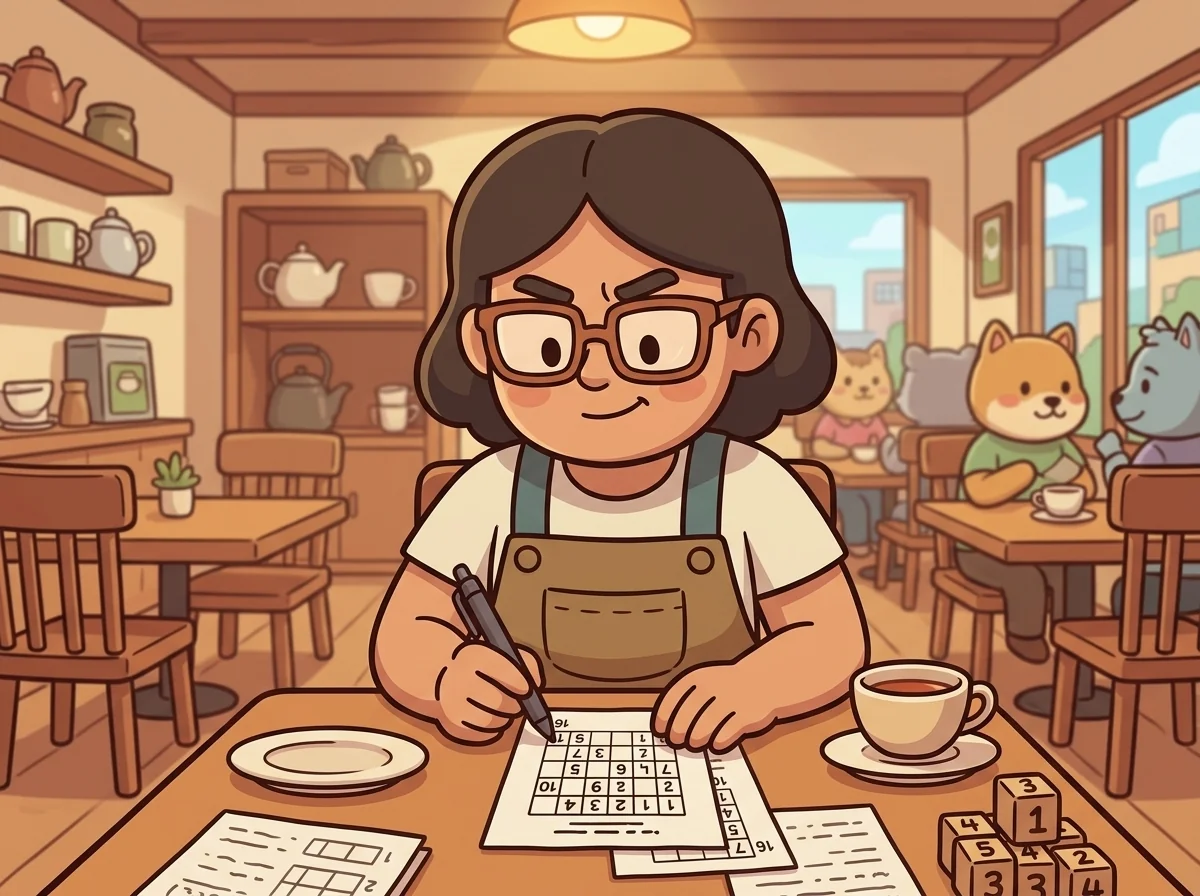
Ada found her doing puzzle-runs on the back of a receipt at a tea shop. "You're computing the forced sets in your head," Ada said, sitting down uninvited.
"There's usually only one," Kaku said. "People think a total is loose. It's the opposite. A small total in a long run, or a big total in a short run — those are the tightest clues in the whole grid. They barely have any freedom at all."
"Come keep the Guild's ledger," Ada said. "We have runs no one else will touch."
Kaku's method is to start where the sums are meanest. A four-cell run clued *10 is just one, two, three, four — the only four different digits that reach ten. A two-cell run clued 16 is seven and nine. She fills the forced sets first, then lets the crossing runs — where a horizontal run and a vertical run share a single cell — settle the order. The horizontal says this cell is a 7 or a 9; the vertical says this cell is a 3 or a 7*; both are true, so the cell is seven, and the rest falls.

A boy brought her a run he swore was impossible: three cells, clue *24*.
"Seven, eight, nine," Kaku said. "The three biggest different digits. Twenty-four is the most three cells can hold. So there's no choice about which digits — only about their order, and the crossing runs will fix that."
"How did you know that so fast?"
"Because twenty-four in three cells has no slack," she said. "When a run is stretched to its absolute maximum or squeezed to its absolute minimum, the set is forced. Learn the meanest and the biggest sums by heart and half the grid fills itself." She wrote 24-in-3 → {7,8,9} in his hand with her fingertip, so he'd feel it, not just see it.
At the close of a grid Kaku runs her pen down every clue one last time, checking each run against its total. Three sums to six. Ten sums to ten. Twenty-four sums to twenty-four. No digit doubled in any run. The books balance.
She lets out a slow breath she's been holding since the meanest clue — that tight, held-in breath you keep without noticing while a thing is still uncertain. When the last run checks, the breath goes out long and even, and something behind her sternum loosens. "The total knew all along," she says quietly, closing the ledger. "It named its own parts. I just wrote them down in the right order." And the relief of it — of a thing that had to be, finally being — is as good as any full night's sleep.
The LatticeForge ensemble
Kaku is part of LatticeForge's distributed-narrative cast. Each character embodies a different curricular primitive; together they teach the full subject.
-

Onlie
Sudoku — Latin-square uniqueness: sets her lantern on the only place a number can go in its row, column, and box
-
Cage
KenKen — arithmetic-cage: fills a fenced region so its numbers hit the plaque's target under its operation
-
Pica
Nonogram/Picross — run-length deduction: reads the edge numbers and fills the overlap that must be filled
-

Chevron
Futoshiki — inequality/ordering: obeys the < / > flags between neighbours to force the numbers into order
-

Umbra
Hitori — elimination + connectivity: shades out duplicates so none touch and the rest stays whole
-

Serra
Skyscrapers — visibility count: places towers so each edge clue counts how many can be seen, taller hiding shorter
-

Lasso
Slitherlink — single-loop edge deduction: draws one closed loop so each number uses exactly that many edges
-

Vega
Star Battle — partition + non-adjacency: places the stars so each row, column, and region holds its quota and none touch
-

Ada
Mentor host — keeps the puzzle guild; teaches 'every grid hides one rule — find the forced cell, never guess'