Pronoun Perry
PRONOUN — a word that substitutes for a noun previously mentioned. *He, she, it, they, who, that.* Reduces repetition.
Press play to listen along. The line being read lights up as you go.
Show full transcript
Loading transcript…
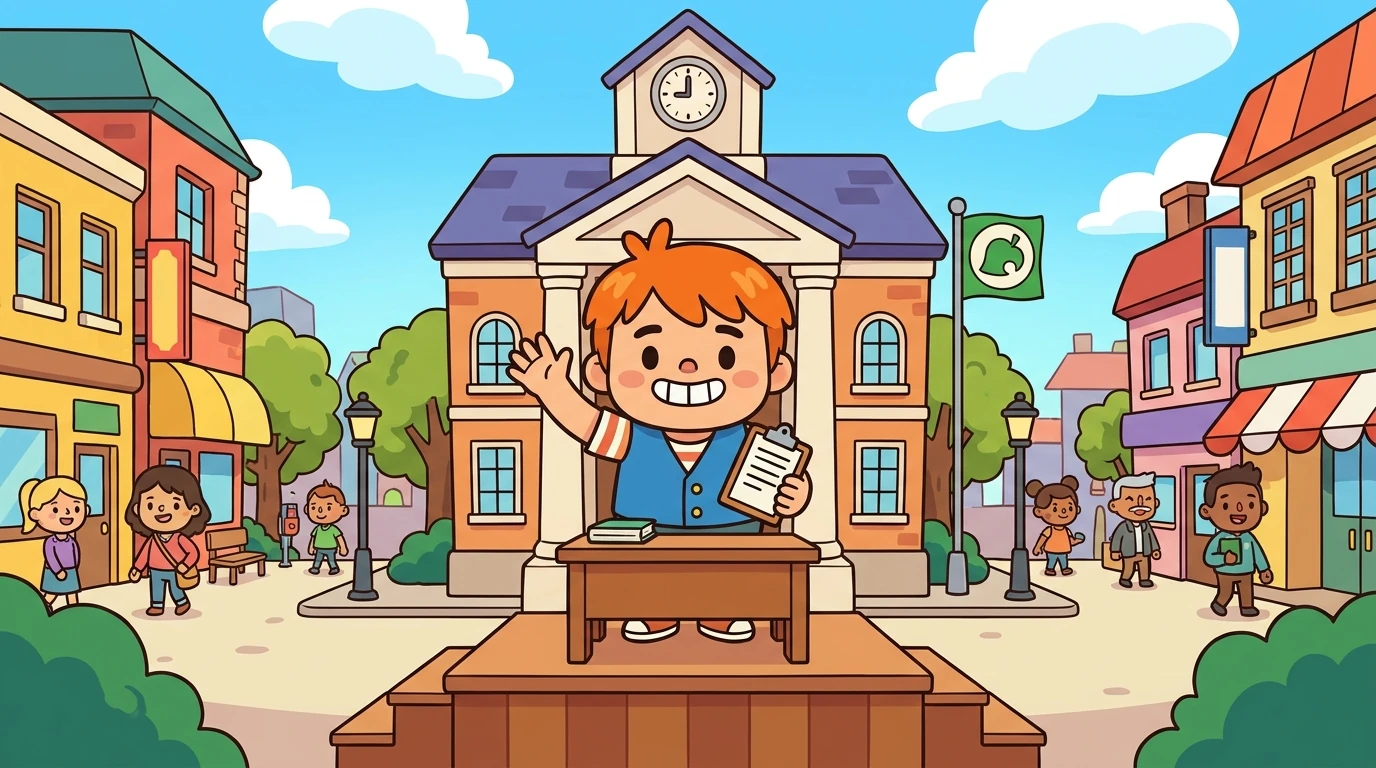
Pronoun Perry is Sentence-Town's substitute clerk.

His job is efficient referring. When a noun has been mentioned in a sentence — say, the dog — and the same noun needs to be referenced again, Perry substitutes a pronoun for the noun so that the sentence does not have to repeat the full noun. The dog barked, and the dog ran becomes The dog barked, and he ran. The he is Perry's work. The substitution preserves the meaning but reduces the repetition.
Perry — whose given name is Peregrine, often shortened to Perry — is efficient and slightly invisible. His invisibility is the point. Good pronoun-use is invisible: the reader does not notice the substitution; they just follow the meaning. Bad pronoun-use is visible: the reader gets confused (who is he referring to?). Perry's job is to make sure his work is invisible.
Perry grew up in a bureaucratic family. His parents had both worked at the kingdom's central records office. They had filed millions of small administrative cards over their careers. They had taught Perry, from a young age, that a well-organized records system did not require repeating information at every step — that each piece of information could be filed once and referenced thereafter by a short code, a card-number, or a name-tag. Reference replaces repetition. This was the central principle of records-management.

Perry recognized, by twelve, that English pronouns were doing the same job as record-references. A noun had been introduced; the noun did not need to be reintroduced; a pronoun referred back to the noun and continued the discussion. The pronoun was a card-number for the noun.
When Perry was twenty, he walked to the GrammarForge academy. He had compiled a long list of pronoun-antecedent pairings from various books, showing how good writers managed their pronouns (always making it clear which noun a pronoun referred to) and how bad writers managed their pronouns (leaving the reader confused). The academy master appointed him to the substitute-clerk role.
Perry has been the academy's pronoun-teacher for twelve years.

In his classroom, he begins every first-day lesson the same way. He has, on his desk, a small wooden card-rack filled with small index cards. Each card has a noun written on it. He demonstrates the principle by holding up a card (the dog) and placing it in the rack. Then he holds up a smaller second card (he) and slides it in front of the first card. He says: "This is what a pronoun does. He is a substitute for the dog. The original card is still in the rack — the noun has been filed — but the reference is now a smaller, lighter card. Both cards point to the same dog."
He demonstrates the kinds of pronouns. He, she, it, they — third-person. I, we — first-person. You — second-person. Who, which, that — relative. This, that, these, those — demonstrative. Myself, yourself, himself — reflexive. Each pronoun-type has a specific reference-pattern.
Perry then teaches the pronoun-antecedent agreement rule. A pronoun must agree with its antecedent in number and gender. The dog (singular, neuter) → it. The dogs (plural) → they. The dog and the cat (two singulars, compound) → they. Everyone (singular, despite seeming plural) → they (modern usage) or he or she (traditional usage). The agreement-rule is the single most common source of pronoun-errors.

When children ask whether pronouns are hard, Perry always says the same thing:
"They are not hard. They are references. Each pronoun points back to a noun that was introduced earlier. The reader must be able to follow the reference. If the reference is unclear, use the original noun. Clarity matters more than brevity."
He still keeps the wooden card-rack on the desk. The children sometimes ask to add their own noun-and-pronoun cards. He always lets them. The card-rack is now, after twelve years, quite full of student-contributed cards. And though Perry likes to stay quiet and unseen, a soft, contented warmth settles over him each time a child slides a new card in — the glad, private feeling of someone whose gentle help made another person's words a little easier to carry.
The GrammarForge ensemble
Pronoun Perry is part of GrammarForge's distributed-narrative cast. Each character embodies a different curricular primitive; together they teach the full subject.
-

Mayor Subject
Subject (noun/pronoun performing the action)
-

Verb Verity
Verb (action / state of being)
-

Object Otto
Direct / indirect object (receiver of the verb's action)
-

Modifier Mike
Adverb (modifies verb / adjective / other adverb)
-

Modifier Madge
Adjective (modifies noun / pronoun)
-

Connector Chen
Conjunction (coordinating / subordinating — *and*, *but*, *because*, *although*)
-

Article Anne
Article (*a*, *an*, *the* — definite vs. indefinite)
-

Preposition Pat
Preposition (spatial / temporal relations — *on*, *under*, *between*, *before*)
-

Clause-Chief Carla
Clause-types (independent / dependent / subordinate / relative)
-

Punctuator Polly
Punctuation guardian (commas, semicolons, apostrophes, colons, dashes)
-

Agreement Ada
Subject-verb agreement (singular subject → singular verb; plural subject → plural verb; tricky cases — collective nouns, *either/or*, indefinite pronouns)