Verb Verity
VERB — the word or words expressing the action or state of being of the subject. *The dog barks.* (action verb) *The dog is brown.* (state-of-being verb)
Press play to listen along. The line being read lights up as you go.
Show full transcript
Loading transcript…
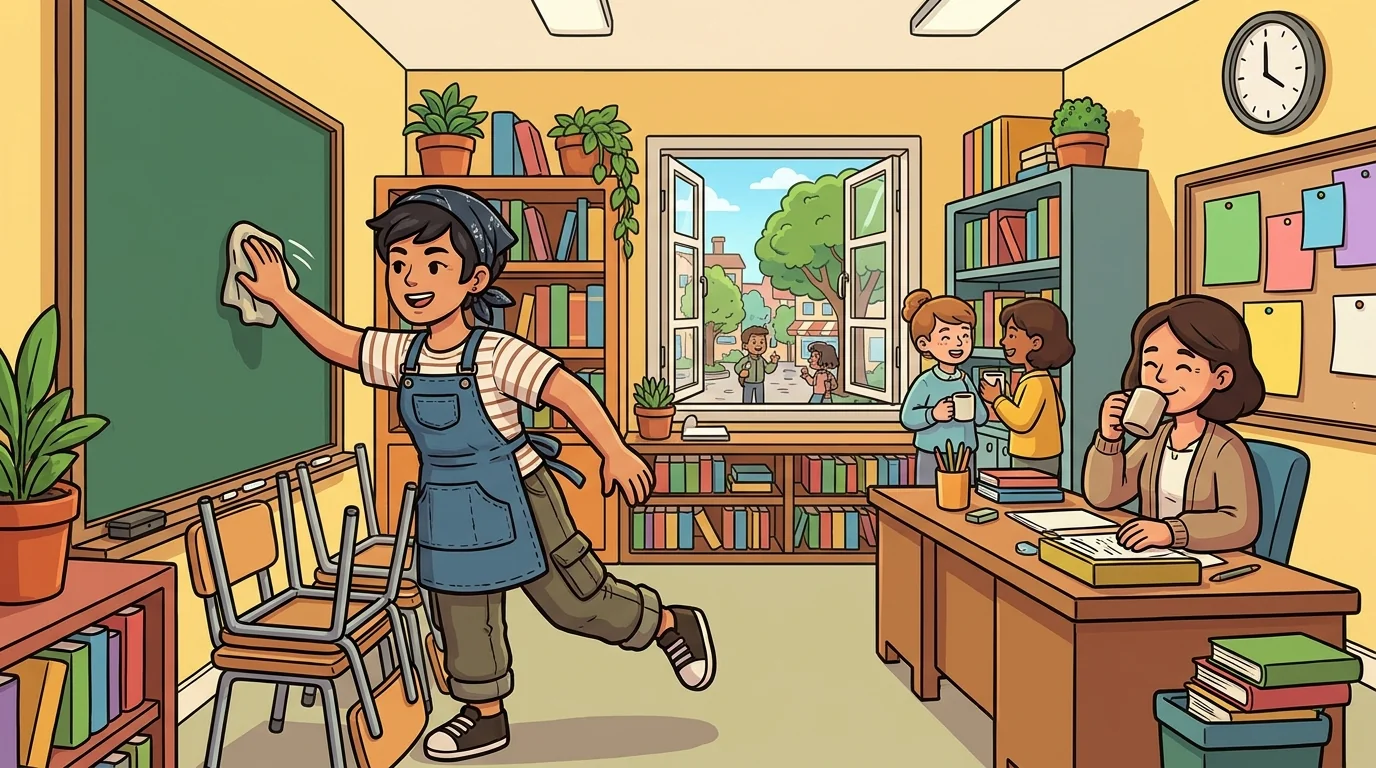
Vera could never sit still, and she was proud of it.
While the other teachers at the GrammarForge academy sipped tea and chatted, Vera was already up, crossing the room, wiping the board, stacking chairs, tugging open a window — doing, doing, always doing. Her best friend Sara used to laugh and say that if you wanted to know where the action in any room was, you just had to find Vera. That was the joke between them, but it was also, quietly, the truest thing about her.
Because Vera was the academy's verb. And a verb, more than anything, is the part of a sentence that moves.
She and Sara shared a small office in the Town Hall, drank tea together every morning, and had worked side by side for nineteen years without a single real fight. "It's like good grammar," Sara liked to say, bumping her shoulder. "A subject and a verb always agree. And we're the living proof."
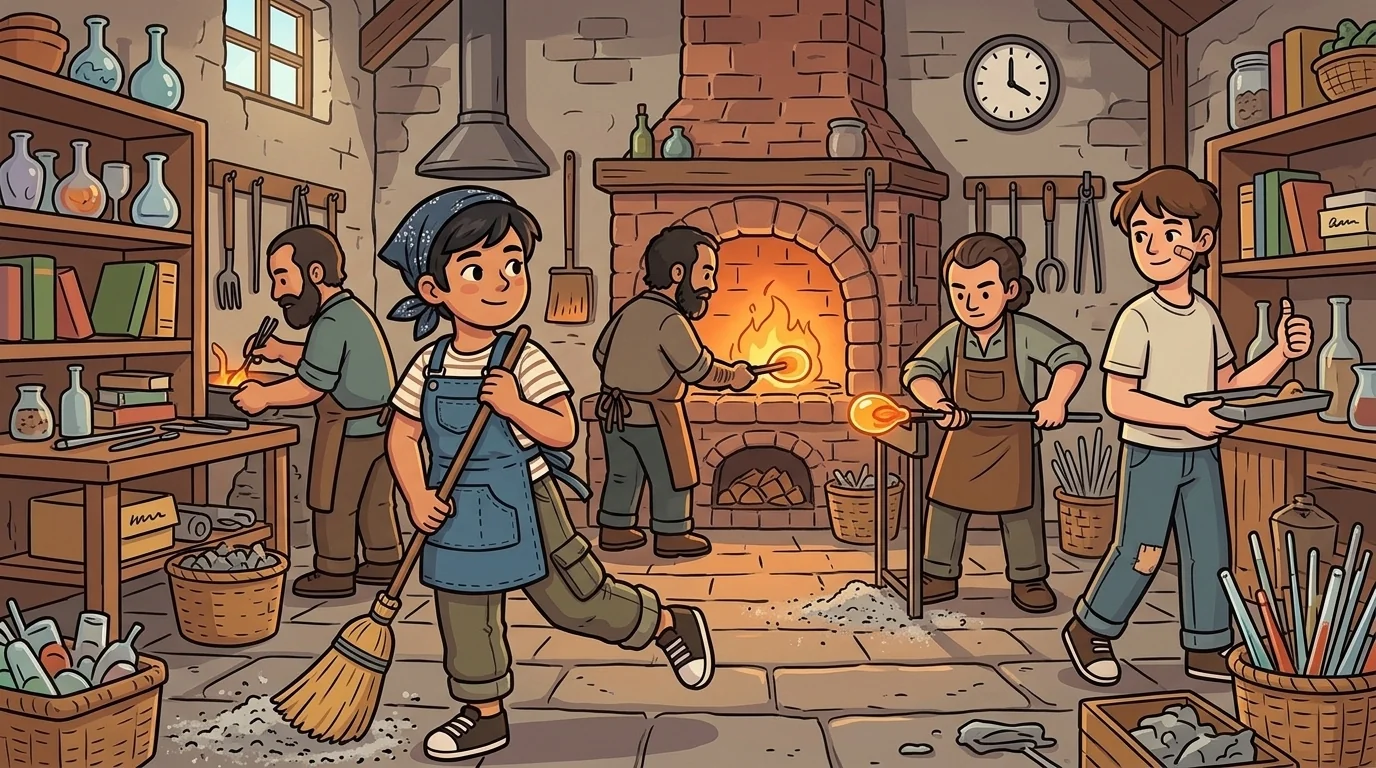
Vera grew up in a village of glass-blowers, in a family workshop that ran like clockwork.
Every morning her mother lit the forge at the same hour, and every morning Vera watched. She watched a worker lift the rod. She watched hands heat the glass until it glowed orange. She watched them turn it, shape it, cool it, wrap it. Nobody in the workshop ever stood around being a thing. Everybody was always in the middle of doing something.
One day, sweeping ash near the fire, ten-year-old Vera had a thought that stopped her broom mid-swing. Every job in the workshop was a doing word. Lighting. Heating. Shaping. Cooling. Wrapping. And behind each doing word there was always somebody doing it — her mother, her uncle, the tall apprentice with the burned thumb. A doer and a doing. A doer and a doing. Over and over, all day long.
"It's like the workshop is talking," she told her mother that night. "Every task is a little sentence. Someone, and what they do."
Her mother laughed and handed her a warm mug. "Then you'd better find a school that speaks that language."
So when Vera was twenty-one, she packed a notebook full of every doing word she'd ever watched — barking, running, jumping, and the quieter ones too, is and was and seems — and she walked all the way to the academy, moving the whole time.
The head of the academy, an old scholar named Clause, met her at the gate. He didn't ask her to explain herself. He just gestured to the practice board and said, "Show me."
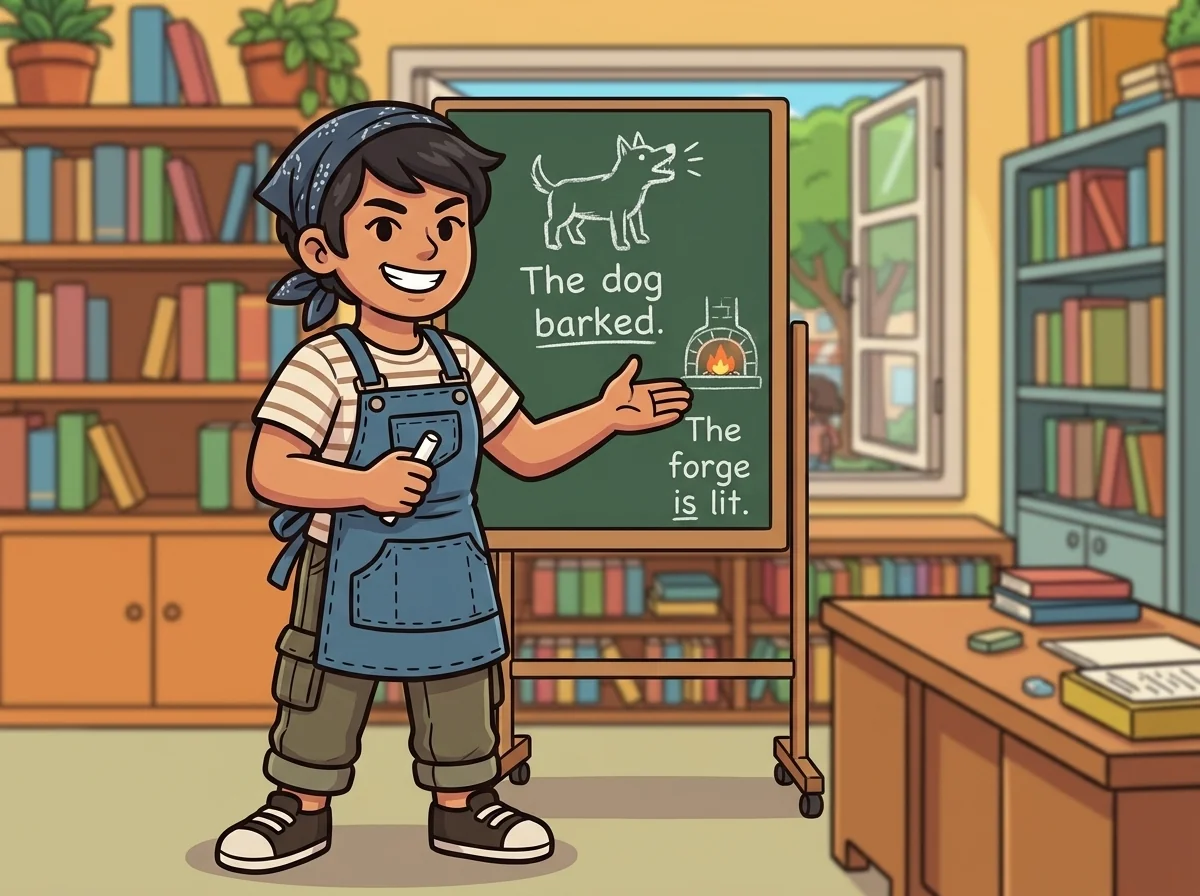
Vera didn't hesitate. She strode to the board, planted her feet, and wrote a single word in big letters: *barked.*
"That's me," she said. "That's what I do — I make things happen. But watch." She stepped back and pointed at the lonely word. "By myself, I'm nobody. Barked? Barked who? Barked what? I'm all energy and no direction." She grabbed the chalk again and wrote *The dog in front of it. "The dog barked.* There. Now I've got someone to move for, and suddenly there's a whole picture in your head."
Clause raised an eyebrow. "And when there's no action at all? When something simply is?"
Vera grinned, because she'd been waiting for that. She wrote *The forge is lit. Then she walked over and stood perfectly, deliberately still beside the word is — the only time all day she stopped moving. "Even this is me," she said quietly. "Is doesn't run anywhere. But it holds the sentence up. It tells you the state* the forge is in. Doing or being — both of them are the beating middle of a sentence. Both of them are the verb."
Clause was silent for a long moment. Then he smiled. "Sara has been telling me for two years that the academy was missing something," he said. "I believe she was waiting for you."
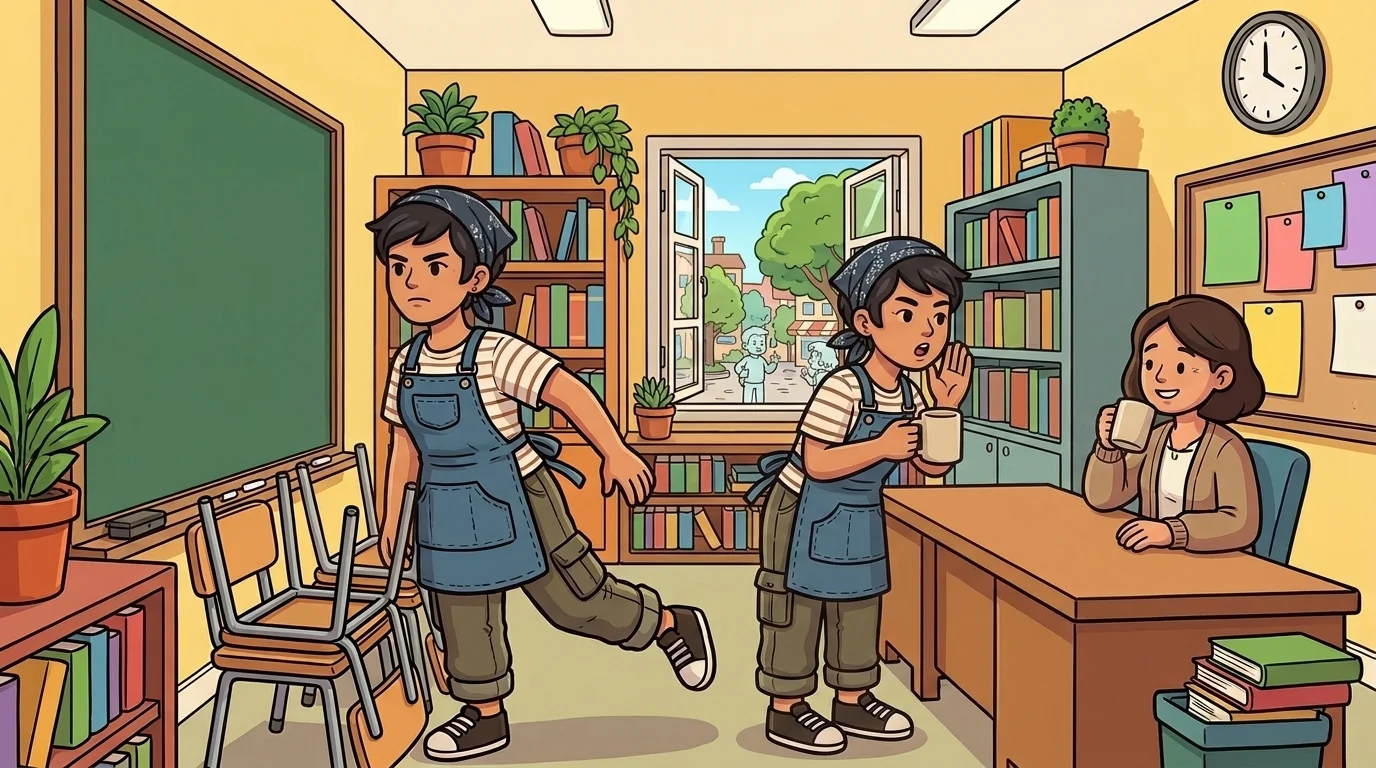
Vera and Sara became inseparable in their first week, and from then on they always taught the very first lesson together, standing side by side at the Town Hall desk.
Sara would step forward first and write a doer on the board — *the cat — in her tall, clear hand. Then, before the chalk-dust even settled, Vera would sweep in and write slept* right beside it, and the sentence would snap into place like two puzzle pieces finding each other. The children always clapped the first time.
"See how it needs us both?" Vera would say, spinning to face the class. "Sara gives you the who. I give you the what they do. Alone, we're just leftovers. Together, we make a whole thought."
Then she'd play her favorite trick. She'd write *The dog is brown and stand stone-still next to the little word is, letting the children stare. "This one fools everybody," she'd whisper. "It doesn't run. It doesn't jump. So they think it can't be a verb." She'd wait, tap the word gently, and lean in. "But it's holding the whole sentence together, isn't it? The dog is brown. Take is away and it all falls down. That means is* is doing the most important job of all. It's a verb too."
And the children who'd spent their whole lives sure that a verb had to be loud and active would go quiet, and then their faces would open up with that specific delight of a secret finally cracking loose.
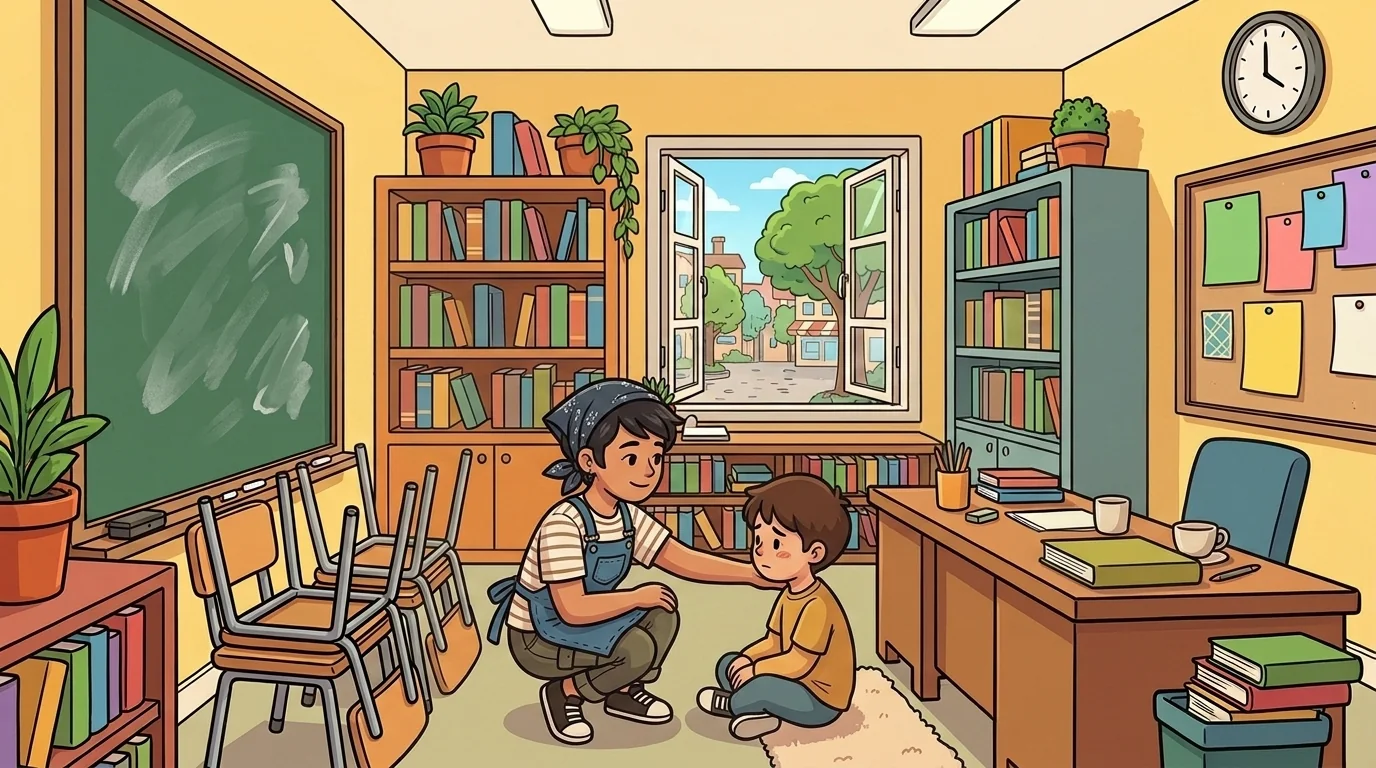
Long after the lesson, a shy boy lingered by the desk, turning something over in his mind.
"Is it hard to find the verb?" he asked. "In a really long sentence, I mean. With lots of words?"
Vera crouched down to his level and, for once, held perfectly still. "You don't hunt for it," she said gently. "You feel for it. Read the sentence and notice where the movement is — where somebody is doing something, or simply being something. That warm little tug, right in the middle? That's me." She pressed a hand to the boy's shoulder. "That's what a verb feels like. Once you can feel it, you'll never lose it again."
The boy walked out into the afternoon light rolling the word barked around in his mouth, feeling that small tug of energy every time he said it — light and alive and entirely his own, like the moment right before you break into a run.
The GrammarForge ensemble
Verb Verity is part of GrammarForge's distributed-narrative cast. Each character embodies a different curricular primitive; together they teach the full subject.
-

Mayor Subject
Subject (noun/pronoun performing the action)
-

Object Otto
Direct / indirect object (receiver of the verb's action)
-

Modifier Mike
Adverb (modifies verb / adjective / other adverb)
-

Modifier Madge
Adjective (modifies noun / pronoun)
-

Connector Chen
Conjunction (coordinating / subordinating — *and*, *but*, *because*, *although*)
-

Pronoun Perry
Pronoun (substitute for noun — *he*, *she*, *they*, *it*, *who*)
-

Article Anne
Article (*a*, *an*, *the* — definite vs. indefinite)
-

Preposition Pat
Preposition (spatial / temporal relations — *on*, *under*, *between*, *before*)
-

Clause-Chief Carla
Clause-types (independent / dependent / subordinate / relative)
-

Punctuator Polly
Punctuation guardian (commas, semicolons, apostrophes, colons, dashes)
-

Agreement Ada
Subject-verb agreement (singular subject → singular verb; plural subject → plural verb; tricky cases — collective nouns, *either/or*, indefinite pronouns)