Mayor Subject
SUBJECT — the noun or pronoun performing the action of the sentence. In *the dog barked,* the dog is the subject. Every sentence needs one (or implies one).
Press play to listen along. The line being read lights up as you go.
Show full transcript
Loading transcript…
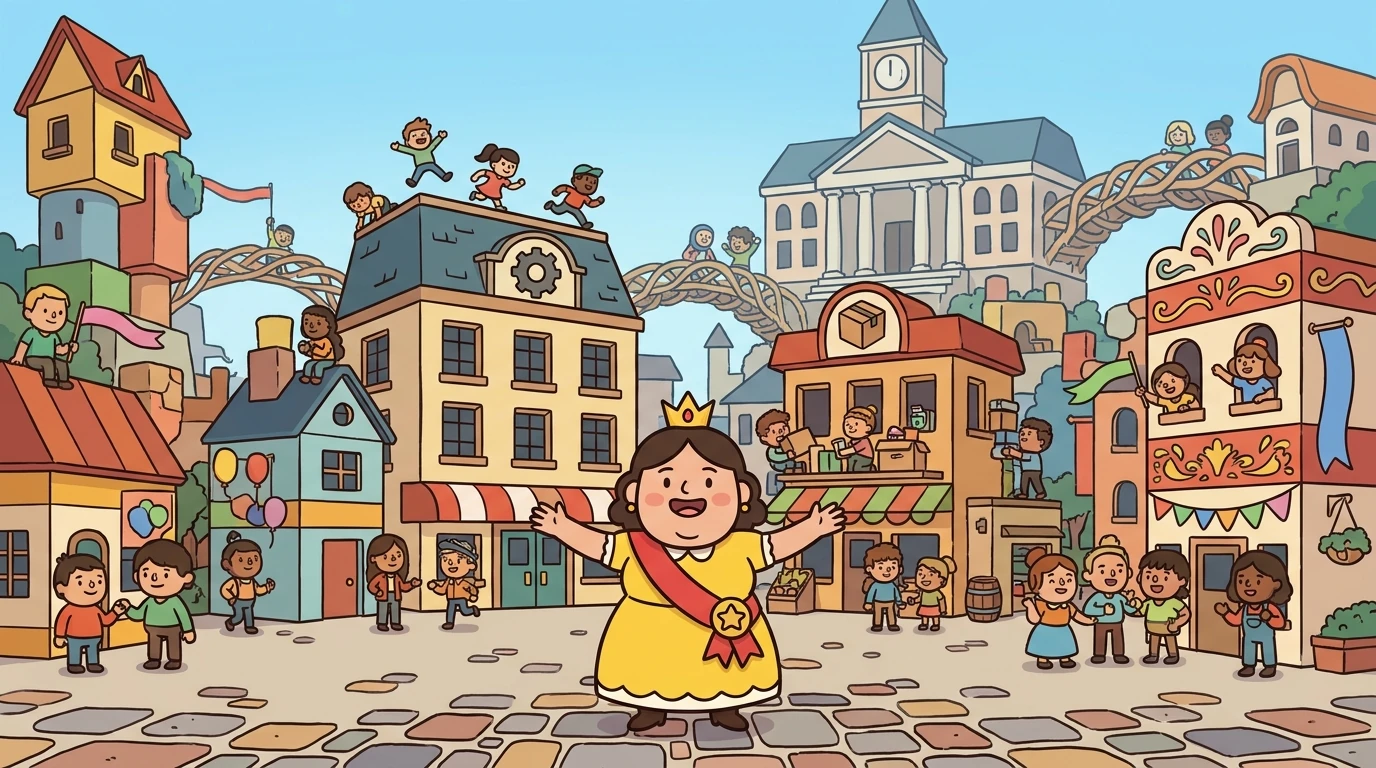
Mayor Subject is exactly what her name says. She is the mayor of a town.
The town is called Sentence-Town. It is a small, busy place. In the GrammarForge academy, this town exists inside every single sentence. Mayor Subject says every English sentence is like a little village. Everyone has a job to do.
First, there is the *subject. The subject* is the star of the sentence, the one who does the work. That is the mayor herself.
Next is the *verb. The verb is the action word, like run or jump*. Verb Verity is the chief of operations who handles the verbs.
Then comes the *object. The object* is the person or thing that receives the action. Object Otto is the public-affairs helper who looks after the objects.
There are also *modifiers. Modifiers* are adjectives and adverbs that describe things. Modifier Madge and Modifier Mike decorate the town with these words.
Finally, there are *connectors. Connectors are conjunctions, the words like and or but* that glue sentences together. Connector Chen is the diplomat who links them up.
Sentence-Town has twelve named officials. Each one has a special job. These jobs are the parts of speech.
Mayor Subject is the most important official of all. She will tell you this is not bragging. It is just a fact. Every English sentence needs a *subject*.
Some sentences do not have an object. Some do not have adjectives. Some do not even have connectors. But every sentence has a *subject*.
Sometimes you see it clearly, like in the sentence: "The dog barked."
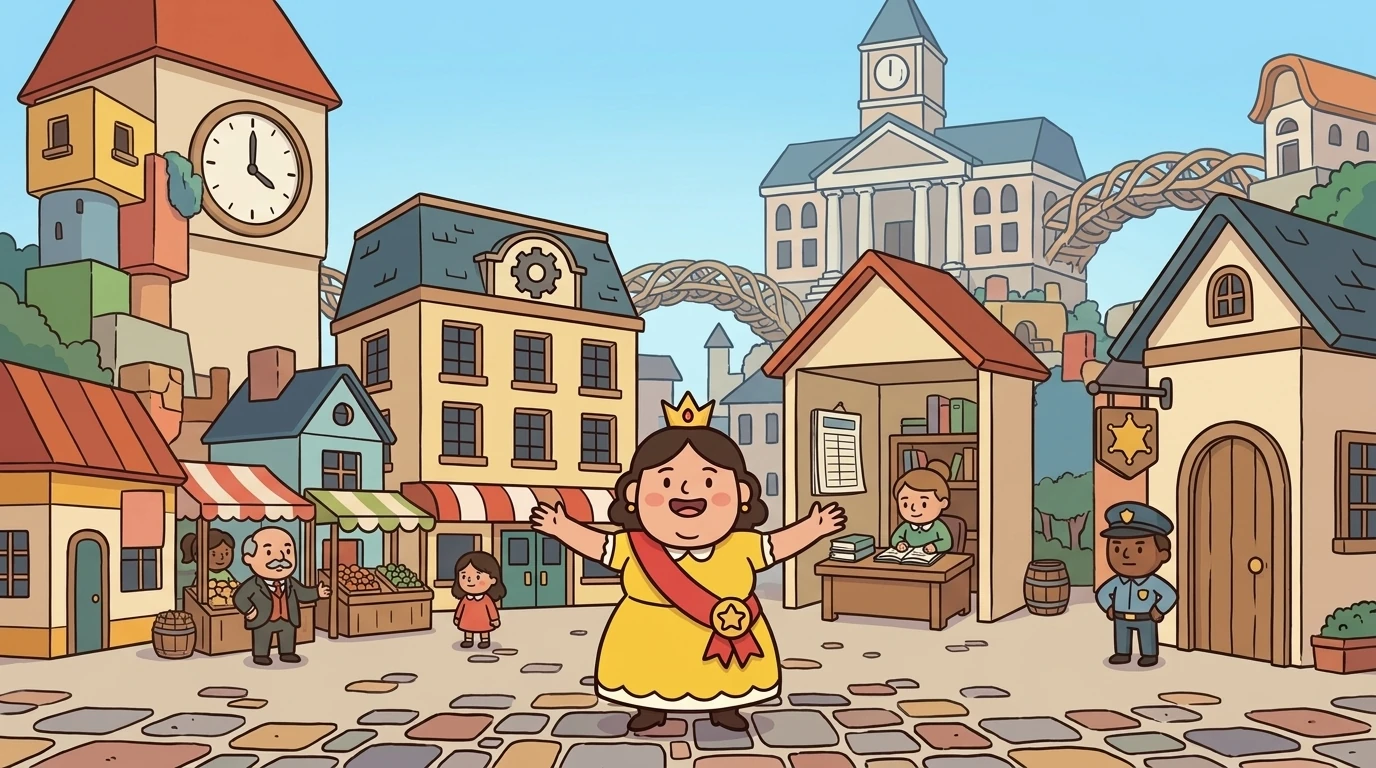
Sometimes the *subject is hidden, like in: "Eat your dinner." Here, the subject is you, even if we do not write it down. Without a subject*, there is no sentence at all. You just have a pile of words.
Mayor Subject’s real name is Sara. No one at the academy calls her that anymore. They have called her Mayor Subject for nineteen years.
She won her election when she was twenty-six. In Sentence-Town, the election is very simple. The job goes to the person who understands the *subject* best. Sara was the obvious choice.
She grew up in a quiet village called Subjectia. The village historians say the name was a mistake. A clerk long ago made a messy ink smudge on a map. Sara always laughed at that story.
Subjectia was a busy market town. It had a mayor, a clerk, a tax collector, and a constable. Young Sara loved to watch them work.
She noticed something interesting when she was nine years old. Every single decision in the village had one clear leader.
The mayor ran the market day. The clerk kept the books. The constable kept the peace. No job happened by itself. Someone always had to do it.
Sara realized that life is made of people doing things. This is the exact same rule that runs our language. It is the *subject-verb relationship*. It is the heartbeat of grammar.
A sentence is just a statement that someone does something. The *subject is the doer. The verb* is the action.
Without a doer, the action cannot happen. A town needs a mayor to make decisions. A sentence needs a *subject* to do the verb.
Sara understood this by the time she was twelve. When she learned grammar at school, she smiled.
"The *subject* is the mayor!" she told her teacher. "The verb is the mayor's decision!"

Her teacher clapped with joy.
At nineteen, Sara walked all the way to the GrammarForge academy. She carried a thick notebook. Inside, she had written down one thousand sentences.
She had circled every single *subject in bright red ink. She even wrote down if the subject* was a noun or a pronoun.
The head of the academy was a kind man named Master Clause. He read her notebook for a whole hour. He nodded and looked over his glasses.
"You must teach the *subject* here," Master Clause said. "Take a year to get ready. Then we will hold the election."
Sara agreed. She taught for a year. The academy voted, and everyone chose her. She has been the mayor ever since.
Her classroom is in the Town Hall building. It has dark wood walls and smells like old paper.
Every year, she starts her first lesson the same way. She puts on a shiny silver chain. It is her official mayor's chain. She sits at her desk and looks at the new students.
"Every sentence needs a mayor," she says. "The mayor is the *subject*. The mayor does the action. Without a mayor, the sentence falls apart."
She picks up a piece of white chalk. She writes on the board:
"The dog barked."
She points to the first two words.
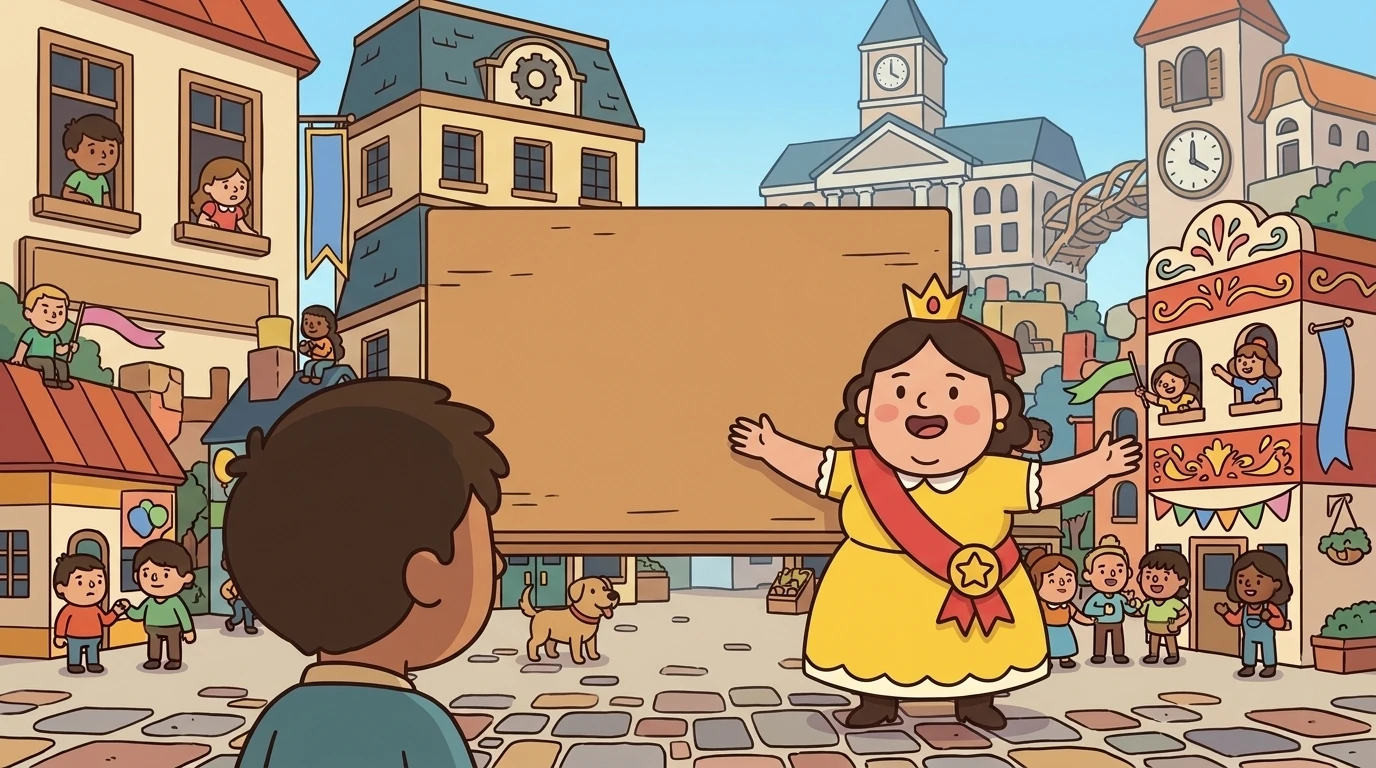
"This is the *subject*," she says. "The dog is doing the barking. The dog is the mayor of this sentence."
Next, she writes a single word:
"Barked."
She turns around to face the class.
"Is this a sentence?" she asks. "No. It is just a verb. There is no actor. There is no mayor. Who barked? We do not know. The sentence is empty."
Then she writes:
"Eat your dinner."
The students look confused. Where is the mayor?
"This looks like it has no mayor," she whispers. "But the mayor is hidden. The mayor is you. I am telling you to eat. This is an imperative sentence."
An *imperative sentence* is a sentence that gives a command or a polite order.
"The *subject* is still there," she says. "We just do not write it down."
The children always understand this. It makes sense.
During one class, a boy named Leo raised his hand. He looked at the heavy silver chain around her neck.
"Can I wear it?" Leo asked.
"Of course," Mayor Subject said.
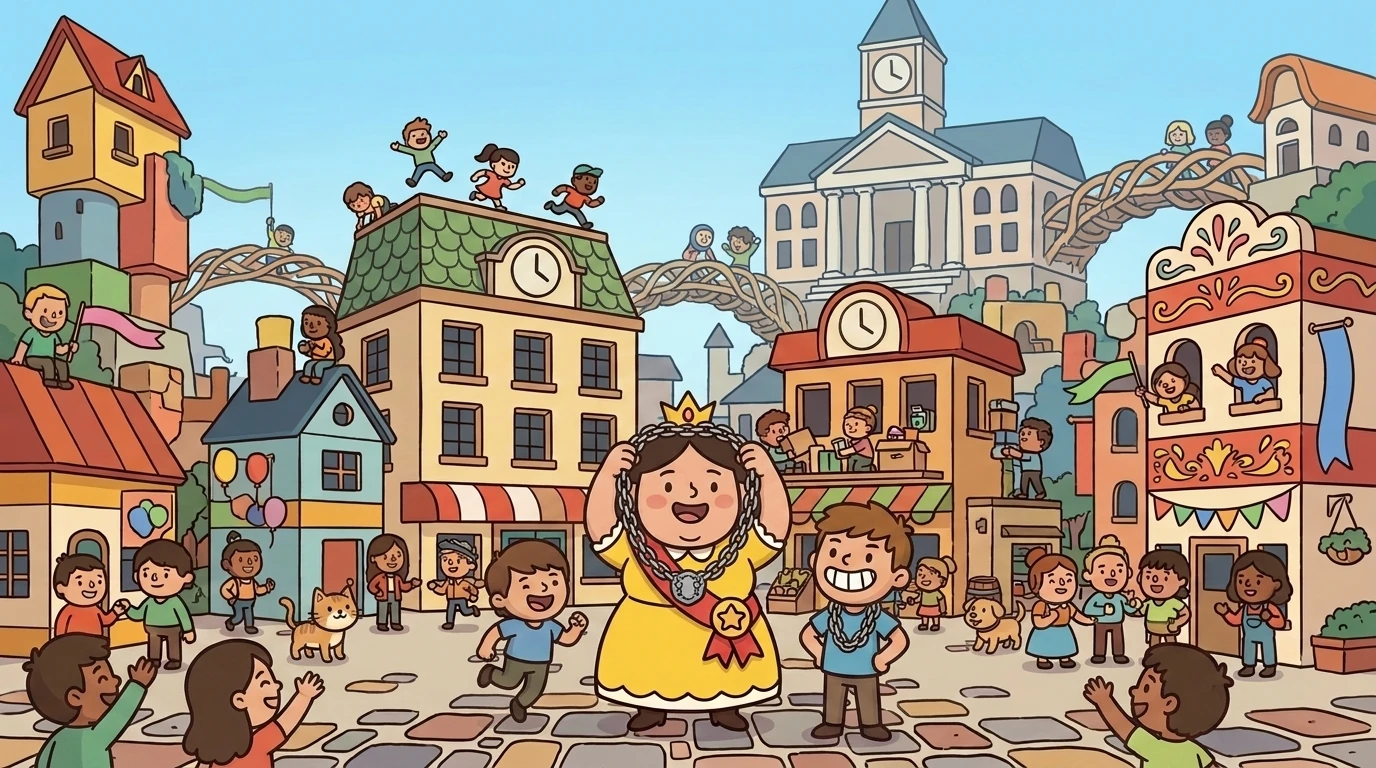
She lifted the chain over her head. It clinked softly. She placed it over Leo's shoulders. It was so big it hung down to his elbows. Leo stood up straight and puffed out his chest.
"Now you are the mayor," she said. "Give us an action!"
"I command everyone to hop on one foot!" Leo shouted.
The class giggled and started hopping.
"Perfect," Mayor Subject laughed. "Who is hopping? We are. We is the *subject. Hop* is the verb. You are a great mayor, Leo."
She gently took the chain back. Leo sat down with a giant smile.
Sometimes kids ask if finding the *subject* is hard. Mayor Subject always shakes her head.
"It is easy," she says. "Just look for the doer. Ask yourself: who or what is doing the action? The answer is your *subject*. Find the mayor, and the rest of the sentence is easy."
She still wears her silver chain to every class. The children like to touch the shiny links. She always lets them hold it.
Over nineteen years, thousands of kids have tried on the mayor's chain. They all leave her room knowing exactly who runs a sentence — and, more than that, they leave feeling a little braver, a little more like someone who can stand at the front and make things happen. That warm flicker of I can be the one who acts is the gift Mayor Subject really hands out. The grammar is just the wrapping.
The GrammarForge ensemble
Mayor Subject is part of GrammarForge's distributed-narrative cast. Each character embodies a different curricular primitive; together they teach the full subject.
-

Verb Verity
Verb (action / state of being)
-

Object Otto
Direct / indirect object (receiver of the verb's action)
-

Modifier Mike
Adverb (modifies verb / adjective / other adverb)
-

Modifier Madge
Adjective (modifies noun / pronoun)
-

Connector Chen
Conjunction (coordinating / subordinating — *and*, *but*, *because*, *although*)
-

Pronoun Perry
Pronoun (substitute for noun — *he*, *she*, *they*, *it*, *who*)
-

Article Anne
Article (*a*, *an*, *the* — definite vs. indefinite)
-

Preposition Pat
Preposition (spatial / temporal relations — *on*, *under*, *between*, *before*)
-

Clause-Chief Carla
Clause-types (independent / dependent / subordinate / relative)
-

Punctuator Polly
Punctuation guardian (commas, semicolons, apostrophes, colons, dashes)
-

Agreement Ada
Subject-verb agreement (singular subject → singular verb; plural subject → plural verb; tricky cases — collective nouns, *either/or*, indefinite pronouns)