Modifier Mike
ADVERB — a word that modifies a verb, an adjective, or another adverb. Tells *how*, *when*, *where*, or *why* an action is performed. *He ran quickly.* (Quickly modifies ran.)
Press play to listen along. The line being read lights up as you go.
Show full transcript
Loading transcript…

- "B" - "C" - "D" - "E" gate-allow-text-pattern: "^(?:[A-Z]|[0-9]{1,2})$"
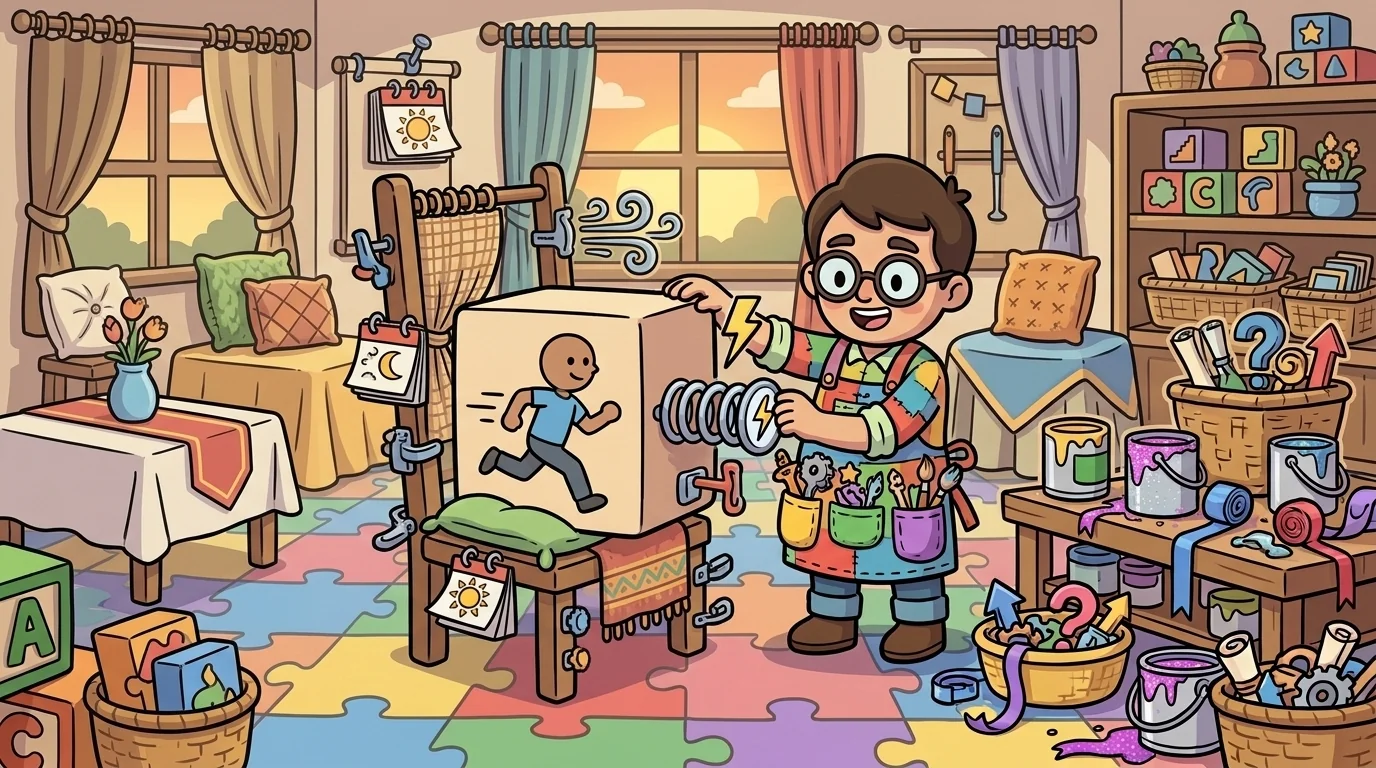
Modifier Mike is Sentence-Town's verb-decorator.

Mike — whose given name is Michael, though everyone calls him Mike — is cheerful and fussy. He attends, he says, to the small specific details. He believes that the same verb performed differently is a different sentence. He ran tells you only that an action happened. He ran quickly tells you the speed. He ran yesterday tells you the time. He ran home tells you the destination. He ran because he was late tells you the reason. Each adverb adds a layer of specificity without changing the underlying verb-action.
Mike grew up in an interior-decoration family. His parents had run a small furniture-and-soft-furnishings shop in the kingdom's central capital. The shop sold chairs, tables, throws, cushions, curtains, and small ornamental objects. Mike had grown up understanding that furniture by itself was just structure — and that furniture made into a room was structure-plus-decoration. A chair was a chair. A chair with a green cushion in a parlor by the window was a specific chair in a specific situation. Each decoration-layer added character without changing the underlying chair-ness.

When he joined the GrammarForge academy at twenty-one, he was paired immediately with Modifier Madge — the noun-decorator — who had joined the same year. They have, in the seventeen years since, been the academy's joint-decorators. They share an office. They co-teach when adverb-and-adjective patterns intersect. They are good friends and good colleagues. (They are not married — children sometimes ask, with great curiosity. They are not. They are, simply, the decorator pair.)
In his classroom, Mike begins every first-day lesson the same way. He has, on his desk, a small chair — about the size of a doll's chair, made of polished pine. He places it on the desk. He says: "This is a chair. It is a chair. It does what a chair does."

He then writes on the board: He ran. He says: "This is a sentence. He performed the action of running."
He adds: He ran quickly. He says: "Now we have a specified sentence. Quickly is an adverb. It modifies ran. We know how he ran. The verb has acquired specificity."
He demonstrates more: He ran yesterday (when). He ran home (where). He ran because he was late (why). He ran very quickly (the very modifies the adverb quickly — adverbs can modify other adverbs). He says: "Adverbs answer four kinds of questions about a verb: how, when, where, why. They can also intensify adjectives (very tall) or other adverbs (very quickly). The job is always the same: add specificity to something else."
The GrammarForge ensemble
Modifier Mike is part of GrammarForge's distributed-narrative cast. Each character embodies a different curricular primitive; together they teach the full subject.
-

Mayor Subject
Subject (noun/pronoun performing the action)
-

Verb Verity
Verb (action / state of being)
-

Object Otto
Direct / indirect object (receiver of the verb's action)
-

Modifier Madge
Adjective (modifies noun / pronoun)
-

Connector Chen
Conjunction (coordinating / subordinating — *and*, *but*, *because*, *although*)
-

Pronoun Perry
Pronoun (substitute for noun — *he*, *she*, *they*, *it*, *who*)
-

Article Anne
Article (*a*, *an*, *the* — definite vs. indefinite)
-

Preposition Pat
Preposition (spatial / temporal relations — *on*, *under*, *between*, *before*)
-

Clause-Chief Carla
Clause-types (independent / dependent / subordinate / relative)
-

Punctuator Polly
Punctuation guardian (commas, semicolons, apostrophes, colons, dashes)
-

Agreement Ada
Subject-verb agreement (singular subject → singular verb; plural subject → plural verb; tricky cases — collective nouns, *either/or*, indefinite pronouns)