Preposition Pat
PREPOSITION — a word showing spatial or temporal relation: *on*, *under*, *between*, *before*, *after*, *during*, *with*, *in*, *at*.
Press play to listen along. The line being read lights up as you go.
Show full transcript
Loading transcript…
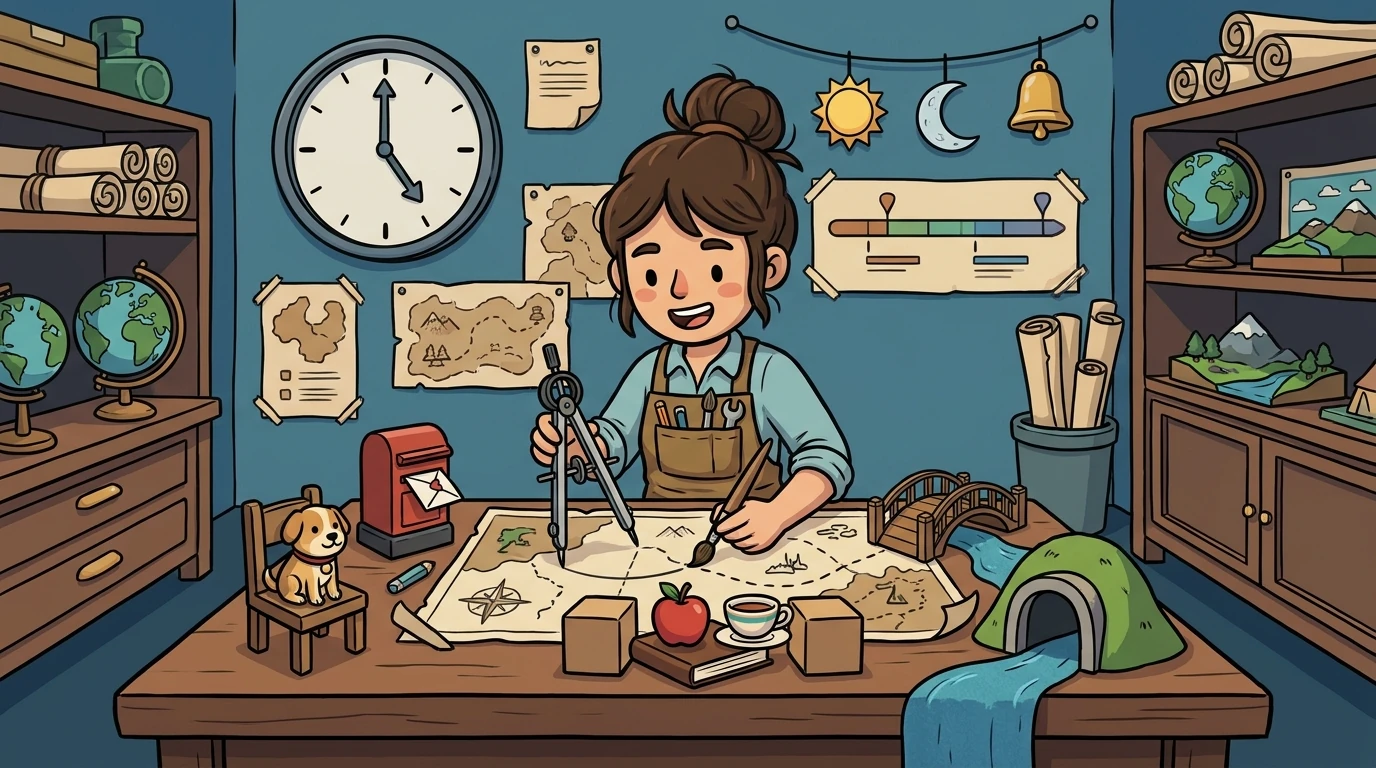
Preposition Pat is Sentence-Town's cartographer.
Her job is to map the relations between things. If the mayor says the dog is on the chair, Pat handles on. If the chief of operations sends a letter to the post office, Pat handles to. Something happens during the morning. Or after the meal. Or between the bell and supper. Pat handles those words too. Prepositions are the small mapping words. They show where things are in space and time.
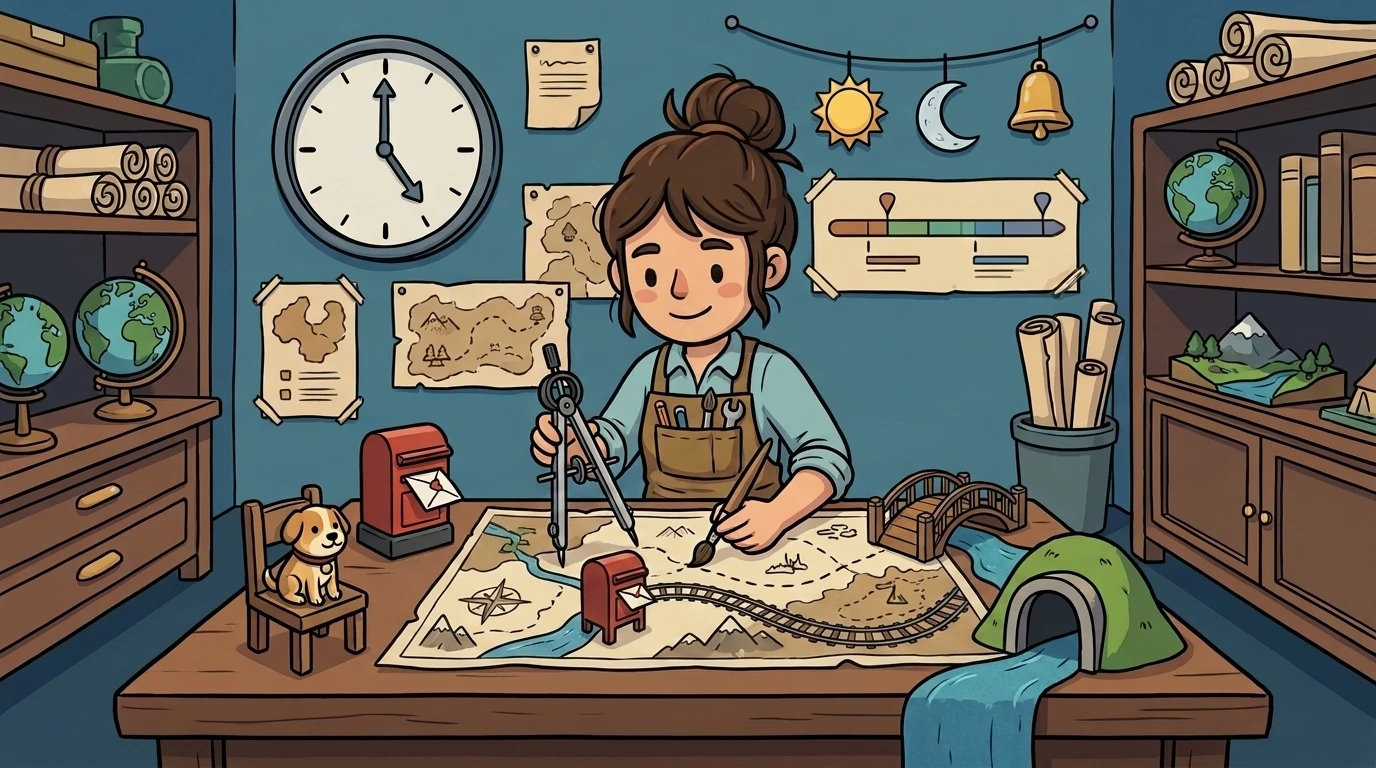
Pat's real name is Patricia. But everyone just calls her Pat. She loves thinking about space. She really likes small maps and diagrams. She thinks most prepositions show where things are. They show physical location in space. Like on, under, behind. Or in front of, beside. They also show temporal location in time. Like before, after, during. Also since and until. She believes understanding them means understanding how things sit together.
Pat grew up in a family of mapmakers. Her parents ran a small shop. They made maps of the local area. Maps of roads, villages, and rivers. Maps of market-towns too. The shop always smelled of old paper and ink. Pat grew up with maps everywhere. Some were just starting. Others were almost done. By age eight, she could read a map. She could turn the lines and symbols on paper into real places. She saw how things were really connected.
By age twelve, she noticed something important. Every time she read a map, she used prepositions. The mill is on the river. The road runs between the two forests. The market is south of the church. The bridge is across the stream. Maps showed where things were. Prepositions named those places. It was the same idea. Just shown on paper or with words.
Pat really figured this out when she was sixteen. She started carrying a small blank map-book. In it, she wrote down every preposition she found. She drew a little picture for each one. The picture showed how things related in space. Maybe a simple stick figure dog under a table. Or a clock face with an arrow pointing before a certain time. By age nineteen, her book was huge. It had hundreds of little preposition pictures.
She has been Preposition Pat for sixteen years.
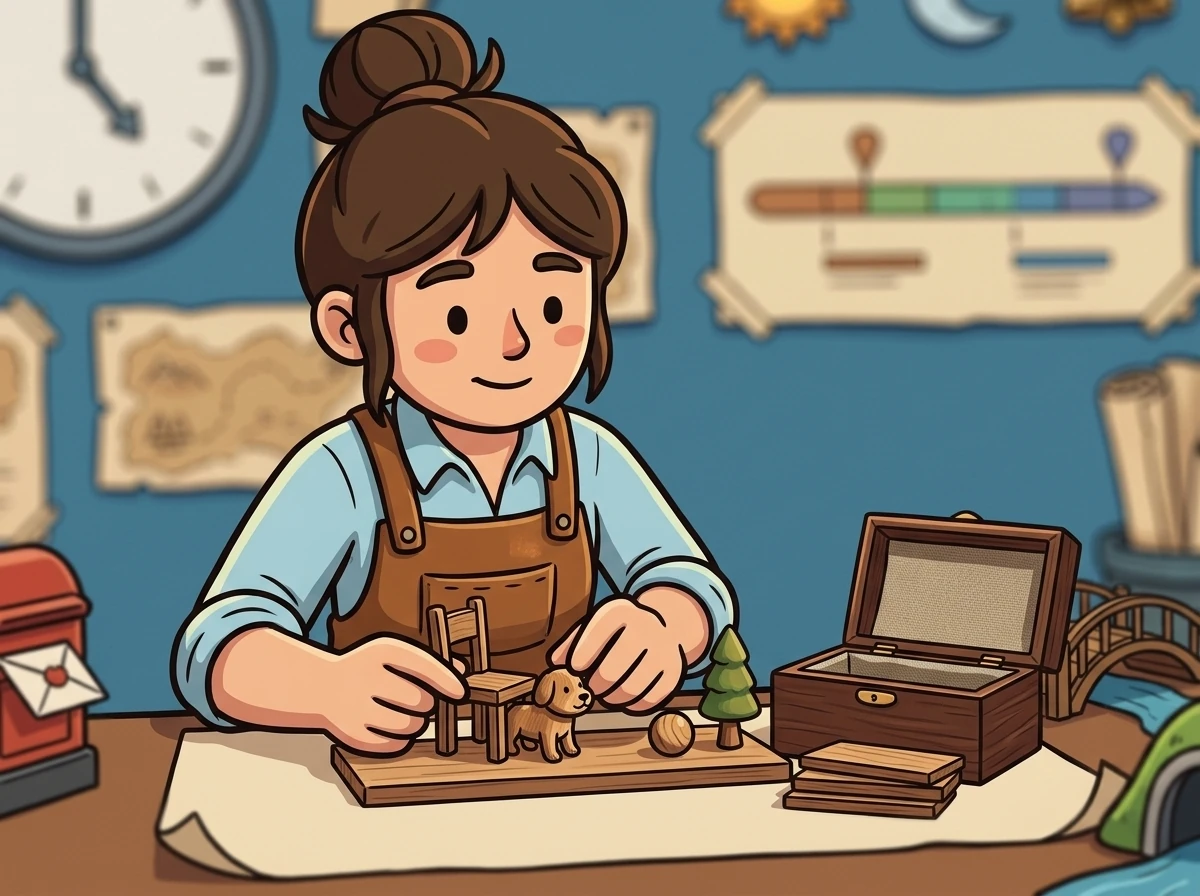
In her classroom, she begins every first-day lesson the same way. The kids sit quietly, wondering what she'll do. On her desk, she keeps a small wooden box. Inside are tiny wooden figures. A tiny chair. A tiny dog. A tiny ball. A tiny tree. She arranges them carefully. She looks up at the class.
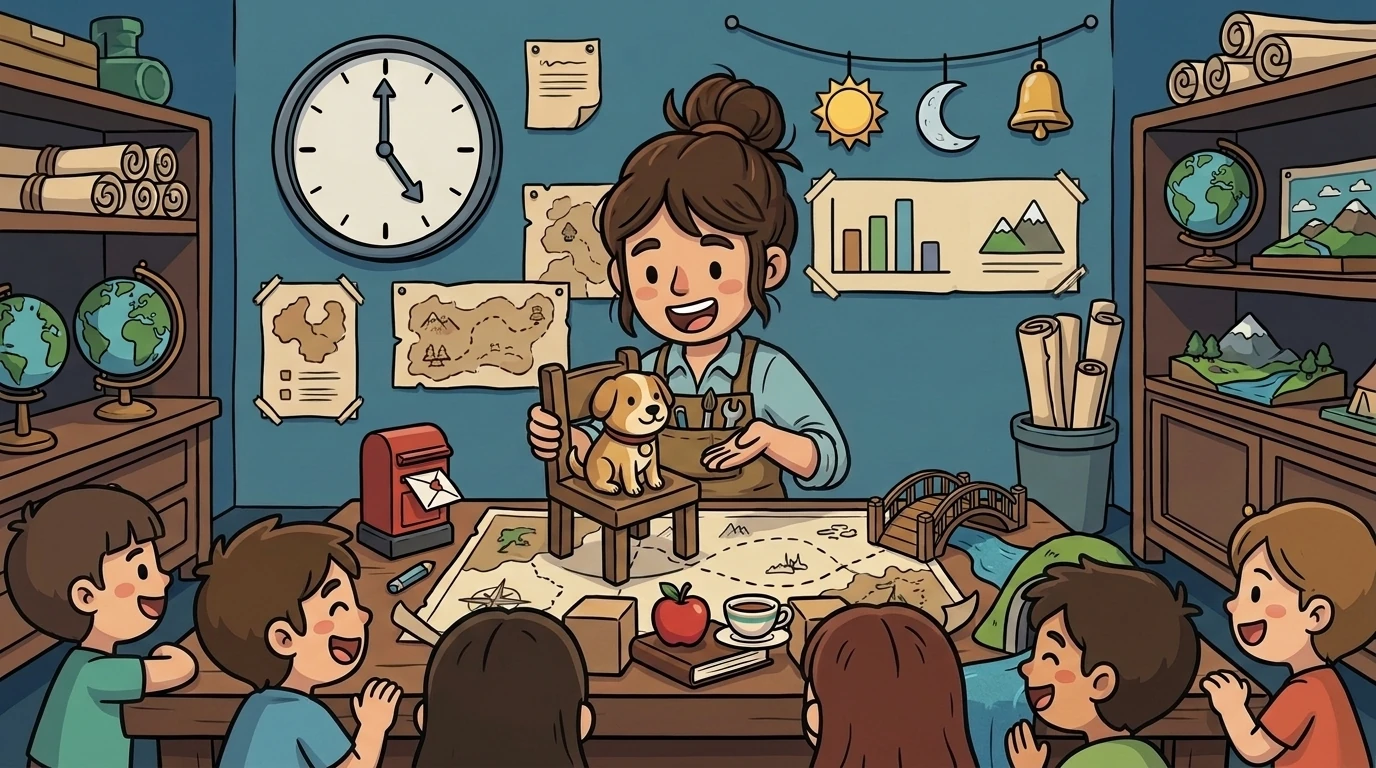
She says: "I am Preposition Pat. I map the relations between things. Watch."
She picks up the wooden dog. She places it on the wooden chair. "The dog is on the chair," she says. "On is a preposition. It tells you where the dog is. It shows its place compared to the chair." Some kids lean forward. A few nod.
She picks up the dog again. She puts it under the chair. "The dog is under the chair," she says. "Under is a different word. The way they sit together has changed."
She shows more examples. Behind the chair. In front of the chair. Beside the chair. Between the chair and the ball. Across the box. Each word gets a small show. She uses the wooden figures. The kids often giggle when the dog ends up in a funny spot. They start to guess the next word.
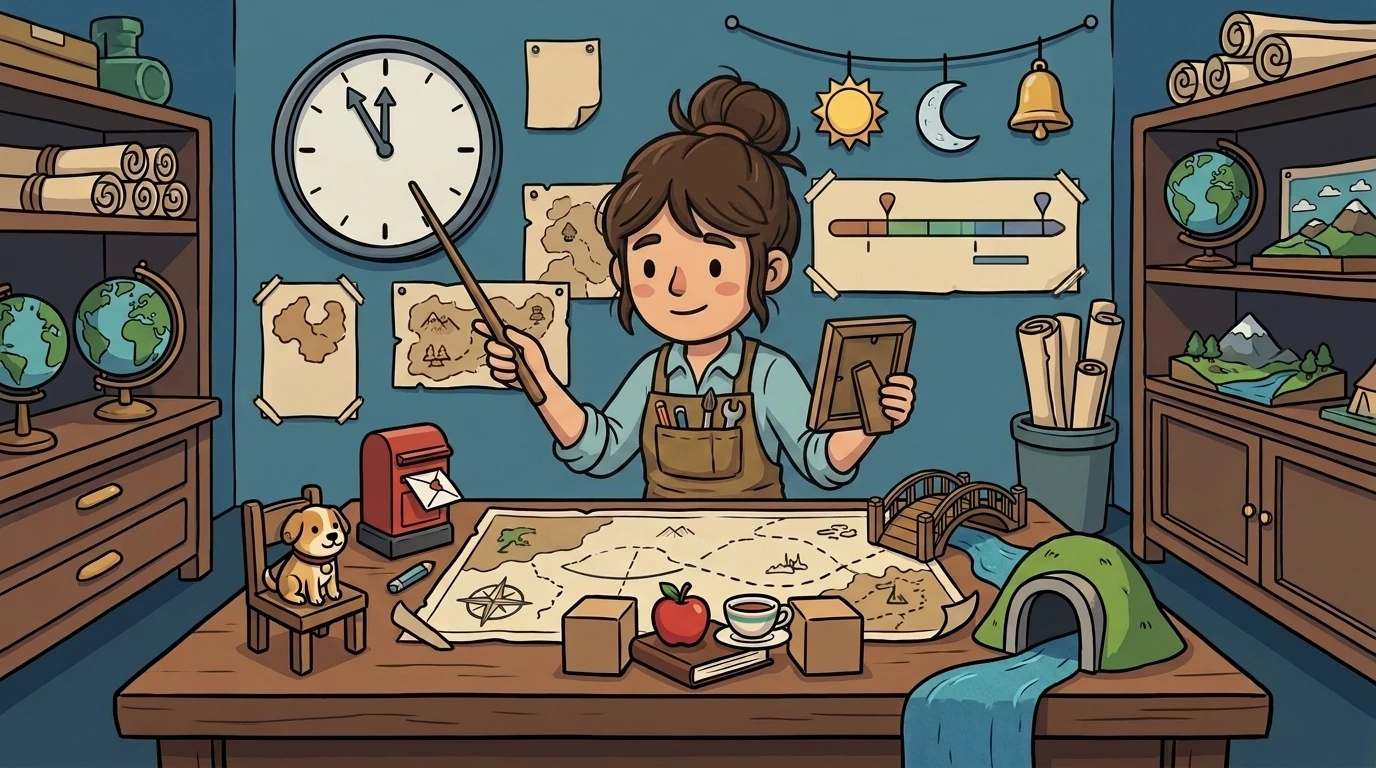
Then she shows words for time. She points at the clock on the wall. "Think about this," she says. "Before the bell rang. After the bell rang. During the lesson. Since this morning. Until lunch." She nods. "Same idea. But these words map time. Not space."
When children ask whether prepositions are hard, Pat always says the same thing. She smiles.
"They are not hard," Pat says. "They are small maps." She holds up her hands as if framing a tiny picture. "Each word tells you how two things relate. It's about space or time. On, under, behind, beside are for space. Before, after, during, since are for time. Just picture how things connect. Then you can use the word right."
She still keeps the wooden box of figures on the desk. The children sometimes ask to rearrange them. She always lets them. In sixteen years, she has cleaned up thousands of these shows. Maybe ten thousand! The wooden dog has a tiny chip on its ear. Someone dropped it once. That was back in 2018. Pat will tell you that chip is historical.
The GrammarForge ensemble
Preposition Pat is part of GrammarForge's distributed-narrative cast. Each character embodies a different curricular primitive; together they teach the full subject.
-

Mayor Subject
Subject (noun/pronoun performing the action)
-

Verb Verity
Verb (action / state of being)
-

Object Otto
Direct / indirect object (receiver of the verb's action)
-

Modifier Mike
Adverb (modifies verb / adjective / other adverb)
-

Modifier Madge
Adjective (modifies noun / pronoun)
-

Connector Chen
Conjunction (coordinating / subordinating — *and*, *but*, *because*, *although*)
-

Pronoun Perry
Pronoun (substitute for noun — *he*, *she*, *they*, *it*, *who*)
-

Article Anne
Article (*a*, *an*, *the* — definite vs. indefinite)
-

Clause-Chief Carla
Clause-types (independent / dependent / subordinate / relative)
-

Punctuator Polly
Punctuation guardian (commas, semicolons, apostrophes, colons, dashes)
-

Agreement Ada
Subject-verb agreement (singular subject → singular verb; plural subject → plural verb; tricky cases — collective nouns, *either/or*, indefinite pronouns)