
Mayor Subject and Object Otto
SUBJECT-OBJECT PAIR — *Mayor Subject names who acts. Object Otto names who receives. Together with the verb between them, they make every sentence go.*
Press play to listen along. The line being read lights up as you go.
Show full transcript
Loading transcript…

The morning sun, bright and insistent, streamed into Sentence-Town. The Town Hall steeple clock chimed nine, its resonant tone echoing through the quiet streets. Mayor Subject sat poised at her desk, her official sash perfectly straight, her hair meticulously tidy. A modest stack of unsorted sentences awaited her attention in the inbox. She preferred to organize them during the cool quiet of the morning, before the sun's full glare dominated the office.
The heavy oak door of the Town Hall swung open, and Object Otto entered. He wore his official receiver's hat, a soft, round cap with a brim that flopped slightly to one side, and carried his pristine clipboard. Otto maintained a particular fondness for a clean clipboard, free of stray marks or smudges. He carefully placed it on the corner of Mayor Subject's desk.
"Morning," Otto said.
"Morning," said the Mayor.
They shared a quiet appreciation for their morning routine. Most days, Otto would cross from his Public-Affairs Desk to assist in clearing the overnight cases. Together, they could process twenty sentences with remarkable efficiency before lunch. The Mayor identified the actors, Otto pinpointed the receivers, and the verb, like a diligent delivery truck, transported meaning between them. This precise division of labor ensured the town's linguistic order.
A small, insistent bell chimed from the inbox, signaling the arrival of a new note. This particular note, however, was unlike any other. It was distinctly restless, the paper itself twitching and jumping off the stack. It would settle back down, only to spring up again moments later.
Mayor Subject and Otto looked at each other.
"That," the Mayor said, "is a sentence that won't sit still."
Otto carefully retrieved the note, handling it with the same gentle caution one might employ with a small, live creature. He read the words, and his brow furrowed in concentration.
> Ada baked Otto a pie.
He reread it, his brow deepening its furrow.
"Hmm," he said.
"What," the Mayor said.
"It's about me."
"I know."
"That's never happened before."
"I know."
Otto extended the note, which continued its subtle, unsettling tremors in his hand. The Mayor accepted it, then tapped her desk twice, a small, familiar ritual she performed before commencing any new case. "Then let's diagram it," she declared. "You and I. The proper way. Slowly."

The Mayor smoothed the restless note flat upon her desk, then retrieved a fresh sheet of grid paper from her drawer. The paper was pre-printed with three distinct columns. A wide one occupied the left, a narrow one the middle, and another wide one the right. Above these columns, in her characteristically tidy hand, she had inscribed three small, significant letters: *S — V — O*.
"First step," she announced, her voice precise. "We identify the actor. That's my domain. Who, in this particular sentence, is performing the action?"
Otto squinted at the still-unsettled note. "Ada," he confirmed.
"Precisely." The Mayor inscribed Ada in the left column, directly beneath the *S*. For a single, fleeting second, the note ceased its tremors, as if acknowledging its proper designation. Then, just as suddenly, it resumed its subtle agitation.
The subject, she continued, isn't necessarily the most important word in a sentence; rather, it is the entity performing the verb's action. People often confuse this, searching for the largest, most appealing, or even their favorite noun. But a subject's true function lies in its agency. Who bakes? Ada bakes. Therefore, Ada unequivocally serves as the subject.
Otto nodded slowly, diligently recording her words on his clipboard. "Subjects do," he murmured, distilling the concept.
"Subjects do," the Mayor affirmed. "Even a seemingly quiet subject performs an action. Consider The dog sleeps — the dog remains the subject, despite sleeping appearing to be a passive state. It is, after all, the dog that performs the sleeping."
She tapped the *S* column once, with one finger, decisively. "Step one done."
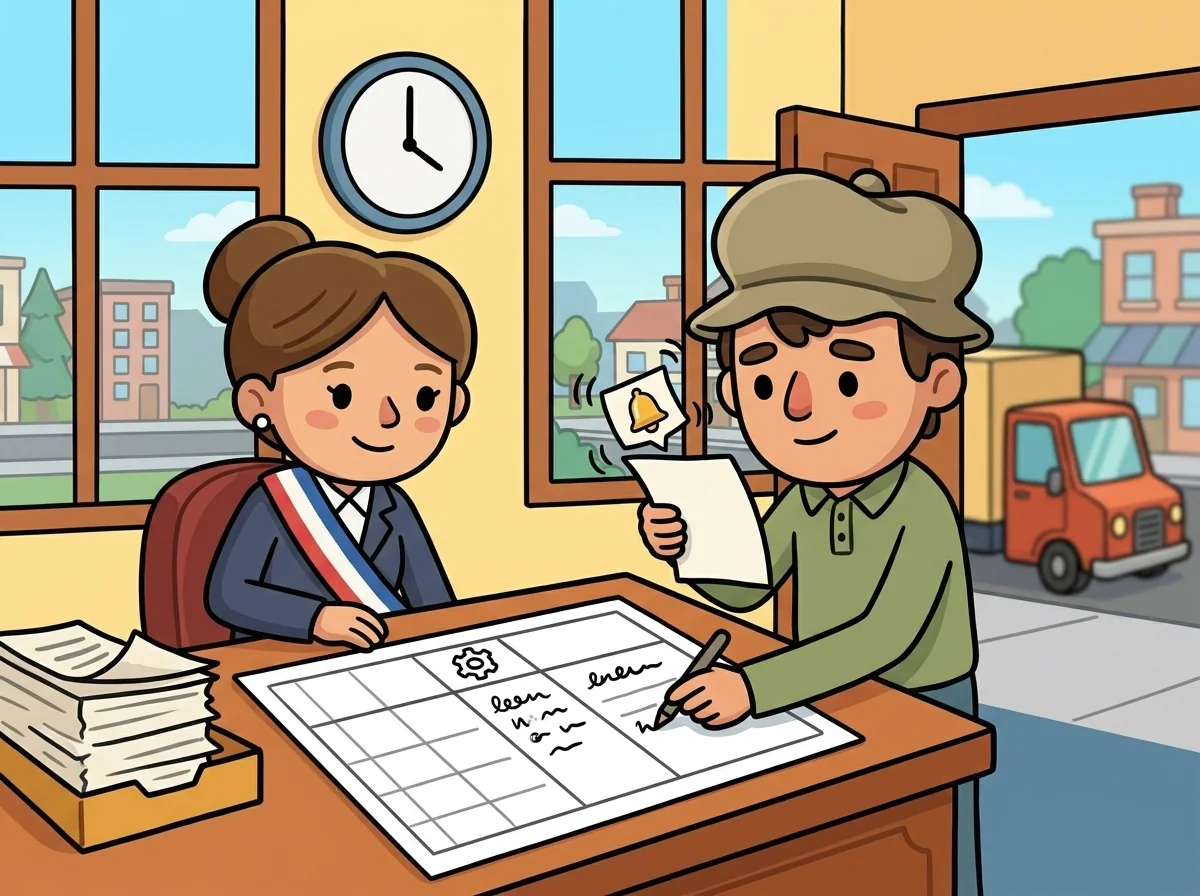
Otto extended his hand for the grid paper. The Mayor, with a small, almost imperceptible ceremonial nod, passed it to him. Their routine was well-established: she identified the subject, then transferred the paper, and he, in turn, pinpointed the receiver. This was their precise, shared rhythm.
"Step two," Otto said. "Find the verb."
"That's Verity's domain," the Mayor said.
"Yes, but we can name it for the diagram. Verity won't mind."
The Mayor smiled. "Verity will hear about it and bring you a pie of her own, in return."
Otto chuckled softly. He carefully inscribed baked in the narrow middle column, beneath the *V*. The note on the desk emitted a faint, contented sound, almost like a distant, tiny bell.
"Step three," Otto said. "Find the receiver. That's me."
He held up the still-restless note, reading it aloud slowly: Ada baked Otto a pie. He remained motionless for a moment, processing. Clearly, the sentence contained two receivers: Otto and a pie. Both were recipients of the action, though in different capacities. He received the pie; the pie received the baking.
"This sentence," he observed, "presented a unique challenge: it contained two distinct receivers. Both me and a pie occupied the receiving side of the action. One, he reasoned, must be the direct receiver, and the other, the indirect."
The Mayor leaned forward slightly, a subtle signal of her appreciation for Otto's meticulous process. "Which is which?" she prompted.
Otto closed his eyes, concentrating deeply. "The pie," he articulated slowly, "is what was directly baked. The verb's action flowed straight into the pie. Therefore, the pie is the *direct object." He opened his eyes. "And I received the pie. I am the indirect object*. The pie, having undergone the action, then passed through to me."
He began to write in the right column. First, he inscribed pie, accompanied by a small *DO label. Below it, slightly offset, he added Otto with an IO label. He then drew a thin, decisive arrow from the verb baked directly to pie. This was followed by a softer, more circuitous arrow from pie over to Otto*.
"There," he said. "The pie was baked. Then the pie came to me. Two receivers. Different jobs."
The Mayor studied the completed diagram, then reread it carefully. "That," she stated, "is an exceptionally clean diagram, Otto."
A faint blush crept into Otto's ears.

The note on the desk had, at last, ceased its restless wiggling. It now rested flat and still, precisely as a properly sorted sentence should. Mayor Subject and Object Otto gazed down at the grid paper, observing the clear inscription: *S → V → O.* Ada — baked — pie (direct) — Otto (indirect). Every constituent part now occupied its designated place.
"This," the Mayor said quietly, "is why we work together."
She tapped the *S* column with a single finger. "I identify the actor. That is my essential function. The town requires clarity on who is performing the action; without it, nothing can be accomplished. A sentence lacking a subject is akin to a town meeting without a presiding official. People mill about, and no agenda can commence."
Otto, in turn, tapped the *O* column. "And I name the receiver. This is my crucial responsibility. The town must understand who is receiving the action; otherwise, the verb's purpose remains unfulfilled. A sentence without an object—when the verb intrinsically demands one—is like a delivery truck that departs the parking lot. It then veers aimlessly into a field. Its cargo never reaches its intended destination."
He paused, reflecting. "Some verbs, of course, do not require objects. The dog sleeps exemplifies this; 'sleep' needs no receiver, and the Mayor manages such cases independently. Other verbs, however, demand an object. The dog chased—'chased what?'—necessitates something I can identify. And then there are verbs, like 'give,' 'bake,' and 'send,' which accommodate two receivers. These include the direct object, representing the thing itself, and the indirect object, designating the recipient."
The Mayor nodded in solemn agreement. "We divide the labor. The subject anchors one end, the object secures the other. The verb traverses the space between us, performing the essential act of carrying meaning. We function as the two banks of a river, and the verb serves as the indispensable bridge."
At the bottom of the grid paper, in small, elegant script, she added: *S → V → O. Every sentence is a small journey across a small bridge.*

Otto carefully lifted the note, folding it with deliberate precision before placing it in the processed tray. The paper, now fully understood and categorized, no longer exhibited any restless tremors. It was a calm, designated, and organized sentence: Ada baked Otto a pie. Subject: Ada. Verb: baked. Direct object: a pie. Indirect object: Otto.
A second note promptly appeared in the inbox. The Mayor reached for it, her movements efficient, and slid the grid paper back to the center of the desk, poised for the next diagram.
"Next?" she said.
Otto retrieved his clipboard, flipping to a pristine page. The brim of his cap, slightly askew from his earlier concentration, remained untouched. He made no effort to straighten it; he rather preferred its jaunty angle.
"Next," he said.
Outside the Town Hall window, the morning sun continued its slow, deliberate traverse across the office floor. A faint bell chimed from the Public-Affairs Desk down the hall. The distinct sound of Verb Verity ascending the stairs, two at a time, grew steadily louder. The town was stirring, its daily linguistic cases beginning to arrive. Mayor Subject and Object Otto remained seated across the desk from each other. They embodied the *S column and the O* column, the actor and the receiver, the two steadfast banks of every small river of meaning.
The verb, the essential bridge between them, would arrive momentarily. Then they would diagram another sentence. And another. And another. Thus, the town would maintain its intricate organization, and its sentences would, invariably, learn to sit still.
The GrammarForge ensemble
Mayor Subject and Object Otto is part of GrammarForge's distributed-narrative cast. Each character embodies a different curricular primitive; together they teach the full subject.
-

Mayor Subject
Subject (noun/pronoun performing the action)
-

Verb Verity
Verb (action / state of being)
-

Object Otto
Direct / indirect object (receiver of the verb's action)
-

Modifier Mike
Adverb (modifies verb / adjective / other adverb)
-

Modifier Madge
Adjective (modifies noun / pronoun)
-

Connector Chen
Conjunction (coordinating / subordinating — *and*, *but*, *because*, *although*)
-

Pronoun Perry
Pronoun (substitute for noun — *he*, *she*, *they*, *it*, *who*)
-

Article Anne
Article (*a*, *an*, *the* — definite vs. indefinite)
-

Preposition Pat
Preposition (spatial / temporal relations — *on*, *under*, *between*, *before*)
-

Clause-Chief Carla
Clause-types (independent / dependent / subordinate / relative)
-

Punctuator Polly
Punctuation guardian (commas, semicolons, apostrophes, colons, dashes)
-

Agreement Ada
Subject-verb agreement (singular subject → singular verb; plural subject → plural verb; tricky cases — collective nouns, *either/or*, indefinite pronouns)