
Mayor Subject and Object Otto
SUBJECT-OBJECT PAIR — *Mayor Subject names who acts. Object Otto names who receives. Together with the verb between them, they make every sentence go.*
Press play to listen along. The line being read lights up as you go.
Show full transcript
Loading transcript…
- pie - baked gate-allow-text-pattern: '^([SVO]( -> | → )?[SVO]?( -> | → )?[SVO]?|[0-9]{1,2})$' ---
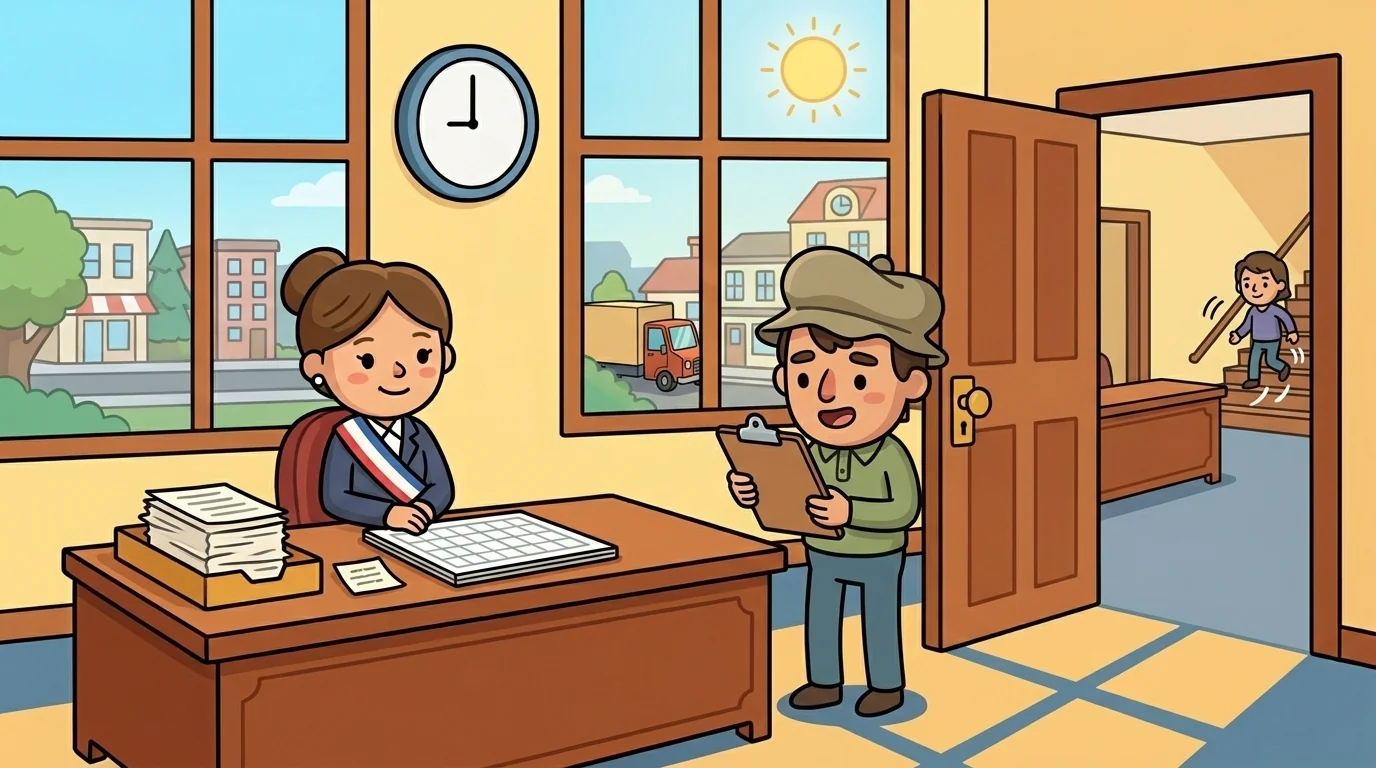
The morning was bright in Sentence-Town. The clock on the Town Hall steeple chimed nine. Mayor Subject was at her desk. Her sash was straight. Her hair was tidy. A short stack of unsorted sentences waited in her inbox. She liked to sort them in the cool of the morning, before the sun got bossy.
The Town Hall door opened. Object Otto came in. He was wearing his official receiver's hat — a soft round cap with a brim that flopped a little on one side. He carried his clipboard. The clipboard was clean. Otto liked a clean clipboard. He set it on the corner of Mayor Subject's desk.
"Morning," Otto said.
"Morning," said the Mayor.
They liked working in the morning together. Otto came over from his Public-Affairs Desk most days to clear the overnight cases. The two of them could fly through twenty sentences before lunch. The Mayor named the actors. Otto named the receivers. The verb went between them like a delivery truck. The town stayed organized.
A small bell rang from the inbox. A new note had just popped in. The note was different. It was wiggling. The paper jumped up off the stack and landed back down. It jumped up again.
Mayor Subject and Otto looked at each other.
"That," the Mayor said, "is a sentence that won't sit still."
Otto picked up the note carefully, the way you'd pick up a small frog. He read it. His brow scrunched.
> Ada baked Otto a pie.
He read it again. The brow scrunched harder.
"Hmm," he said.
"What," the Mayor said.
"It's about me."
"I know."
"That's never happened before."
Otto held the note out. The note jumped a little in his hand. The Mayor took it. She tapped her desk twice, the way she always did before a case. "Then let's diagram it," she said. "You and me. The proper way. Slowly."
The Mayor laid the note flat on her desk. She pulled a fresh sheet of grid paper from her drawer. The grid paper had three columns. One column was wide. The middle column was narrow. The right column was wide. Above the columns, she had printed three small letters, in her tidy handwriting: *S — V — O*.
"First step," she said. "We find the actor. That's me. Who is doing the doing in this sentence?"
Otto squinted at the wiggly note. "Ada."
"Yes." The Mayor wrote Ada in the left column under the *S*. The note stopped wiggling for one second, as if it appreciated being named. Then it started up again.
"The subject isn't the most important word," the Mayor went on. "It's the one doing the verb. People sometimes mix that up. They look for the biggest noun, or the prettiest noun, or the noun they like best. But that's not how a subject works. A subject is the one acting. Who bakes? Ada bakes. So Ada is the subject."
Otto nodded, taking notes on his clipboard. "Subjects do."
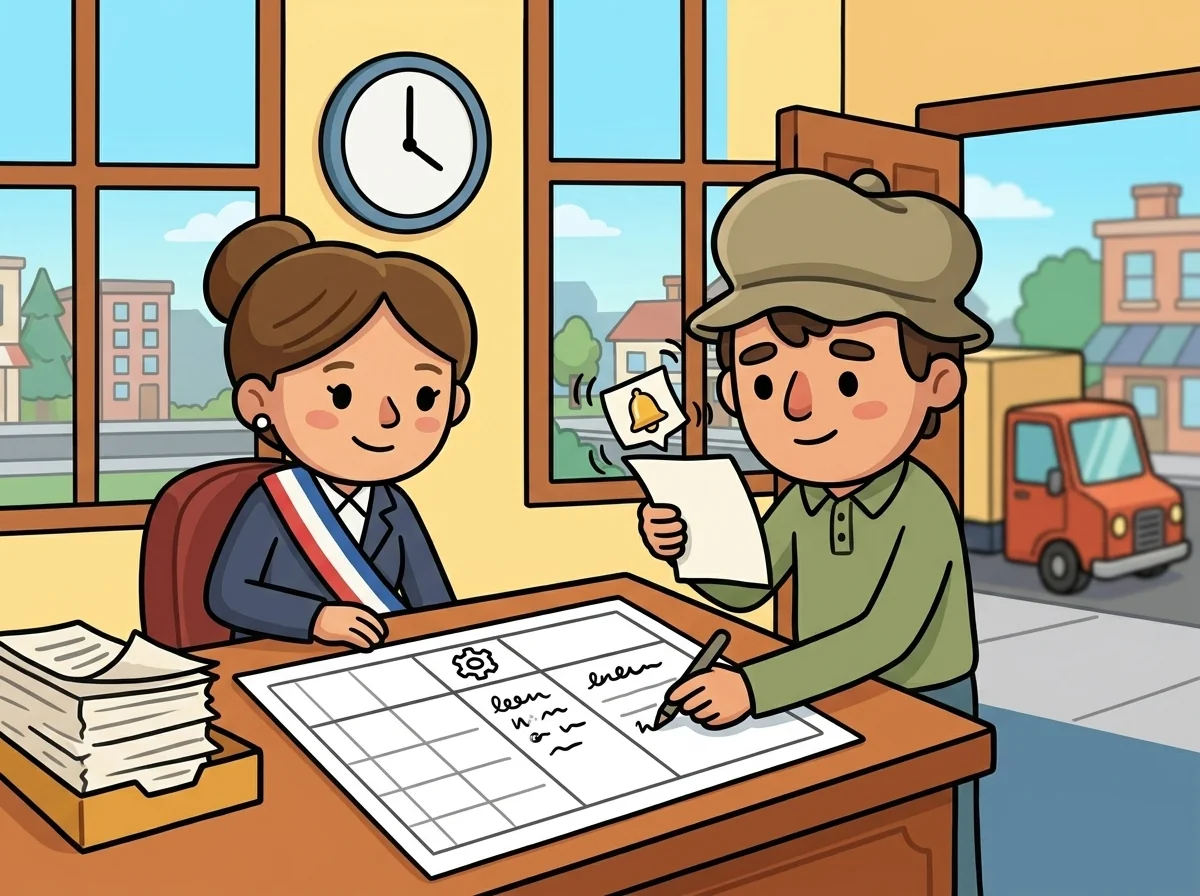
She tapped the *S* column once, with one finger, decisively. "Step one done."
Otto reached for the gridpaper. The Mayor handed it over with a small ceremonial nod. They had a routine. The Mayor named the subject. Then she passed the paper. Then Otto named the receiver. That was the rhythm.
"Step two," Otto said. "Find the verb."
"That's Verity's domain," the Mayor said.
"Yes, but we can name it for the diagram. Verity won't mind."
The Mayor smiled. "Verity will hear about it and bring you a pie of her own, in return."
Otto laughed. He wrote baked in the narrow middle column under the *V*. The note on the desk made a tiny happy sound, like a small bell.
"Step three," Otto said. "Find the receiver. That's me."
He held up the wiggly note. Read it slowly. Ada baked Otto a pie. He sat very still for a moment. The two receivers in the sentence were Otto and a pie. Both of them got something. He got the pie. The pie got the baking.
"This sentence has two of me," Otto said. "It has me and it has a pie. They're both on the receiving side. One of them is the direct receiver. One of them is the indirect."
The Mayor leaned forward. She liked when Otto did the slow work. "Which is which?"
Otto closed his eyes. "The pie is what got baked. The verb went straight into the pie. So the pie is the direct object." He opened his eyes. "And I got the pie. I'm the indirect object. The pie passed through the action and arrived at me."
He wrote in the right column. He wrote pie first, with a small *DO label. Below it, a little to the side, he wrote Otto with a small IO label. He drew a thin arrow from the verb baked into pie. He drew a softer arrow from pie over to Otto*.
"There," he said. "The pie was baked. Then the pie came to me. Two receivers. Different jobs."
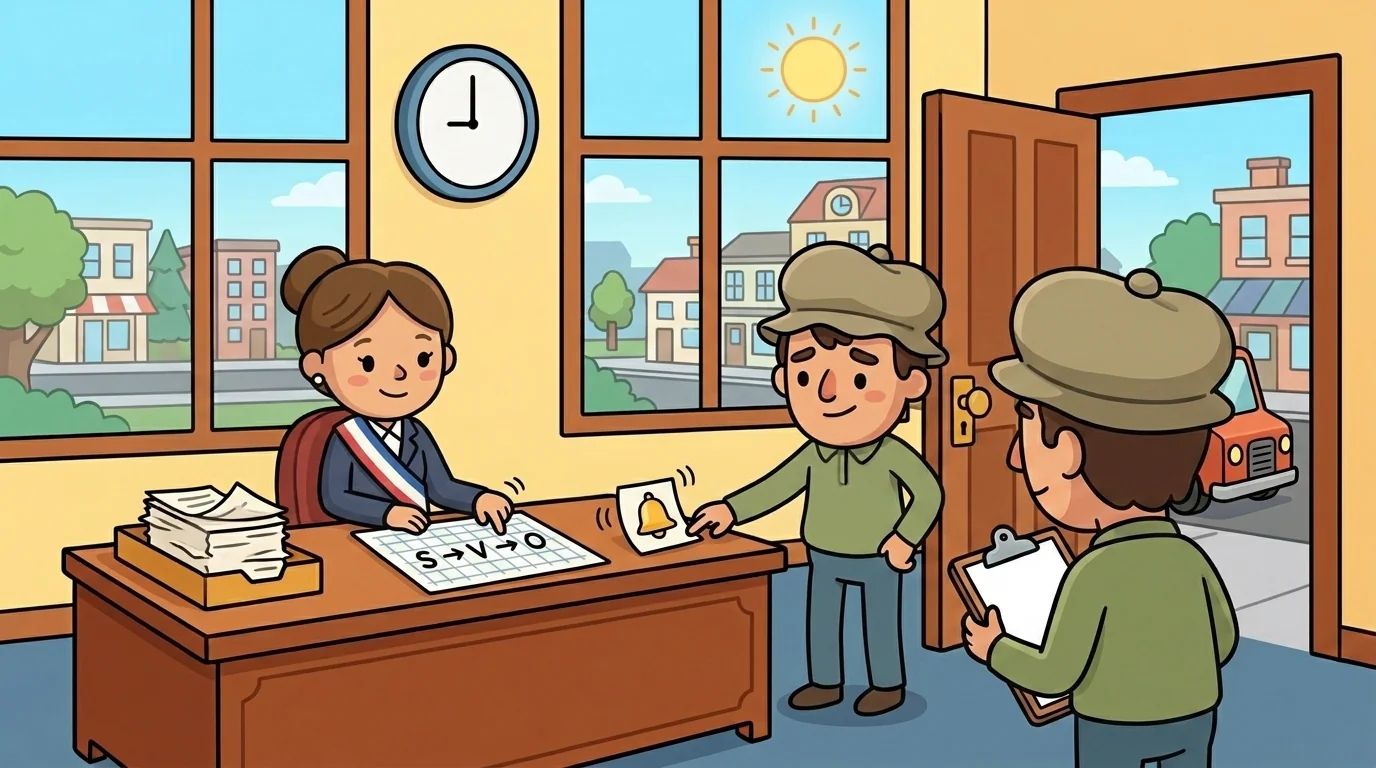
Otto's ears went a little pink.
The note on the desk had stopped wiggling. It sat flat and calm, the way a sorted sentence should. Mayor Subject and Otto looked down at the grid paper. *S → V → O.* Ada — baked — pie (direct) — Otto (indirect). Every part was in its place.
"This," the Mayor said quietly, "is why we work together."
She tapped the *S* column. "I name the actor. That's my job. The town has to know who's doing the doing. Otherwise nothing gets done. A sentence without a subject is a town meeting with no one at the front. People stand around. Nothing starts."
Otto tapped the *O* column. "And I name the receiver. That's my job. The town has to know who's getting the doing. Otherwise the verb has nowhere to land. A sentence with no object — when the verb needs one — is a delivery truck that drives out of the parking lot and into a field. The cargo gets nowhere."
He paused. "Some verbs don't need objects. The dog sleeps — sleep doesn't need a receiver. Mayor handles that one alone. Some verbs need objects. The dog chased — chased what? — has to have something Otto can name. And some verbs, like give and bake and send, take two of me. The direct one and the indirect one. The thing and the recipient."
She wrote at the bottom of the grid paper, in small letters: *S → V → O. Every sentence is a small journey across a small bridge.*
Otto carefully picked up the note. He folded it. He put it in the processed tray. The note didn't wiggle anymore. It was a calm, named, organized sentence. Ada baked Otto a pie. Subject: Ada. Verb: baked. Direct object: a pie. Indirect object: Otto.
A second note appeared in the inbox. The Mayor reached for it. She slid the gridpaper back to the middle of the desk, ready for another diagram.
"Next?" she said.
Otto picked up his clipboard. He flipped to a fresh page. The cap on his head was a little crooked from leaning over the desk. He didn't fix it. He liked it crooked.
"Next," he said.
The GrammarForge ensemble
Mayor Subject and Object Otto is part of GrammarForge's distributed-narrative cast. Each character embodies a different curricular primitive; together they teach the full subject.
-

Mayor Subject
Subject (noun/pronoun performing the action)
-

Verb Verity
Verb (action / state of being)
-

Object Otto
Direct / indirect object (receiver of the verb's action)
-

Modifier Mike
Adverb (modifies verb / adjective / other adverb)
-

Modifier Madge
Adjective (modifies noun / pronoun)
-

Connector Chen
Conjunction (coordinating / subordinating — *and*, *but*, *because*, *although*)
-

Pronoun Perry
Pronoun (substitute for noun — *he*, *she*, *they*, *it*, *who*)
-

Article Anne
Article (*a*, *an*, *the* — definite vs. indefinite)
-

Preposition Pat
Preposition (spatial / temporal relations — *on*, *under*, *between*, *before*)
-

Clause-Chief Carla
Clause-types (independent / dependent / subordinate / relative)
-

Punctuator Polly
Punctuation guardian (commas, semicolons, apostrophes, colons, dashes)
-

Agreement Ada
Subject-verb agreement (singular subject → singular verb; plural subject → plural verb; tricky cases — collective nouns, *either/or*, indefinite pronouns)