Sir Transverse
PARALLEL-LINE TRANSVERSALS — when a transversal cuts two parallel lines, corresponding angles are equal; alternate interior angles are equal; the intercept theorem holds (proportional segments).
Press play to listen along. The line being read lights up as you go.
Show full transcript
Loading transcript…
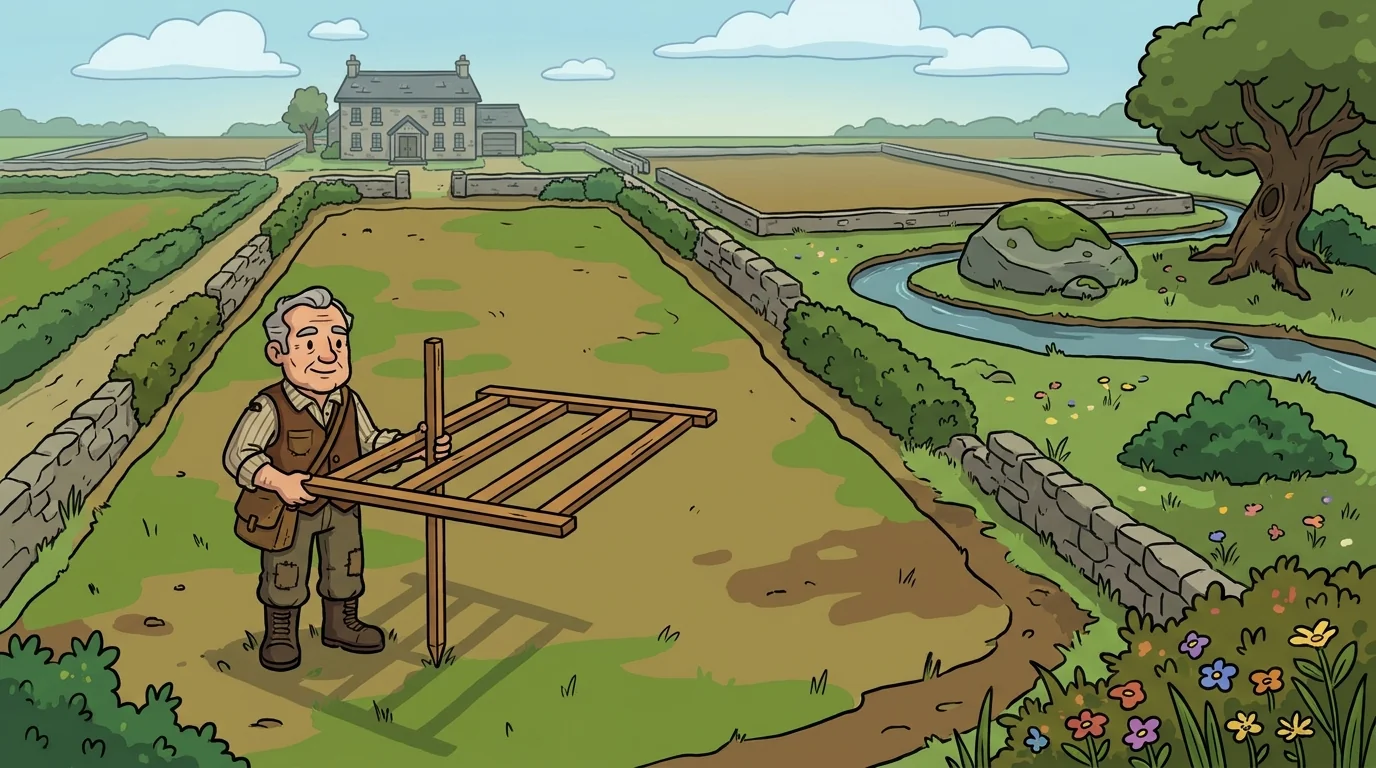
Sir Transverse measured fields. He did this for thirty years.
He worked for the kingdom's land office. It was a quiet government place. The office sat in a sleepy stone building. His job was to divide fields. He had to make sure they were fair.
This was not as simple as it sounds.
The fields of the kingdom were, mostly, rectangles. Some were longer than they were wide. Some were squarer. Some fields had funny corners. A stream might cut them off. Or a big rock. Maybe an old tree stood there. It was there before the field. But most fields had four sides. They had two long sides and two short sides.
The trouble was that the long sides were parallel.
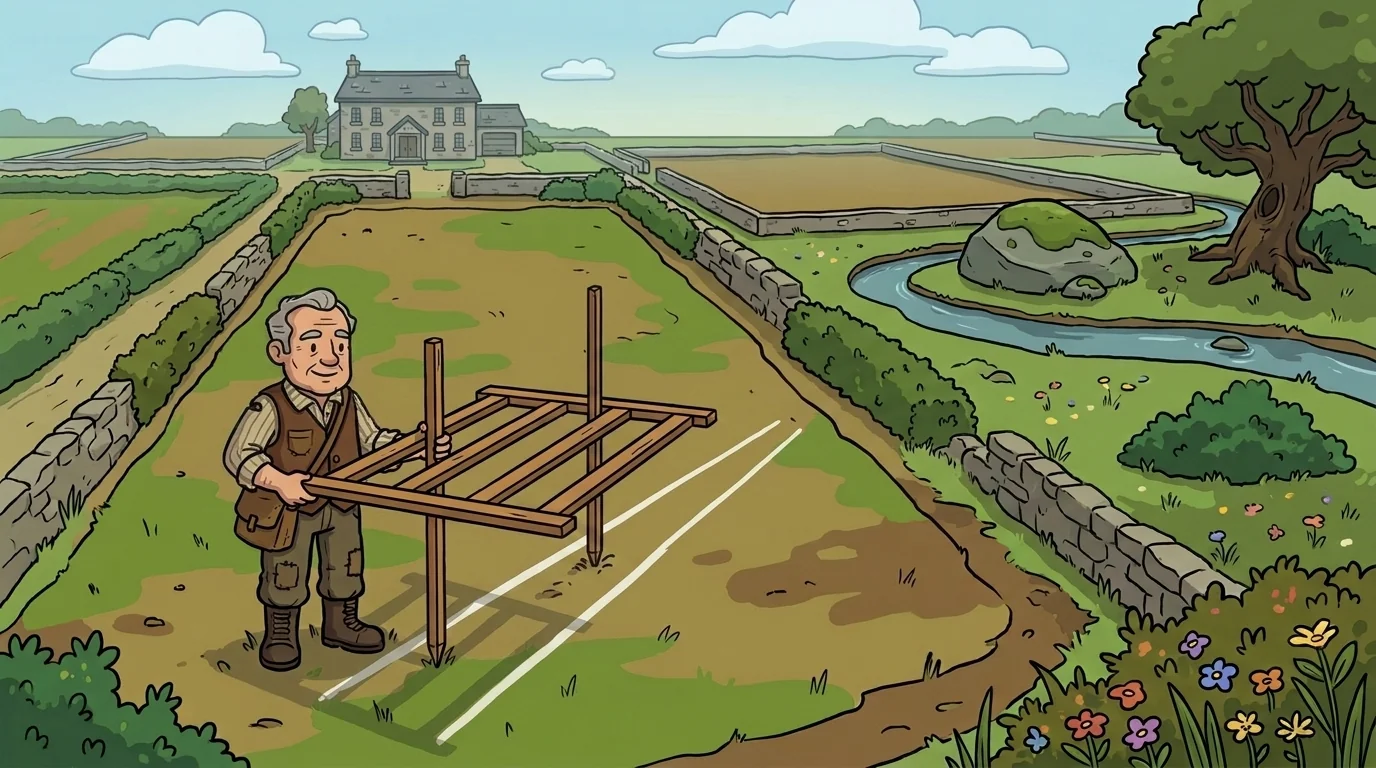
Families often needed to divide fields. Maybe parents had died. Then brothers and sisters shared. Neighbors might argue over a line. Sometimes friends owned land together. They always wanted a fair share.
Fairness in fields meant one thing. It meant: each owner got a strip. The strips had to be the same proportional width. This was measured along the parallel sides.
If a field was 300 paces long, and three kids shared it, they wanted three strips. Each strip was 100 paces wide. If a field was 240 paces long, and four kids shared it, they wanted four strips. Each strip was 60 paces wide. Simple.
But fields are not always nicely lined up north-to-south. Sometimes the parallel sides are not even the longest sides. Sometimes they cut diagonal strips. Maybe a strip needed to touch the road. Or reach the stream. Each sibling wanted a piece like that. And then the math becomes interesting.
Sir Transverse was thin. He had long, stork-like legs. Everyone called him Sir. He had been Sir since he was six. It was a family nickname. No one knew why.
When he was nineteen, he found something out. It was his second year as a surveyor. He saw that if you cut a field with a diagonal line. He called this a transversal. It went across two parallel boundary lines. Then he cut another diagonal line. This second line was parallel to the first. The strip between these two diagonals always had a special width. This width was proportional to how far the strip was from the main parallel lines.

This was the intercept theorem. It's a very old math rule. Sir Transverse, of course, did not know it had a name. He simply observed it. He measured it on every field he surveyed for the next four years. It held. Every time.
By age twenty-three, he was a master. He walked into any field. He saw the people arguing. He asked one question: "How do you want the strips to touch the road?" In ten minutes, he laid out fair strips. He used only his measuring-staff. And a knotted cord.
He never measured the whole field. He never figured out its total area. He didn't need to. He just cut parallel lines. He used parallel transversals. The proportions worked themselves out.
The people arguing always left happy. This made Sir Transverse, by age thirty, famous. Everyone wanted him. He was the busiest surveyor in three provinces.
He spent thirty years doing this work. He divided many fields. He counted them carefully. One thousand, four hundred, sixty-two fields. He never had a complaint. He never had a re-survey. He never, even once, made a strip a half-pace too wide or too narrow.
His friends at the land office had a saying about him. They joked that he had the soul of a ratio. It was a funny thing to say, but they meant it.
The GeometryForge academy needed a teacher. They wanted someone to teach proportional reasoning. This meant the intercept theorem. And how transversals cut parallel lines. The academy master heard about Sir Transverse. His nephew told him. The nephew had been in a tough family field fight. Sir Transverse had solved it.
The nephew said, "He is amazing!" He added, "He makes fair division a math rule. Not just an argument."
The academy master wrote Sir Transverse a letter. Sir Transverse was forty-nine. His knees were getting old. He worried about walking in the rain. He accepted the job.
He brought his measuring-staff and a coil of knotted cord. He still has both. He keeps them in the corner of his classroom.
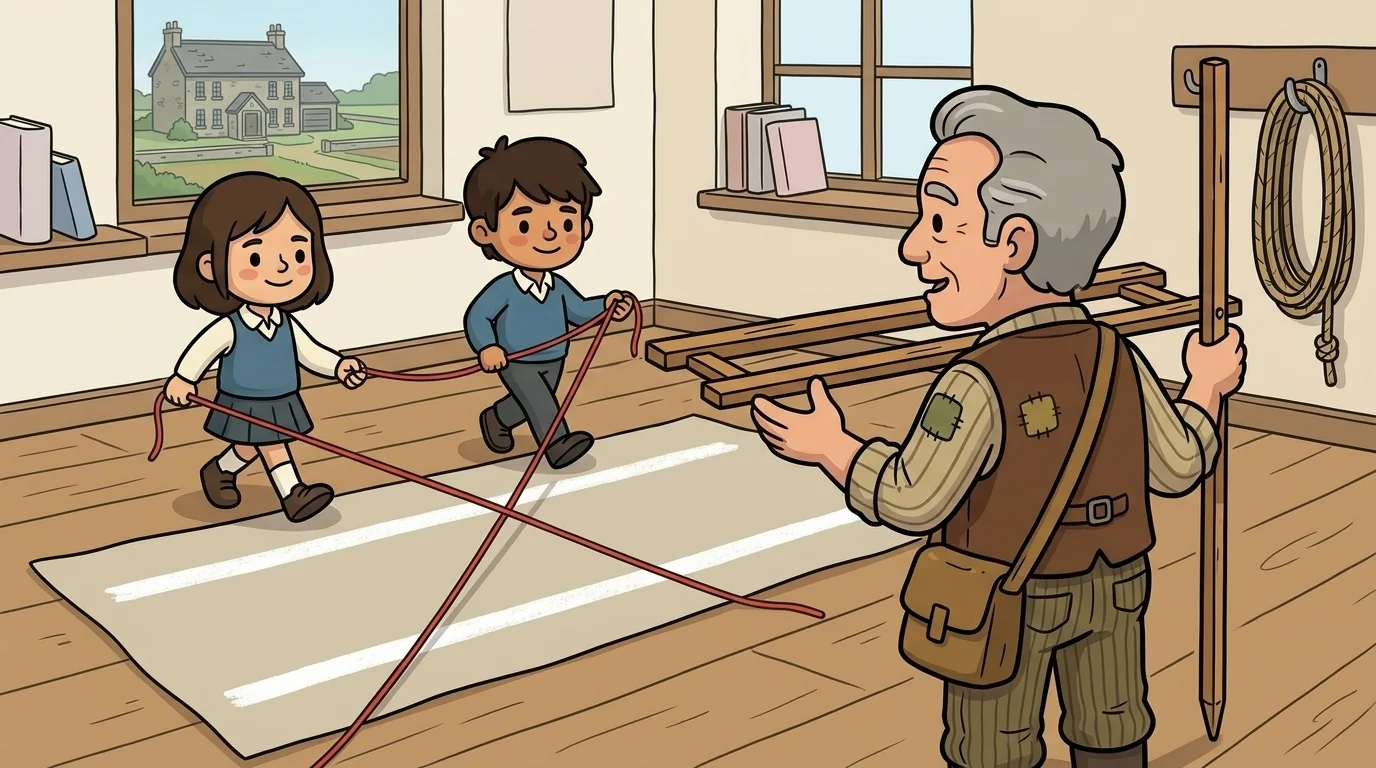
He teaches the intercept theorem his own way. He teaches it by walking. He lays a long cloth strip on the floor. It has two parallel lines marked with chalk. He picks two students. He gives them each a length of red string.
He says, "You are a transversal." He tells them, "Walk across the cloth. Hold your string tight. Choose any angle, but stay straight."
The students walk. The red strings cross the parallel lines at angles. Sir Transverse watches.
Then he asks them to walk a second transversal. This one must be parallel to the first. The class measures the strip between them. The strip is always proportional. Always.

No matter the angle, the ratio always holds. The strip's width compared to its distance from the parallel lines stays the same.
The children gasped. Their eyes went wide. They had never seen math work like magic before. Sir Transverse just smiled. He had felt the same way at nineteen. He was patient with their wonder.
He says gently, "The transversals were straight. The boundaries are parallel. The proportions just work. You didn't even have to do math."
He adds, "Geometry, when the lines agree, is fair."
Kids ask if the intercept theorem is hard. Sir Transverse always says the same thing:
"It is not hard. It is only fair. Cross two parallel lines with a transversal. The ratio holds. Cross them with two parallel transversals. The strip between is proportional. Every time."
He still has his measuring-staff. Children sometimes ask to hold it. He always lets them.
The GeometryForge ensemble
Sir Transverse is part of GeometryForge's distributed-narrative cast. Each character embodies a different curricular primitive; together they teach the full subject.
-

Master Hypotenuse
Right-triangle relations: a² + b² = c²
-

Lady Inscribed-Angle
Circle theorems (inscribed-angle, central-angle, tangent-chord, cyclic quadrilateral)
-

Apprentice Sides
Area formulas (triangle area from side lengths; rectangle / parallelogram / trapezoid area)
-

Captain Construction
Compass-and-straightedge constructions (bisector, perpendicular, equilateral triangle, regular hexagon, circle-given-three-points)
-

Compass Wraith
Locus problems + circle-as-set-of-equidistant-points
-

Madame Polygon
Regular-polygon facts (interior-angle sum, exterior-angle sum, regular-tessellation, symmetry of regular n-gons)
-

Master Tangent
Limit-and-touch problems (tangent to a circle from external point, tangent-chord angle, tangent-as-limit-of-secant)
-

Axia & Theora
Twin theorists — Axia carries axiomatic-first reasoning; Theora carries theorem-application; together they bridge geometric postulates to derived results
-

Madame Motion
Rigid motions and congruence — sliding, turning, or flipping a shape never changes its size or shape; two shapes are congruent if one can be carried exactly onto the other.
-

Scout Scale
Dilation and similarity — resizing a shape by a scale factor keeps every angle the same and multiplies every length equally; similar shapes are the same shape at a different size.
-

Lady Lattice
The coordinate plane — every point has an exact two-number address, so you can plot it, measure the distance between two points, and find the midpoint exactly between them.