
Lady Lattice
THE COORDINATE PLANE — every point has an exact address written as two numbers, how far across and how far up. With those addresses you can plot any point, measure the distance between two points, and find the midpoint exactly halfway between them.
Press play to listen along. The line being read lights up as you go.
Show full transcript
Loading transcript…
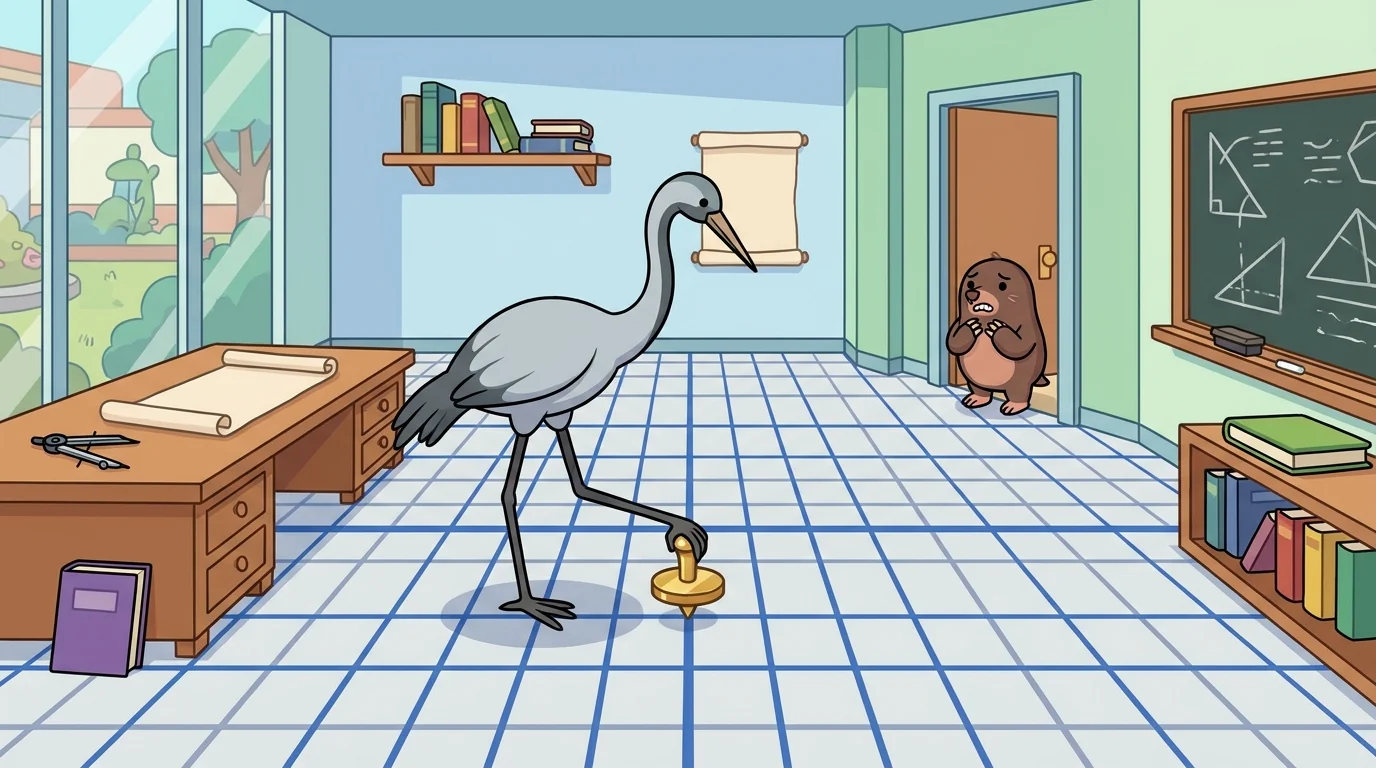
Lady Lattice never got lost, and she could not bear to watch anyone else be lost either.
Her room at the GeometryForge academy had a floor painted into a perfect grid, lines running across and lines running up, and a small brass marker she could set down on any crossing. "Give me two numbers," she liked to say, "and I will put my marker on the exact spot you mean, every single time." She was an elegant grey crane with a long, careful neck, and when she lowered the marker onto a crossing she did it the way you'd set down something precious.
A small mole named Burr stood in the doorway, twisting his paws. "I lost my marble," he said miserably. "It rolled off the table. It's over there somewhere, near the — near the thing, by the other thing."
Lady Lattice tilted her head kindly. "'Over there near the thing' is how marbles stay lost," she said. "Everything has an address, Burr. Two numbers — how far across, and how far up. Tell me those, and a thing is never lost again. Let me show you why I trust that so completely."
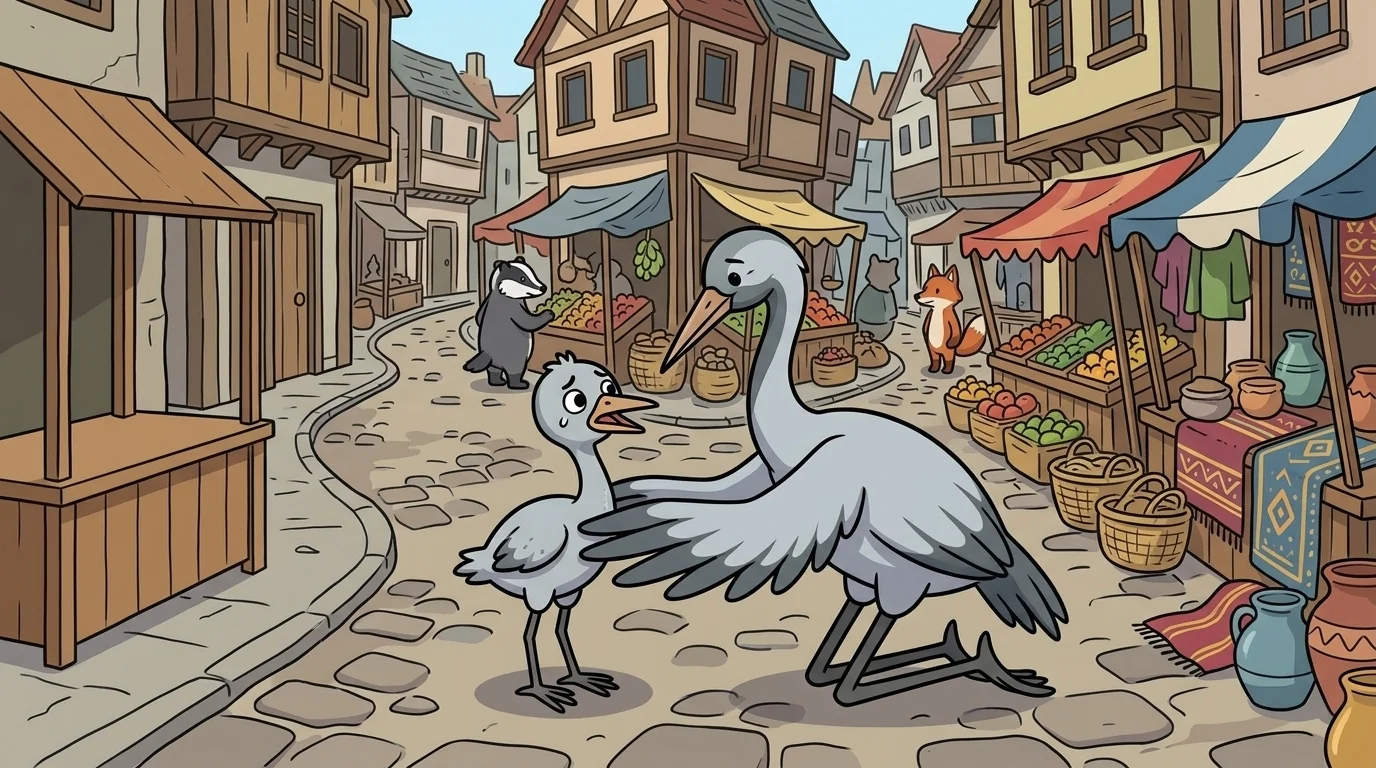
Lady Lattice grew up in a town called Crosshaven, where the streets ran in a perfect grid — numbered streets going across, numbered avenues going up — and every door in town had an address made of two numbers.
She knew her own house by heart: three streets across, four avenues up. She could walk home blindfolded.
But once, when she was small, her family visited a different town — an old, tangled place where the streets curled and looped and doubled back, and nothing was numbered. She let go of her mother's hand for one moment in the market, turned around, and the whole world was suddenly a maze with no addresses. She had never been so frightened. Every street looked like every other street. There was no across and no up. There was only lost.
Her grandmother, a patient old crane, found her at last and carried her home to Crosshaven. That night, on their own front step, her grandmother knelt down.
"You were frightened because that town had no addresses," she said. "Here, you can never truly be lost. Pick any corner in Crosshaven. Count how many streets across it is, and how many avenues up. Those two numbers are its address, and an address is a promise — it says this spot can always be found again."
Lady Lattice looked down their own gridded street, every corner quietly holding its two numbers, and the frightened, maze-lost feeling drained out of her. As long as a place had an address, it could be found. She was never going to be lost again.
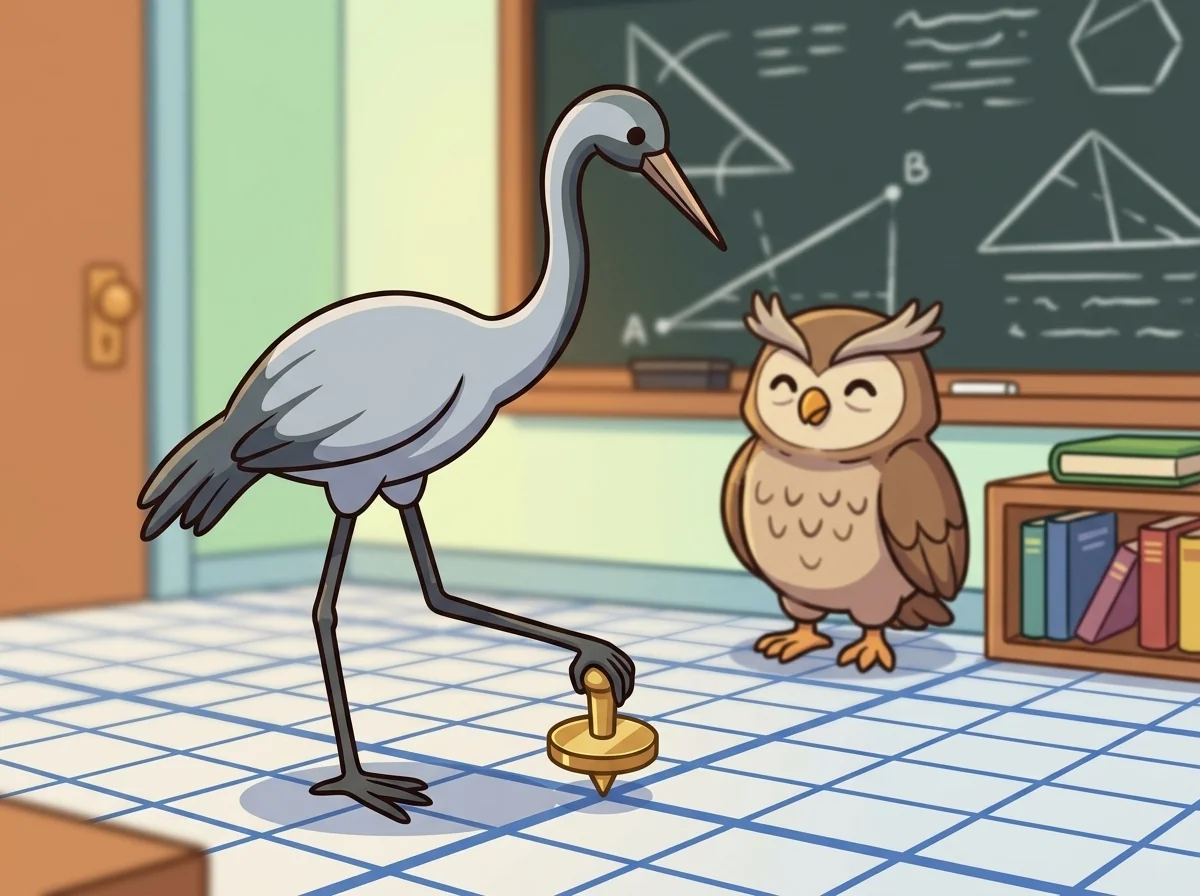
Years later, she came to the GeometryForge academy and stood before the academy master, an ancient owl who had tested every teacher in the kingdom.
He drew a grid on the board and marked two points on it, one he labelled A and one he labelled B.
"Tell me about these two points," he said.
Lady Lattice did not hesitate. "Point A's address is how far across and how far up it sits — two numbers. Point B has its own two numbers. And from those addresses alone," she went on, "I can tell you the distance between them — how far across plus how far up you'd travel from one to the other — and I can find the midpoint, the spot exactly halfway, just by landing on the address that's halfway across and halfway up." She set the owl's chalk on that middle crossing.
The owl had taught geometry for sixty years. He had watched many students plot a point. He had rarely watched one treat an address as a promise. "Start teaching this autumn," he said. And once she had fully become the thing she taught, she took the name Lady Lattice.
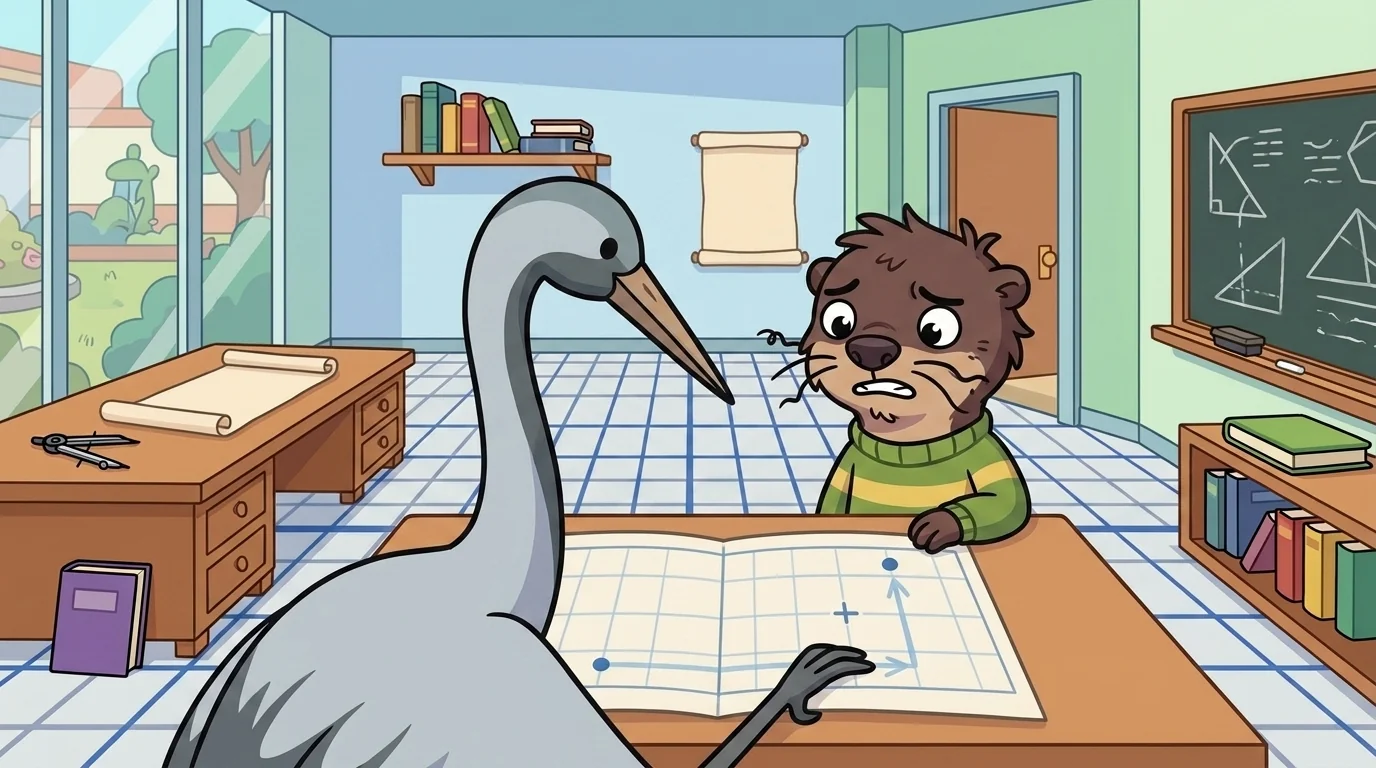
In her gridded room, a flustered young otter named Wade was nearly in knots over two dots on a worksheet.
"I'm supposed to say where these points are and how far apart they are," Wade groaned, "but I don't even know how to start. They're just... dots."
"They're not just dots — they have addresses," Lady Lattice said calmly. "Watch. For the first dot, I count across from the corner: that's the first number. Then I count up: that's the second number. Now it has an address — two numbers — and it can never be lost." She did the same for the second dot. "There. Both have addresses now."
"Okay," Wade said slowly. "But how far apart are they?"
"Count the journey between the addresses. How many steps across from one to the other? How many steps up? That tells you how far you'd travel." She traced it with a claw. "And the midpoint — the exact middle — is the address that's halfway across and halfway up. You can find it by taking the halfway point of each number. The middle of the two 'across' numbers, and the middle of the two 'up' numbers."
Wade blinked. "So once they have addresses, I can find everything — where they are, how far apart, the exact middle?"
"Everything," said Lady Lattice. "That's the gift of an address. A point with an address is never lost, never vague, and never out of reach."
Wade looked at the two dots, no longer just dots, and let out a long breath. "They were findable the whole time. I just had to give them their numbers."
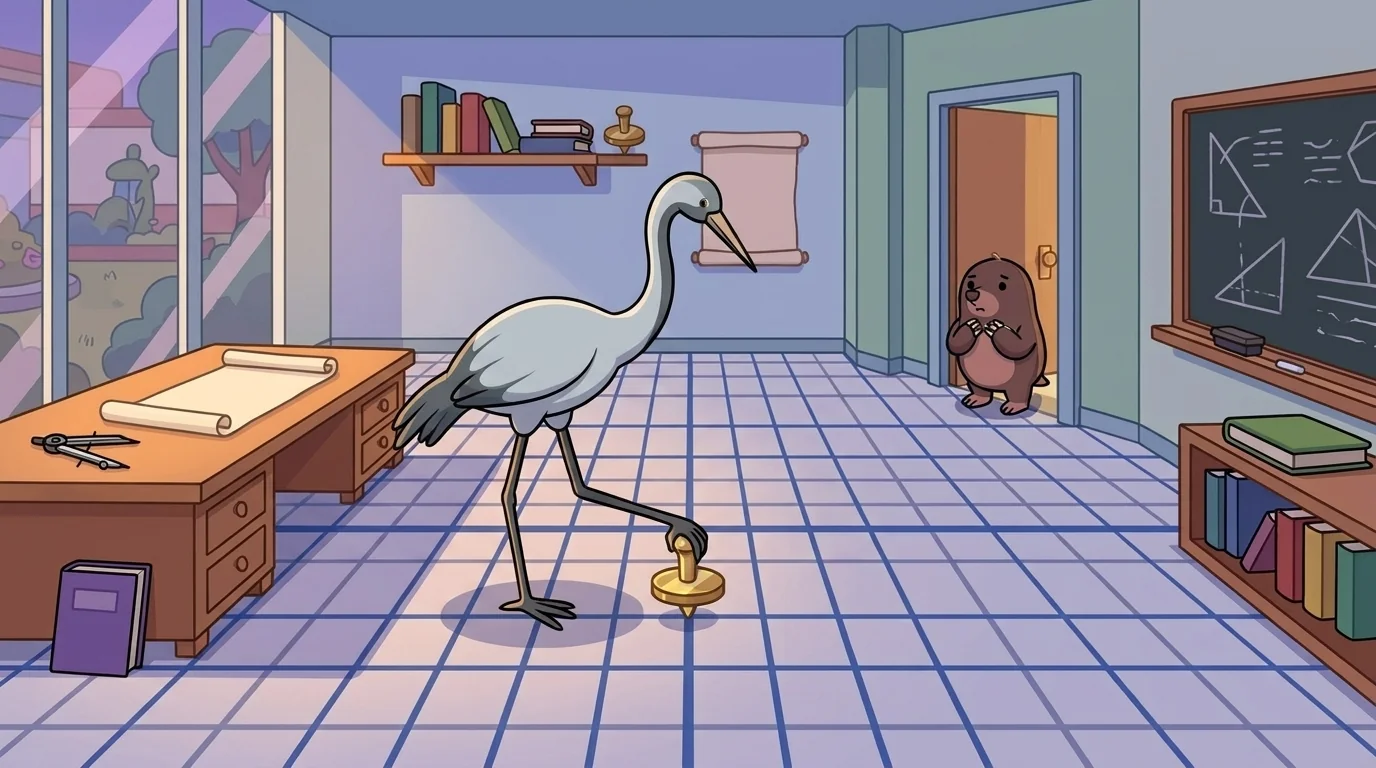
When evening came and the academy went quiet, Lady Lattice lifted her brass marker from the floor and set it gently on its shelf, on the one crossing where it always lived.
She thought, the way she often did, about that tangled town with no addresses, and the cold maze-feeling of being small and lost — and about her grandmother kneeling on the step, teaching her that a grid is a promise.
Burr the mole, still in the doorway, asked the last question of the day. "Lady Lattice? How do I make sure I never lose my marble — or anything — again?"
Lady Lattice lowered her marker onto a crossing. "Give it an address," she said. "Two numbers — how far across, how far up. Once a thing has its address, you can always find it again, always measure the way to it, always find the exact middle between it and you."
Burr looked at the marker, resting on its precise and findable spot, and nodded.
And as the little mole headed home across the quiet, gridded kingdom, he found he wasn't thinking about his lost marble at all anymore — he was thinking how good it felt to know that nothing with an address is ever truly gone, and that there is always, always a way back.
The GeometryForge ensemble
Lady Lattice is part of GeometryForge's distributed-narrative cast. Each character embodies a different curricular primitive; together they teach the full subject.
-

Master Hypotenuse
Right-triangle relations: a² + b² = c²
-
Lady Inscribed-Angle
Circle theorems (inscribed-angle, central-angle, tangent-chord, cyclic quadrilateral)
-

Sir Transverse
Parallel-line transversals + intercept theorem (proportional segments cut by parallel lines)
-

Apprentice Sides
Area formulas (triangle area from side lengths; rectangle / parallelogram / trapezoid area)
-
Captain Construction
Compass-and-straightedge constructions (bisector, perpendicular, equilateral triangle, regular hexagon, circle-given-three-points)
-

Compass Wraith
Locus problems + circle-as-set-of-equidistant-points
-

Madame Polygon
Regular-polygon facts (interior-angle sum, exterior-angle sum, regular-tessellation, symmetry of regular n-gons)
-
Master Tangent
Limit-and-touch problems (tangent to a circle from external point, tangent-chord angle, tangent-as-limit-of-secant)
-

Axia & Theora
Twin theorists — Axia carries axiomatic-first reasoning; Theora carries theorem-application; together they bridge geometric postulates to derived results
-
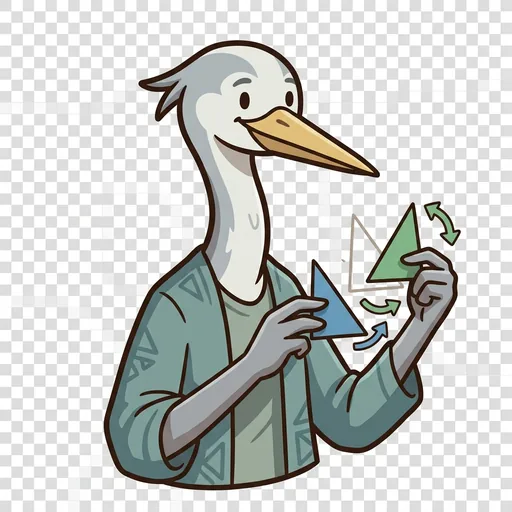
Madame Motion
Rigid motions and congruence — sliding, turning, or flipping a shape never changes its size or shape; two shapes are congruent if one can be carried exactly onto the other.
-

Scout Scale
Dilation and similarity — resizing a shape by a scale factor keeps every angle the same and multiplies every length equally; similar shapes are the same shape at a different size.