Captain Construction
COMPASS-AND-STRAIGHTEDGE CONSTRUCTIONS — bisector, perpendicular, equilateral triangle, regular hexagon, circle-given-three-points. Geometry built with only two tools, never measuring with a ruler.
Press play to listen along. The line being read lights up as you go.
Show full transcript
Loading transcript…
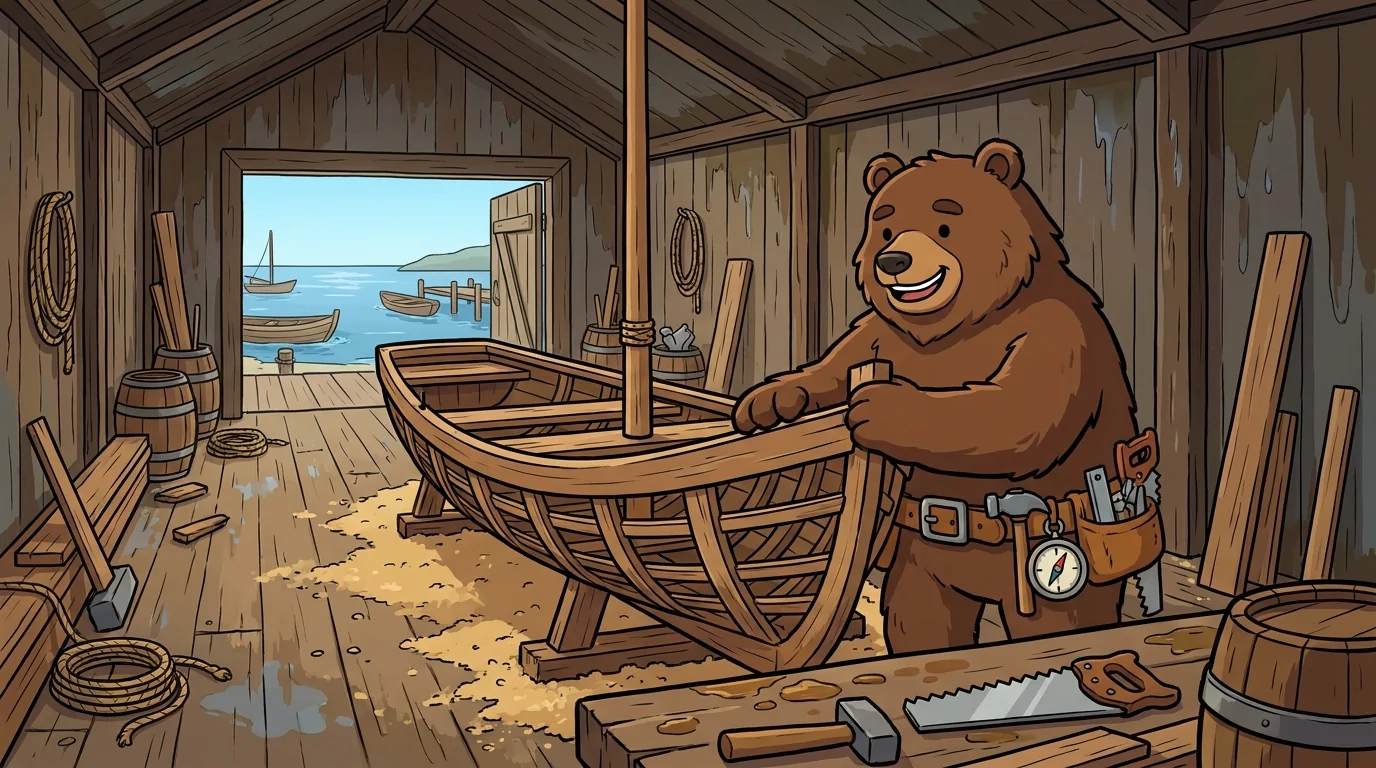
Captain Construction was, for twenty-two years, a shipwright.
He built small wooden boats in the coastal town of Hull Bay. The boats were, mostly, fishing boats — single-mast, single-sail, single-hull, suitable for two or three fishermen and a morning's catch. He built them in a long wooden shed at the head of the bay. The shed smelled of pine resin and rope-oil. The floor was always sawdust. The walls were always damp.
Captain Construction — whose given name was Bram, though everyone called him Captain since he was nineteen, even though he had never captained a boat in his life (the title was a workshop nickname that stuck) — was a bear-headed shipwright with thick brown fur on his arms and a leather toolbelt that was, even by shipwright standards, full of more tools than it strictly needed.
But Bram only ever used two of those tools when he was laying out the curves of a hull.
A compass.
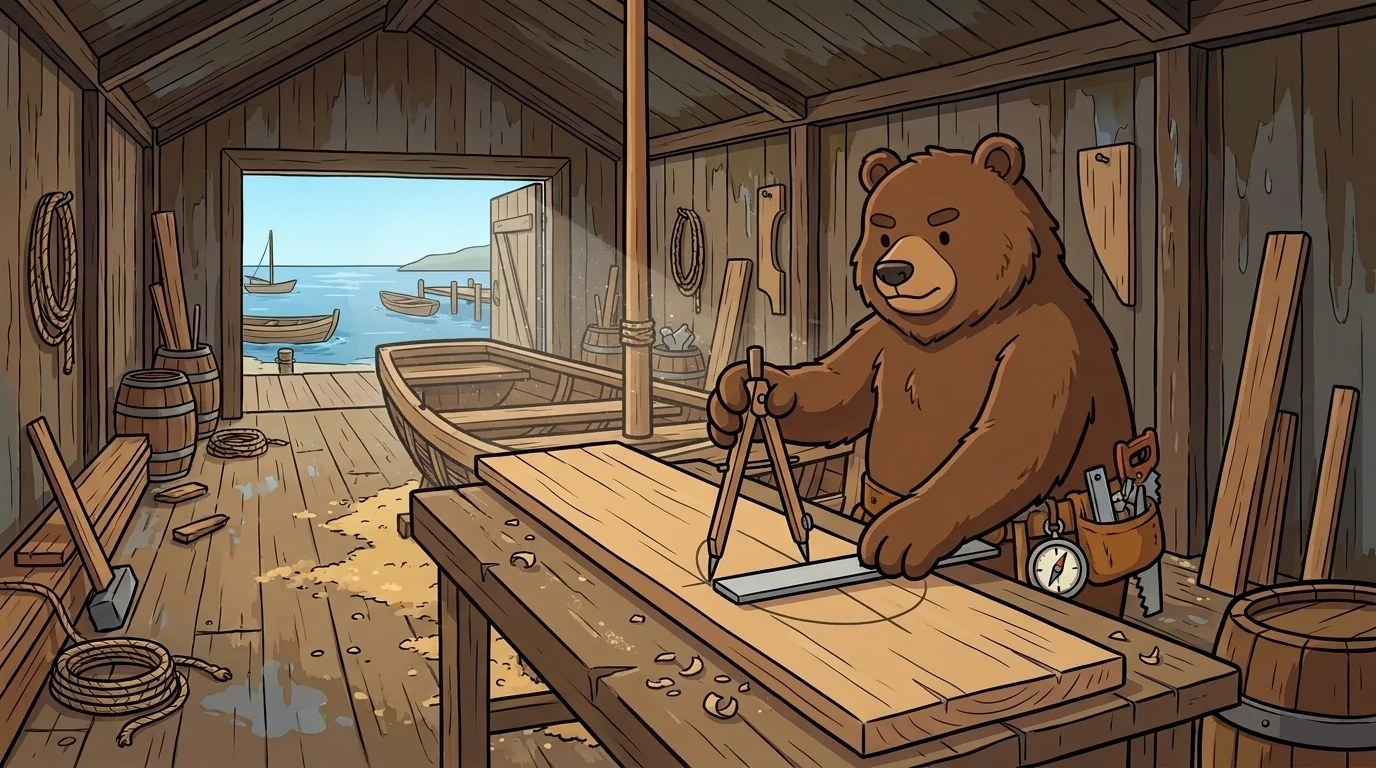
And a straightedge.
This was, to other shipwrights in Hull Bay, absurd.
Other shipwrights used rulers. They used measuring-sticks marked in thumbs and palms and forearm-lengths. They used templates copied from their fathers' templates. They penciled distances on the wood, measured them, marked them, sawed them.
Bram refused.
"A ruler is a lie waiting to happen," he used to growl, in his bear-rumbly voice, to anyone who asked him why. "The marks on a ruler wear off. The wood swells. The marks shift. A measurement made with a ruler can be off by half a thumb and you do not know it. A construction made with compass-and-straightedge is the same construction every time. The compass arc does not care if the wood has swelled. The straightedge does not care if the chalk has worn. The construction is the geometry. The geometry is the boat."
This was, to Bram, an article of faith.

He had learned it from his father, who had learned it from his grandfather, who had learned it (the family said) from a shipwright in the next valley over who had been famous for never losing a boat to a structural fault. The compass-and-straightedge tradition was, in Bram's family, three generations old.
He spent twenty-two years building boats this way. He laid every curve as a compass-arc. He found every right angle by constructing a perpendicular from a chosen point to a line — never by measuring with a square. He divided every spar into halves and thirds by constructing bisectors and trisectors — never by counting thumb-widths. The work was slower. The work was more careful. The work was correct.
In twenty-two years, he built one hundred and forty-six boats.
In twenty-two years, not one of his boats sank.
This was — and it remains — unusual. The going rate for fishing boats in Hull Bay was that about one in every twenty would suffer some structural failure within five years. Bram's boats did not. The reason, the harbour-master eventually decided after thirty years of watching Bram work, was that the geometry was right. Other shipwrights built boats that worked. Bram built boats that had to work — because every curve had been derived from a single principle, every angle had been constructed, every dimension had been the logical consequence of every other dimension. The boat was not assembled from parts. The boat was constructed from a small number of axioms.
When the GeometryForge academy was looking for someone to teach compass-and-straightedge constructions to children, the academy master had heard about Bram from a sea captain who had bought one of his boats. The sea captain said: "He does not build boats. He builds proofs that happen to float."

The academy master wrote Bram a letter. Bram, who was forty-one and beginning to think his bear-shoulders would not survive another decade of bending over a hull, accepted.
He brought his compass and his straightedge. He still has both. He calls the compass the swing-arm, because, he says, it swings around its center the way a gate swings around its hinge.
In his classroom, the first lesson is always the same. He sets out, on every child's desk, a compass and a straightedge. He says: "Today we are not going to measure anything. We are going to construct everything. The compass first. The straightedge second. No measuring. That's the deal."
The children — always — protest. They ask how they can possibly draw anything accurate without measuring.
Captain Construction smiles. (Bear-headed smiles are slow and gradual but they are warm.) He says: "You will see. The geometry will tell you what to do. The compass will tell you how far. The straightedge will tell you which way."
He then shows them the first construction. Bisecting an angle. The method is older than the kingdom. The method is older than Bram's grandfather. The method does not require a ruler. The method does not require measurement. The method gives an angle bisector that is, exactly, a bisector.
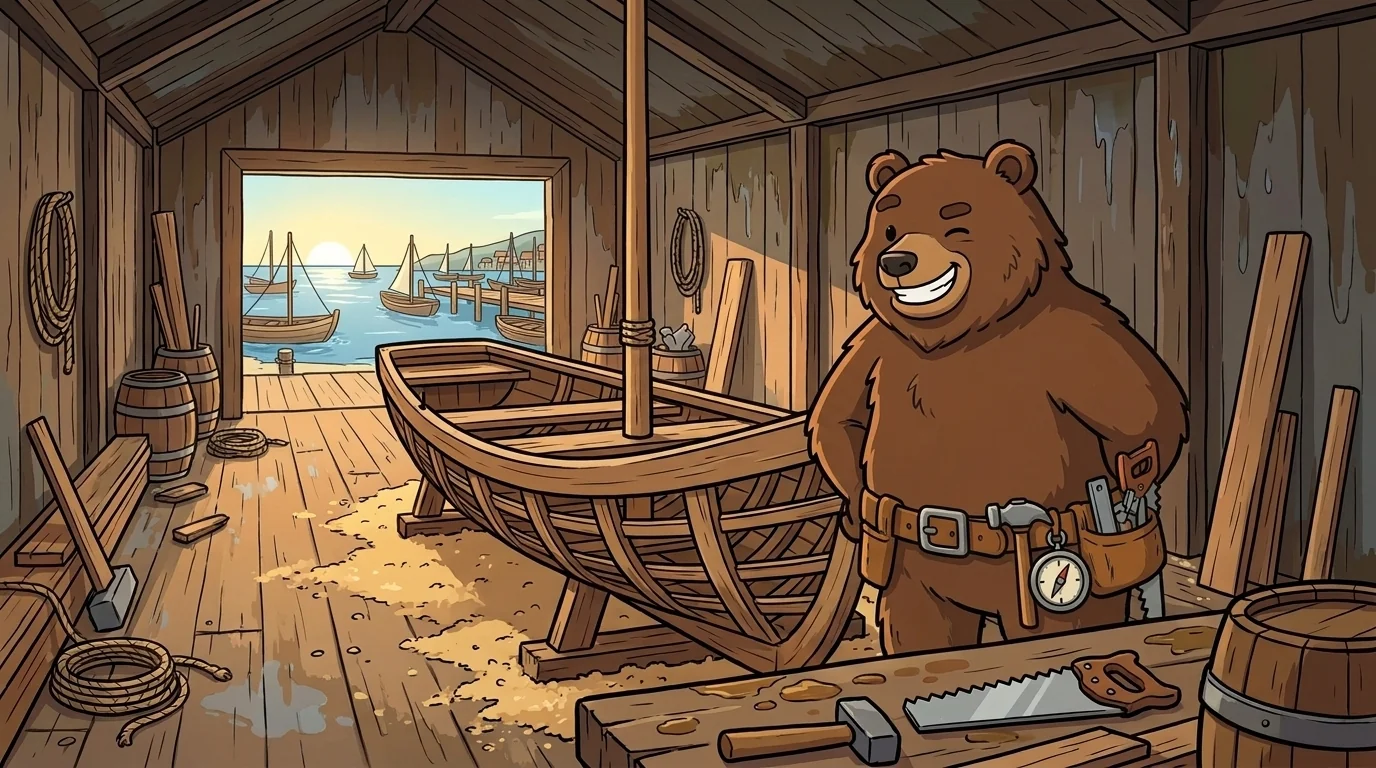
The children try it. The bisector works. They check it with a protractor (the academy keeps protractors for verification; Bram tolerates them grudgingly). The bisector is exactly half of the original angle. Every time.
Captain Construction nods. He says: "This is geometry. The compass and the straightedge are the only tools you need. Everything else follows."
He adds, in his bear-rumble: "Also: my boats did not sink. The geometry, in case you are wondering, was exactly the same as this. Just bigger."
When children ask whether compass-and-straightedge construction is hard, Captain Construction always says the same thing:
"It is not hard. It is only patient. Compass first. Straightedge second. No measuring. The geometry tells you what to do. Trust the geometry."
He still keeps the compass on his belt. The children sometimes ask to hold it. He always lets them — and he watches their faces, the careful, delighted way they turn it, and it makes his old bear-heart glad. That quiet pride, he says, is the whole reason he came ashore to teach: not to be right, but to hand the calm, sure feeling of this will hold to someone new.
The GeometryForge ensemble
Captain Construction is part of GeometryForge's distributed-narrative cast. Each character embodies a different curricular primitive; together they teach the full subject.
-

Master Hypotenuse
Right-triangle relations: a² + b² = c²
-

Lady Inscribed-Angle
Circle theorems (inscribed-angle, central-angle, tangent-chord, cyclic quadrilateral)
-

Sir Transverse
Parallel-line transversals + intercept theorem (proportional segments cut by parallel lines)
-

Apprentice Sides
Area formulas (triangle area from side lengths; rectangle / parallelogram / trapezoid area)
-

Compass Wraith
Locus problems + circle-as-set-of-equidistant-points
-

Madame Polygon
Regular-polygon facts (interior-angle sum, exterior-angle sum, regular-tessellation, symmetry of regular n-gons)
-
Master Tangent
Limit-and-touch problems (tangent to a circle from external point, tangent-chord angle, tangent-as-limit-of-secant)
-

Axia & Theora
Twin theorists — Axia carries axiomatic-first reasoning; Theora carries theorem-application; together they bridge geometric postulates to derived results
-

Madame Motion
Rigid motions and congruence — sliding, turning, or flipping a shape never changes its size or shape; two shapes are congruent if one can be carried exactly onto the other.
-

Scout Scale
Dilation and similarity — resizing a shape by a scale factor keeps every angle the same and multiplies every length equally; similar shapes are the same shape at a different size.
-
Lady Lattice
The coordinate plane — every point has an exact two-number address, so you can plot it, measure the distance between two points, and find the midpoint exactly between them.