Compass Wraith
LOCUS — the set of all points satisfying a given condition. Special case: the circle as the locus of points equidistant from a center.
Press play to listen along. The line being read lights up as you go.
Show full transcript
Loading transcript…

The Compass Wraith is, strictly speaking, not alive.
This is a thing that needs to be said at the start, because the other GeometryForge cast members are all — Master Hypotenuse, Sir Transverse, Apprentice Sides, Axia, Theora, Captain Construction, Lady Inscribed-Angle, Madame Polygon, Master Tangent — alive. They eat, they sleep, they go home for holidays, they have favourite teas. The Compass Wraith does not eat. The Compass Wraith does not sleep. The Compass Wraith does not have a favourite tea.
The Compass Wraith is a spirit.
She is translucent — pale violet, with a moonlight halo. Her lower body fades into mist. She wears a cape woven from dotted lines, like the tracing-paths a compass leaves. She holds a glowing compass that traces silver arcs through the air. She moves without footsteps.
The other cast members accept this cheerfully.

Children find her, on the first day they meet her, slightly thrilling. They are not afraid of her. (She is, despite being a spirit, kind.) But they are aware that she is unusual. They watch her closely. They ask the other cast members about her. The other cast members shrug and say: "She has always been here. The academy is older than any of us. The Compass Wraith was here before the academy was here."
This is, as far as anyone has been able to confirm, true.
The Compass Wraith — whose name, the academy master has been told, is Lune (though she has never confirmed this) — appears in the geometry curriculum whenever a problem asks the question:
"Where could the point be?"
Not — and this is important — "where is the point?" The point's location is, in those problems, not yet known. The problem gives a condition. The condition is something like: "a point five paces from this rock" or "a point that is equidistant from these two trees" or "a point that is closer to the river than to the road." The problem then asks the student to draw, on a map or a diagram, all the places the point could possibly be.
The set of all such places is called the locus.
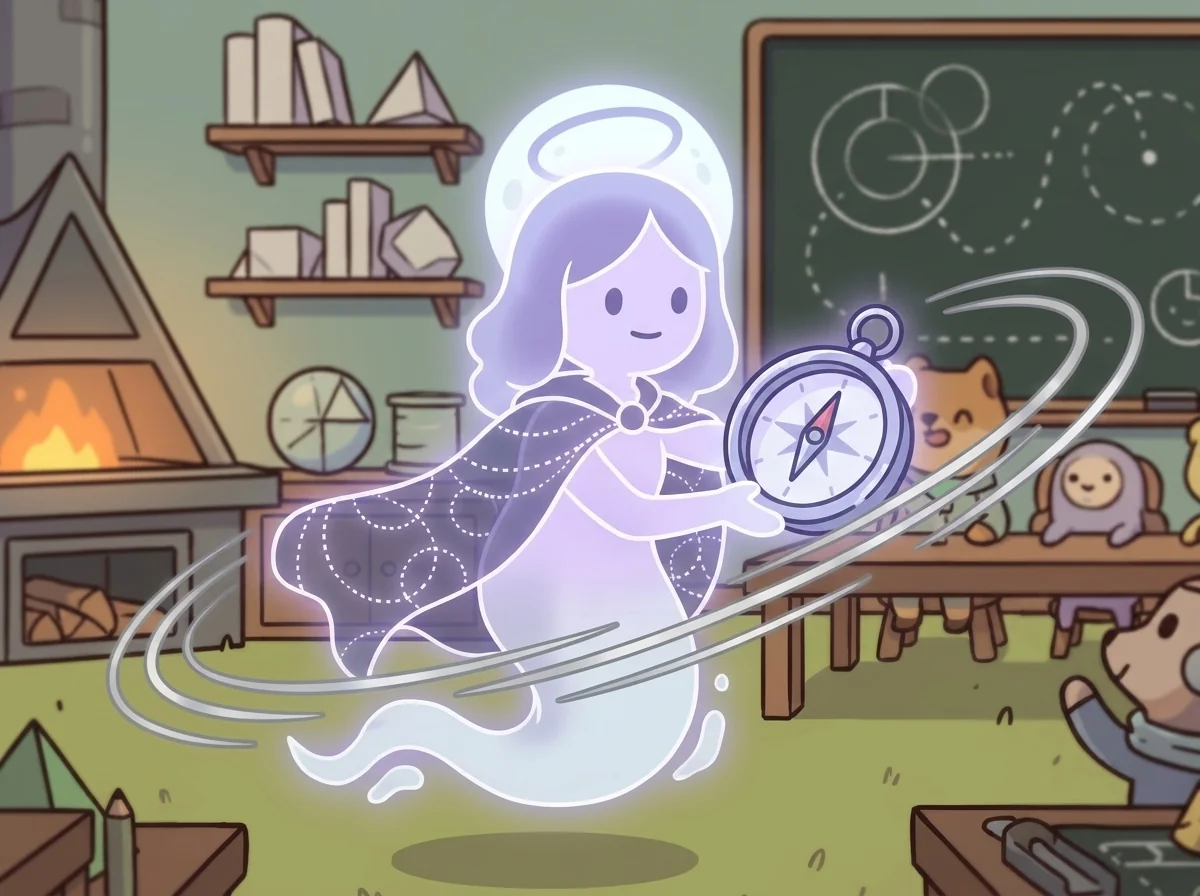
Most loci are circles, lines, or arcs of circles. (The locus of points five paces from a rock is a circle of radius five centered on the rock. The locus of points equidistant from two trees is a perpendicular line bisecting the line between the two trees. The locus of points closer to a river than to a road is a region — bounded by a parabola, but children do not need to know that yet.)
Working out a locus is not easy for children. It requires thinking about all the possibilities at once — which is a habit of mind children do not naturally have. They want to find the answer. They do not want to find all possible answers.
This is where the Compass Wraith comes in.
When a locus problem appears in a kit, the Compass Wraith materializes. She does this without warning. The classroom is in the middle of a discussion about some other topic. Suddenly the air shimmers, slightly. A pale violet figure appears at the front of the room. Her glowing compass is in her hand. She raises it. She turns slowly. The compass traces a silver arc through the air.
The arc is the locus.
The Compass Wraith does not, usually, speak. She simply shows. The children watch the silver arc unfold. They see the set of all possible points. They understand, viscerally, what locus means.
Sometimes she does speak. When she does, her voice is airy and slightly distant, but warm. She says things like:

"Every point that is equally far from here. I show you all of them at once."
Or:
"All the places where the bird could be hiding, given that you know how far it sang from. Watch."
And then the silver arc traces the answer.
When the locus is a circle, she draws a perfect circle. When the locus is a line, she walks a perfectly straight path. When the locus is more complex — an arc, a pair of lines, a region — she shows it in soft silver outlines that hang in the air for a few seconds before fading.
Then she vanishes.
The other cast members are used to this. The other cast members will be in the middle of a sentence and the Compass Wraith will appear, do her work, and disappear, and the cast member will simply continue the sentence. (Sir Transverse, who is the most matter-of-fact of the cast, has been known to say "Thank you, Lune" without breaking his stride. The Compass Wraith, even mid-vanish, nods at him.)
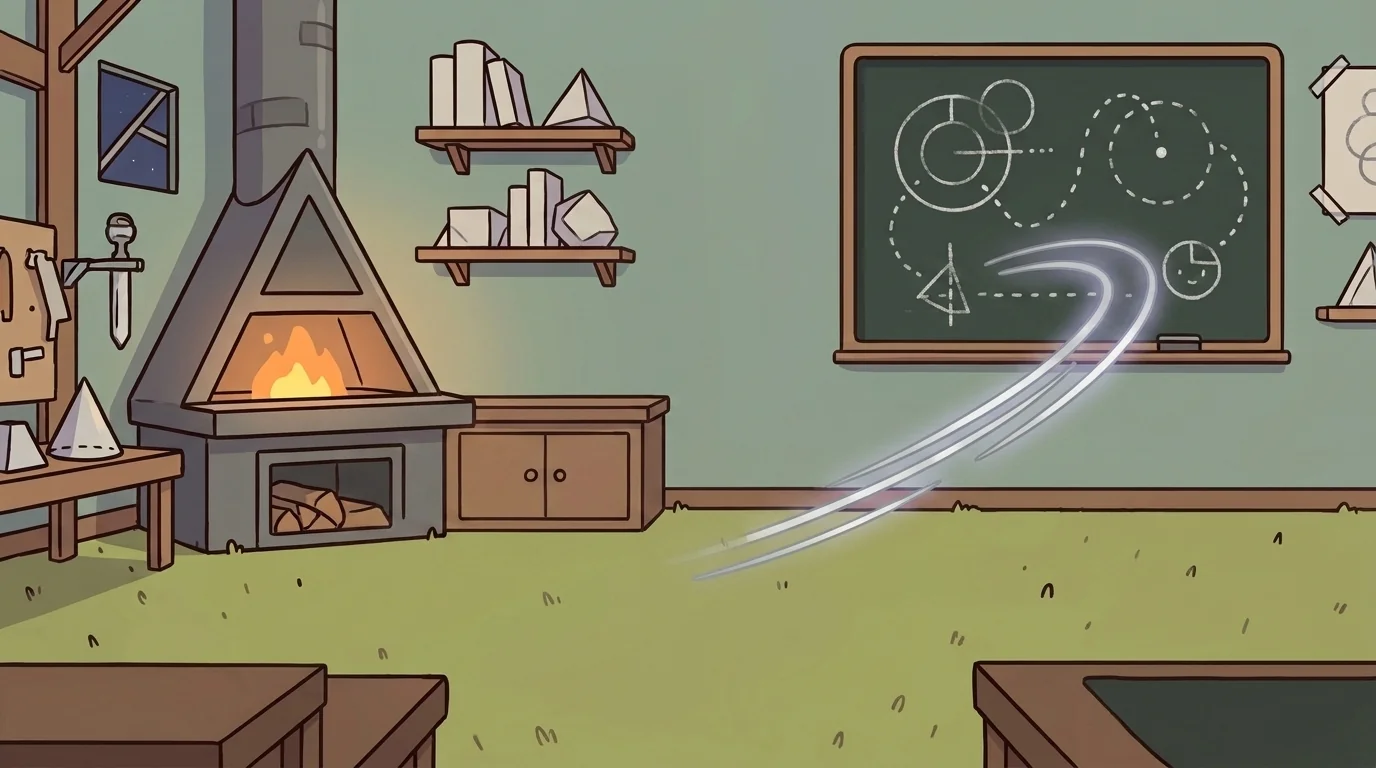
Children eventually come to look forward to her arrivals. They ask: "Will the Compass Wraith come today?" And Lady Inscribed-Angle, who knows the curriculum's locus-problems by heart, will say: "Yes. Around the middle of the lesson. She always comes when there is a circle to draw."
The Compass Wraith does not, as far as anyone can tell, age. She has been doing this work — whatever exactly this work is, in whatever realm she inhabits when she is not appearing in classrooms — for as long as anyone at the academy can remember. She is the academy's quietest faculty member and also, the academy master sometimes thinks, the most reliable.
When children ask her — once, sometimes, on a brave day — whether she is really a ghost, the Compass Wraith always says the same thing. Her airy voice is patient. She says:
"I am the set of all points equidistant from this place to this place. I am the locus. I am the arc the compass would trace if you turned it forever. Some of me you can see. The rest of me you have to imagine."
Then she fades. The classroom is left, briefly, with the silver outline of her last arc still hanging in the air.
It always fades within a minute.
The children always remember it for longer.
The GeometryForge ensemble
Compass Wraith is part of GeometryForge's distributed-narrative cast. Each character embodies a different curricular primitive; together they teach the full subject.
-

Master Hypotenuse
Right-triangle relations: a² + b² = c²
-

Lady Inscribed-Angle
Circle theorems (inscribed-angle, central-angle, tangent-chord, cyclic quadrilateral)
-

Sir Transverse
Parallel-line transversals + intercept theorem (proportional segments cut by parallel lines)
-

Apprentice Sides
Area formulas (triangle area from side lengths; rectangle / parallelogram / trapezoid area)
-

Captain Construction
Compass-and-straightedge constructions (bisector, perpendicular, equilateral triangle, regular hexagon, circle-given-three-points)
-

Madame Polygon
Regular-polygon facts (interior-angle sum, exterior-angle sum, regular-tessellation, symmetry of regular n-gons)
-
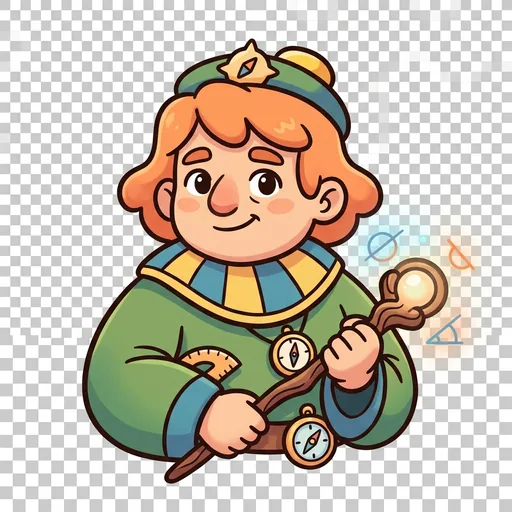
Master Tangent
Limit-and-touch problems (tangent to a circle from external point, tangent-chord angle, tangent-as-limit-of-secant)
-

Axia & Theora
Twin theorists — Axia carries axiomatic-first reasoning; Theora carries theorem-application; together they bridge geometric postulates to derived results
-

Madame Motion
Rigid motions and congruence — sliding, turning, or flipping a shape never changes its size or shape; two shapes are congruent if one can be carried exactly onto the other.
-

Scout Scale
Dilation and similarity — resizing a shape by a scale factor keeps every angle the same and multiplies every length equally; similar shapes are the same shape at a different size.
-
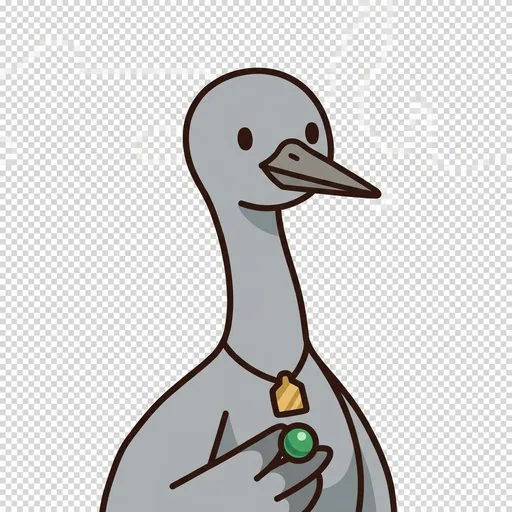
Lady Lattice
The coordinate plane — every point has an exact two-number address, so you can plot it, measure the distance between two points, and find the midpoint exactly between them.