Lady Inscribed-Angle
CIRCLE THEOREMS — inscribed-angle is half the central-angle subtending the same arc. The angle at the rim, half of the arc you see across.
A story read by Lady Inscribed-Angle
Press play to listen along. The line being read lights up as you go.
Show full transcript
Loading transcript…

Lady Inscribed-Angle grew up on the shore of Lake Drumhead.
This was, even by the standards of the kingdom — which has a great many small lakes — an unusual lake. It was, as far as anyone could measure, perfectly circular. Not approximately. Not roughly. Perfectly. The villagers of the surrounding village (which was also called Drumhead, because the village had been there longer than the kingdom had a habit of giving things distinct names) had measured the lake every generation for three hundred years. Every measurement agreed: a perfect circle, about half a mile across.
Lady Inscribed-Angle — whose given name, before the academy, was Pell — was born and raised on the rim of this lake.
The children of Drumhead had a game. It was old. Older than anyone could remember. It was called the chord-walk.

The game went like this: a child stood at a chosen point on the rim of the lake. The child picked two other points on the rim, anywhere they liked, and walked the arc from one to the other. While they walked, they kept their head turned so they were always looking at the chord — the straight line between the two endpoints they had picked. When they had walked the arc, they came back to the chosen starting point and the older children, who had been watching, would measure two things: the angle at which the starting child had been standing (between the two picked points), and the length of the arc the child had walked.
Then the older children would announce a number. Always the same kind of number. Half.
The arc walked was always twice the angle at the starting child's position. Always.
This was the game. It was not explained. It was a thing the children of Drumhead grew up with. It was, the villagers said, what the lake taught.
Pell was eleven when she started thinking about this seriously.

She walked the chord, by her own count, three hundred and seventeen times over the course of one summer. She tried it from every starting point on the rim. She tried it with chords short enough that the arc was just a tiny sliver, and chords long enough that the arc went more than halfway around the lake. She tried it standing on a rock, on a tree-stump, on her cousin's shoulders. The rule held. The angle at the rim was always half the arc.
She did not, at eleven, know why. She knew only that.
When she was sixteen, a travelling tutor came through Drumhead — a quiet woman named Mira who taught geometry to children in villages along the coast — and Pell asked her the question. Mira sat down on the rim of the lake. She drew three pictures in the wet sand. She said:
"The angle you stand at is called an inscribed angle. The angle a person standing at the center of the lake would measure to the same two points is called the central angle. The central angle is the same as the arc, just expressed as a number of degrees instead of a length. And the inscribed angle is always — exactly, every time, for any circle — half of the central angle."
Mira drew it. Pell watched. Pell understood.

She said: "The lake has been teaching this to children for three hundred years. Nobody told us what it was called."
Mira smiled. She said: "The lake teaches very well. The names are just for the children who do not have a lake."
Pell, who was sixteen, decided in that moment that she wanted to be the person who taught children-without-lakes what the lake had taught her. She studied with Mira for two years, then with the academy of GeometryForge for three more, then took the name Lady Inscribed-Angle (which, in the academy's tradition, is what you do when your character has fully embodied a single geometric primitive). She has been teaching ever since.
She still goes home to Drumhead twice a year. She still walks the chord. She still gets the same result.
When children arrive in her classroom for the first time, she always begins the same way. She draws a circle on the board. She draws a chord. She marks a point on the rim. She marks the center. She says: "This is the inscribed angle. This is the central angle. Which is bigger?"
The children — always — guess wrong the first time. They say the inscribed angle is bigger, because it looks closer to them.

Lady Inscribed-Angle smiles. She says: "It looks bigger. It is half. The central angle is twice."
Then she lets them measure it. Then she lets them try it from a different point on the rim. Then she lets them try it from a different chord. They always get the same answer.
She tells them, gently: "This is a thing about circles. It is true for every circle. You do not need a lake to test it — but you do need a circle, and you need patience, and you need to walk the chord."
When children ask whether the inscribed-angle theorem is hard, Lady Inscribed-Angle always says:
"It is not hard. It is only half. The angle at the rim is half the arc you see. Every time. Every circle."
She tilts her head, slightly, when she says it. She has, the academy children have noticed, fox ears, and the ears prick forward whenever a circle appears in a problem. She does not seem to do this on purpose. The circles, she says, simply call to her. And when a child finally feels the theorem click — when their whole face goes soft and surprised, the way hers did on the rim of the lake — those fox ears prick all the way forward, because that warm, glad little jump in her chest is the thing she came so far from Drumhead to feel again.
The GeometryForge ensemble
Lady Inscribed-Angle is part of GeometryForge's distributed-narrative cast. Each character embodies a different curricular primitive; together they teach the full subject.
-

Master Hypotenuse
Right-triangle relations: a² + b² = c²
-

Sir Transverse
Parallel-line transversals + intercept theorem (proportional segments cut by parallel lines)
-

Apprentice Sides
Area formulas (triangle area from side lengths; rectangle / parallelogram / trapezoid area)
-

Captain Construction
Compass-and-straightedge constructions (bisector, perpendicular, equilateral triangle, regular hexagon, circle-given-three-points)
-

Compass Wraith
Locus problems + circle-as-set-of-equidistant-points
-

Madame Polygon
Regular-polygon facts (interior-angle sum, exterior-angle sum, regular-tessellation, symmetry of regular n-gons)
-
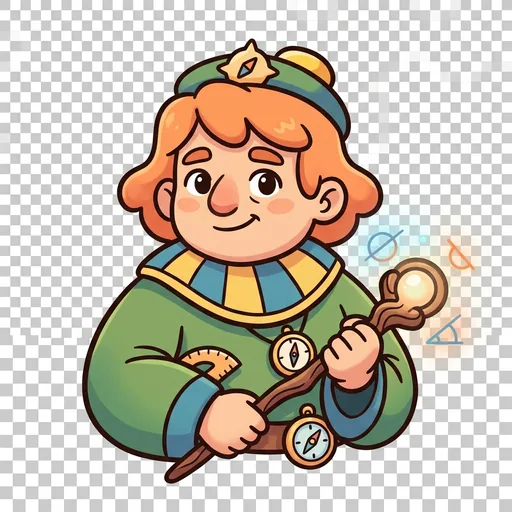
Master Tangent
Limit-and-touch problems (tangent to a circle from external point, tangent-chord angle, tangent-as-limit-of-secant)
-

Axia & Theora
Twin theorists — Axia carries axiomatic-first reasoning; Theora carries theorem-application; together they bridge geometric postulates to derived results
-

Madame Motion
Rigid motions and congruence — sliding, turning, or flipping a shape never changes its size or shape; two shapes are congruent if one can be carried exactly onto the other.
-

Scout Scale
Dilation and similarity — resizing a shape by a scale factor keeps every angle the same and multiplies every length equally; similar shapes are the same shape at a different size.
-
Lady Lattice
The coordinate plane — every point has an exact two-number address, so you can plot it, measure the distance between two points, and find the midpoint exactly between them.