Master Tangent
TANGENT — a line that touches a circle at exactly one point, never crossing. Also: the limit of a sequence of secants. Also: in trigonometry, the ratio opposite/adjacent in a right triangle.
Press play to listen along. The line being read lights up as you go.
Show full transcript
Loading transcript…
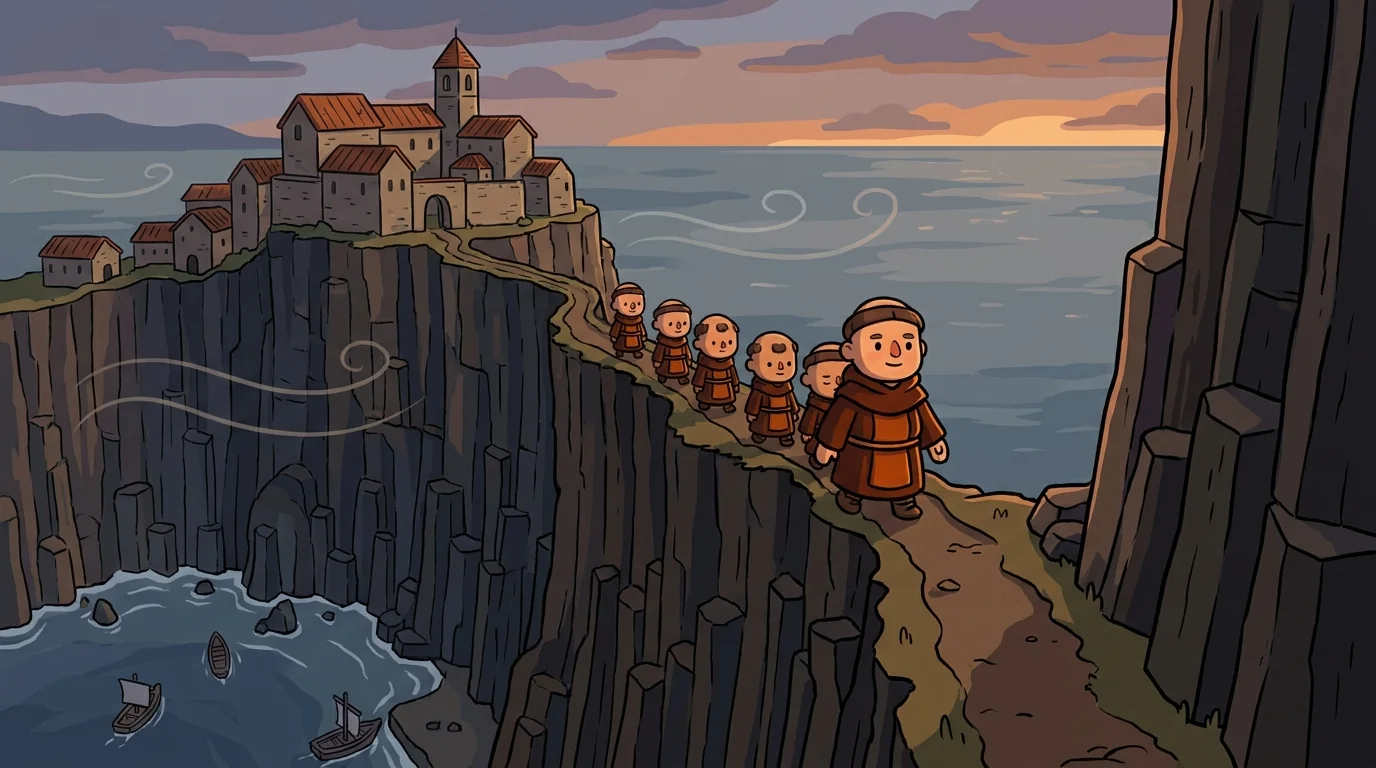
Master Tangent grew up in a monastery on a cliff above the sea.
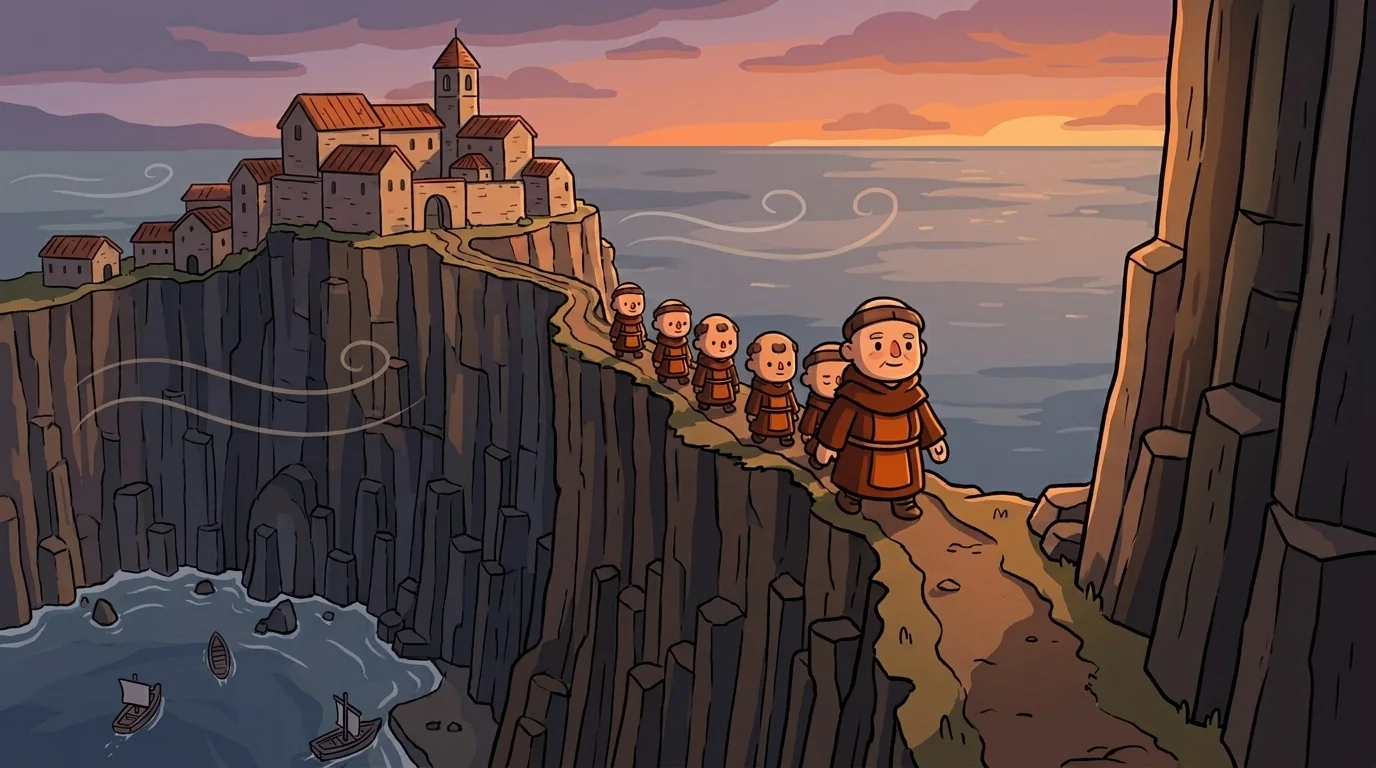
The monastery — which is called, simply, Sea-Cliff Monastery, because nobody has ever come up with a better name — sits on the very edge of a tall basalt cliff overlooking the cold-water bay of Northshore. The cliff is about three hundred feet high. The bay is below it, far below it. The sea is grey most of the year. The wind, even in summer, is cold.
The monks of Sea-Cliff Monastery had — and still have — a daily practice.
At sunset, every monk who is well enough to walk goes outside. They walk, single-file, along the very edge of the cliff. Their right shoulders are toward the sea. Their left shoulders are toward the monastery. The path along the edge is no wider than a single footstep. The drop, to their right, is three hundred feet straight down.
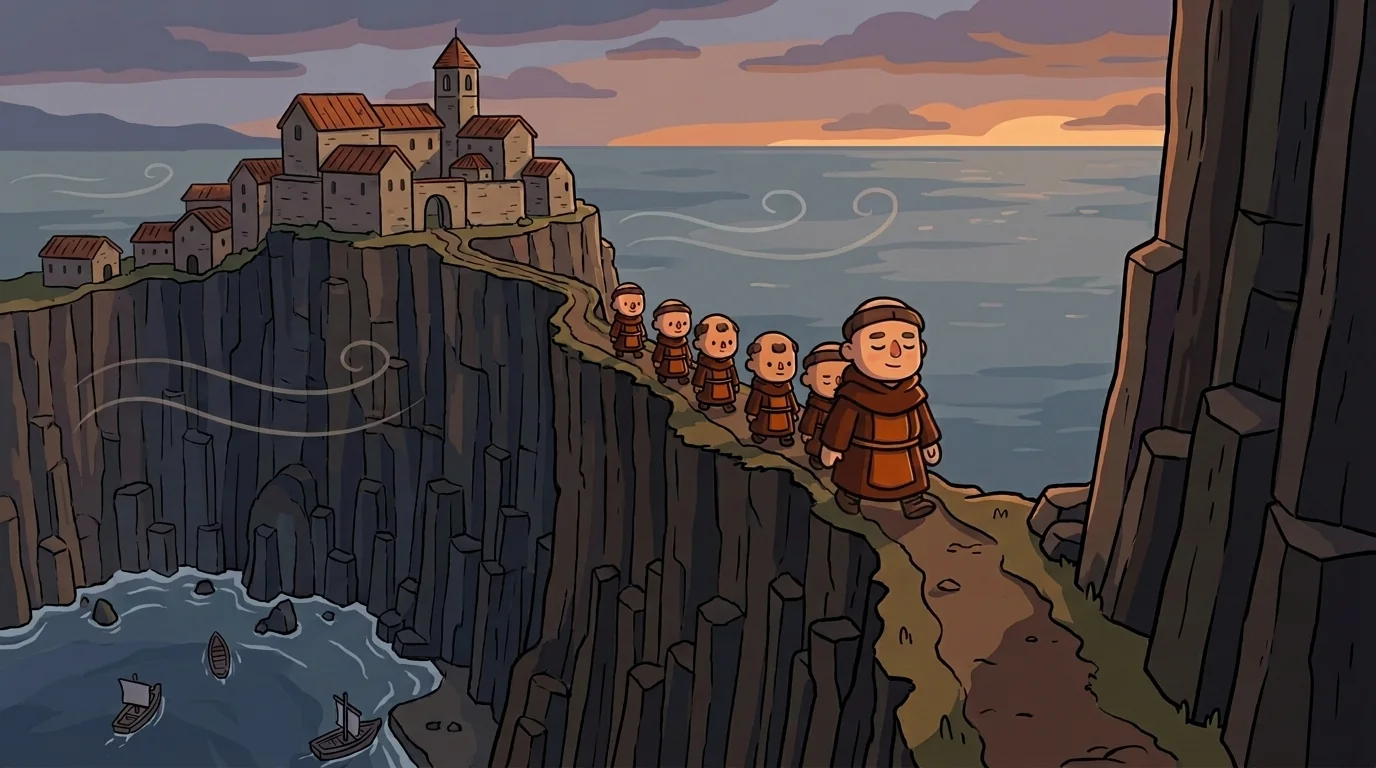
They walk along the edge. They do not walk across it.
This is the practice. It is older than the monastery, the monks say. It is older than the kingdom. It might be older than the cliff itself, though that of course is impossible.
The point of the practice is the touching-without-crossing. The monks walk where the cliff and the sky meet. They place each foot at the boundary. They do not stray inward (which would be safe but uninstructive). They do not stray outward (which would be terminal). They walk along the line of touch.
Master Tangent — whose given name was Heron (though he stopped using this name when he took his monastic robes at sixteen, because Heron was the name of a Mediterranean mathematician with no particular connection to him and the local children were beginning to make jokes about it) — joined the monastery when he was twelve. His family had sent him because he had been, even as a small child, unusually still. He could sit for hours without moving. He could watch the sea for an entire afternoon. The local sage said: "This boy has the cliff-walking temperament."
He did. He walked the cliff every sunset from the age of twelve to the age of forty. That is twenty-eight years of cliff-walking. Twenty-eight years of placing each foot at the boundary between rock and sky. Twenty-eight years of touching without crossing.
What Master Tangent eventually understood — and he understood it not in any single moment but over the slow accretion of those twenty-eight years — was that the cliff-edge was a geometric primitive. It was a line. It was the boundary between two regions. To walk it was to approach the boundary as the limit of a series of approximations. Each step was an approximation. Each step was slightly off — slightly inward, slightly outward, slightly off-balance. But the average of the steps, taken over a long enough walk, was the line itself. The monks were, by their practice, converging on the cliff-edge. They were tracing, with their bodies, the tangent.
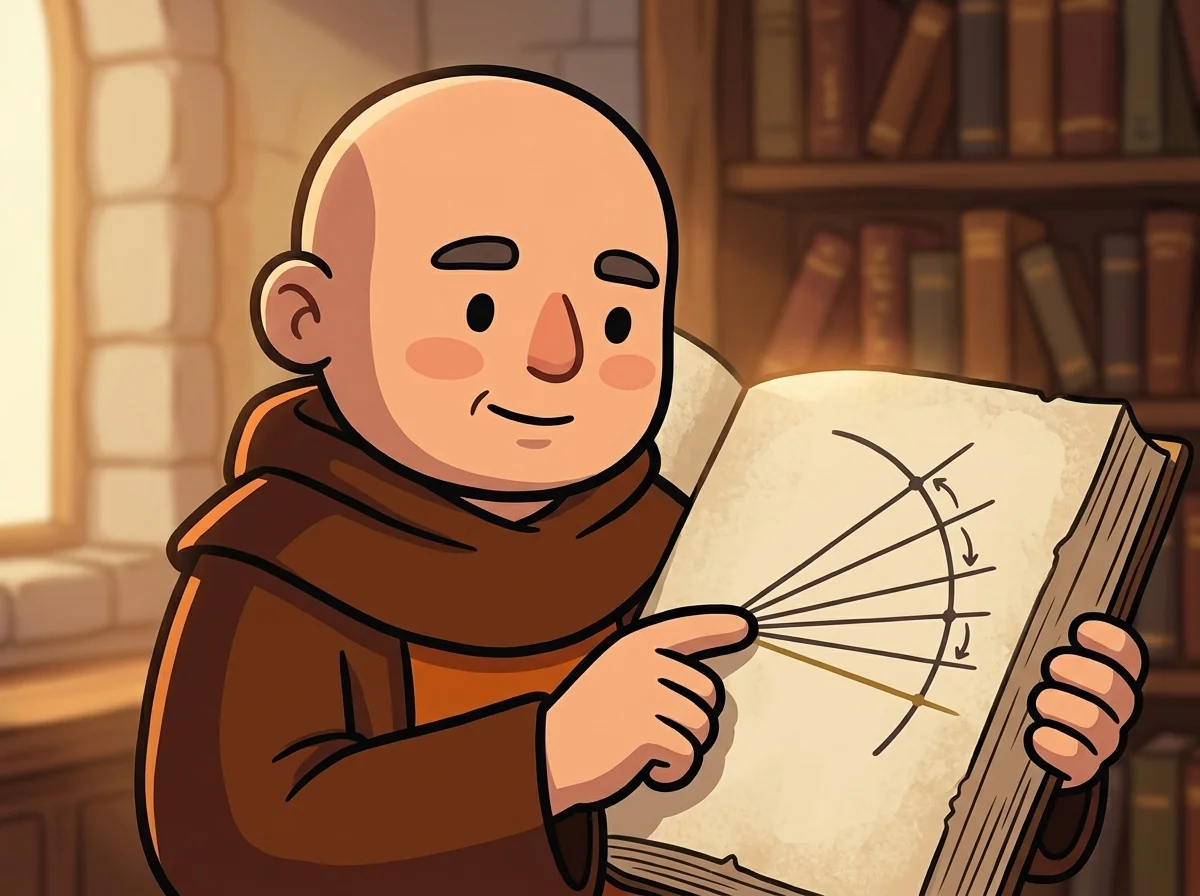
This was the principle.
A tangent line to a circle is a line that touches the circle at exactly one point and does not cross it. A tangent line can be derived as the limit of a sequence of secants — lines that cross the circle at two points, where the two points are getting closer and closer together. As the two points merge, the secant becomes a tangent. The crossing-line becomes a touching-line.
Master Tangent saw this for the first time when he was thirty-one. He was reading a borrowed geometry book in the monastery library. The book had a diagram showing a sequence of secants approaching a tangent. He looked at the diagram for a long time. Then he set down the book and walked out to the cliff-edge.
He thought: the cliff-edge is the tangent. The walking-paths I have made over twenty years are the secants. Each path crossed in slightly; each path crossed out slightly. The average of all my paths is the tangent line. I have been doing this exercise all along.
He did not, at the time, know that he would eventually leave the monastery to teach this. But nine years later, when the GeometryForge academy was looking for someone to teach tangent-to-circle problems to children, the academy master had heard about the cliff-walking monks. He travelled to Northshore. He spoke with Master Tangent (who was by then forty and was beginning to think his knees would not survive another decade of cliff-edge balance). He invited him to teach.
Master Tangent considered the invitation for two months. He spoke with the abbot. The abbot said: "The cliff-edge has taught you what it can. The children may need you more than the edge does."

Master Tangent accepted.
He brought, to the academy, one straight reed. He cut it himself from the marsh below the monastery before he left. He still has it. It is about three feet long. It is perfectly straight. He uses it in class. He places it against a chalk-drawn circle on the board. The reed touches the circle at exactly one point. It does not cross.
He says: "This is a tangent. The reed touches the circle. The reed does not cross. That is the whole trick."
The children — always — protest. They want to know how you find the tangent. They want a method.
Master Tangent smiles. He is a whip-thin heron-headed character in a long pale-grey robe. His smile is dry and slight. He says: "The method is patience. You start with a secant — a line that crosses. You move the two crossing points closer together. When they merge into one point, the line touches without crossing. That is the tangent. The limit of the approach."
The children try it. They draw secants. They move the crossing points together. The secant rotates. As the crossing points merge, the line settles. The settled line is the tangent.
Master Tangent watches them. He says, in his soft monastic voice: "This is what I learned on the cliff-edge. The line you cannot quite reach. The line you can only approach. The tangent. Every circle has them everywhere. Every point on a circle has one. You touch. You do not cross."
When children ask whether tangent problems are hard, Master Tangent always says the same thing:
"They are not hard. They are delicate. You touch the circle. You do not cross it. Find the radius to the touching-point. The tangent is perpendicular to the radius there. Always. Every circle."
He still walks the cliff-edge once a year. He goes back to the monastery for the autumn equinox. He walks the sunset path. He places each foot at the boundary.
He has, after forty-five years of cliff-walking, never crossed.
And each autumn, standing at the edge with the cold wind on his face and the grey sea far below, he feels the same steady calm he has felt his whole life — the quiet, settled peace of someone who has learned to walk right up to the hardest line and simply, gently, stay.
The GeometryForge ensemble
Master Tangent is part of GeometryForge's distributed-narrative cast. Each character embodies a different curricular primitive; together they teach the full subject.
-

Master Hypotenuse
Right-triangle relations: a² + b² = c²
-

Lady Inscribed-Angle
Circle theorems (inscribed-angle, central-angle, tangent-chord, cyclic quadrilateral)
-

Sir Transverse
Parallel-line transversals + intercept theorem (proportional segments cut by parallel lines)
-

Apprentice Sides
Area formulas (triangle area from side lengths; rectangle / parallelogram / trapezoid area)
-

Captain Construction
Compass-and-straightedge constructions (bisector, perpendicular, equilateral triangle, regular hexagon, circle-given-three-points)
-

Compass Wraith
Locus problems + circle-as-set-of-equidistant-points
-

Madame Polygon
Regular-polygon facts (interior-angle sum, exterior-angle sum, regular-tessellation, symmetry of regular n-gons)
-

Axia & Theora
Twin theorists — Axia carries axiomatic-first reasoning; Theora carries theorem-application; together they bridge geometric postulates to derived results
-

Madame Motion
Rigid motions and congruence — sliding, turning, or flipping a shape never changes its size or shape; two shapes are congruent if one can be carried exactly onto the other.
-

Scout Scale
Dilation and similarity — resizing a shape by a scale factor keeps every angle the same and multiplies every length equally; similar shapes are the same shape at a different size.
-
Lady Lattice
The coordinate plane — every point has an exact two-number address, so you can plot it, measure the distance between two points, and find the midpoint exactly between them.