
Madame Motion and Scout Scale
CONGRUENT VERSUS SIMILAR — two shapes are congruent if you can slide, turn, or flip one exactly onto the other (same size); they are similar if you also need to resize it by a scale factor (same shape, different size). Congruent is the special case of similar where the scale factor is one.
A story read by Madame Motion and Scout Scale
Press play to listen along. The line being read lights up as you go.
Show full transcript
Loading transcript…
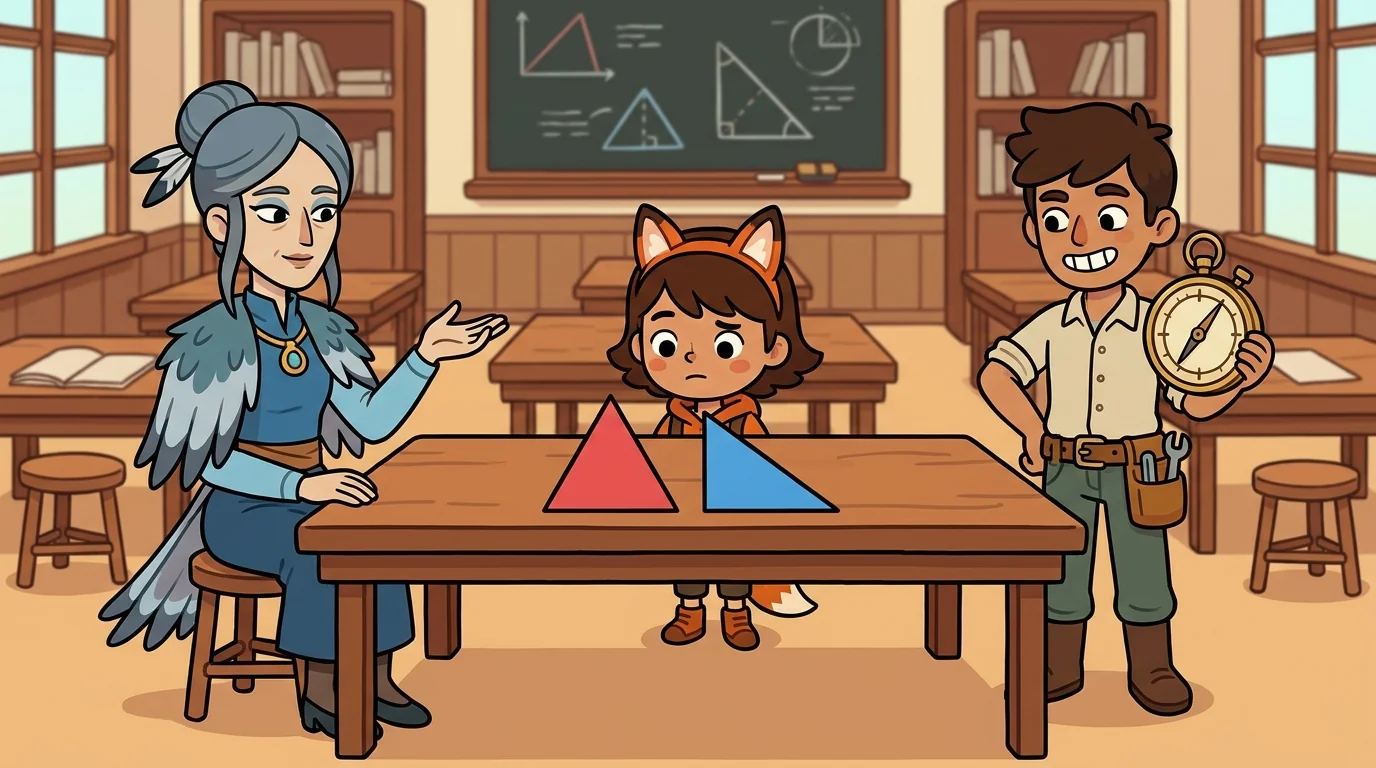
Two triangles sat on the academy table, and a young fox named Quen could not stop staring at them.
"Are these two triangles the same?" Quen finally asked the room.
Two teachers answered at once, and they did not agree.
"Yes," said Madame Motion, the tall, calm heron who carried shapes from place to place. "I'm fairly sure I can carry one straight onto the other."
"Maybe," said Scout Scale, the quick young model-maker with the brass scaling dial. "It depends what you mean by same."
Quen looked between them. "There's more than one kind of same?"
"Oh, definitely," said Scout. "That's the whole problem with the word. Motion hears 'same' and thinks one thing. I hear 'same' and think another. So before we can answer you, we have to figure out which same you're asking about." Scout grinned. "Lucky for you, between the two of us, we cover both."
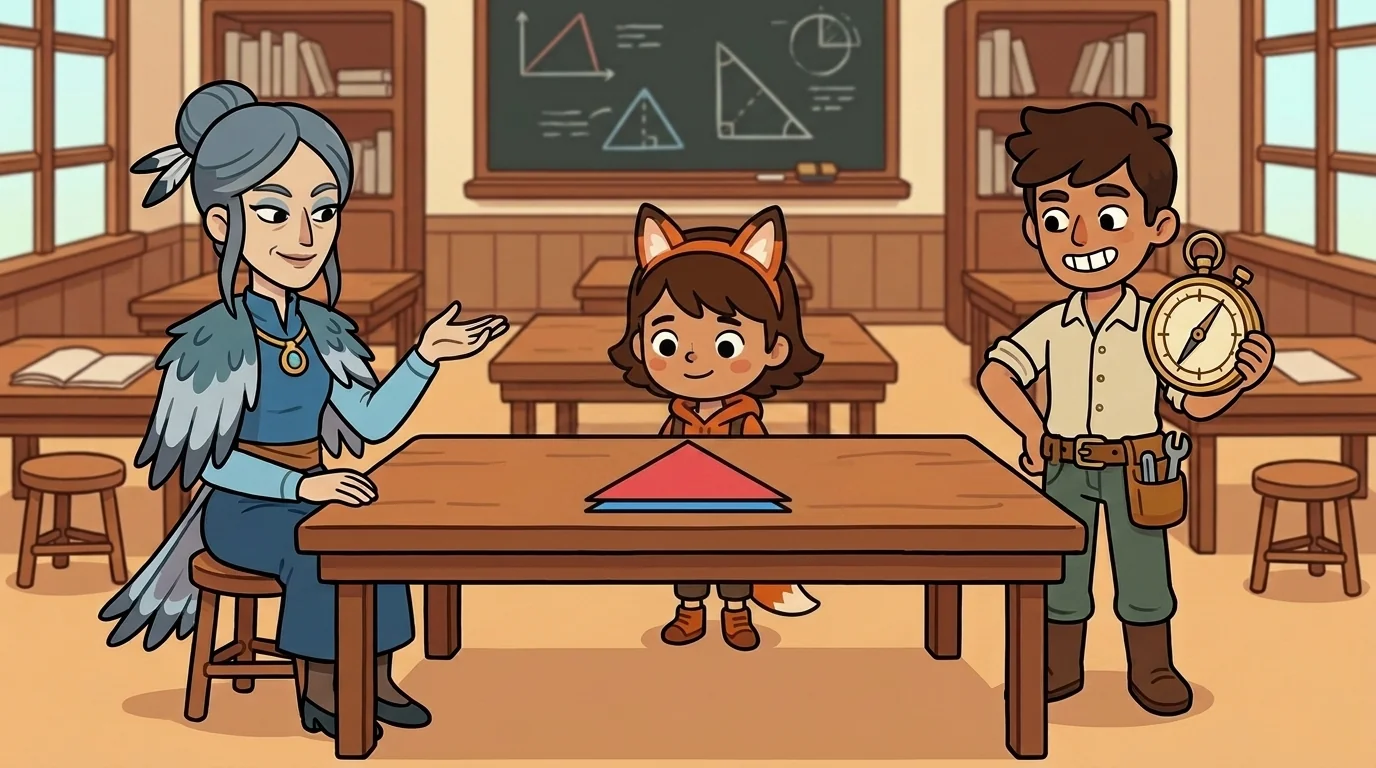
Madame Motion went first, because her question was the simpler one.
"My kind of same is called congruent," she said, lifting one of the triangles. "It means: can I carry this one exactly onto the other one — same size and all — using only my three moves? A slide, a turn, a flip. No resizing. Nothing stretched, nothing shrunk." She slid the triangle across the table, gave it a quarter-turn, and laid it down on its twin.
It fit. Corner A onto corner A, side B onto side B, every edge matched. Not a sliver stuck out.
"Congruent," Motion announced, satisfied. "Exactly the same size and the same shape. I carried one onto the other without changing it one bit. When my three moves are enough — when I never have to resize — the shapes are congruent."
Quen nodded slowly. "So these two ARE the same."
"They're congruent," Motion said. "Which is the strongest kind of same there is. But Scout's about to show you it isn't the only kind."
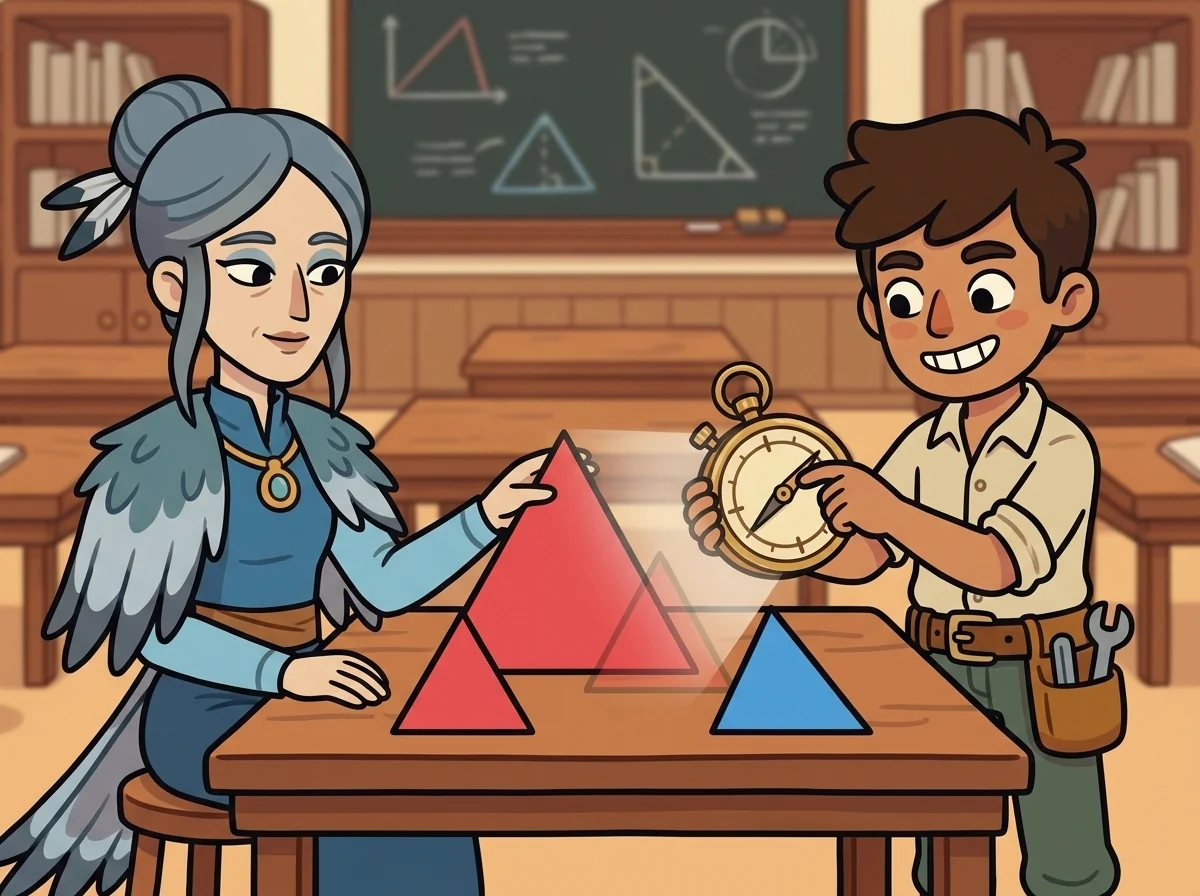
Scout Scale stepped up and put a third triangle on the table — much bigger than the other two, but the very same shape.
"Now try Motion's test on this one," Scout said. "Go on, Madame Motion. Slide it, turn it, flip it onto the little triangle."
Motion tried. She slid and turned and flipped the big triangle every way she knew — and it never fit. It always hung over the edges. "I can't," she admitted. "It's too big. My three moves can't shrink it. So by my test, it's not the same."
"Right — not congruent," Scout agreed, spinning the brass dial. "Because congruent needs same size, and these are different sizes. But watch what happens when I'm allowed to resize." Scout dialed the big triangle down, every length shrinking by the same factor, until it dropped to the exact size of the small one — and then it slid right on top. "Same shape the whole way down. Every angle stayed equal; every side shrank by the same amount. That's my kind of same. It's called similar. Same shape, but the size is allowed to change."
Quen's eyes went wide. "So the big one and the little one are similar, but not congruent."
"Now you've got both words," said Scout.
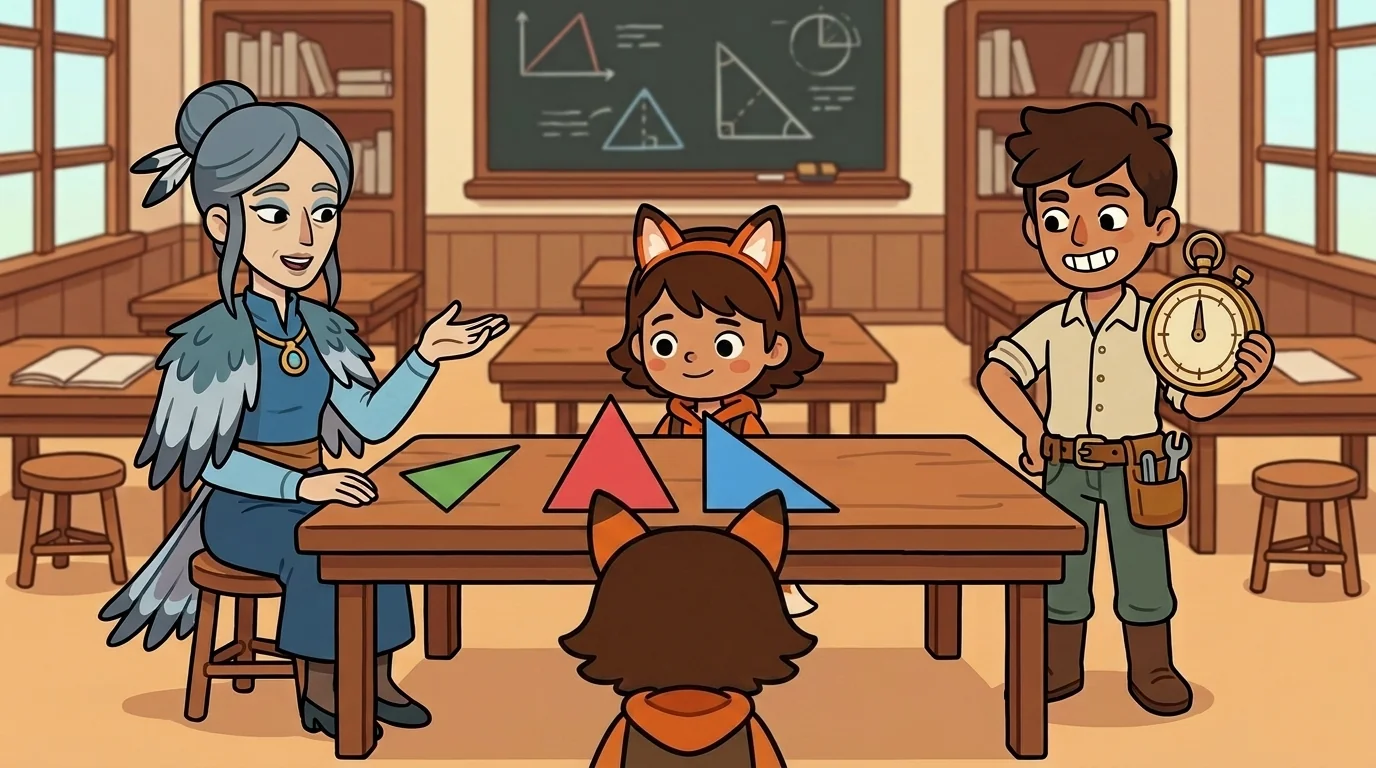
And then the two teachers looked at each other, and Scout said the thing that tied it all together.
"Here's the secret Motion and I share," Scout told Quen. "Congruent and similar aren't really two separate ideas. Congruent is just my similar, with the dial set to one." Scout held up the brass dial. "When I resize a shape and the scale factor turns out to be exactly one — no growing, no shrinking — then 'similar' and 'congruent' are the same thing. Same shape and same size."
"So congruent is a special kind of similar," Quen said slowly. "The special case where nothing has to change size at all."
"Exactly," said Madame Motion, looking almost surprised, the way she always did when Scout zoomed out on her. "All my life I thought my 'same' and Scout's 'same' were rivals. They're not. Mine is just the tidiest corner of Scout's. Every congruent pair is also a similar pair — it just happens to have a scale factor of one." She set her triangle down gently. "Two questions. One bigger idea. We were always on the same map; I just couldn't see the whole thing from my corner of it."
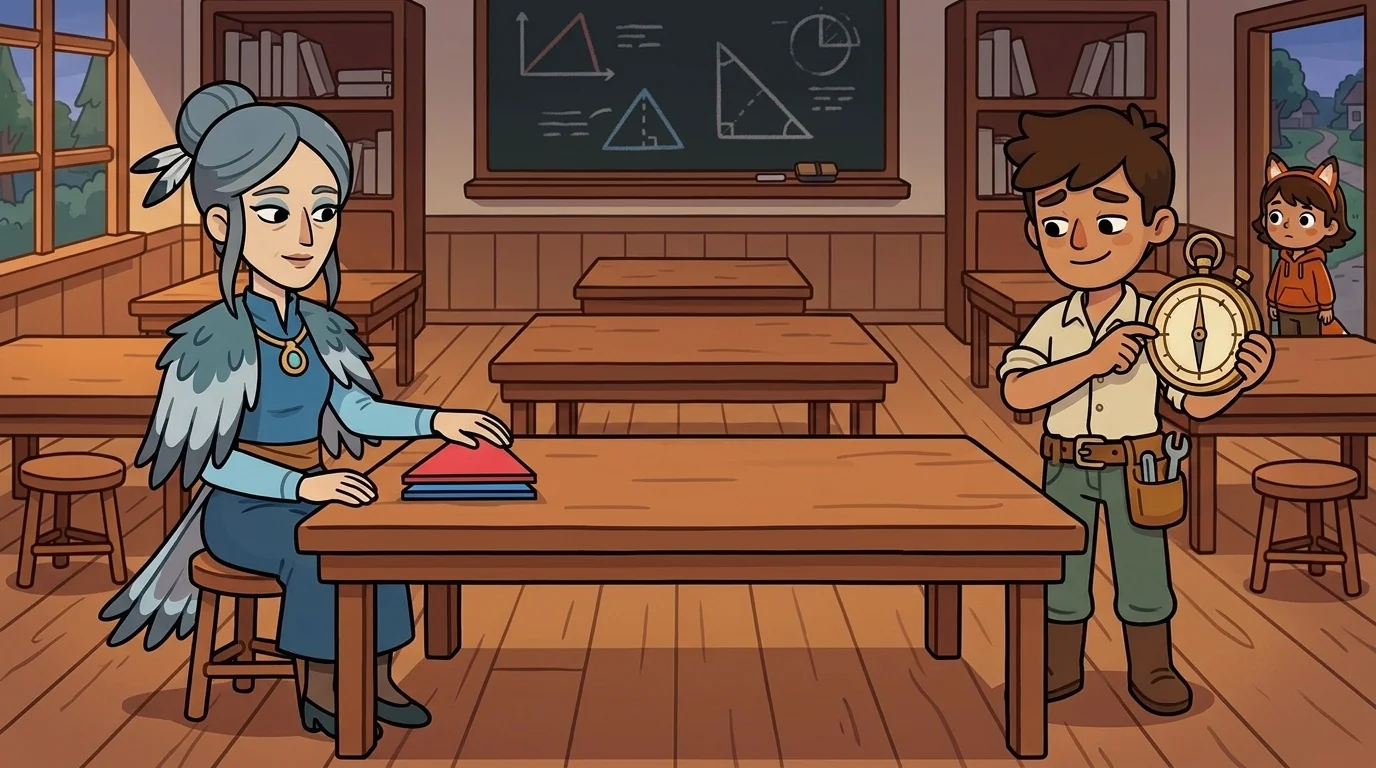
Later, when the academy had emptied and the lamps burned low, Madame Motion stacked the triangles into a neat pile and Scout Scale clicked the brass dial back to one.
Quen lingered by the door. "I'm never going to hear the word same the same way again," the young fox said. "There's same-size-same-shape. And there's same-shape-any-size. And one's just hiding inside the other."
"Two meanings, one idea," Scout said.
Madame Motion rested a wing on the little pile of triangles. "For the longest time I thought Scout and I taught opposite things," she said quietly. "It turns out we were teaching two halves of the same truth, and neither of us could see the whole of it alone. I had the special case. Scout had the big picture. We needed each other to make it whole."
And as Quen walked out into the cool evening, the young fox felt a warm, settling kind of wonder — not about any of the math at all, but about how much gentler and kinder the world becomes when you discover that two things you'd quietly set against each other were, all along, just one idea seen from two loving sides. It felt, Quen thought, a little like watching two friends realize they'd never really been rivals.
The GeometryForge ensemble
Madame Motion and Scout Scale is part of GeometryForge's distributed-narrative cast. Each character embodies a different curricular primitive; together they teach the full subject.
-

Master Hypotenuse
Right-triangle relations: a² + b² = c²
-
Lady Inscribed-Angle
Circle theorems (inscribed-angle, central-angle, tangent-chord, cyclic quadrilateral)
-
Sir Transverse
Parallel-line transversals + intercept theorem (proportional segments cut by parallel lines)
-

Apprentice Sides
Area formulas (triangle area from side lengths; rectangle / parallelogram / trapezoid area)
-
Captain Construction
Compass-and-straightedge constructions (bisector, perpendicular, equilateral triangle, regular hexagon, circle-given-three-points)
-

Compass Wraith
Locus problems + circle-as-set-of-equidistant-points
-

Madame Polygon
Regular-polygon facts (interior-angle sum, exterior-angle sum, regular-tessellation, symmetry of regular n-gons)
-
Master Tangent
Limit-and-touch problems (tangent to a circle from external point, tangent-chord angle, tangent-as-limit-of-secant)
-

Axia & Theora
Twin theorists — Axia carries axiomatic-first reasoning; Theora carries theorem-application; together they bridge geometric postulates to derived results
-

Madame Motion
Rigid motions and congruence — sliding, turning, or flipping a shape never changes its size or shape; two shapes are congruent if one can be carried exactly onto the other.
-

Scout Scale
Dilation and similarity — resizing a shape by a scale factor keeps every angle the same and multiplies every length equally; similar shapes are the same shape at a different size.
-
Lady Lattice
The coordinate plane — every point has an exact two-number address, so you can plot it, measure the distance between two points, and find the midpoint exactly between them.