
Madame Motion
RIGID MOTIONS AND CONGRUENCE — a slide (translation), a turn (rotation), and a flip (reflection) move a shape to a new place without changing its size or shape. Two shapes are congruent if you can slide, turn, or flip one so it lands exactly on the other.
Press play to listen along. The line being read lights up as you go.
Show full transcript
Loading transcript…
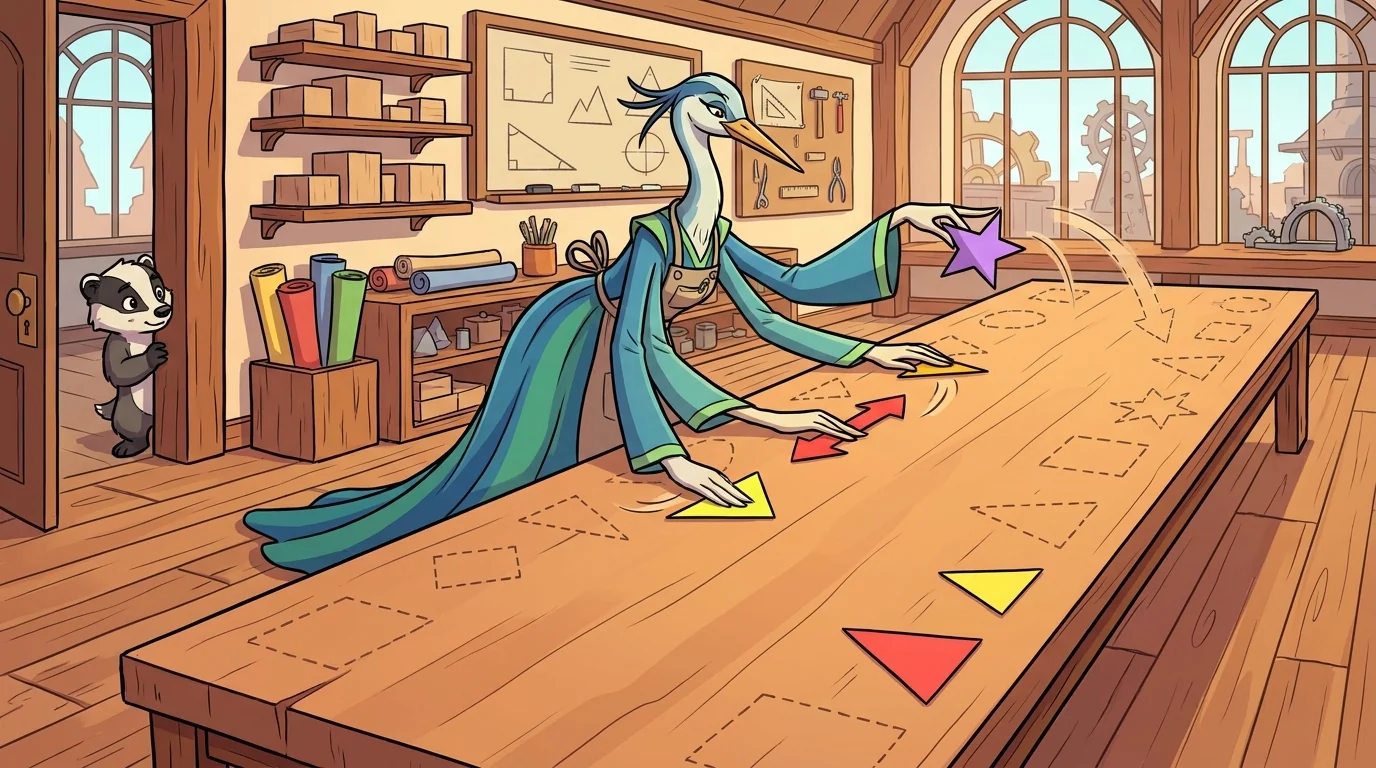
Madame Motion never broke anything. She only moved it.
In her room at the GeometryForge academy there was a long, smooth table, and on the table she kept paper shapes — triangles, arrows, little crooked stars — each one matched to a faint outline drawn on the wood. All day she slid the shapes across the table, or spun them on a fingertip, or flipped them over like pancakes, and dropped each one back onto its outline. Every time, the shape landed exactly inside its line. Nothing stuck out. Nothing left a gap.
She was a tall, calm heron of a woman with long careful arms, and she moved the way a stagehand moves a heavy thing across a stage — quietly, and without ever bumping it into a wall.
A young badger named Bex watched from the doorway. Madame Motion picked up a paper triangle, slid it a hand's width to the left, turned it a quarter-turn, flipped it over, and set it down on a fresh outline. It fit perfectly.
"But you changed it," Bex said. "You turned it upside down. It's a different triangle now."
Madame Motion smiled. "It's in a different place," she said. "And it's facing a different way. But it is the very same triangle. Moving a thing never changes what it is. Let me show you why I'm so sure."
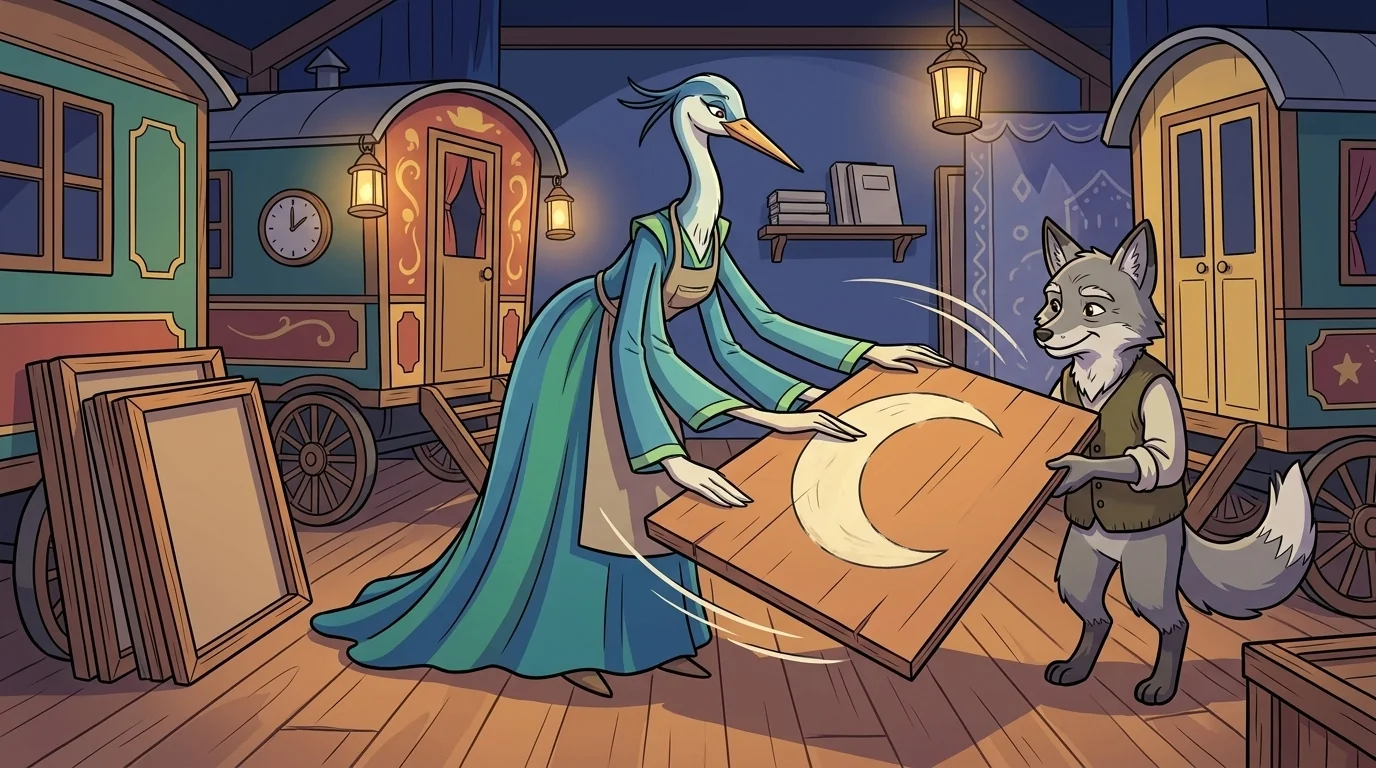
When Madame Motion was young, her name was Mona, and she carried scenery for a travelling theatre.
The theatre moved from town to town in three painted wagons, and Mona's job was to shift the great flat boards of painted scenery around the stage — a board with a moon on it, a board with a forest, a board with a castle wall. She slid them, she spun them on their corners, she flipped them to show the painting on the back. Heavy work, but she was good at it.
One night, in a town called Lantern Cross, she slid the painted moon from the left side of the stage all the way over to the right. And a small, anxious thought caught hold of her: Is it still the same moon? I moved it so far. I turned it. What if I've ruined it?
The old stage-master, a grey fox who had run the theatre for forty years, saw her standing frozen, staring at the moon-board. He came and stood beside her.
"You're worried you changed it," he said. It wasn't a question.
Mona nodded.
He walked to the board, slid it back to the left, then slid it to the right again. He spun it slowly all the way around and back. He flipped it over and flipped it again. "Look at it," he said. "Same moon. Same size. Same shape. Same paint. All you did was carry it. Sliding a thing, turning a thing, even flipping a thing — none of those ever make it bigger or smaller, or bend it out of shape. They only ever change where it is and which way it faces."
Mona looked at the moon, glowing the same as ever in its new spot, and felt the anxious knot in her chest come loose. A thing carried somewhere new was still, entirely, itself.
She never feared moving anything again.
Years later, Mona came to the GeometryForge academy and stood before the academy master, an ancient owl who had tested every teacher in the kingdom.
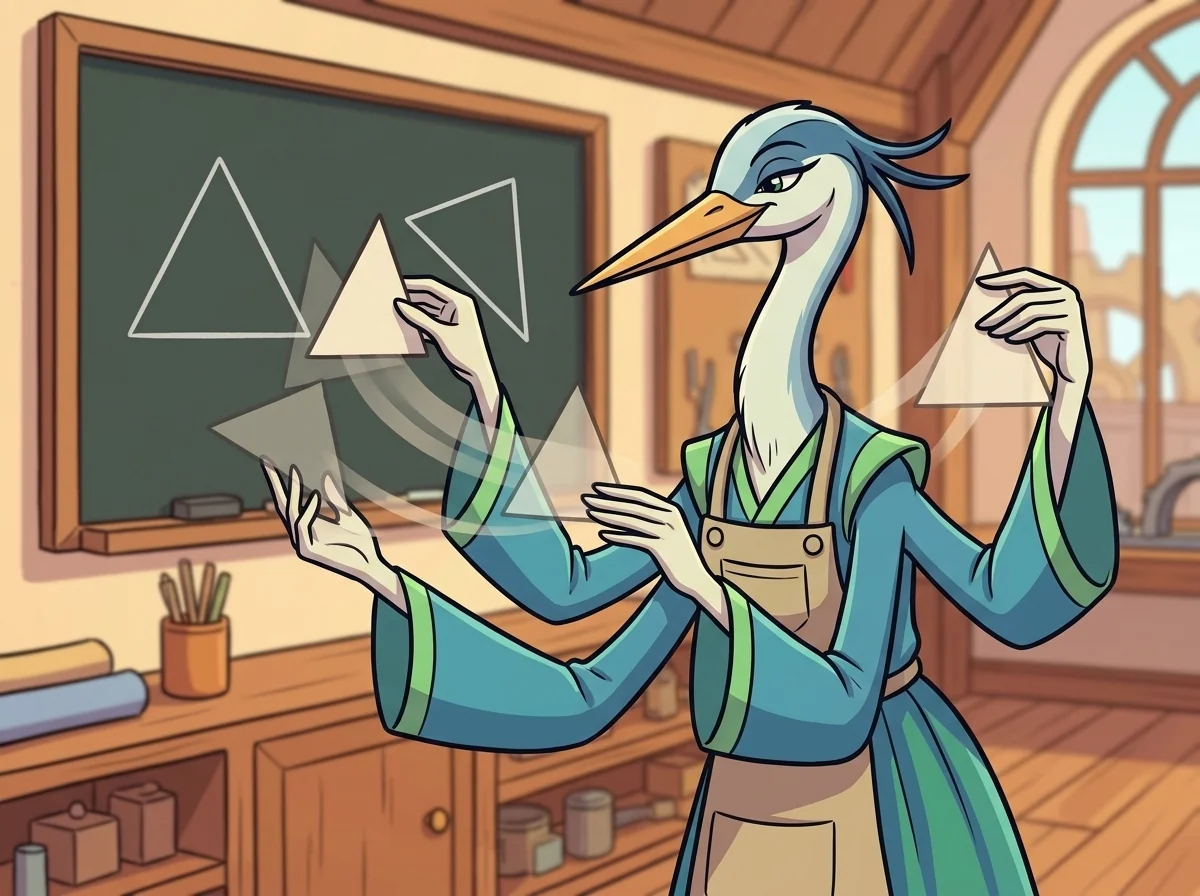
He drew two triangles on the board. The second one was the first one, but turned on its side and flipped. To most eyes they looked like two different shapes entirely.
"Are these the same?" the owl asked.
Mona did not argue and she did not measure. She copied the first triangle onto paper, and then — slowly, the way she'd moved a moon across a stage — she slid it, turned it, and flipped it, until it came down on top of the second triangle and disappeared into it completely. Not a corner stuck out. Not a sliver of gap showed.
"They're the same," she said. "I can carry one onto the other with a slide, a turn, and a flip. When that works, the shapes are congruent — same size, same shape, just sitting differently."
The owl had taught geometry for sixty years. He had never seen anyone carry a shape onto its twin so gently. "Start teaching this autumn," he said. And in the academy's tradition, once she had fully become the thing she taught, Mona took the name Madame Motion.
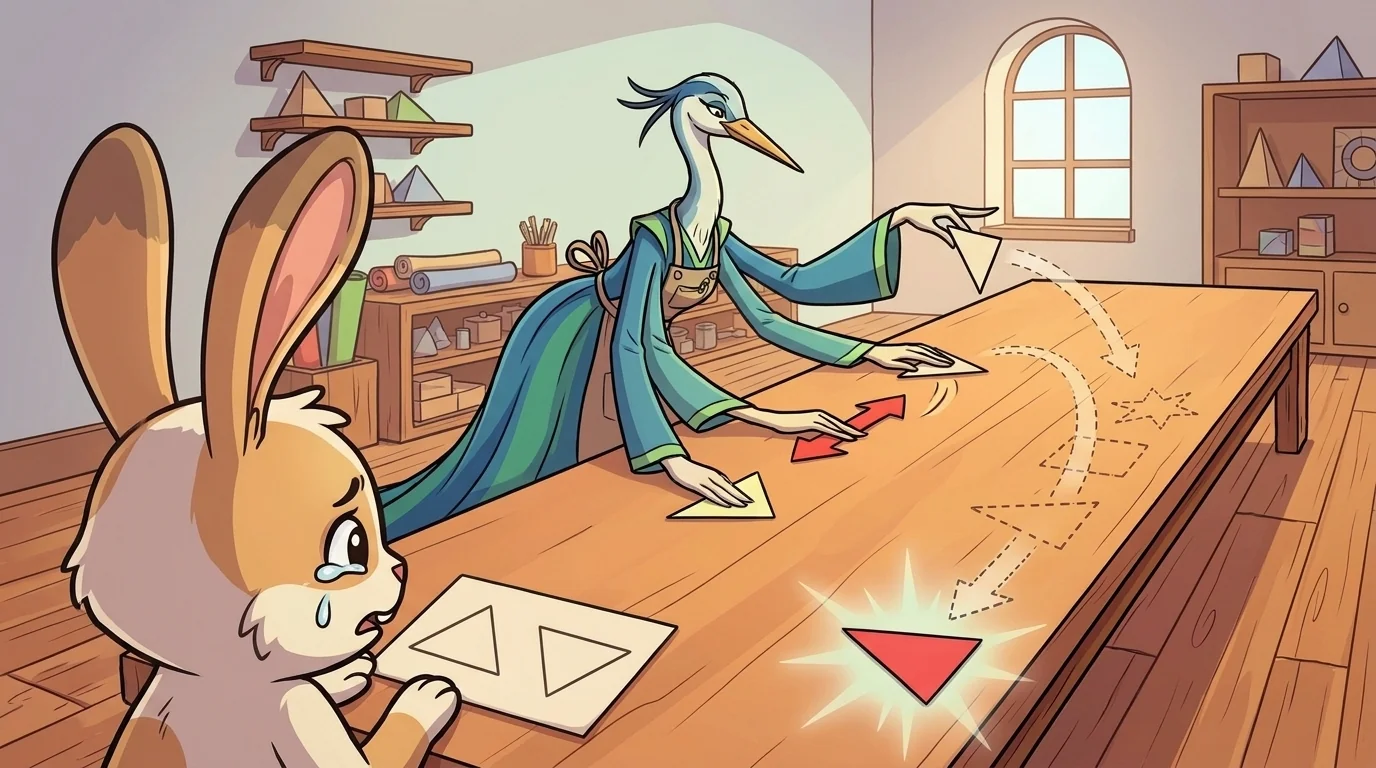
In her room, a flustered young rabbit named Pip was nearly in tears over two triangles on a card, one of them upside down.
"My teacher says these two triangles are the same," Pip said, "but they can't be. Look — this one points up and this one points down. They're different!"
"Let's carry one onto the other and find out," Madame Motion said calmly. "There are only three ways I'm allowed to move it. I can slide it — straight across, no turning. I can turn it — spin it around a point. And I can flip it — over, like turning a page. That's all. Three moves."
She slid Pip's upward triangle over. She turned it. She flipped it. It settled onto the downward triangle and vanished into it — corner A onto corner A, side B onto side B, every edge matched.
"Same shape, same size," she said. "Congruent. The only thing different about them was which way they faced."
Pip stared. "So... flipping it didn't make it smaller?"
"Never," said Madame Motion. "That's the whole secret. My three moves carry a shape somewhere new, but they never stretch it or shrink it. If you ever have to make a shape bigger or smaller to match — well, that's a different kind of moving, and it's my friend Scout Scale's job, not mine. My shapes come out the very same size they went in. Always."
Pip wiped their eyes and almost laughed. "So they were the same all along. I just had to turn one around to see it."
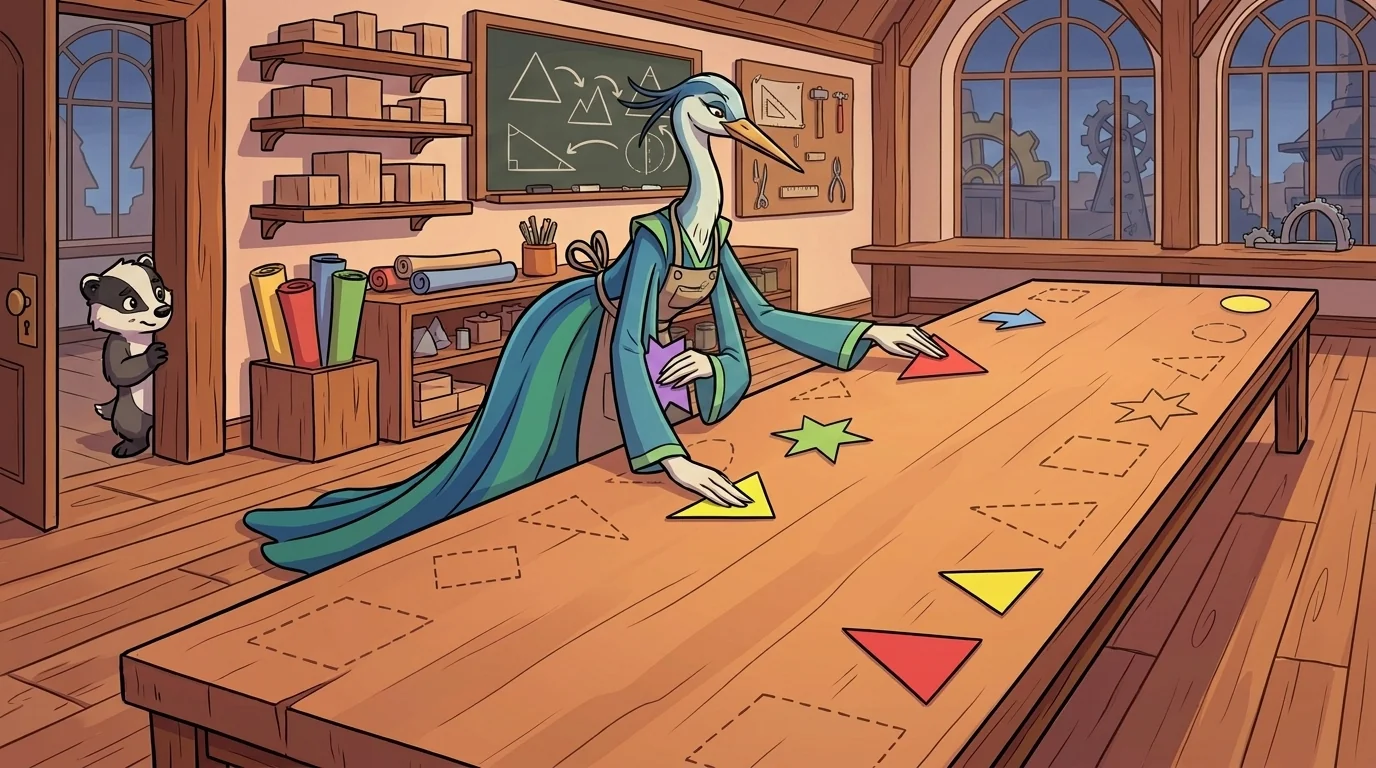
When evening came and the academy went quiet, Madame Motion tidied her paper shapes back onto their outlines, sliding and turning and flipping each one home.
She thought, as she often did, about the painted moon in Lantern Cross — how far she'd carried it across that stage, and how it had stayed exactly itself the whole way.
Bex the badger, still in the doorway, asked the last question of the day. "Madame Motion? How will I ever know for sure if two shapes are really the same?"
Madame Motion set the last triangle on its outline. "Try to carry one onto the other," she said. "Slide it. Turn it. Flip it. If it lands exactly — nothing sticking out, no gaps — then they're the same shape, no matter where they sit or which way they face."
Bex nodded slowly, watching the shape rest perfectly inside its line.
And as the badger walked home through the quiet kingdom, every signpost they passed seemed to slide and every weathervane seemed to turn — and Bex felt, in a way that was hard to put into words, that a thing could move all it liked, all the way across the world, and still come home as nothing more or less than itself.
The GeometryForge ensemble
Madame Motion is part of GeometryForge's distributed-narrative cast. Each character embodies a different curricular primitive; together they teach the full subject.
-

Master Hypotenuse
Right-triangle relations: a² + b² = c²
-
Lady Inscribed-Angle
Circle theorems (inscribed-angle, central-angle, tangent-chord, cyclic quadrilateral)
-

Sir Transverse
Parallel-line transversals + intercept theorem (proportional segments cut by parallel lines)
-

Apprentice Sides
Area formulas (triangle area from side lengths; rectangle / parallelogram / trapezoid area)
-
Captain Construction
Compass-and-straightedge constructions (bisector, perpendicular, equilateral triangle, regular hexagon, circle-given-three-points)
-
Compass Wraith
Locus problems + circle-as-set-of-equidistant-points
-

Madame Polygon
Regular-polygon facts (interior-angle sum, exterior-angle sum, regular-tessellation, symmetry of regular n-gons)
-
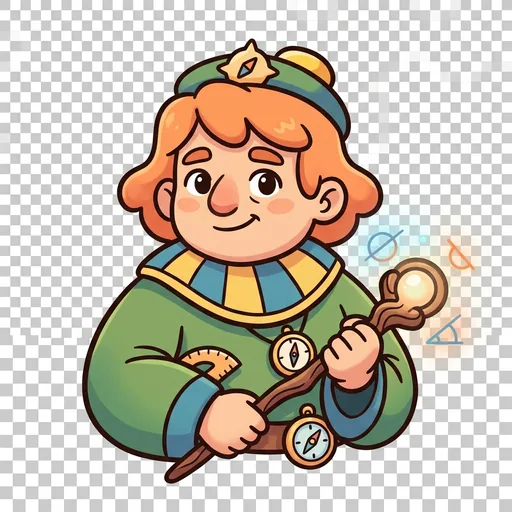
Master Tangent
Limit-and-touch problems (tangent to a circle from external point, tangent-chord angle, tangent-as-limit-of-secant)
-

Axia & Theora
Twin theorists — Axia carries axiomatic-first reasoning; Theora carries theorem-application; together they bridge geometric postulates to derived results
-

Scout Scale
Dilation and similarity — resizing a shape by a scale factor keeps every angle the same and multiplies every length equally; similar shapes are the same shape at a different size.
-
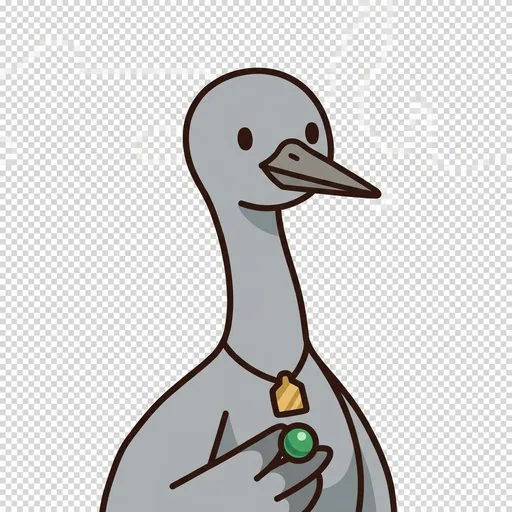
Lady Lattice
The coordinate plane — every point has an exact two-number address, so you can plot it, measure the distance between two points, and find the midpoint exactly between them.