
Scout Scale
DILATION AND SIMILARITY — a dilation resizes a shape from a center point by a scale factor. Every angle stays exactly the same; every length is multiplied by the same factor. Two shapes are similar if one is a scaled copy of the other — same shape, possibly a different size.
Press play to listen along. The line being read lights up as you go.
Show full transcript
Loading transcript…
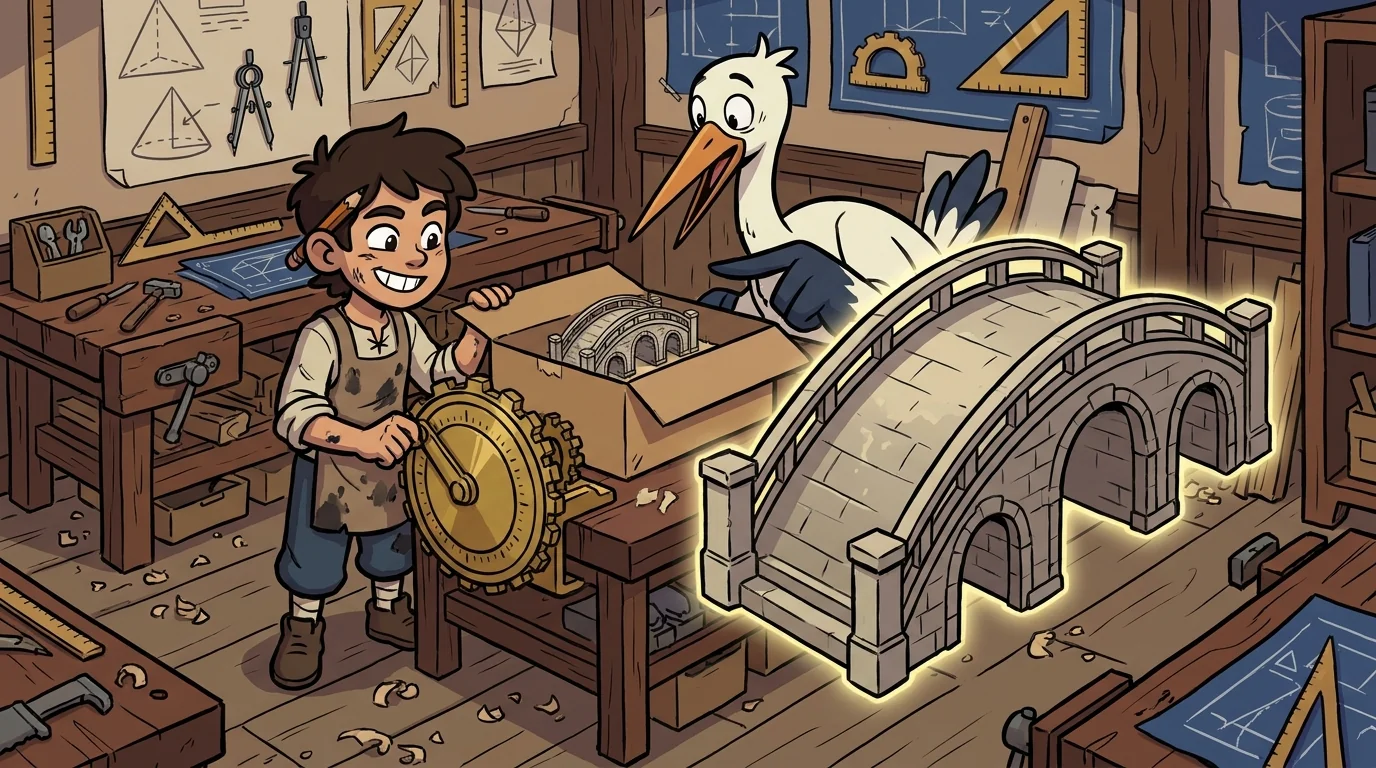
Scout Scale built tiny things, and the tiny things were never wrong.
In the corner of the GeometryForge academy workshop, Scout kept a shoebox, and inside the shoebox was the kingdom's great stone bridge — every arch, every pillar, every railing — shrunk down small enough to sit on a palm. Beside the shoebox stood a brass dial that Scout called the scaling wheel. Turn it one way and a shape grew; turn it the other and it shrank. But however far it grew or shrank, Scout watched the corners like a hawk, and the corners never moved.
Scout was young, quick, and a little ink-stained, with a carpenter's pencil behind one ear — more apprentice than master, and proud of it.
A tall stork named Quill peered into the shoebox. "That's the great bridge," Quill said, surprised. "But it's wrong. It's far too small."
Scout grinned and set the brass dial spinning. The little bridge swelled until it was the size of a real archway, then shrank back into the shoebox. "It's not wrong," Scout said. "It's scaled. Same shape, smaller size. Watch the angles — every corner of my little bridge matches the real one exactly. Only the lengths changed, and they all changed by the very same amount. Let me show you how I know it's a true copy and not a fib."

Before the academy, Scout was apprenticed to an old model-maker in a harbour town called Thimble, where the whole trade was making small.
Scout's first real job was a model of Thimble's famous lighthouse for the harbour museum. Scout measured the real lighthouse, divided every length by twelve, and built a little lighthouse exactly one-twelfth as tall. But when it was finished, Scout stared at it with a sinking feeling: It's so small. The real one is enormous and mine fits in a basket. It can't really be the lighthouse. It's a fake.
The old model-maker, a walrus with spectacles and endless patience, picked up the little lighthouse and held it next to a drawing of the real one.
"You think small means false," he said. "Let's check. Is the doorway the same shape — same corners?"
Scout looked. "Yes."
"Is every part exactly one-twelfth of the real part? The height, the width, the windows, all shrunk by the same twelve?"
Scout had measured it a hundred times. "Yes. All of them. The same twelve."
"Then it is not a fake," the walrus said gently. "It is similar. Same shape. Same angles. Every length shrunk by the same scale factor. A true model isn't a lie about a big thing — it's the big thing's exact shape, made a size you can hold." He set the little lighthouse down. "Small is not the same as wrong."
Scout felt the sinking feeling lift, and something steady and proud settle in its place. The model wasn't less than the lighthouse. It was the lighthouse — its shape, kept perfectly, at a size that fit in two hands.
Years later, Scout brought the shoebox bridge to the GeometryForge academy and set it before the academy master, an ancient owl who had tested every teacher in the kingdom.
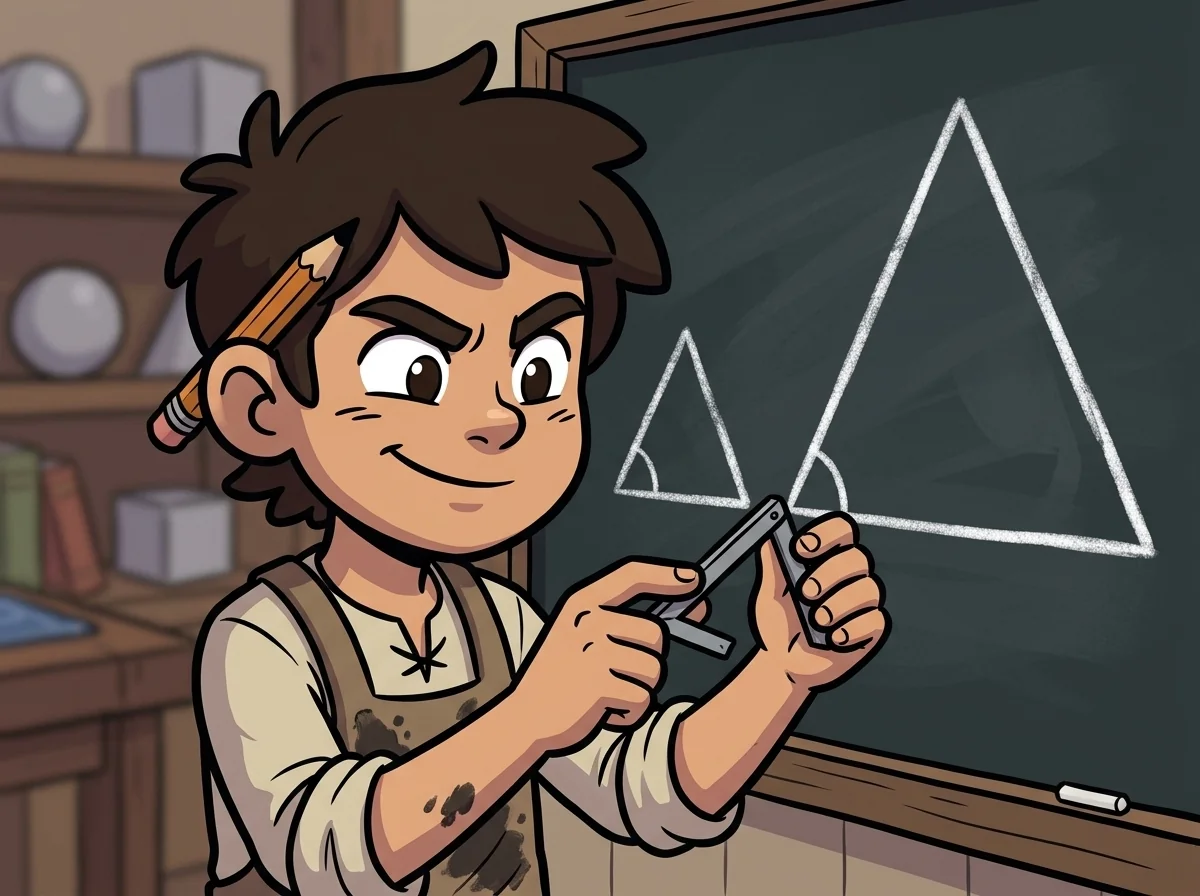
The owl chalked two triangles on the board: a small one, and a large one beside it. The large one was the small one, every side tripled.
"Are these the same shape?" the owl asked.
Scout did not guess. Scout checked the three corners of the small triangle against the three corners of the large one — each angle matched its partner exactly. Then Scout measured: every side of the big triangle was precisely three times its matching small side. "Same shape," Scout said. "Scaled by three. They're similar — the angles are identical, and every length grew by the very same factor."
The owl had taught geometry for sixty years and had watched many students confuse bigger with different. He had rarely seen one check the corners first. "Start teaching this autumn," he said. And once Scout had fully become the thing he taught, he took the name Scout Scale.
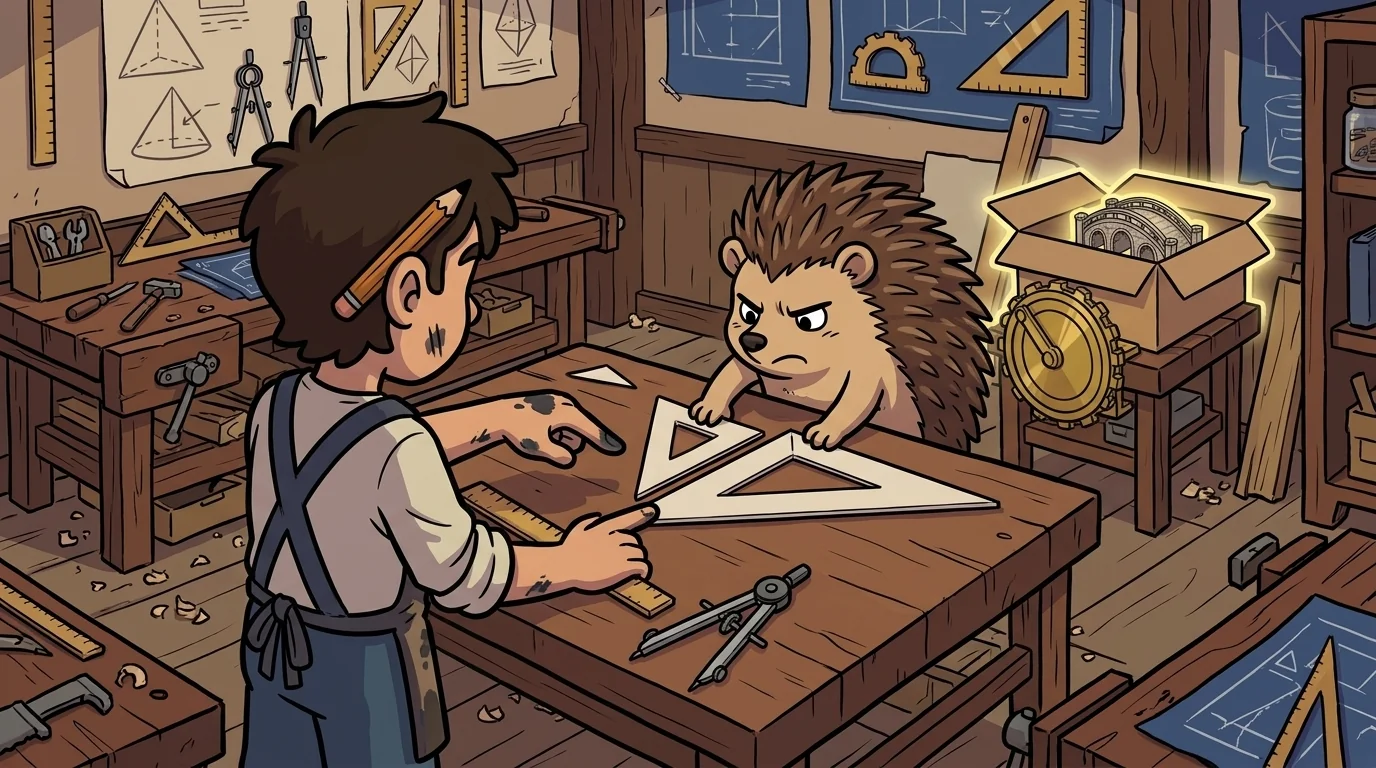
In the workshop, a frustrated young hedgehog named Dell shoved two paper triangles across the bench, one small and one large.
"My teacher says these are the same shape," Dell huffed, "but one's tiny and one's huge. How can they be the same? They're nothing alike!"
"Let's measure instead of squinting," Scout said. "Two checks, that's all. First: do the corners match?" Scout laid corner A of the small triangle against corner A of the large one, then B against B, then C against C. "All three angles, exactly equal. Good. Second: did every length grow by the same amount?" Scout measured. The big sides were each exactly twice the small sides — every one, doubled. "Scale factor of two. Same shape, twice the size. They're similar."
Dell frowned. "So 'similar' means same shape but maybe a different size?"
"Exactly," Scout said. "And here's the neat part. When the scale factor is one — when nothing grows or shrinks at all — the two shapes aren't just similar, they're the very same size too. That's congruent, which is my friend Madame Motion's specialty. Congruent shapes are just similar shapes that happen to have a scale factor of one. Same shape always; same size only sometimes."
Dell turned the two triangles over, one in each hand. "So the big one isn't a different shape. It's the little one, grown up."
"That's it exactly," Scout said, delighted.
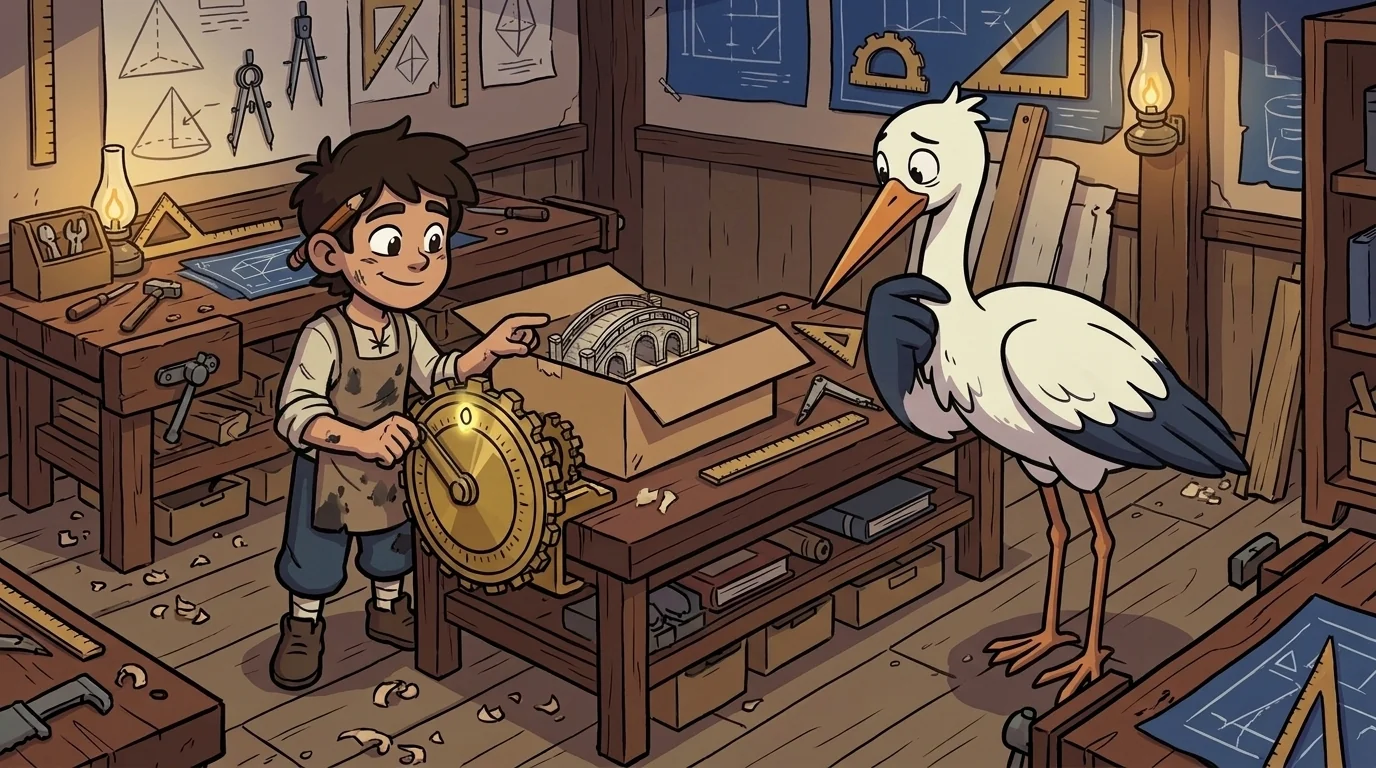
When evening came and the workshop lamps burned low, Scout set the brass dial back to one, so the shoebox bridge settled to its proper tiny size, and tucked it safely away.
Scout thought, the way Scout often did, about the little lighthouse in Thimble — how small it was, and how it had taken a kind old walrus to show that small had never meant false.
Quill the stork, still by the bench, asked the last question of the day. "Scout? How will I ever know if two shapes are truly the same shape, even when one's much bigger?"
Scout pointed at the corners of the shoebox bridge. "Two checks," Scout said. "Are all the matching corners equal? And did every length grow or shrink by the very same amount? If yes to both, they're the same shape — similar — however big or small they happen to be."
Quill nodded, looking at the tiny bridge that was, in every corner, the great bridge exactly.
And as the stork walked home beneath the real arches of the real bridge, Scout's words settled in somewhere quiet and warm — that being small, or being the smallest one in the room, had never once made a thing any less truly, completely itself.
The GeometryForge ensemble
Scout Scale is part of GeometryForge's distributed-narrative cast. Each character embodies a different curricular primitive; together they teach the full subject.
-

Master Hypotenuse
Right-triangle relations: a² + b² = c²
-
Lady Inscribed-Angle
Circle theorems (inscribed-angle, central-angle, tangent-chord, cyclic quadrilateral)
-

Sir Transverse
Parallel-line transversals + intercept theorem (proportional segments cut by parallel lines)
-

Apprentice Sides
Area formulas (triangle area from side lengths; rectangle / parallelogram / trapezoid area)
-
Captain Construction
Compass-and-straightedge constructions (bisector, perpendicular, equilateral triangle, regular hexagon, circle-given-three-points)
-

Compass Wraith
Locus problems + circle-as-set-of-equidistant-points
-

Madame Polygon
Regular-polygon facts (interior-angle sum, exterior-angle sum, regular-tessellation, symmetry of regular n-gons)
-
Master Tangent
Limit-and-touch problems (tangent to a circle from external point, tangent-chord angle, tangent-as-limit-of-secant)
-

Axia & Theora
Twin theorists — Axia carries axiomatic-first reasoning; Theora carries theorem-application; together they bridge geometric postulates to derived results
-

Madame Motion
Rigid motions and congruence — sliding, turning, or flipping a shape never changes its size or shape; two shapes are congruent if one can be carried exactly onto the other.
-
Lady Lattice
The coordinate plane — every point has an exact two-number address, so you can plot it, measure the distance between two points, and find the midpoint exactly between them.