Axia and Theora (twin sisters)
A story read by Axia and Theora (twin sisters)
Press play to listen along. The line being read lights up as you go.
Show full transcript
Loading transcript…
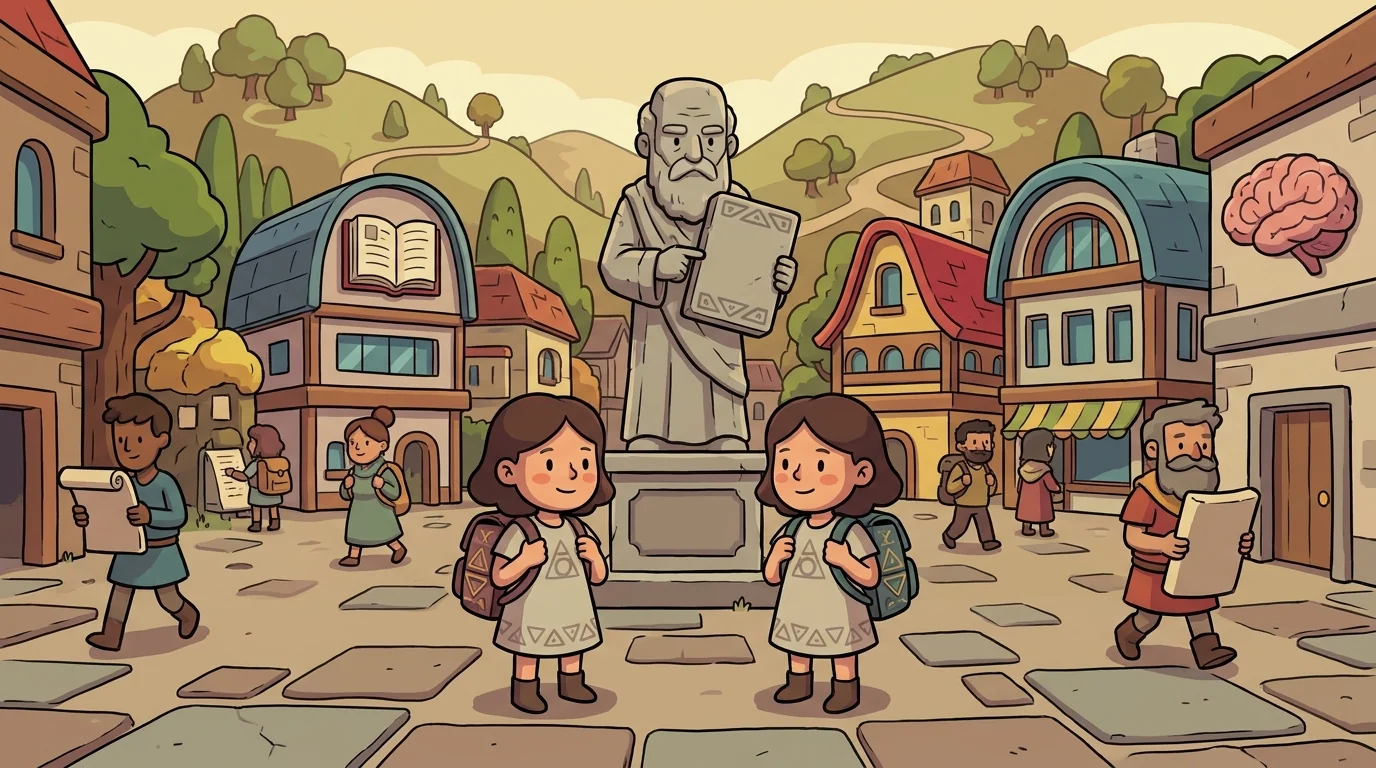
Axia and Theora are twin sisters.
This twin thing was actually a big deal. It was key to the special math they taught. They were like two sides of the same coin. They showed a way to think about math that always made sense. This way had two parts. One part was what you said was true (these were called *axioms). The other part was what you figured out from those true statements (these were called theorems*). You needed both parts. One without the other was not complete. The sisters knew this. They had known it since they were six years old.
They grew up in the town of Postulate.
Postulate was a small town. It still is. It sat in the kingdom's eastern hills. The town's main business was thinking about logic. There was a school just for thinkers. There was a club for thinkers, too. In the town square, a statue stood tall. It showed an old thinker holding a stone tablet. The tablet said, "Begin with the rules. Continue with the consequences."
Axia and Theora's mother was a thinker. Her name was Pellia. She was super patient. Even for Postulate, she was patient. She never rushed kids. She let them figure things out slowly. Pellia believed something important. She said it often. Every kid already knew the difference. They knew what was a guess. They knew what was really true. Grown-ups just had to help them remember it.
Pellia had a clever way. She helped her daughters remember this truth.
She made a game.
She played the game with her twin daughters every night at dinner. They played it from when they were six. They played until they were twenty-one. The game went like this:
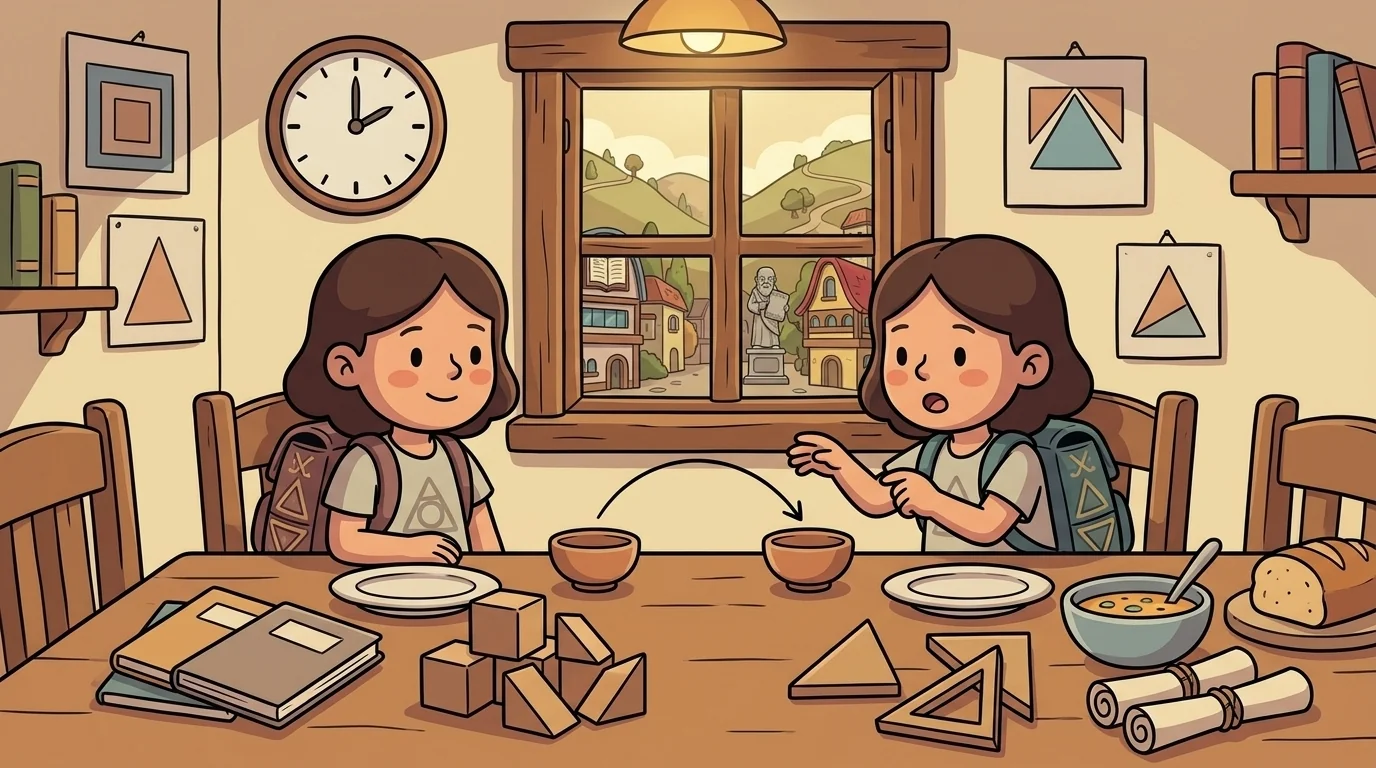
One sister would start. They took turns each night. She would state something simple. Something true. Something everyone knew was true. It didn't need proof.
"A straight line can be drawn between any two points."
Then the other sister would build new, longer ideas from that first rule.
"So, if two straight lines meet at a point, they make an angle. And if two straight lines meet at the same point twice, they are the same line. That means the line between any two points is unique."
The first sister would then add a second rule.
"All right angles are equal."
And the second sister would build even more ideas.
"So, the angle between the floor and the wall in this room is the same. It's the same as that angle in any other room. That means a right angle is a right angle anywhere."
The game continued. Every night. For fifteen years.
Axia preferred stating the rules. Even as a small child, she was fast and sure. She liked making a rule. Everyone in the room just had to agree with it. She liked how one short sentence could be impossible to argue with.
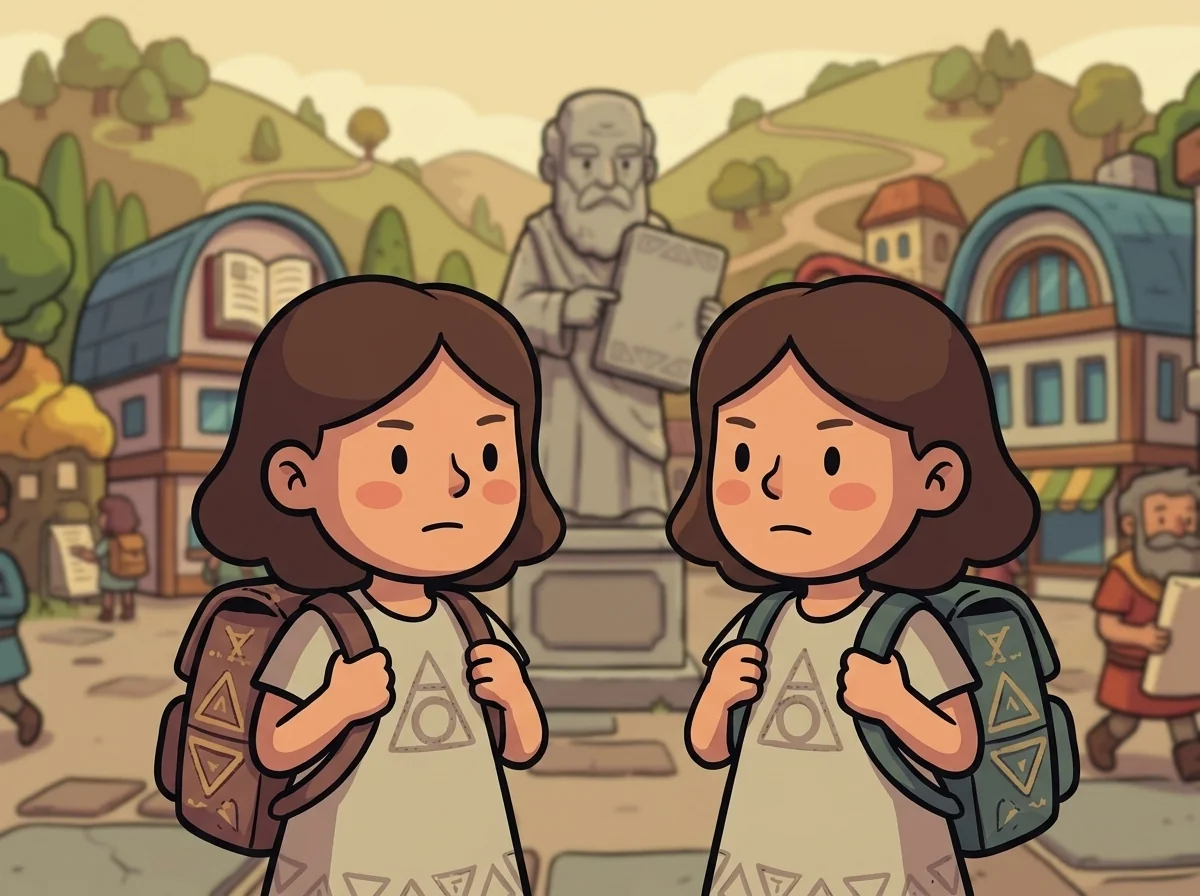
Theora preferred building the ideas. Even as a small child, she was patient and careful. She liked taking a small rule. She liked finding the long sentences that followed from it. She liked how a long path of ideas could still lead to one sure answer.
By the time they were ten, Pellia had stopped calling the sisters "staters" and "builders." Instead, she called them Axia. That was a word in their family's old language. It meant the starting rule. She called the other Theora. That word meant the path you build. The names stuck. Their birth names were Mara and Lina. Those names got forgotten over time. Even Pellia eventually called them Axia and Theora.
When the sisters were nineteen, Pellia took them to the GeometryForge academy. She spoke to the academy master. "My daughters have played the rule-and-build game for thirteen years," she said. "I think they are ready to teach it."
The academy master had heard good things about Pellia. He asked the sisters one question. He said: "What is the difference between an axiom and a theorem?"
Axia answered first. She said: "An axiom is what we agree on. A theorem is what follows."
Theora added: "An axiom is a starting place. A theorem is a path. It goes from one starting place to an end point. The two go together. Without axioms, you cannot build theorems. Without theorems, the starting rules don't go anywhere."
The academy master had been a teacher for forty years. He had heard many answers to this question. He nodded. He said: "Start teaching this fall."
That was twelve years ago. Axia and Theora have been teaching ever since. They almost always teach together. They sit at the same long desk. Axia sits on the left. She wears her white peplos. It has a gold key-pattern border. Theora sits on the right. She wears her ink-blue peplos. It is the same style. They each carry a symbol of their job. Axia has a stone tablet. It has five carved *axiom* symbols. The parallel postulate is the biggest one. Theora has a long scroll. It is already partly unrolled. It shows a proof that wasn't quite done.
When children arrive for the first time, the sisters begin the same way. They sit down. They look at the children. Axia says, in her firm, short voice:
"We agree: two points make a line."
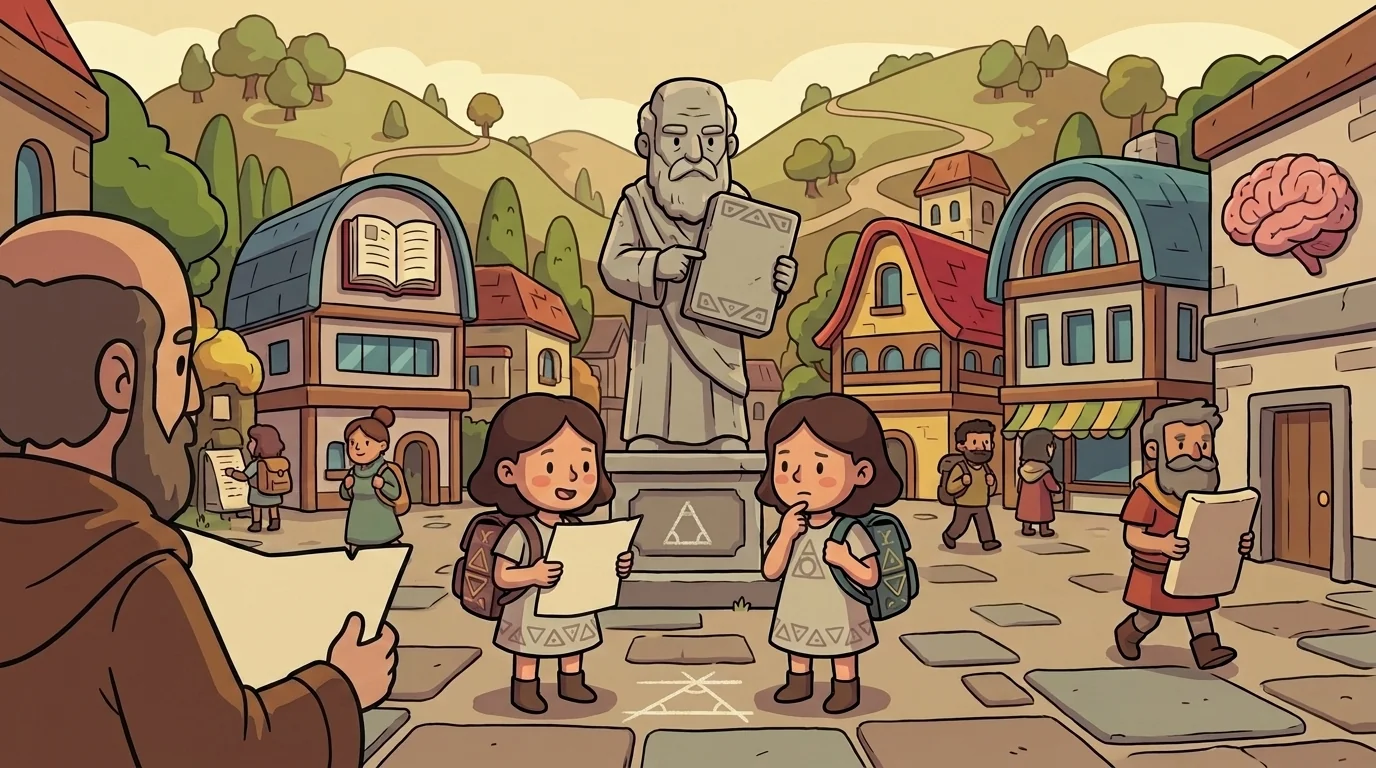
Theora picks it up:
"Therefore, if two different lines share two points, they are the same line."
Axia continues:
"We agree: all right angles are equal."
Theora continues:
"Therefore, an angle that is one right angle anywhere is one right angle everywhere. So, a perfectly straight corner is always a perfectly straight corner."
Axia continues:
"We agree: through a point not on a given line, exactly one parallel line can be drawn."
Theora's voice gets a small bit more excited:
"Therefore — and these are big ideas that people had figured out. Ideas from thousands of years of math — the angles inside any triangle add up to 180 degrees. Therefore, when a line cuts across two parallel lines, the angles inside match up. They are equal. Therefore — "
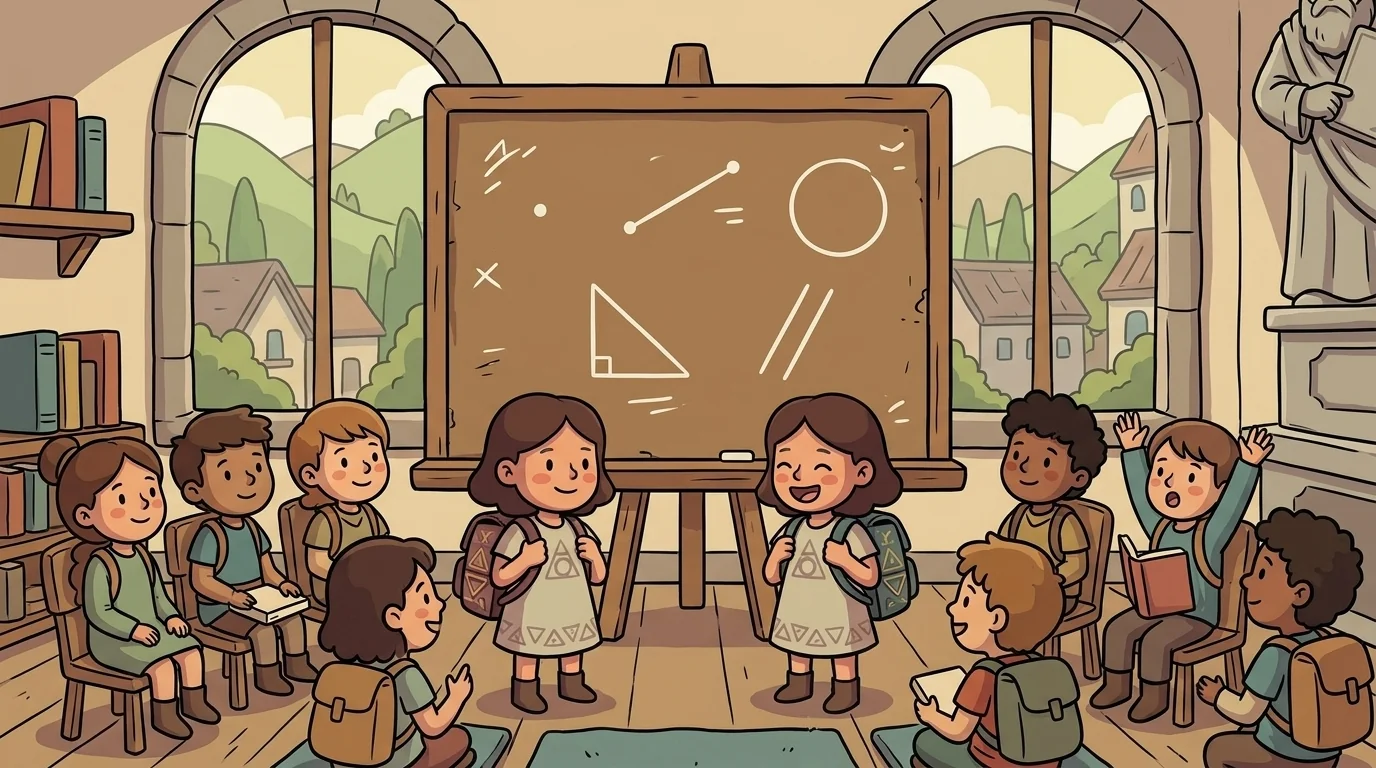
Axia cuts her off, gently: "That is enough for one introduction."
Theora laughs. The children laugh. The sisters look at each other.
Axia says, to the children: "This is geometry. We agree on a small number of things. We figure out everything else."
Theora adds: "You will spend the next sixteen kits doing exactly this. We agree. We build. We agree on a new thing. We build more. The whole system works."
Children always have one question. It's always the same question on the first day. They ask: "How do we know which things to agree on?"
Axia and Theora look at each other. They smile. They have answered this question for twelve years. They have decided that this is the best question children ask.
Axia says: "You agree on what no one can argue with. The fewer things you agree on, the stronger the math. We agree on five things. Everything else follows."
Theora adds, more softly: "It is not magic. It is patience. The agreements are small. The results are huge."
The sisters then write the five *axioms* on the board. They write them one at a time. They take their time. They let the children read each one aloud. They wait until every child is nodding.
Then they begin to build.
The GeometryForge ensemble
Axia and Theora (twin sisters) is part of GeometryForge's distributed-narrative cast. Each character embodies a different curricular primitive; together they teach the full subject.
-

Master Hypotenuse
Right-triangle relations: a² + b² = c²
-

Lady Inscribed-Angle
Circle theorems (inscribed-angle, central-angle, tangent-chord, cyclic quadrilateral)
-

Sir Transverse
Parallel-line transversals + intercept theorem (proportional segments cut by parallel lines)
-

Apprentice Sides
Area formulas (triangle area from side lengths; rectangle / parallelogram / trapezoid area)
-

Captain Construction
Compass-and-straightedge constructions (bisector, perpendicular, equilateral triangle, regular hexagon, circle-given-three-points)
-

Compass Wraith
Locus problems + circle-as-set-of-equidistant-points
-

Madame Polygon
Regular-polygon facts (interior-angle sum, exterior-angle sum, regular-tessellation, symmetry of regular n-gons)
-
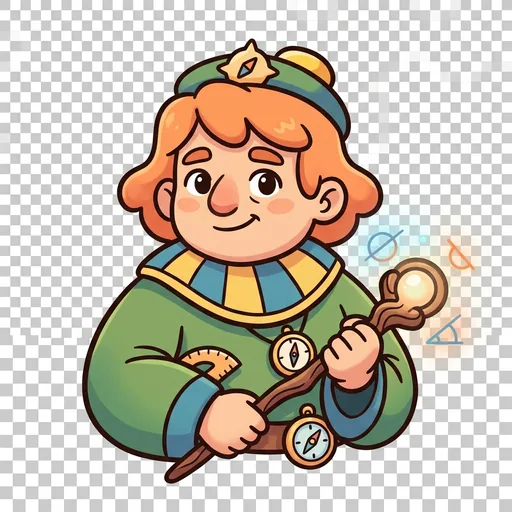
Master Tangent
Limit-and-touch problems (tangent to a circle from external point, tangent-chord angle, tangent-as-limit-of-secant)
-

Madame Motion
Rigid motions and congruence — sliding, turning, or flipping a shape never changes its size or shape; two shapes are congruent if one can be carried exactly onto the other.
-

Scout Scale
Dilation and similarity — resizing a shape by a scale factor keeps every angle the same and multiplies every length equally; similar shapes are the same shape at a different size.
-

Lady Lattice
The coordinate plane — every point has an exact two-number address, so you can plot it, measure the distance between two points, and find the midpoint exactly between them.