
Master Tangent
TANGENT — a line that touches a circle at exactly one point, never crossing. Also: the limit of a sequence of secants. Also: in trigonometry, the ratio opposite/adjacent in a right triangle.
Press play to listen along. The line being read lights up as you go.
Show full transcript
Loading transcript…
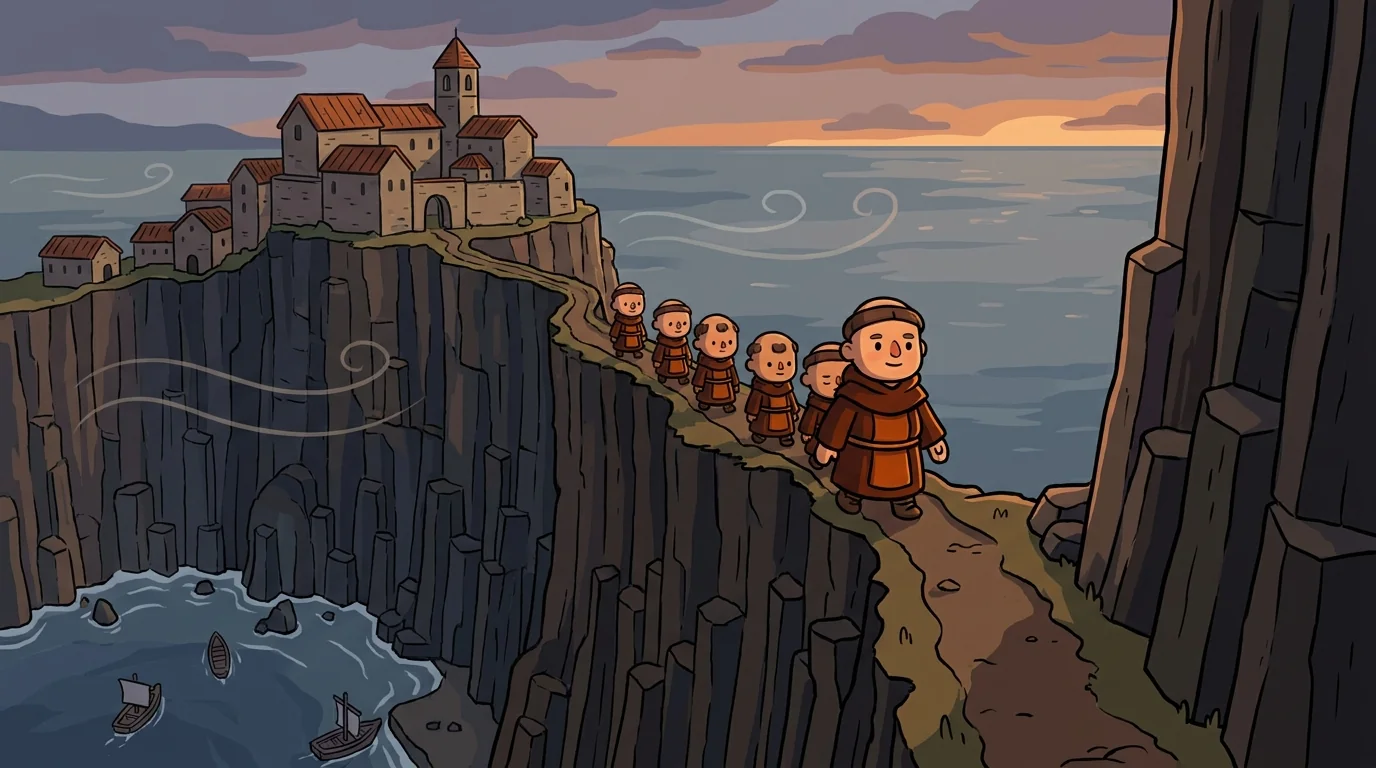
Master Tangent spent his childhood in a monastery perched high on a cliff. Below, the sea stretched out, vast and cold.
The monks called their home, simply, Sea-Cliff Monastery. No one had ever thought of a better name. It clung to the very edge of a tall basalt cliff, three hundred feet above Northshore’s cold, grey bay. The sea itself often looked like slate, even in summer. The wind, constant and sharp, carried the scent of salt and stone.
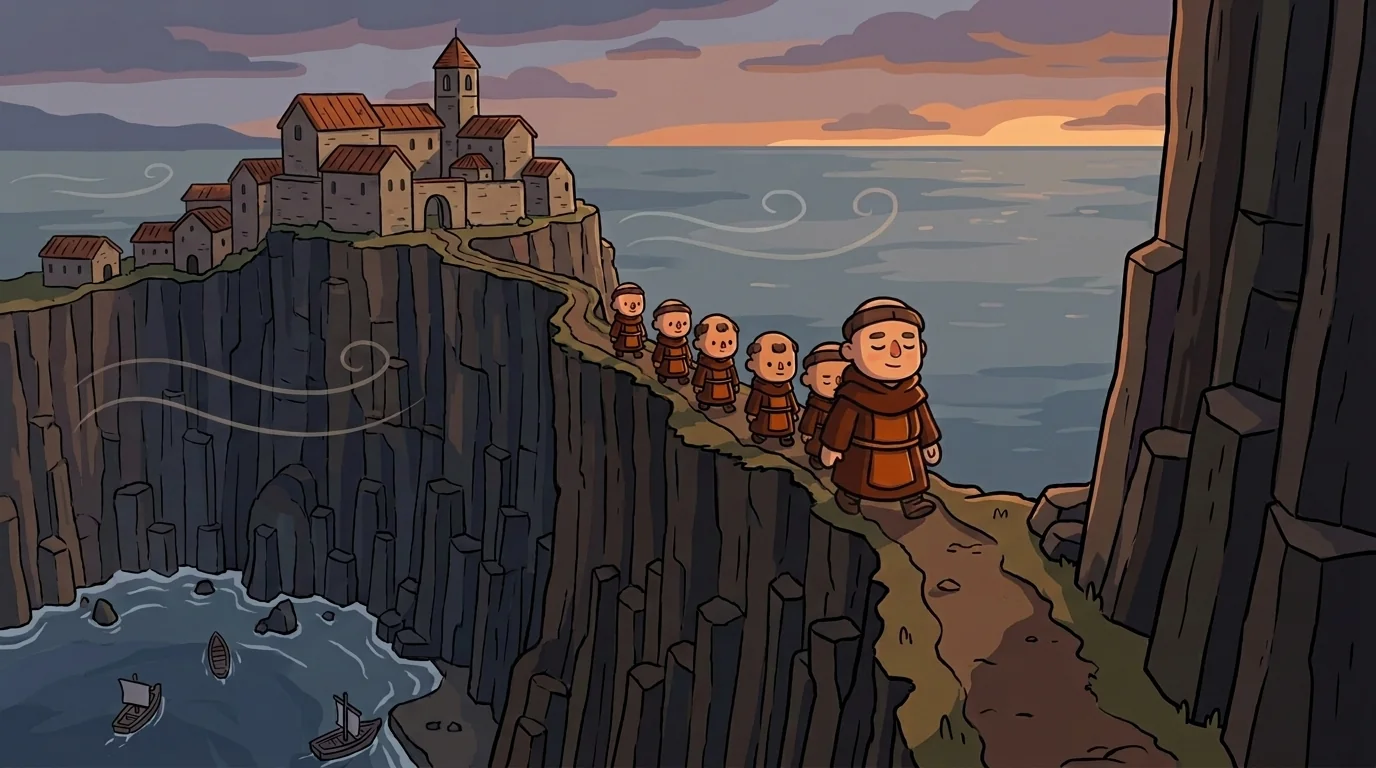
The monks of Sea-Cliff Monastery followed a daily practice, one they still observe. Each sunset, every monk able to walk gathered outside. They moved in a silent, single file. Their path traced the extreme edge of the cliff. Right shoulders faced the vast, open sea. Left shoulders turned toward the monastery walls. The narrow track was barely wider than a single boot. To their right, the cliff plunged three hundred feet straight down.
They walked along that perilous edge. They never walked across it.
This ritual was ancient, the monks claimed. Older than their monastery, older than the kingdom itself. Perhaps even older than the cliff, though that seemed impossible.
The purpose of this walk was simple: touching without crossing. The monks moved precisely where the cliff met the sky. Each step landed exactly at this boundary. They never veered inward, which would offer safety but no lesson. They never stepped outward, which would mean certain death. They walked along the line of touch, feeling the fine edge of existence.
Master Tangent’s birth name was Heron. He stopped using it at sixteen, when he took his monastic robes. Heron was the name of an ancient Mediterranean mathematician, a figure with no real connection to the boy. Besides, local children had started making jokes. Heron joined the monastery when he was twelve. His family sent him because he was, even as a small child, remarkably still. He could sit for hours without fidgeting. He might watch the sea for an entire afternoon, motionless. The village sage once observed, "This boy has the cliff-walking temperament."
The sage was right. Heron walked the cliff every sunset from age twelve until he turned forty. That meant twenty-eight years of cliff-walking. Twenty-eight years of carefully placing each foot where rock met sky. Twenty-eight years of touching that boundary without ever crossing it.
Master Tangent’s understanding didn't arrive in a single flash. It built slowly, gathering over those twenty-eight years. He came to see the cliff-edge as a fundamental shape, a *geometric primitive. It was a line, he realized. A sharp boundary separating two distinct regions: solid ground and empty air. To walk it was to approach that boundary like a limit. Each step was an approximation, a tiny guess. Some steps landed slightly inward, others slightly outward, a few off-balance. But the average of all those steps, taken over a long enough walk, that was the line itself. The monks, through their careful practice, were converging on the cliff-edge. They were tracing, with their bodies, the tangent*. This became his central principle.
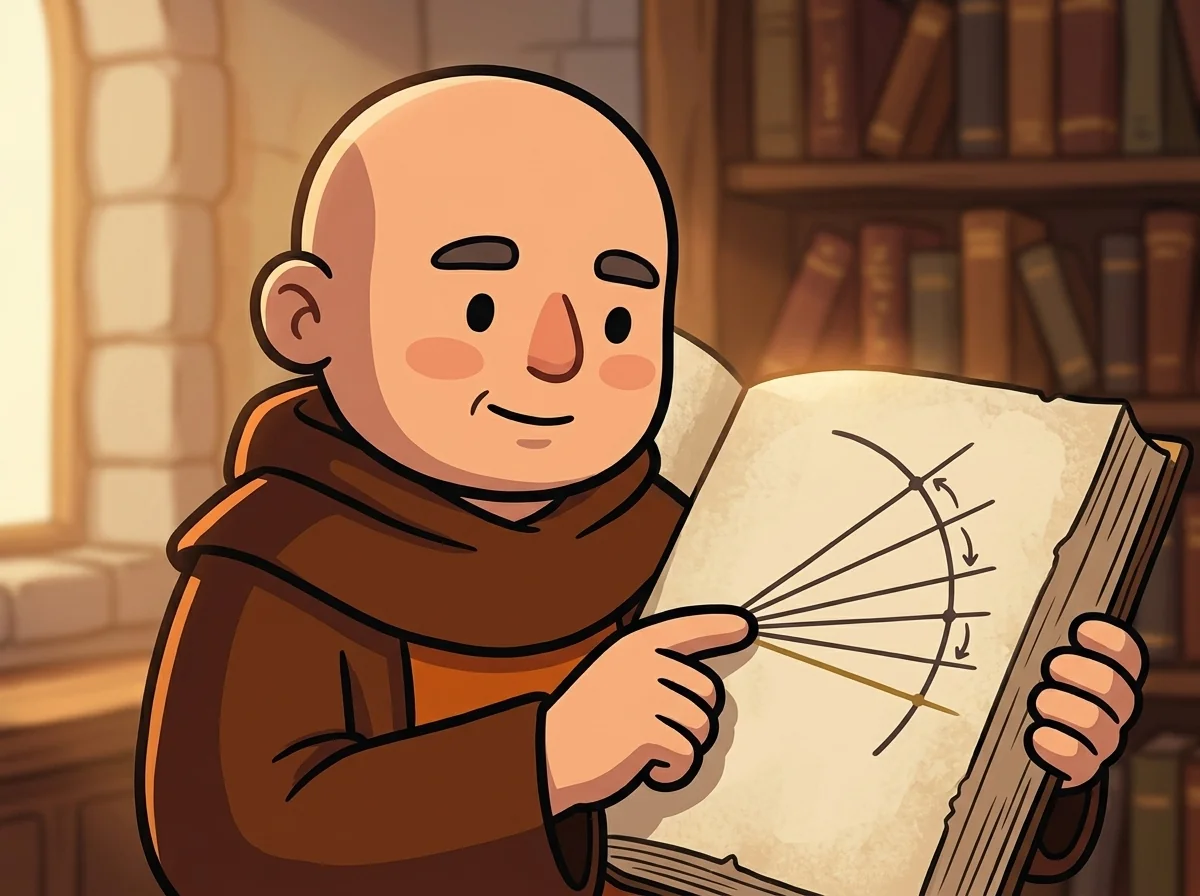
He knew the formal definition from old texts. A *tangent line to a circle touches the circle at exactly one point. It never crosses. He also knew a tangent could be found as the limit of a sequence of secants*. A secant is a line that cuts across a circle at two distinct points. Imagine those two points moving closer and closer together. As they finally merge into one, the secant line transforms. The crossing-line becomes a touching-line. It becomes a tangent.
Master Tangent was thirty-one when he first truly saw it. He sat in the monastery library, a borrowed geometry book open before him. A diagram showed a sequence of secants, like spokes, gradually approaching a tangent line. He stared at the drawing for a long time. The lines seemed to pulse with meaning. He closed the book, his heart thrumming. He walked straight out to the cliff-edge, the familiar wind whipping his robes. The cliff-edge is the tangent, he thought, a revelation settling deep within him. All the walking-paths I’ve made over twenty years, those are the secants. Each path had crossed slightly inward, or slightly outward. But the average of all those paths, the invisible line they collectively formed, that was the tangent line. I have been doing this exercise all along, he realized, a quiet smile touching his lips.
He didn't know then that he would eventually leave the monastery to teach this very idea. Nine years passed. The GeometryForge Academy began searching for someone to teach children about tangent-to-circle problems. The academy master had heard tales of the cliff-walking monks. He traveled to Northshore, a long journey. He found Master Tangent, who was then forty and privately worried his knees might not endure another decade of cliff-edge balancing. The master extended an invitation to teach.
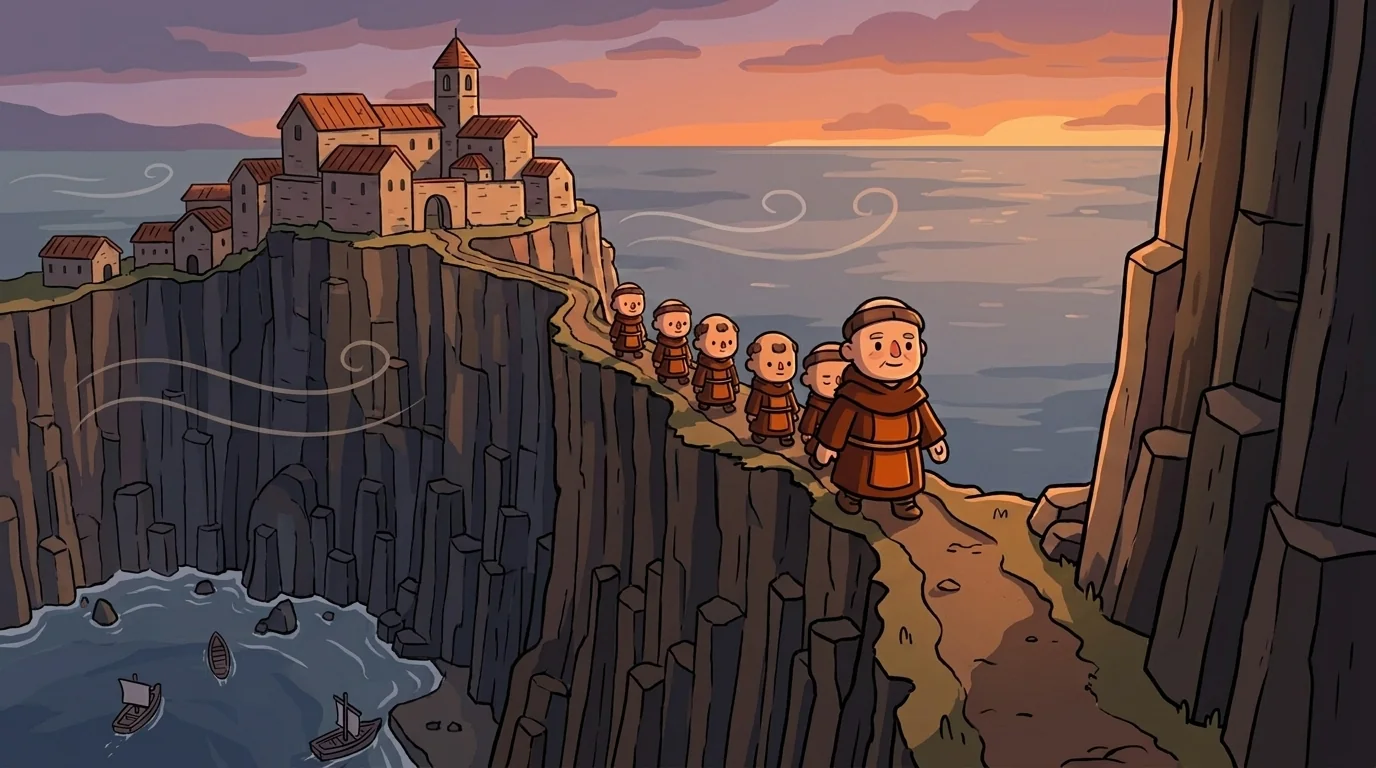
Master Tangent considered the offer for two full months. He spoke with the abbot, his spiritual guide. "The cliff-edge has taught you what it can," the abbot said, his voice calm. "The children may need you more than the edge does now." Master Tangent accepted the invitation.
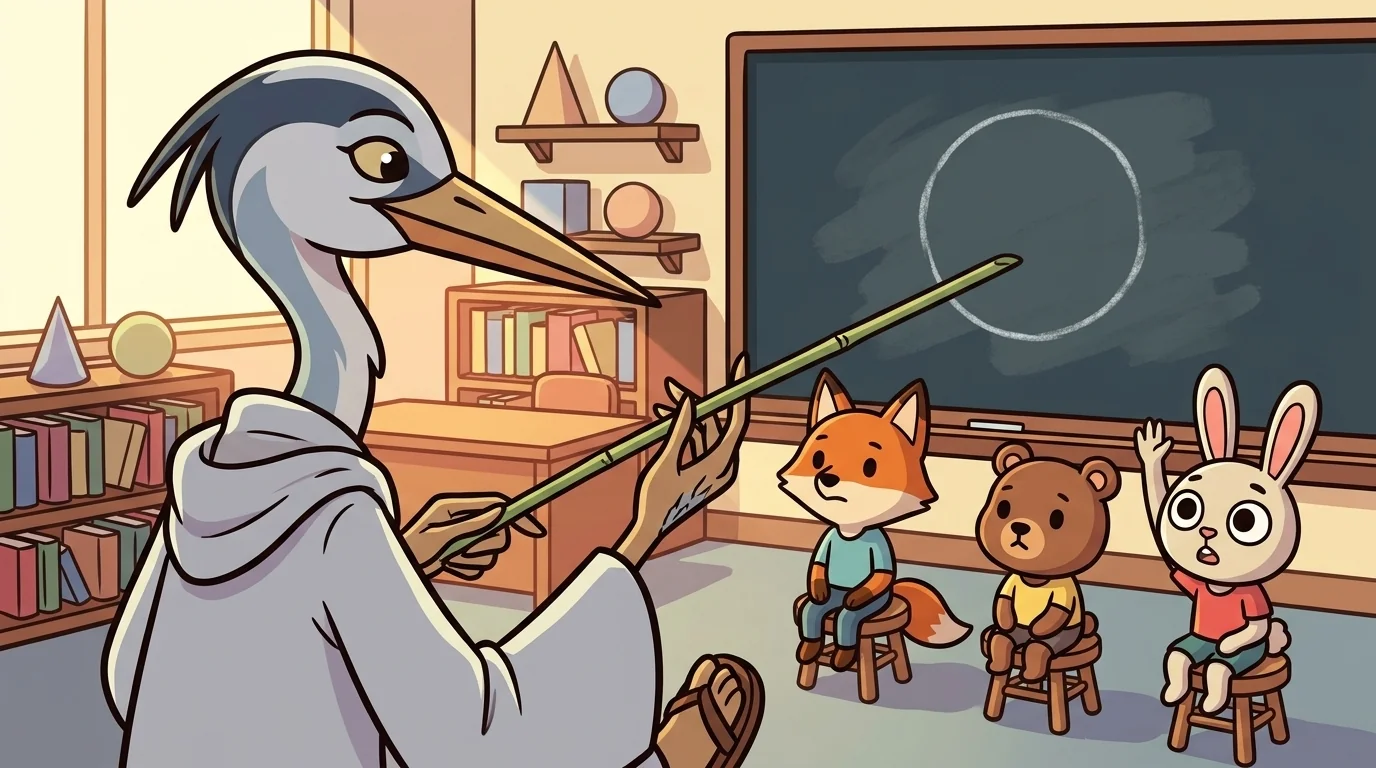
He brought one thing to the academy: a single, straight reed. He had cut it himself from the marsh below the monastery before he left. He still uses it today. It is about three feet long, perfectly straight, and smooth from years of handling. In class, he holds it against a chalk-drawn circle on the blackboard. The reed touches the circle at exactly one point. It does not cross. "This is a *tangent*," he explains, his voice soft but clear. "The reed touches the circle. It does not cross. That is the whole trick."
The children, as always, protest. "But how do you find the tangent?" one asks. "We need a method!" Master Tangent smiles. He is a whip-thin figure, like a heron in a long, pale-grey robe. His smile is dry and barely visible. "The method is patience," he tells them. "You begin with a *secant — a line that crosses the circle at two points. Then, you imagine moving those two crossing points closer together. When they merge into one single point, the line touches without crossing. That is the tangent. It is the limit* of the approach, the point you get closer and closer to, but never quite pass."
The children try it. They draw circles, then secants cutting through them. They use their fingers to visualize the crossing points moving closer. The secant line seems to rotate, shifting its angle. As the two imaginary points merge, the line settles into a new position. That settled line is the tangent. Master Tangent watches them, his gaze steady
The GeometryForge ensemble
Master Tangent is part of GeometryForge's distributed-narrative cast. Each character embodies a different curricular primitive; together they teach the full subject.
-

Master Hypotenuse
Right-triangle relations: a² + b² = c²
-
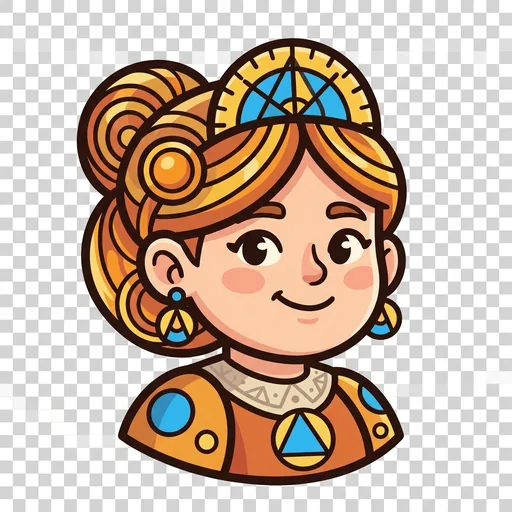
Lady Inscribed-Angle
Circle theorems (inscribed-angle, central-angle, tangent-chord, cyclic quadrilateral)
-

Sir Transverse
Parallel-line transversals + intercept theorem (proportional segments cut by parallel lines)
-

Apprentice Sides
Area formulas (triangle area from side lengths; rectangle / parallelogram / trapezoid area)
-
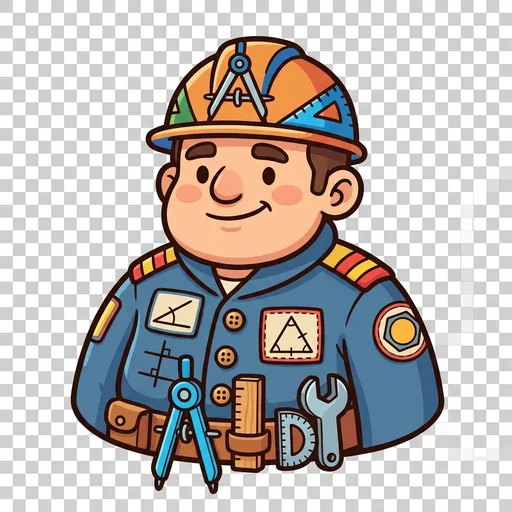
Captain Construction
Compass-and-straightedge constructions (bisector, perpendicular, equilateral triangle, regular hexagon, circle-given-three-points)
-

Compass Wraith
Locus problems + circle-as-set-of-equidistant-points
-

Madame Polygon
Regular-polygon facts (interior-angle sum, exterior-angle sum, regular-tessellation, symmetry of regular n-gons)
-

Axia & Theora
Twin theorists — Axia carries axiomatic-first reasoning; Theora carries theorem-application; together they bridge geometric postulates to derived results
-

Madame Motion
Rigid motions and congruence — sliding, turning, or flipping a shape never changes its size or shape; two shapes are congruent if one can be carried exactly onto the other.
-

Scout Scale
Dilation and similarity — resizing a shape by a scale factor keeps every angle the same and multiplies every length equally; similar shapes are the same shape at a different size.
-
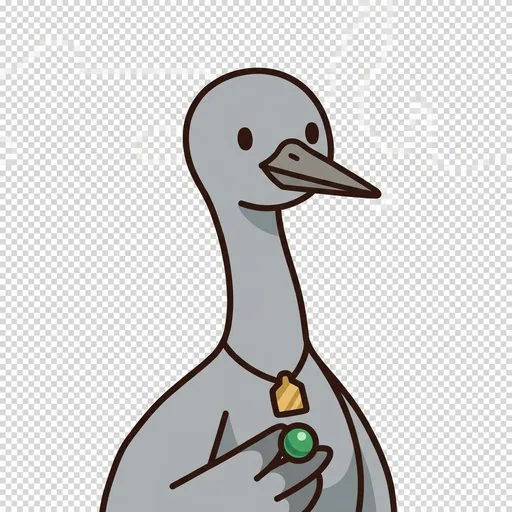
Lady Lattice
The coordinate plane — every point has an exact two-number address, so you can plot it, measure the distance between two points, and find the midpoint exactly between them.