
Master Hypotenuse and Apprentice Sides
SPECIAL-CASE-VS-GENERAL — Master Hypotenuse (a² + b² = c² for right triangles) + Apprentice Sides (Heron's formula for ANY triangle) — when one tool is enough, when you need the more general tool
A story read by Master Hypotenuse and Apprentice Sides
Press play to listen along. The line being read lights up as you go.
Show full transcript
Loading transcript…
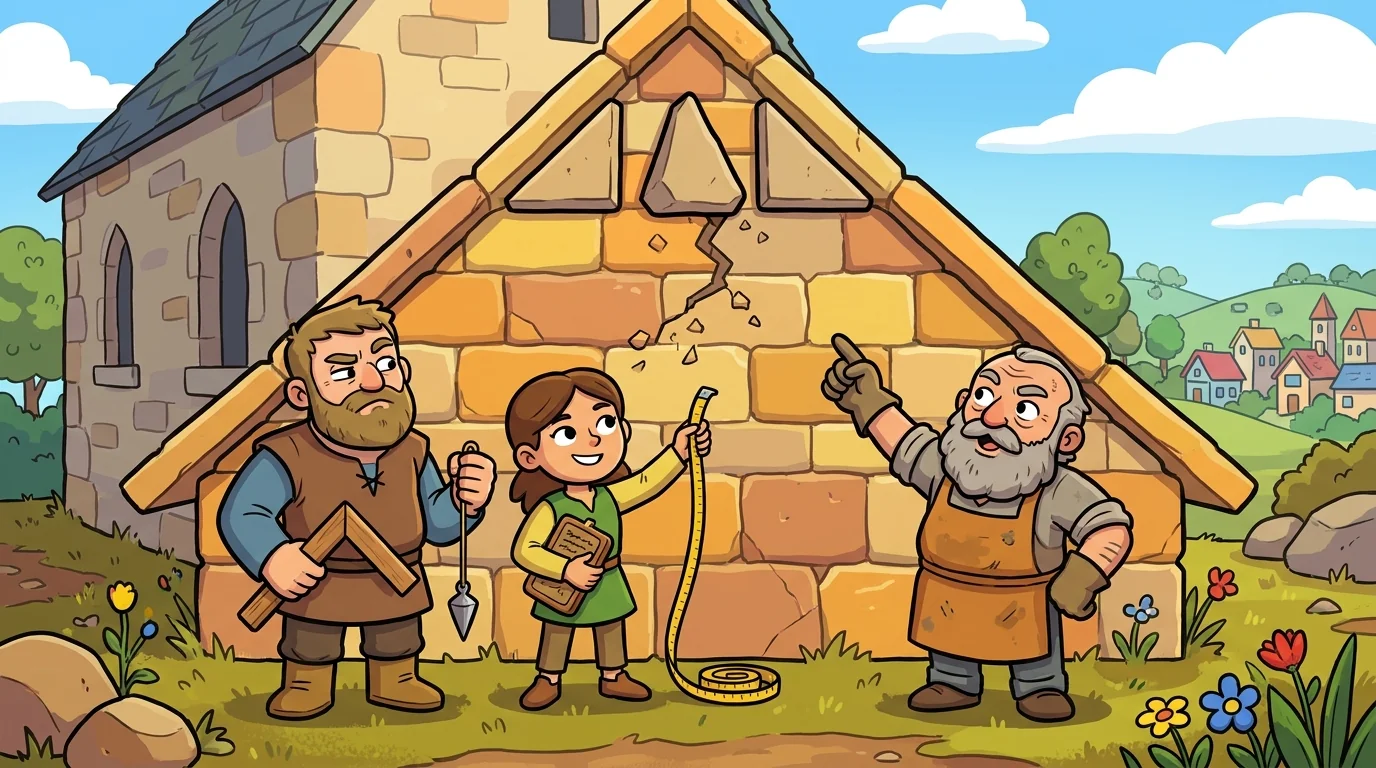
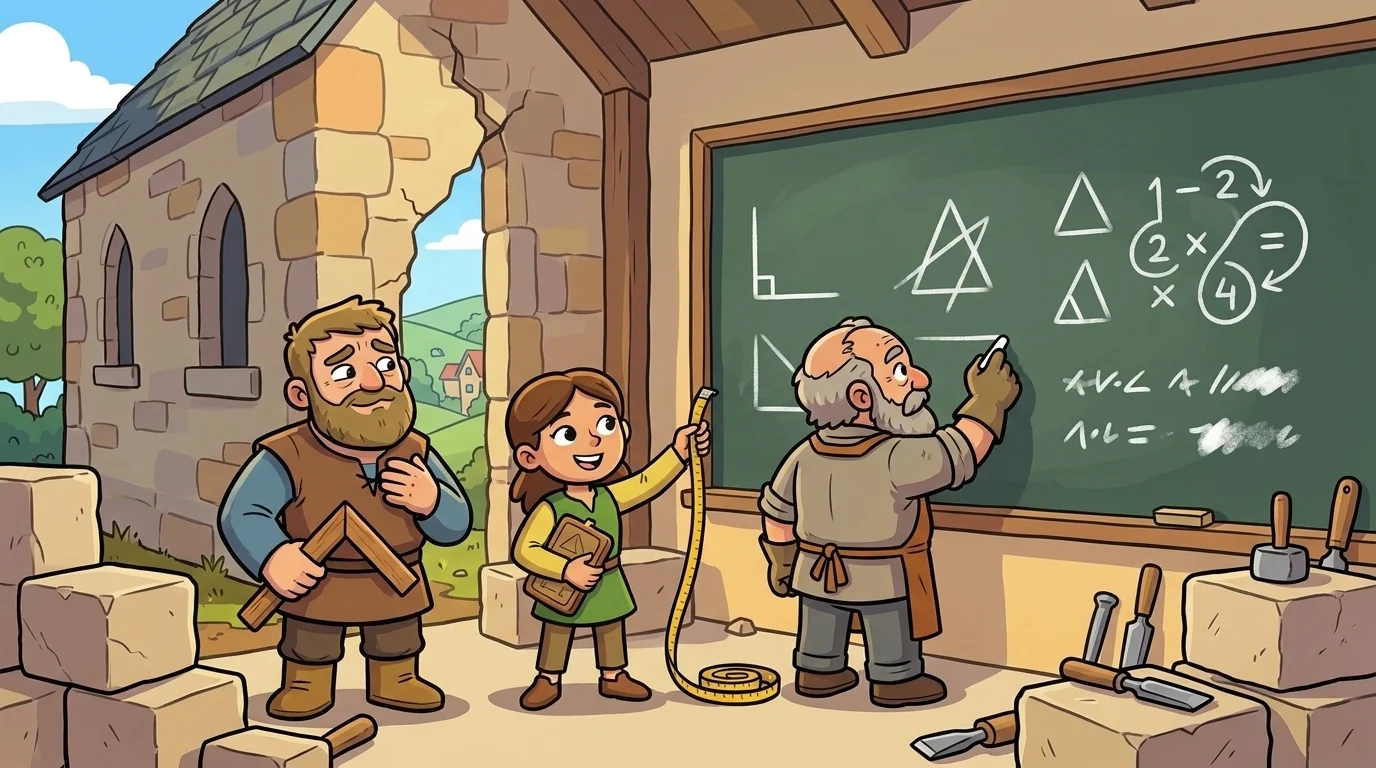
The chapel roof had cracked at the western gable, and the masons needed measurements before they could carve the replacement stones. Master Hypotenuse arrived first, with a square and a plumb line. Apprentice Sides arrived second, with a tape measure and a wax-tablet.
The Master Mason met them at the base of the gable. He pointed up.
"Three triangle stones at the apex," he said. "Two are right triangles. One is not. I need the AREAS of all three so I can quote the price of the limestone. Can you measure them and give me the areas?"
Master Hypotenuse looked up at the gable. "I can do the two right triangles."
Apprentice Sides looked up at the gable. "I can do all three."
Master Hypotenuse glanced sideways at her, mildly insulted. "I can do all three too."
"Maybe. But you'll need a ladder to reach the angle of the third one. I won't."
The Master Mason raised an eyebrow. "Show me."
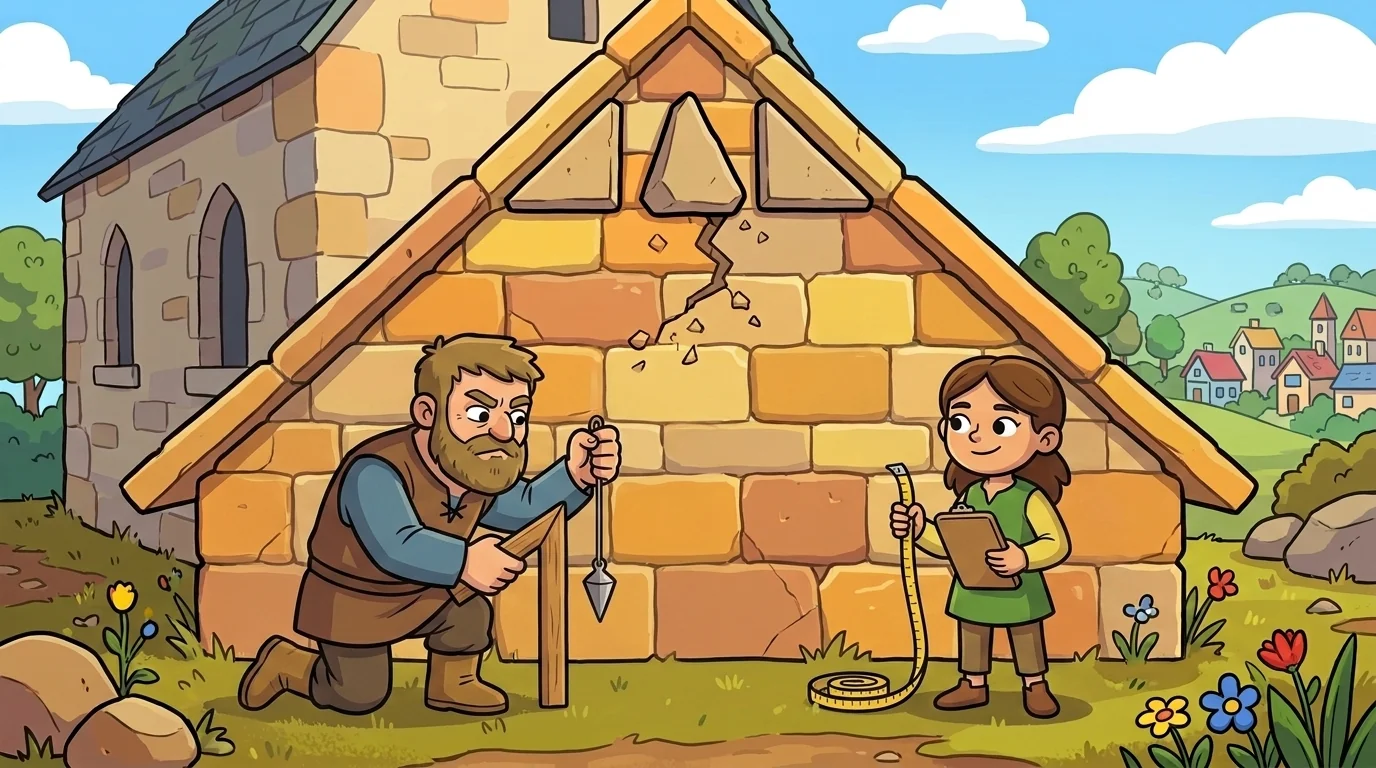
Master Hypotenuse went first. He set up his square and plumb line at the base of the first right-triangle stone. He measured the two legs of the right angle.
"This one is a right triangle," he said. "The legs are five hands wide and twelve hands tall. The hypotenuse — the side opposite the right angle — is the diagonal across the top. By the Pythagorean theorem, five squared plus twelve squared equals the hypotenuse squared. Twenty-five plus one hundred and forty-four is one hundred and sixty-nine. The square root of one hundred and sixty-nine is thirteen. So the hypotenuse is thirteen hands."
He wrote it down. Right triangle 1: legs 5 and 12, hypotenuse 13.
"And the area," he said. "For a right triangle, the area is one-half times leg times leg. One-half times five times twelve is thirty. So the area is thirty square hands."
He moved to the second right triangle. He measured its legs.
"Eight and fifteen. Eight squared is sixty-four. Fifteen squared is two hundred twenty-five. Sum is two hundred eighty-nine. Square root is seventeen. So the hypotenuse is seventeen, and the area is one-half times eight times fifteen, which is sixty."
He wrote it down. Right triangle 2: legs 8 and 15, hypotenuse 17. Area 60.
He came down to the ground. "Two right triangles, areas 30 and 60. The third one is the trouble. Its angles aren't ninety. I can climb up and measure the angle and then drop a perpendicular from the apex — but that means a ladder and a plumb line and probably an hour."
Apprentice Sides looked at him. "You don't need any of that."
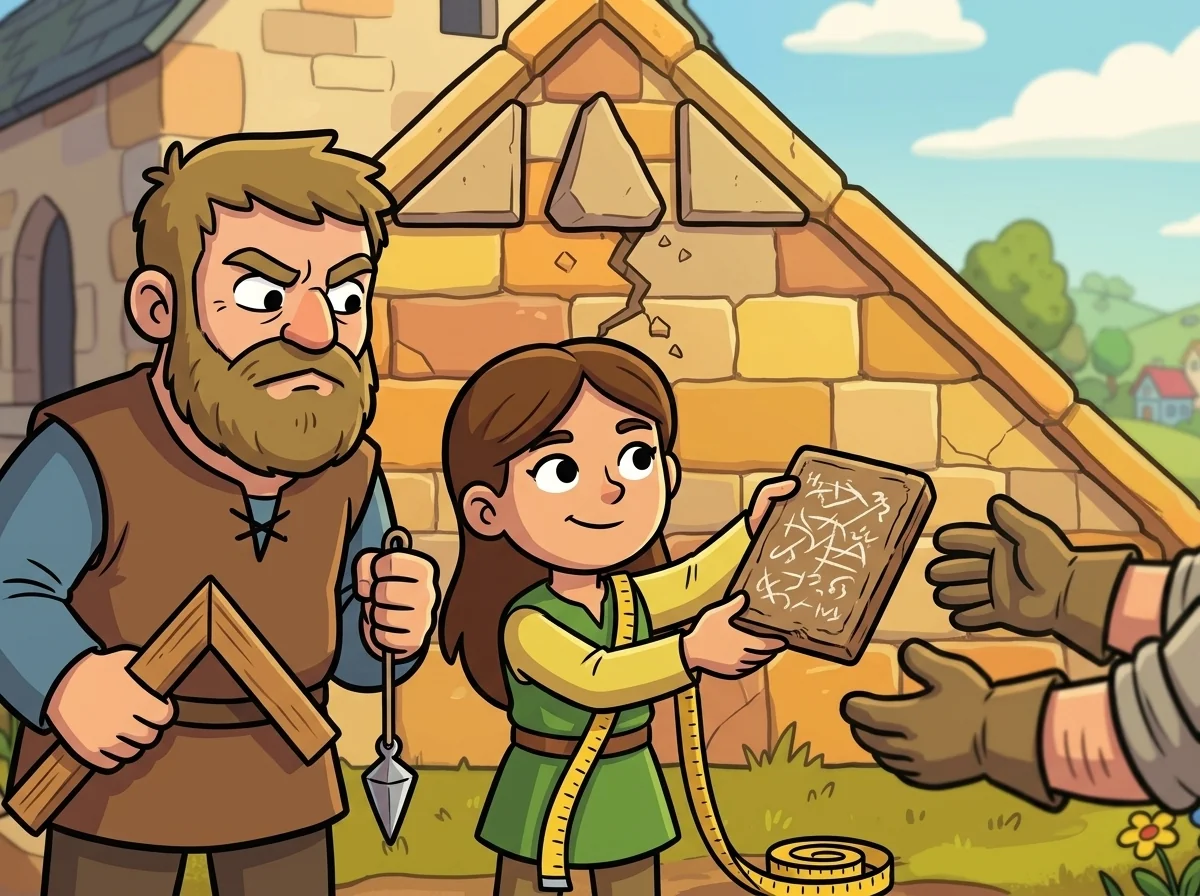
Apprentice Sides climbed nimbly up to the gable's edge. She did not measure any angles. She did not drop any perpendiculars. She just measured the three SIDES of the third triangle with her tape measure.
"Side one: nine hands. Side two: ten hands. Side three: eleven hands."
She came back down. She wrote the three numbers on her wax-tablet.
"For any triangle whose three sides are a, b, c — even a non-right triangle — there is a formula for the area in terms of just the three sides. It's called Heron's formula. First you compute the semi-perimeter, which is half the sum of the three sides."
She wrote: s = (a + b + c) / 2 = (9 + 10 + 11) / 2 = 30 / 2 = 15.
"Then the area is the square root of s times s-minus-a times s-minus-b times s-minus-c."
She wrote: Area = √(15 × (15−9) × (15−10) × (15−11)) = √(15 × 6 × 5 × 4) = √(1800).
The square root of one thousand eight hundred was a little messy. She did the arithmetic carefully on the wax-tablet. About forty-two-and-a-half square hands.
She handed the wax-tablet to the Master Mason. "Area of the third triangle is about forty-two-point-four square hands. No ladder. No plumb line."
The Master Mason stared at the wax-tablet for a long moment.
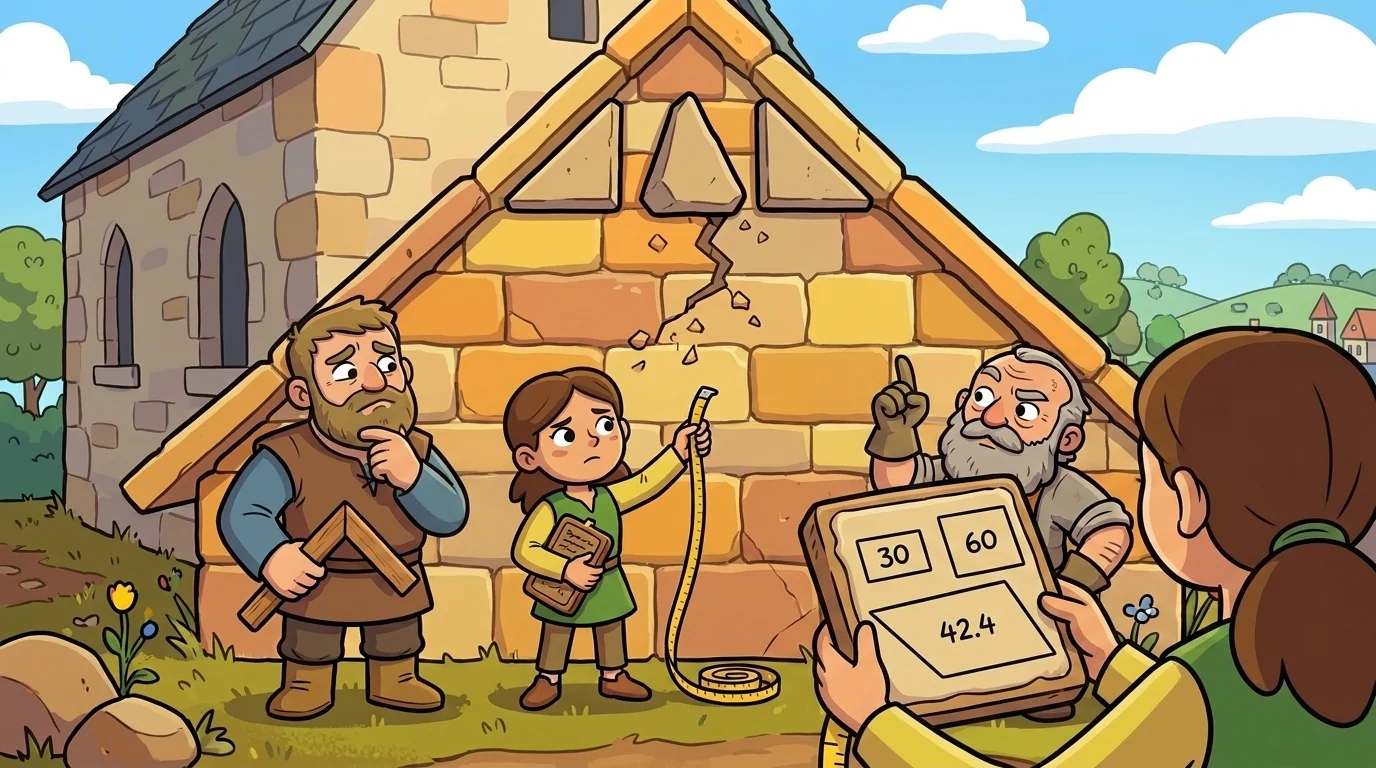
"You just got an area from three side-lengths."
"Yes."
"Without any angle measurement."
"Yes."
He looked at Master Hypotenuse. "Do you know Heron's formula?"
"I know it exists," Master Hypotenuse said, slightly grudging. "I have always taught the right-triangle case because it's simpler. The Pythagorean theorem is one of the first things kids learn. Heron's formula is heavier; it has a square root nested inside a product, and most of the arithmetic gets messy."
"Right," Apprentice Sides said. "Yours is the cleaner tool for the easy case. Mine is the messier tool for any case."
The Master Mason wrote down the three areas. "Thirty. Sixty. Forty-two-point-four. I have everything I need."
He paused.
"There's a lesson in this for the apprentices," he said. "Which one of you tells it?"
Master Hypotenuse and Apprentice Sides looked at each other.
"You go," Master Hypotenuse said.
Apprentice Sides nodded. "When the triangle has a right angle, his tool is fastest. The arithmetic is light. You don't need a tape measure and a wax-tablet and a semi-perimeter formula. You just need two leg-lengths and the Pythagorean theorem."
"And when the triangle doesn't have a right angle..."
"You need mine. Heron's formula handles ANY triangle. The cost is the heavier arithmetic. The benefit is you don't need any angles at all. Just side-lengths."
"So the rule is," Master Hypotenuse said slowly, "use the simpler tool when the special-case condition holds. Use the general tool when it doesn't."
"Use the simpler tool first," Apprentice Sides said. "Switch to the general tool when the special case fails."
"Same idea told twice."
"Same idea told twice."
The Master Mason wrote both rules on the chalk wall of the workshop. The masons read them later. The chapel roof was repaired by the end of the week.
The GeometryForge ensemble
Master Hypotenuse and Apprentice Sides is part of GeometryForge's distributed-narrative cast. Each character embodies a different curricular primitive; together they teach the full subject.
-

Master Hypotenuse
Right-triangle relations: a² + b² = c²
-

Lady Inscribed-Angle
Circle theorems (inscribed-angle, central-angle, tangent-chord, cyclic quadrilateral)
-

Sir Transverse
Parallel-line transversals + intercept theorem (proportional segments cut by parallel lines)
-

Apprentice Sides
Area formulas (triangle area from side lengths; rectangle / parallelogram / trapezoid area)
-
Captain Construction
Compass-and-straightedge constructions (bisector, perpendicular, equilateral triangle, regular hexagon, circle-given-three-points)
-

Compass Wraith
Locus problems + circle-as-set-of-equidistant-points
-

Madame Polygon
Regular-polygon facts (interior-angle sum, exterior-angle sum, regular-tessellation, symmetry of regular n-gons)
-

Master Tangent
Limit-and-touch problems (tangent to a circle from external point, tangent-chord angle, tangent-as-limit-of-secant)
-

Axia & Theora
Twin theorists — Axia carries axiomatic-first reasoning; Theora carries theorem-application; together they bridge geometric postulates to derived results
-

Madame Motion
Rigid motions and congruence — sliding, turning, or flipping a shape never changes its size or shape; two shapes are congruent if one can be carried exactly onto the other.
-

Scout Scale
Dilation and similarity — resizing a shape by a scale factor keeps every angle the same and multiplies every length equally; similar shapes are the same shape at a different size.
-
Lady Lattice
The coordinate plane — every point has an exact two-number address, so you can plot it, measure the distance between two points, and find the midpoint exactly between them.