
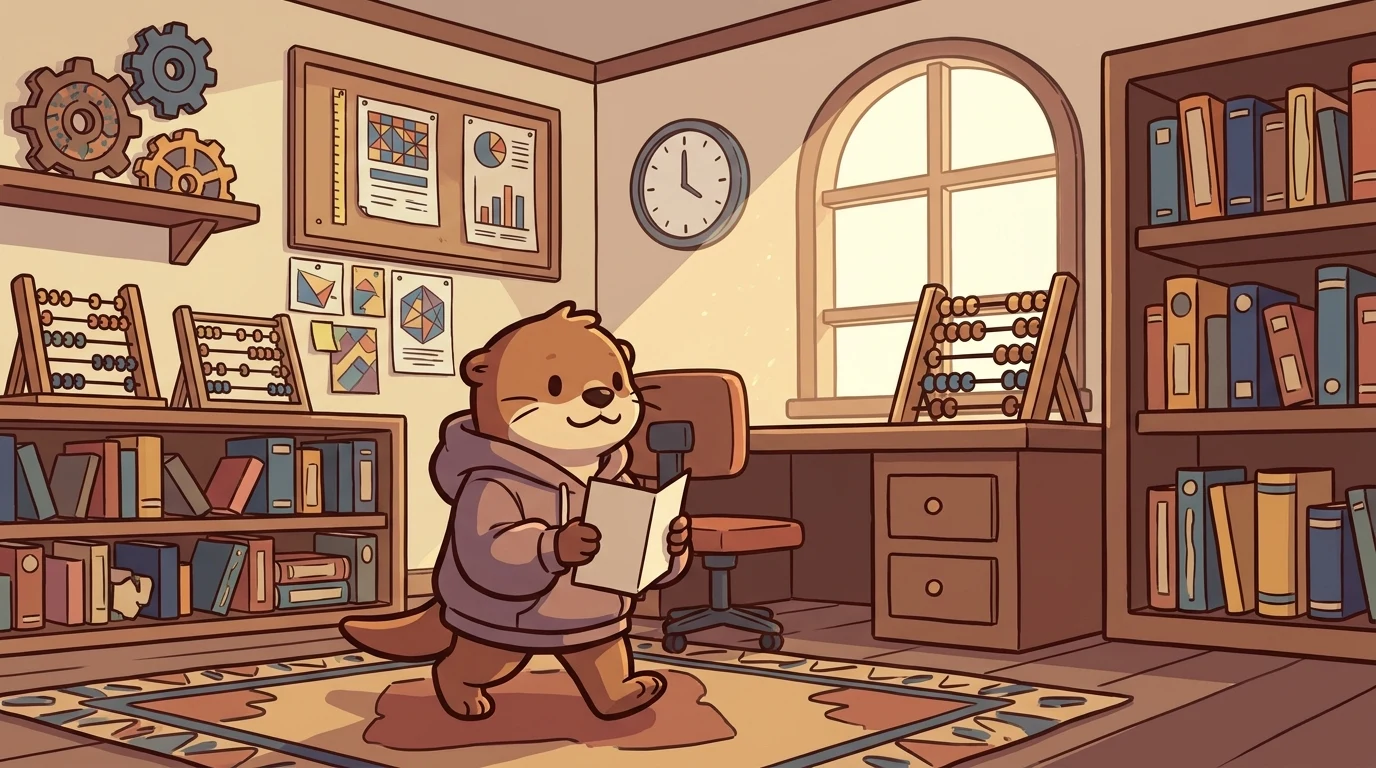
Tally
NUMBER-BASED CODES — *A1Z26, ASCII, binary, book ciphers; any mapping that converts letters to numbers.* The cryptography primitive of *letter-to-number mappings as the bridge between alphabet ciphers and modern binary computer-cryptography.*
Listen along — Tally
Loading audio…
Press play to listen along. The line being read lights up as you go.
Show full transcript
Loading transcript…
Chapter 6 — Tally and the Conversion-Table
Tally was a small otter-tween with fur the color of warm-brown river mud and creamy undersides. Her bright eyes constantly scanned, as if searching for hidden connections. She moved with a quick, purposeful energy, always seeming to know exactly where she was going and why. Her most distinctive feature, tucked into a small pocket on her tunic, was a folded card. This was her conversion-table, a small, sturdy rectangle of parchment covered in tiny, neat columns: alphabet letters, A1Z26 numbers, ASCII numbers, and binary representations.
(shared with: CipherForge Tally ≠ EscapeForge Tally (math-puzzles archetype). Same first name, different domains per registry rule 3. EscapeForge Tally counts; CipherForge Tally maps letters to numbers.)
This card was more than just a tool; it was Tally herself, in miniature. It showed how she thought, how she saw the world. Tally understood that all information, even words, could be transformed. She embodied the idea of number-based codes. For Tally, the world was full of systems waiting to be mapped.
“Okay, listen up,” Tally chirped, tapping her paw on a chalk drawing of her conversion-table. A group of young otters, new to CipherForge, leaned closer. “Computers don’t see letters like we do. They see numbers. Every single letter, every space, every punctuation mark – it all becomes a number.”
She pointed to the first column. “See here? We start with the alphabet. Simple, right? A, B, C.” She slid her paw to the next column. “Now, the first way to turn letters into numbers is called A1Z26. It’s super straightforward. A is 1, B is 2, and so on, all the way to Z, which is 26.”
A young otter named Pip raised a paw. “So, if I wanted to write ‘CAT’ in A1Z26, it would be… C is 3, A is 1, T is 20?”
“Exactly!” Tally beamed. “See? Letters become numbers. Numbers become letters. It’s just a mapping.”
She moved on, her voice clear and precise. “But computers need a more universal language. That’s where ASCII comes in.” She tapped the column on her card marked ‘ASCII’. “This is like the secret handshake for computers. Every character, even a space, gets a specific number between 0 and 127.”
“So ‘A’ isn’t 1 anymore?” Pip asked, frowning.
“Nope,” Tally said, shaking her head. “In ASCII, ‘A’ is 65. ‘B’ is 66, and so on. Lowercase ‘a’ is 97. Even a space is 32. It’s a different system, a different mapping, but the idea is the same. We’re just giving letters a numerical identity.” She paused, letting the information settle. “It’s how your computer knows what you typed.”
“And then,” Tally continued, her eyes sparkling, “those ASCII numbers get turned into something even simpler for the computer: binary.” She pointed to the final column, filled with long strings of 0s and 1s. “Binary is the computer’s true language. It only uses two symbols: zero and one. So, our ASCII number 65, for ‘A’, becomes 01000001 in binary.”
“Whoa,” another otter whispered. “That’s a lot of zeros and ones.”
“It is!” Tally agreed. “But it’s still just a mapping. A number becomes a sequence of 0s and 1s. This is how information is stored and sent across wires. It’s how computers talk to each other.”
Tally loved these transformations. She saw the elegance in how a simple letter could become a number, then a string of binary digits, and then, with the right key, transform back again. It was all about understanding the rules of the game.
Her fascination with mappings began long before CipherForge. Tally grew up in a small village nestled beside a bustling trade river. Her family had been the village’s currency-exchangers for generations. Their job was to convert the village’s standard river-pebble currency into the shiny shells or woven reeds that seasonal traders brought. It was a constant dance of equivalencies: how many pebbles for one shell? How many shells for a bundle of reeds? Each exchange was a mapping, a conversion from one system to another. Tally learned early that different systems could represent the same value, if you just knew the conversion rate.
When she walked into CipherForge at twenty-two, her paws still calloused from counting pebbles, Cypher had asked her, “What are number-based codes?”
Tally hadn’t hesitated. “Letters become numbers. Mappings both ways. A1Z26, ASCII, binary. Each is a different mapping. It’s the bridge from understanding simple alphabet puzzles to modern computer cryptography.”
Cypher had simply nodded. “You are appointed.”
Tally believed it was not hard. It was mappings. Letters ↔ numbers. And once you understood that, a whole new world of secrets opened up. She taught other ways, too. Book ciphers, where letters were found by their location in a shared book – a page, a line, a word, a letter. It was like a secret treasure hunt through your favorite story. She showed them Hex, another base-16 system common in computer talk, just another way to represent those numbers. All of it, she explained, was part of the bridge to modern cryptography, feeding into the complex operations Lattice taught, like XOR operations on binary. For Tally, every code was just a different language, and she was the translator, showing everyone how to speak it.
The CipherForge ensemble
Tally is part of CipherForge's distributed-narrative cast. Each character embodies a different curricular primitive; together they teach the full subject.
-

Caesar
Caesar shift / monoalphabetic shift cipher
-
Mask
Atbash + general monoalphabetic substitution (every letter has a fixed substitute)
-

Vigenère
Vigenère / polyalphabetic keyword cipher (the Caesar-on-a-rotating-keyword pattern)
-

Echo Pair
Playfair digraph cipher (letters encoded in pairs through a 5×5 grid)
-

Rail
Rail-fence + columnar transposition ciphers (rearrange letter order without changing the letters themselves)
-

Sift
Frequency analysis + cryptanalysis-by-statistics (the cipher-breaking method, not a cipher itself)
-

Lattice
Modern cryptography fundamentals — XOR, public-key concept, hashing (the irreversible / asymmetric family)
-

Hollow
Hides a secret message inside something ordinary, so nobody even knows there is a message to look for.
-

Tome
Keeps a shared code-book where whole words stand for secret words, so only someone with the same book can read the note.