Rail
TRANSPOSITION — *rearrange the letters; keep all of them.* The cryptography primitive of *transposition ciphers — changing letter order without changing letter identity.*
Press play to listen along. The line being read lights up as you go.
Show full transcript
Loading transcript…
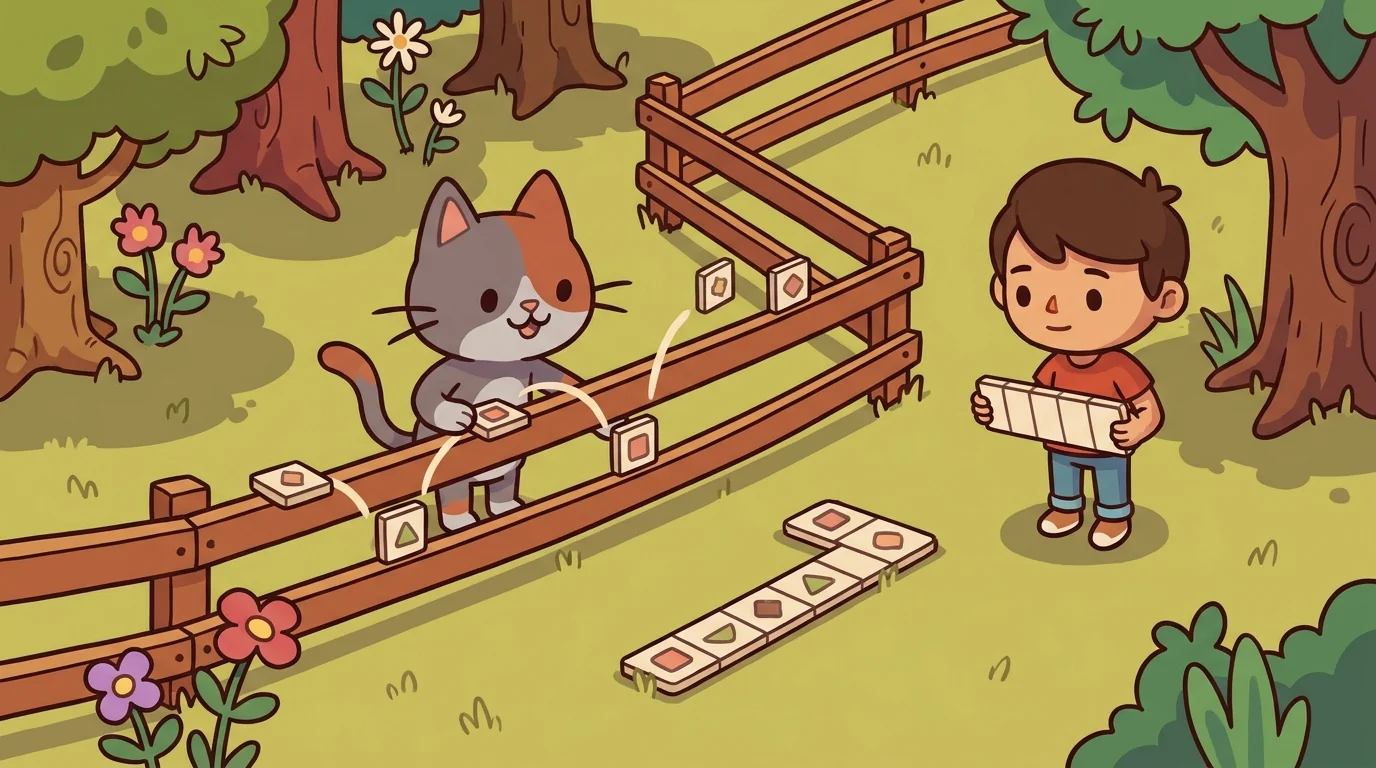
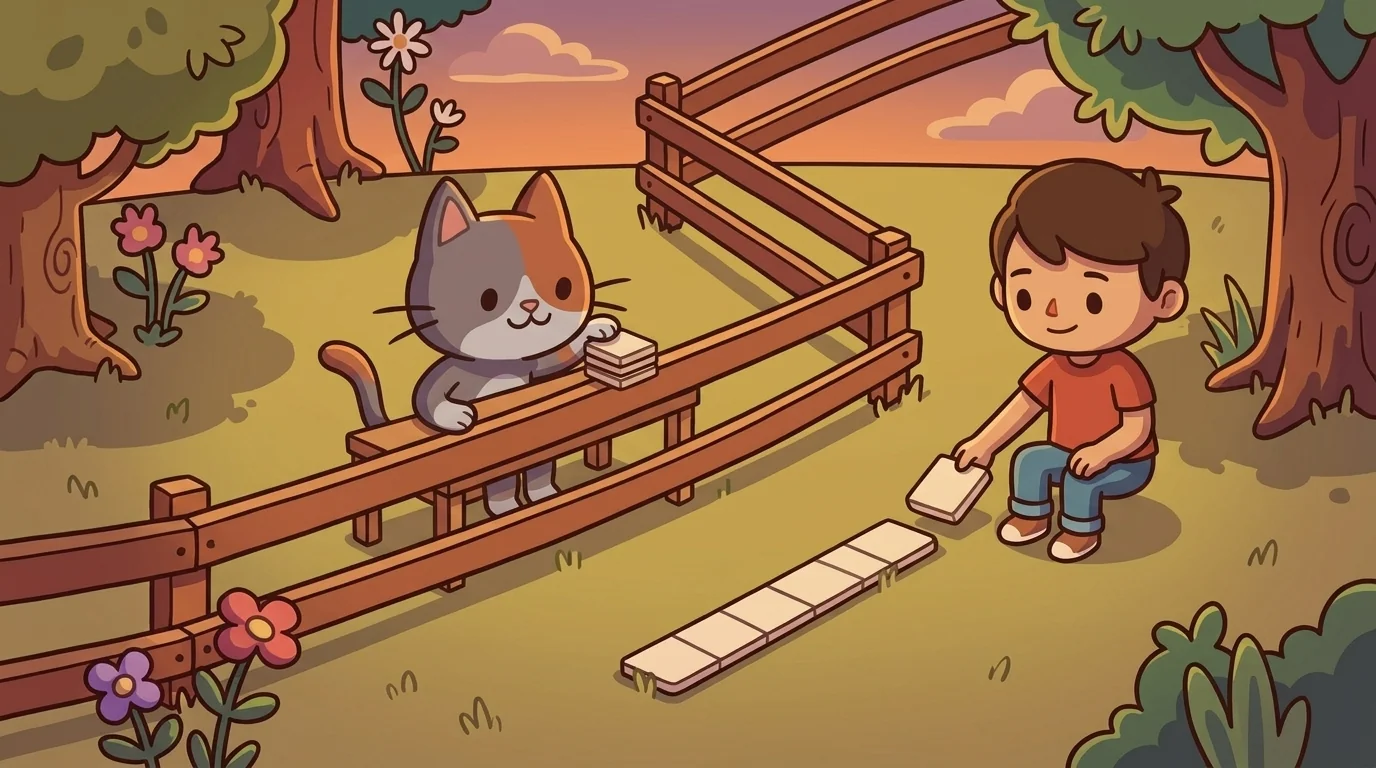
Rail, a quick grey-and-russet cat, took a strip of ten little symbol-tiles from a boy and studied it the way another animal might study a chessboard. Then she began to move the tiles across a low zig-zag frame — a fence of two rails, a top rail and a bottom rail. First tile on the top rail. Next tile dips to the bottom. Next climbs back to the top. Down, up, down, up, the tiles bounced along like a hopping sparrow, until all ten sat scattered across the two rails.
"Now," she said, and her whiskers twitched with pleasure, "I read the top rail all the way across — then the bottom rail all the way across — and copy them out in that new order." She slid the top-rail tiles into a line, then tacked the bottom-rail tiles on after them. The strip that came out held every single tile the boy had started with. Not one added, not one thrown away. Only the order had changed.
"That's the whole trick," Rail said, tapping the new strip. "Caesar and Mask swap your tiles for different-looking ones. I don't swap anything. I keep every tile you gave me and just march them into a new place." She let him check: same tiles, new order.
Then she showed him why it mattered. "Some code-breakers win by counting," she said. "They tally how often each shape appears. Against a swap-code, that counting cracks it wide open." She spread the tiles. "But count mine — every original tile is still here, in the same amounts. Counting learns nothing." She grinned. "Counting my code is like hunting a lost sock by counting your shirts."
"So it can't be broken?" the boy asked.
"Oh, it can," Rail said cheerfully. "Just not by counting. You break mine by unscrambling — the way you solve an anagram, sliding tiles around until real words fall into place. Different code, different tool. That's the lesson I care about most."
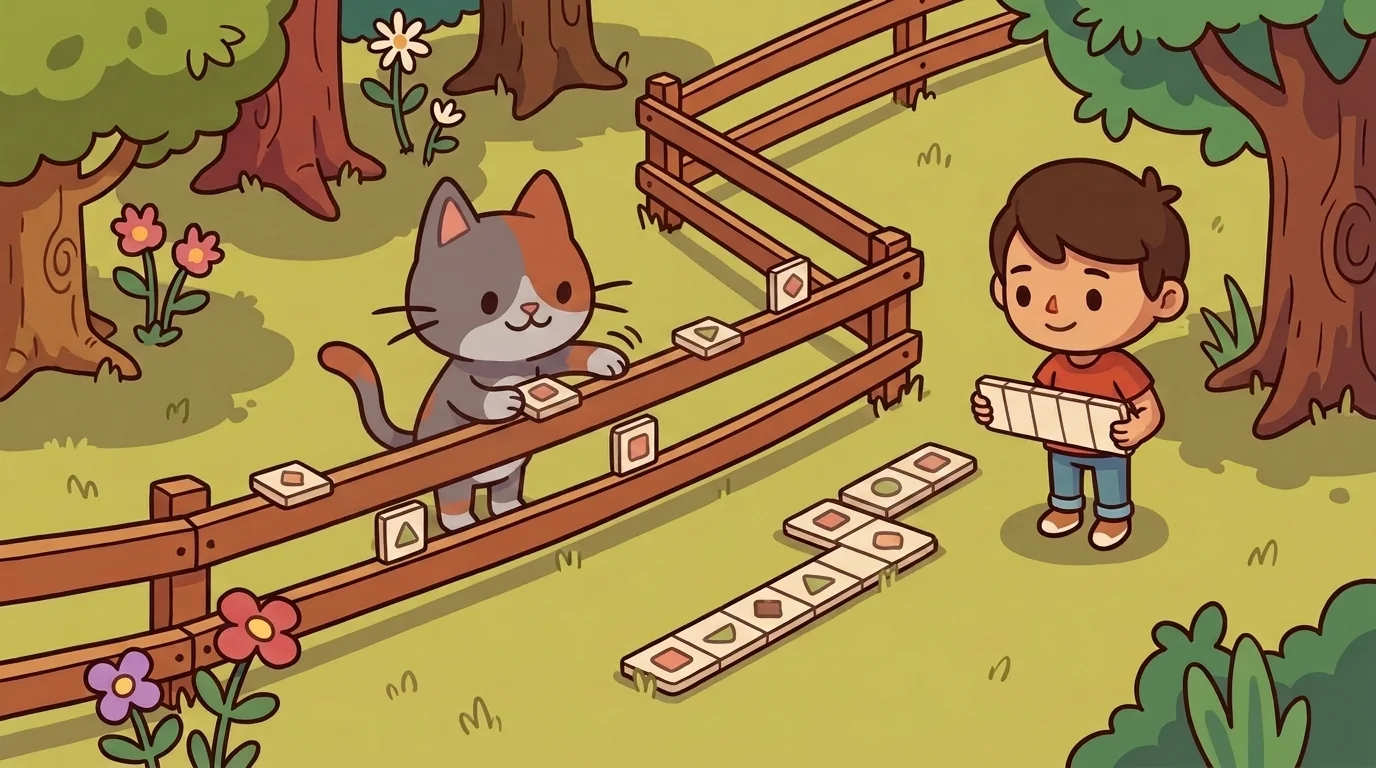
Rail grew up in a village of stage-arrangers, the folk who set the props for every play. Her family didn't write the stories; they placed things — a painted tree, a wooden well, a little bench — and where a thing sat changed what the whole scene meant.
As a kitten Rail learned that a tree set stage-left told the audience one story, and the very same tree set stage-right told another. Nothing about the tree changed. Only its place. Move the bench a few steps and a happy garden became a lonely one, using the exact same props. She used to rearrange the whole set after rehearsal just to feel the story bend and shift under her paws, the same pieces telling a dozen different tales depending only on their order.
Her desk at home was famously, ferociously tidy — every pen and paper in its assigned spot — because she had learned in her bones that order carries meaning. The day she rearranged a clumsy scene into something that made the whole rehearsal-hall gasp, using not one new prop, she felt a spark of pure delight: the thrill of finding the one perfect arrangement hiding inside pieces she already had. That hunt for the cleverest order never left her.
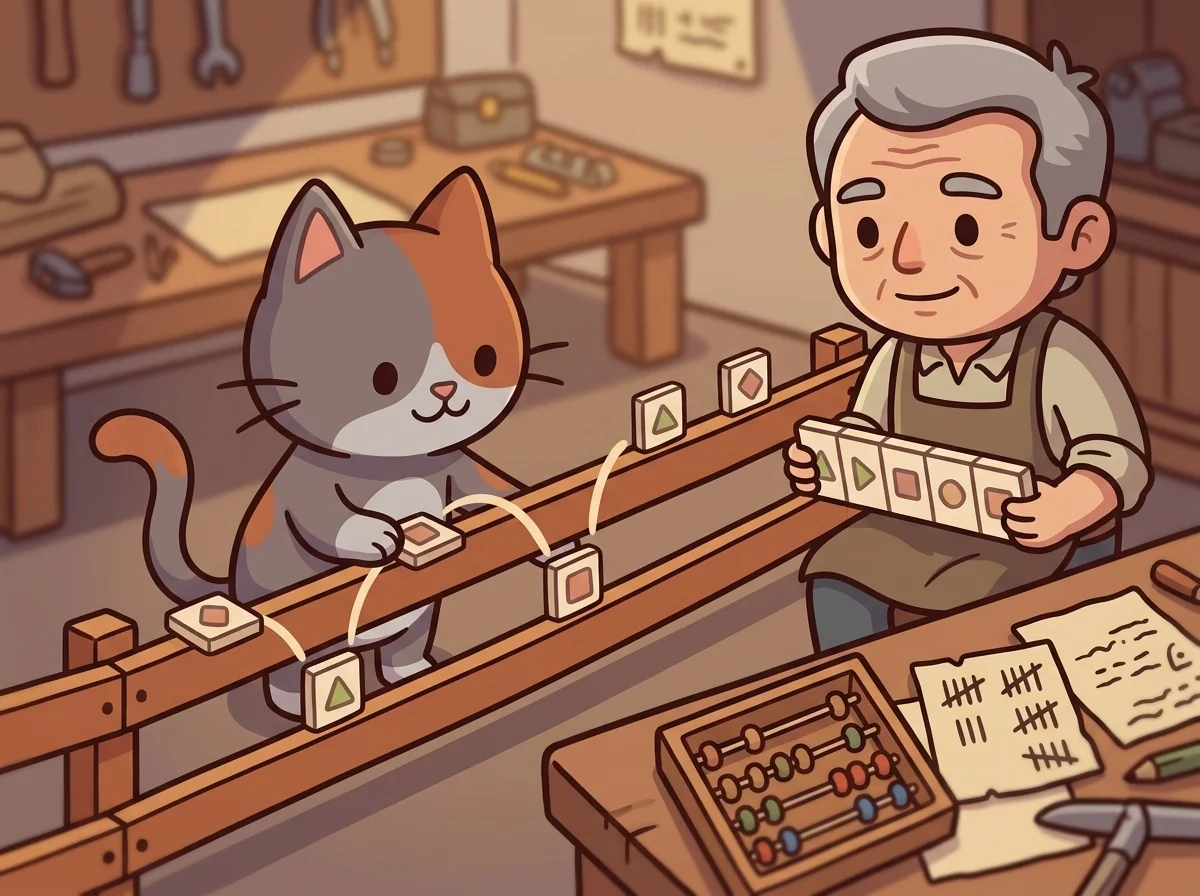
Grown, Rail walked the long road to CipherForge to find the best code-makers. Cypher, the workshop's old keeper, set a strip of symbol-tiles before her and watched.
"Show me your way," he said.
Rail bounced the tiles along a two-rail fence — top, bottom, top, bottom — then read off first the top rail, then the bottom, into a new strip. Cypher lifted it and counted the shapes; the counts came out exactly the same as the original, so his tally told him nothing at all. Then he shuffled the tiles, hunting for a run that made sense, and slowly a real order began to surface.
"Counting fails against you," Cypher said, "because you keep every piece. But unscrambling gets in." He nodded slowly, and the smallest smile touched his face. "Different code, different attack — and you know it. There is a bench for you here." Rail's tail curled with quiet pride. She had found the place where order was the whole point.
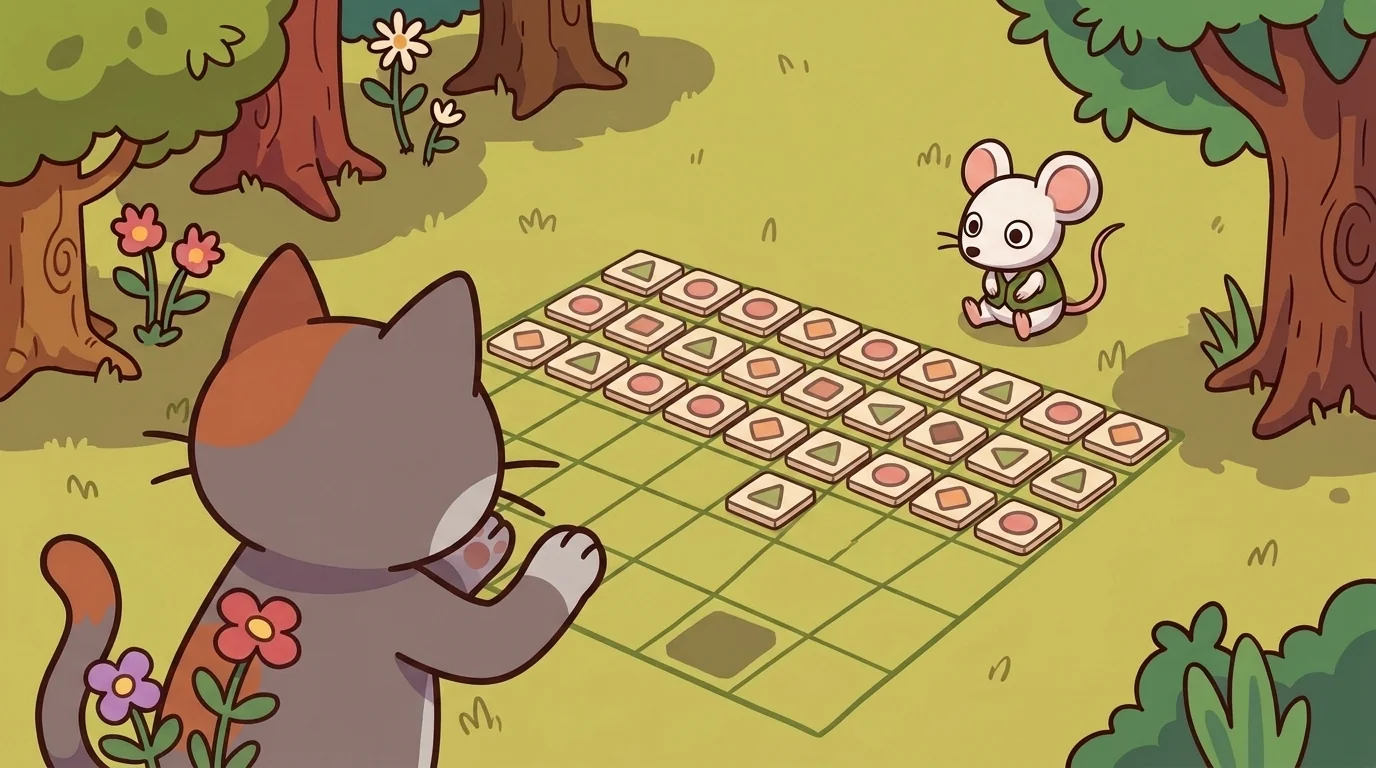
Rail's most eager student, a mouse named Fen, wanted a tougher lock. So Rail showed him the fuller pattern: a grid instead of a two-rail fence. "Write your tiles into the grid row by row," she said, filling it left-to-right, top-to-bottom. "Now — a keyword decides the new order of the columns. Read the columns out one at a time, in the keyword's order, top to bottom." Fen read them off, and the resulting strip looked like utter nonsense — yet held every tile he'd started with.
"It's just jumbled!" Fen said, delighted and a little dizzy.
"Jumbled, not changed," Rail corrected, gentle. "Every tile's still there. Now here's the part I most want you to keep." She held up two paws. "Real systems don't stop at one trick. They swap the tiles — Mask's move — and rearrange them — mine. Two different kinds of lock on one chest. To open it, a thief needs two different tools and two different ways of thinking."
Fen's eyes went round. "So a counter can't win, and an unscrambler can't win either, because there's a swap hiding under the shuffle?"
"Now you understand," Rail said warmly, and Fen sat straighter, thrilled to have caught it. "Same letters, new order — that's me. Add a swap on top, and the whole thing turns nearly uncrackable."
That evening Fen stayed late, sliding his tiles into arrangement after arrangement, hunting for the neatest possible pattern the way Rail hunted for the perfect prop-placement. When at last the tiles clicked into an order that felt exactly right, a warm little jolt of satisfaction ran through him — the quiet joy of the same pieces suddenly making something new.
Rail watched from her spotless desk and felt it too, settling soft and steady in her chest: not the pride of an unbreakable code, but the plain gladness of order found — pieces you already held, nudged into their cleverest place. She squared the last stray tile against its edge, and the small rightness of it warmed her all the way home.
The CipherForge ensemble
Rail is part of CipherForge's distributed-narrative cast. Each character embodies a different curricular primitive; together they teach the full subject.
-

Caesar
Caesar shift / monoalphabetic shift cipher
-

Mask
Atbash + general monoalphabetic substitution (every letter has a fixed substitute)
-

Vigenère
Vigenère / polyalphabetic keyword cipher (the Caesar-on-a-rotating-keyword pattern)
-

Echo Pair
Playfair digraph cipher (letters encoded in pairs through a 5×5 grid)
-

Tally
Number-based codes (A1Z26, ASCII, binary, book ciphers — any mapping that converts letters to numbers)
-

Sift
Frequency analysis + cryptanalysis-by-statistics (the cipher-breaking method, not a cipher itself)
-

Lattice
Modern cryptography fundamentals — XOR, public-key concept, hashing (the irreversible / asymmetric family)
-

Hollow
Hides a secret message inside something ordinary, so nobody even knows there is a message to look for.
-

Tome
Keeps a shared code-book where whole words stand for secret words, so only someone with the same book can read the note.