Echo Pair
PLAYFAIR DIGRAPH CIPHER — *letters encoded in pairs through a 5×5 grid.* The cryptography primitive of *digraph (two-letter-unit) substitution using a keyword-arranged grid.*
Press play to listen along. The line being read lights up as you go.
Show full transcript
Loading transcript…
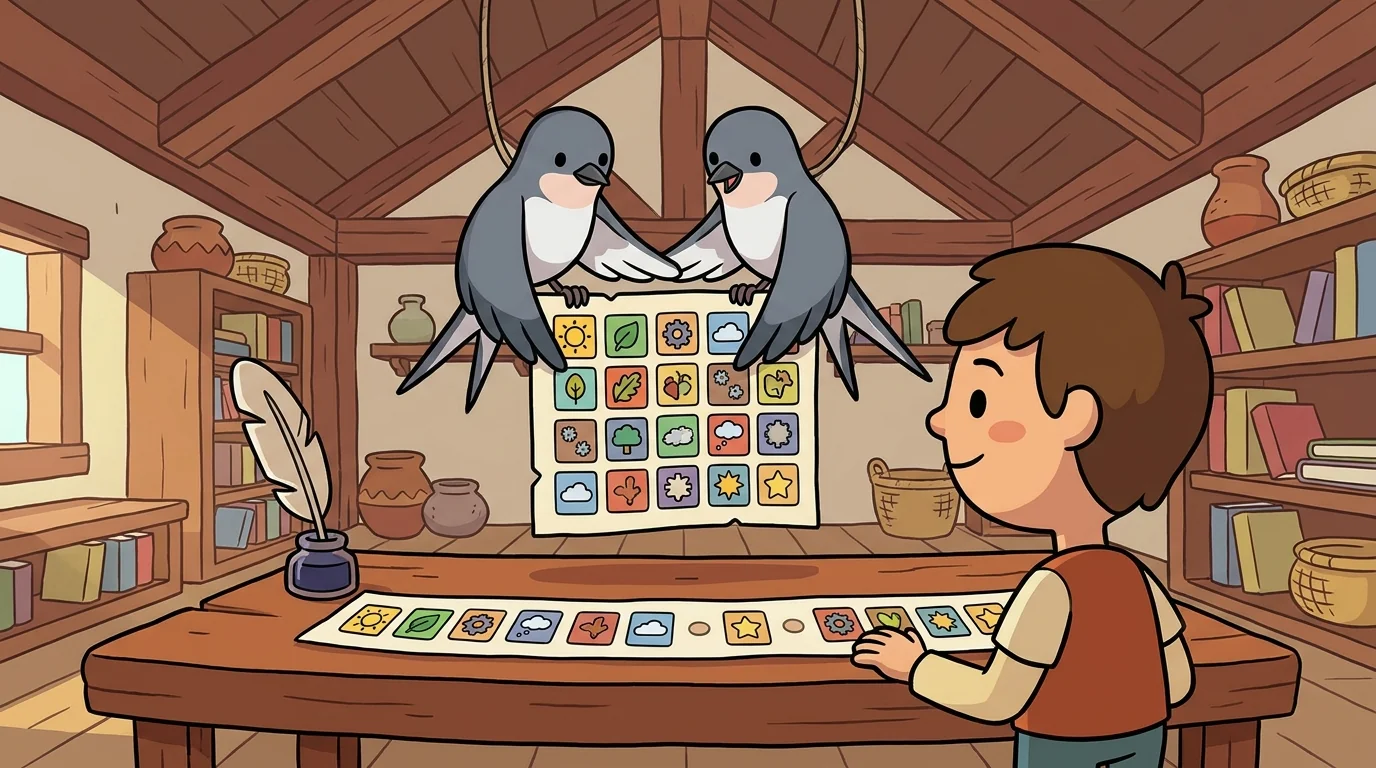
Two grey-and-white swallows dropped from the rafters at exactly the same instant, wingtips almost touching, and landed on the desk facing a boy who had a message he wanted to keep. Between them they unfolded a small card — five little boxes across, five boxes down, a symbol resting quietly in each. Echo touched the top-left corner with one claw. Pair touched it too, from the other side, at the same moment.
"Give us your message," they chirped, one voice split into two.
The boy laid down a strip of picture-symbols. Echo pushed the first two symbols together until they sat side by side, a snug little couple. Pair nudged the next two into their own pair, and the next, until the whole strip had bunched up into pairs, never a lonely symbol left over. When two identical symbols tried to sit together, the birds slipped a small spacer-mark between them so no pair was ever a matched twin — that would tangle the wheel-work.
Then the dance began. For each pair, the twins hopped across their grid together, mirror to mirror. When both symbols sat in the same row, they each slid one box to the right. When both sat in the same column, they each dropped one box down. When the two symbols made the corners of a little rectangle, each swallow flew to the far corner in its own row and traded columns. Two symbols in, two symbols out — always two, never one alone. The boy watched his message turn into a new strip of pairs, each swap depending not on a symbol by itself but on the partner beside it.
"See?" said Echo. "The same symbol can leave the grid as three different things," said Pair, "depending who it stood next to." That was the whole trick. Count the symbols one by one and you learned nothing, because no symbol had a single fixed answer — it changed with its neighbour.
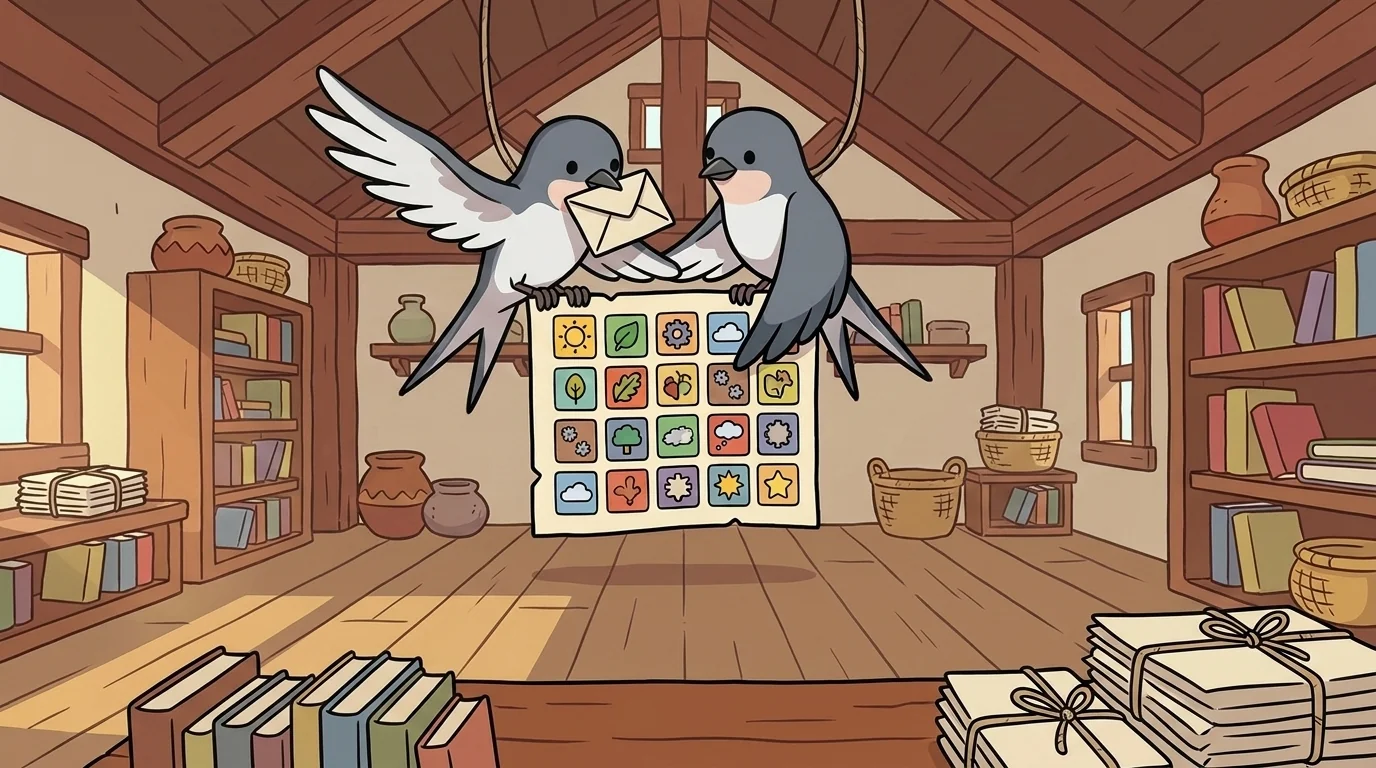
Echo and Pair hatched in a valley of twin-birds where every job was done in twos. Their family carried messages from one hillside village to the next, and the rule of the valley was simple and iron: no message flew alone, and no bird flew alone.
As fledglings they practised on the crossing-cliff. One twin carried the folded note; the other flew a wing-length behind, watching. If the lead bird's memory slipped a beat, the trailing bird's call caught it before the note was lost to the wind. They took turns — lead, then check, then lead again — until the checking felt like breathing. Every message that reached the far village had been read twice, once by each of them, and every message came back correct.
The night a storm split their flight in two, Echo carried a message alone for the first time, and got a swap backwards halfway across. When Pair caught up, wet and frightened, and the two of them re-flew the whole thing together at dawn, the note came out clean. That morning taught them the thing they would carry the rest of their lives: alone, either of them could stumble. Together, checking each other move for move, they almost never fell.
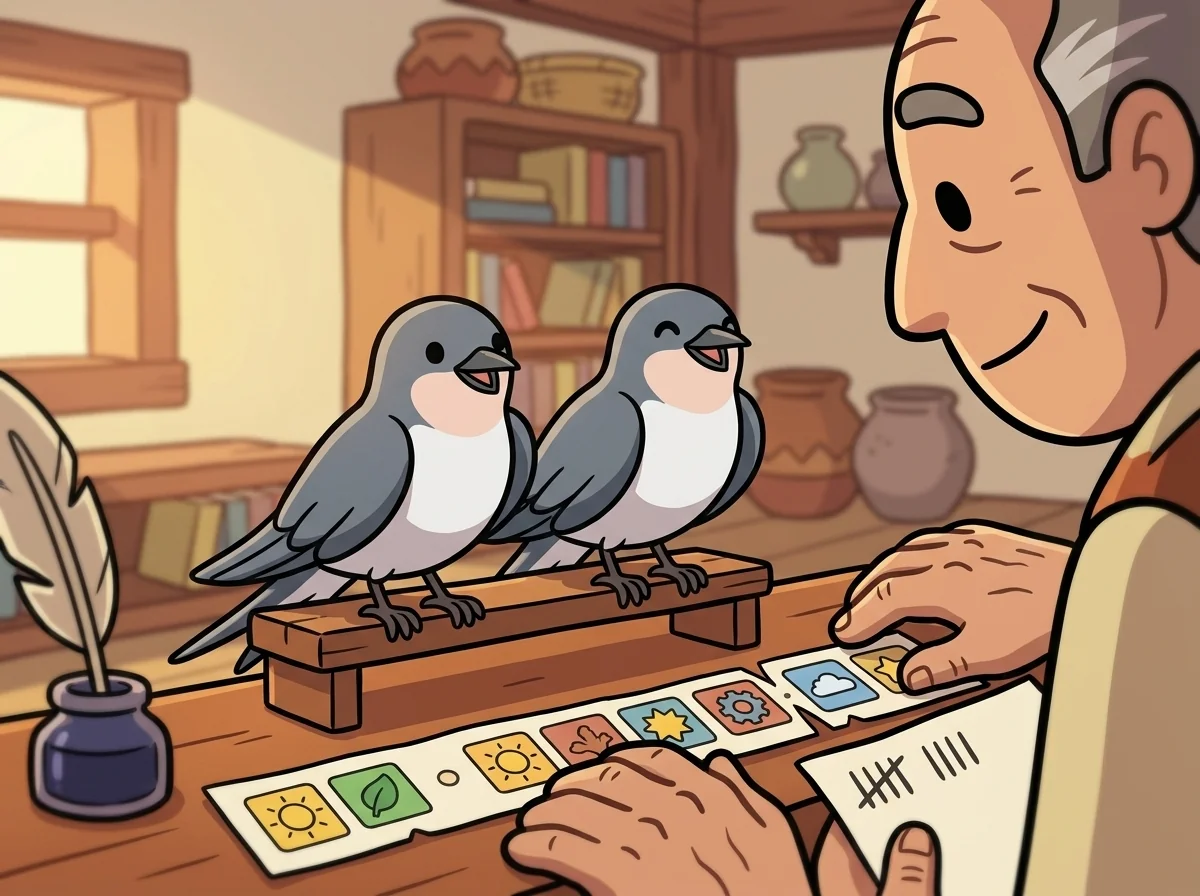
They came to CipherForge full-grown, still flying a wing-length apart out of pure habit. Cypher, the quiet old keeper of the workshop, set a scrambled strip on the desk and watched them.
"Show me your way," Cypher said.
The twins didn't answer in words. Echo split the strip into pairs. Pair walked the grid. When Echo hopped right, Pair hopped right beside her; when the corners made a rectangle, each flew to her own far corner and swapped columns without a heartbeat's hesitation, calling the moves to each other as they went. Cypher leaned in and tried the old counting trick on the result — tallying how often each symbol showed up — and the tally told him nothing, because every symbol wore a different face depending on its neighbour.
Cypher's mouth curved, which almost never happened. "Two symbols at a time. Every answer decided by the pair, not the piece." He slid the strip back. "There is a bench for you here, both of you." The twins puffed their chests and landed on it together, of course.
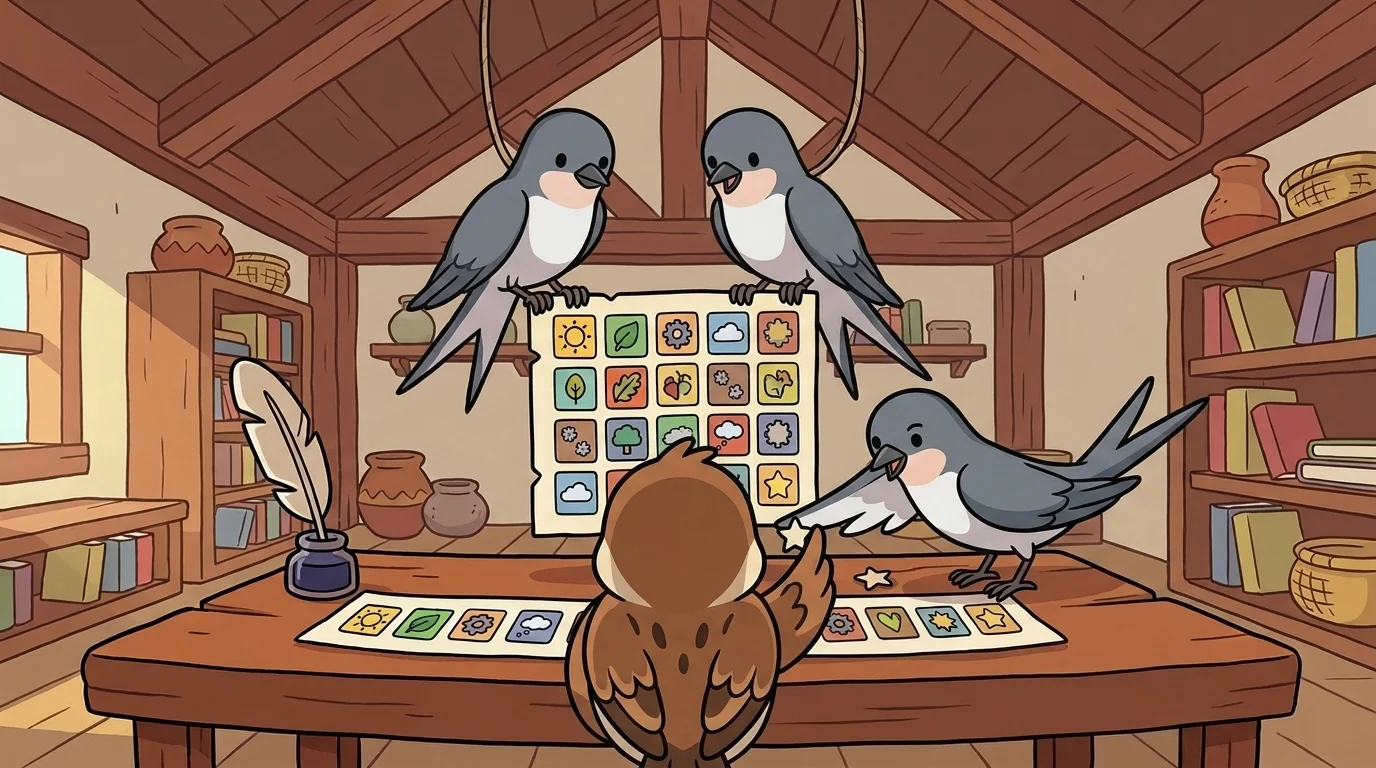
Cypher's youngest student, a sparrow named Tam, wanted to try it alone. She split her message into pairs by herself and started walking the grid, and halfway through she froze — two matching symbols sitting side by side, and no idea what to do.
"Slip a spacer between them," said Echo, hopping up on Tam's left. "So the pair is never a matched twin," said Pair, hopping up on her right. "Now walk it again."
Tam walked it again, and this time when she hit a rectangle she flew the wrong corner. Pair caught it — "your row stays yours, only the column trades" — the same soft catch the twins had given each other on the crossing-cliff a hundred times. Tam fixed it, finished, and read her scrambled strip back. It looked like nonsense, which meant it had worked.
"Will anyone ever crack it?" Tam asked.
"Someone patient could," Echo admitted, not the least bit ashamed. "Not by counting single symbols — that fails. By counting pairs." Pair nodded. "Every code is a game. Ours just makes the game longer." Tam grinned, because a longer game was exactly what she'd wanted.
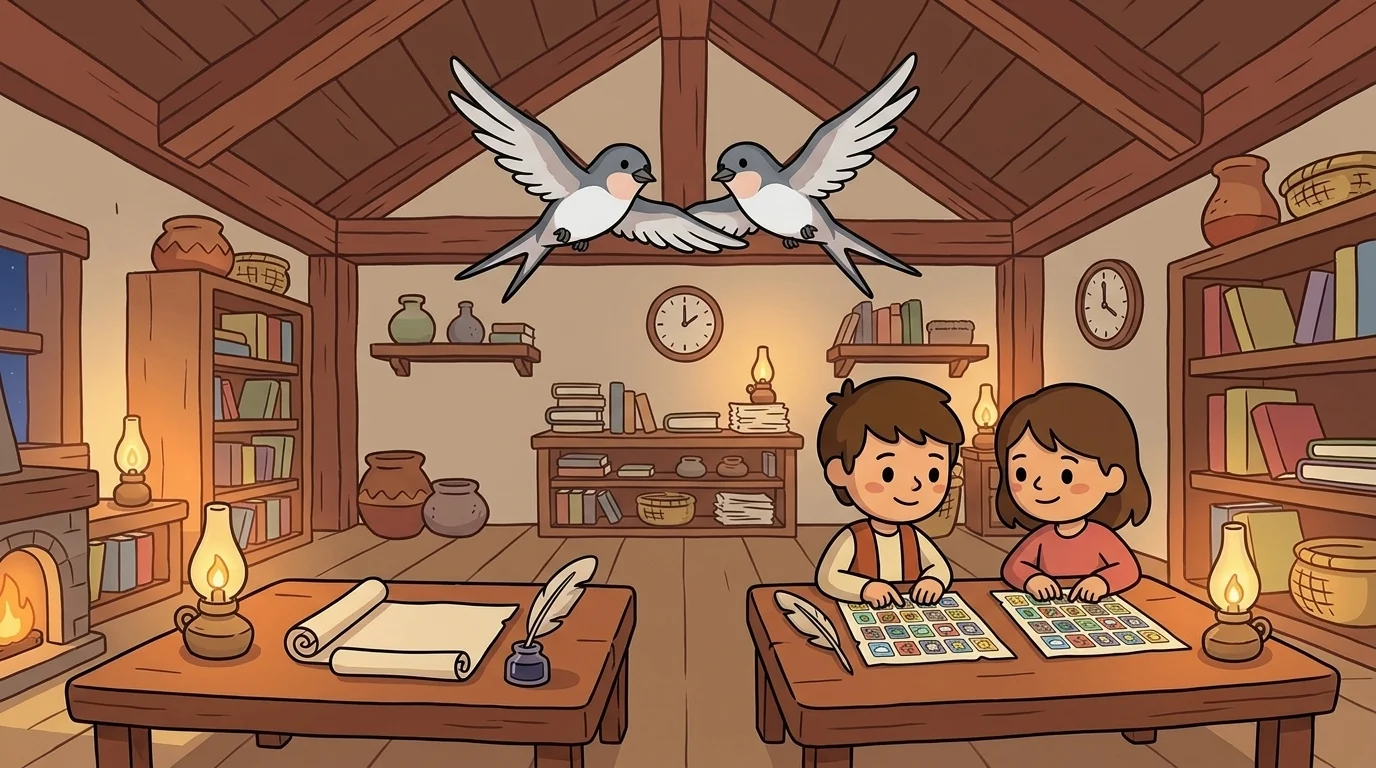
That evening Tam did something small that surprised her. She turned to the friend she'd been passing notes with all week and said, "Check mine, and I'll check yours — every move." They walked their grids side by side, catching each other's slips, and when both messages came out clean there was a warm, settled feeling in Tam's chest she hadn't expected — not the thrill of a hard puzzle solved, but the quiet steadiness of not being the only pair of eyes on the thing that mattered.
Overhead, Echo and Pair drifted toward the rafters, a wing-length apart, checking each other even in the way they flew. Neither of them had to look to know the other was there. That, more than any grid, was the feeling they carried: side by side, nothing slipped past for long.
The CipherForge ensemble
Echo Pair is part of CipherForge's distributed-narrative cast. Each character embodies a different curricular primitive; together they teach the full subject.
-
Caesar
Caesar shift / monoalphabetic shift cipher
-
Mask
Atbash + general monoalphabetic substitution (every letter has a fixed substitute)
-

Vigenère
Vigenère / polyalphabetic keyword cipher (the Caesar-on-a-rotating-keyword pattern)
-
Rail
Rail-fence + columnar transposition ciphers (rearrange letter order without changing the letters themselves)
-

Tally
Number-based codes (A1Z26, ASCII, binary, book ciphers — any mapping that converts letters to numbers)
-

Sift
Frequency analysis + cryptanalysis-by-statistics (the cipher-breaking method, not a cipher itself)
-
Lattice
Modern cryptography fundamentals — XOR, public-key concept, hashing (the irreversible / asymmetric family)
-
Hollow
Hides a secret message inside something ordinary, so nobody even knows there is a message to look for.
-
Tome
Keeps a shared code-book where whole words stand for secret words, so only someone with the same book can read the note.