Mask
MONOALPHABETIC SUBSTITUTION — *every letter has a fixed substitute.* The cryptography primitive of *arbitrary one-to-one alphabet remapping (more general than shift; same letters always become same substitutes).*
Press play to listen along. The line being read lights up as you go.
Show full transcript
Loading transcript…
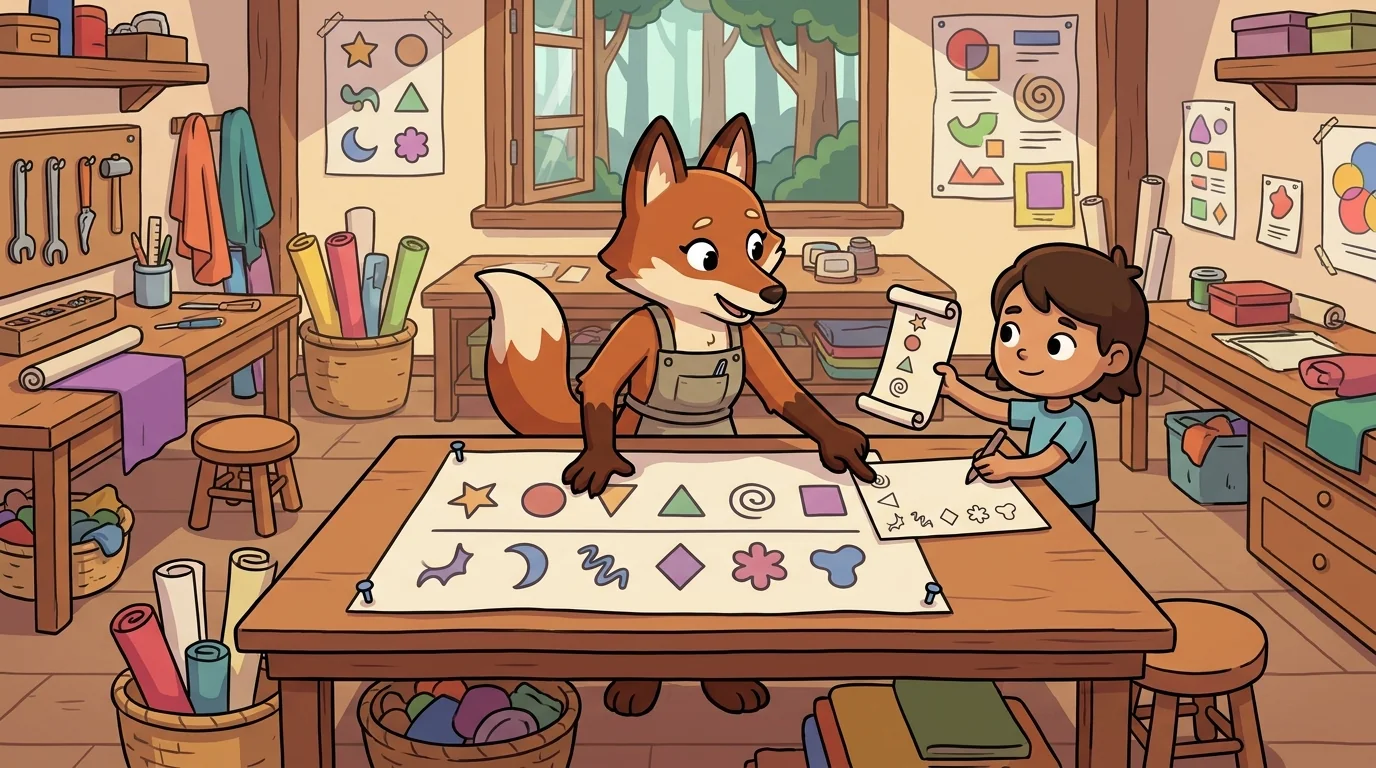
Mask, a quick russet-and-cream fox, spread a wide sheet across the workshop table and pinned it flat with both paws. The top row showed every symbol of the ordinary alphabet, plain and in order. The bottom row showed a scrambled parade of stand-in shapes, each one sitting directly under exactly one ordinary symbol — a fixed partner for every letter, no two sharing the same stand-in.
A student handed her a message. Mask ran a claw along her sheet, symbol by symbol, never hurrying, and for each one she copied down the stand-in shape sitting beneath it. When the first symbol appeared again three lines later, she copied the very same stand-in — the same partner, always. When it appeared a fifth time, the same again. She never once changed her mind partway through.
"Watch what I'm doing," she said, tapping the sheet. "Caesar just slides everything the same distance down the line. Boring. Predictable. I get to choose. Any symbol can become any shape I like — but once I choose, I hold to it. One symbol, one stand-in, forever. Everywhere it shows up, it wears the same disguise."
The student stared at the finished message — a river of unfamiliar shapes. "There must be a zillion ways to build that sheet," he breathed.
"More than you could count in a lifetime," Mask agreed, bright-eyed and pleased. It felt uncrackable. But she leaned in, quieter. "And yet it has a soft spot. Because I never change the disguise, the shape standing in for the most common symbol shows up just as often as that symbol did. Count carefully and the disguise starts to slip." She looked almost fond of the flaw. "Neat and steady is my strength. It's also exactly how a patient friend gets in."
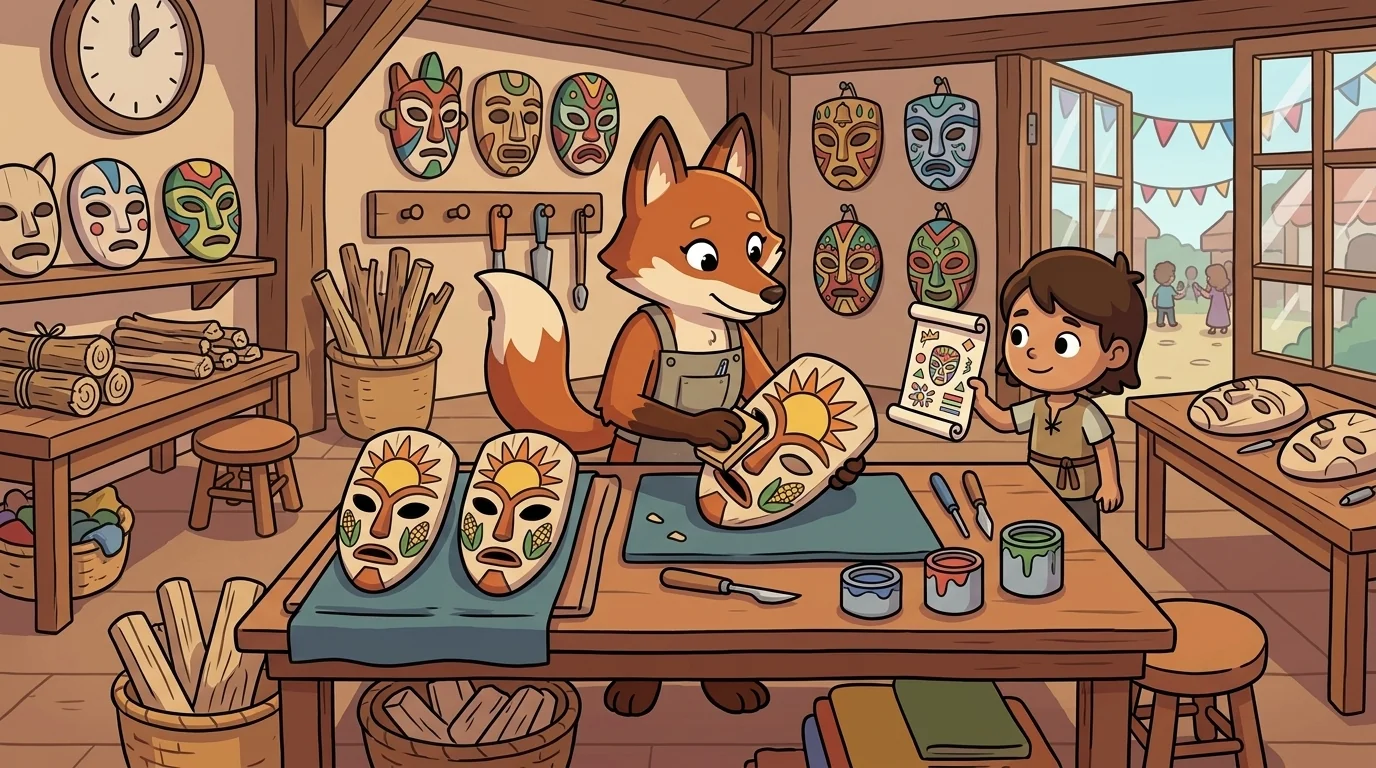
Mask grew up in a village of festival mask-carvers, and her family carved the masks that told everyone who was who. There was a Harvest-Keeper mask and a Bell-Ringer mask and a dozen others, and the rule of the carving-shed was absolute: each mask always looked the same, and each mask always meant the same person.
Young Mask learned to sand each new Harvest-Keeper mask until it matched the one before it exactly — same curve of cheek, same tilt of brow. If a child wore the Bell-Ringer mask at the spring festival, everyone in the square knew the Bell-Ringer without a word spoken. One mask, one meaning, held steady year after year. That steadiness was the whole magic; a mask that changed its meaning would have thrown the festival into confusion.
She loved the tidy rightness of it. Every mask in its place on the shed wall, every face matched to its meaning, nothing ever swapped or muddled. The day she carved her first perfect matching pair — two Harvest-Keepers you couldn't tell apart — she felt a deep, quiet satisfaction, the pleasure of things that line up exactly the way they should. That love of clean, fixed matching went with her everywhere afterward.
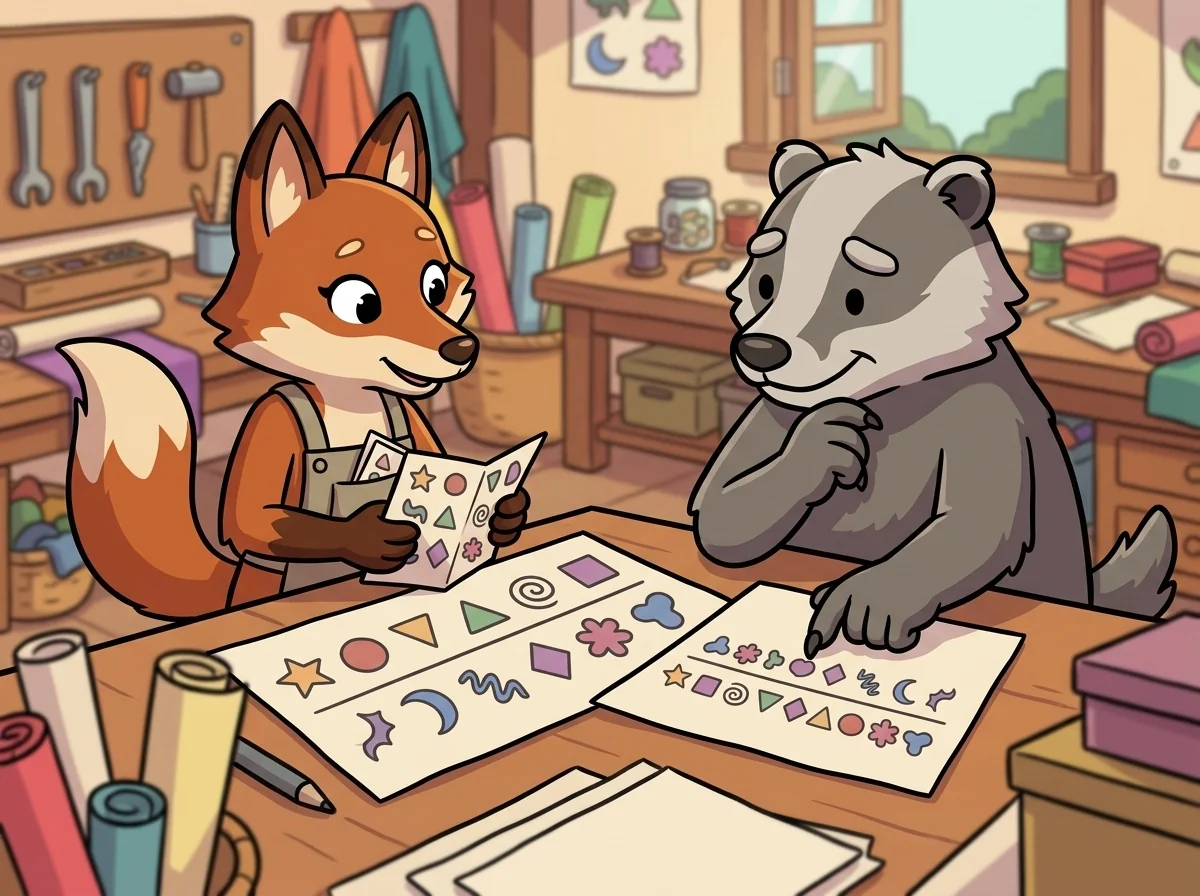
Grown, Mask carried her folded matching-sheet the long road to CipherForge. Cypher, the workshop's old keeper, laid a plain message and a blank sheet in front of her and folded his hands.
"Show me your way," he said.
Mask filled in her sheet first — one stand-in shape beneath each ordinary symbol, every one different, none repeated. Then she rewrote the message, holding to her sheet without a single slip: the same symbol always wearing the same disguise, all the way down. Cypher took the scrambled result and counted how often each shape appeared. The most frequent shape, he saw, stood out just as loudly as the most common symbol in plain writing would have.
"Vast choice," Cypher said, tapping the sheet. "But because you never vary the disguise, the counting slips right in." He nodded, slow. "You understand both the strength and the crack. Stay and teach it." Mask didn't blink. She just tucked her sheet away in its place, the way she'd always tucked masks into their spots on the shed wall.
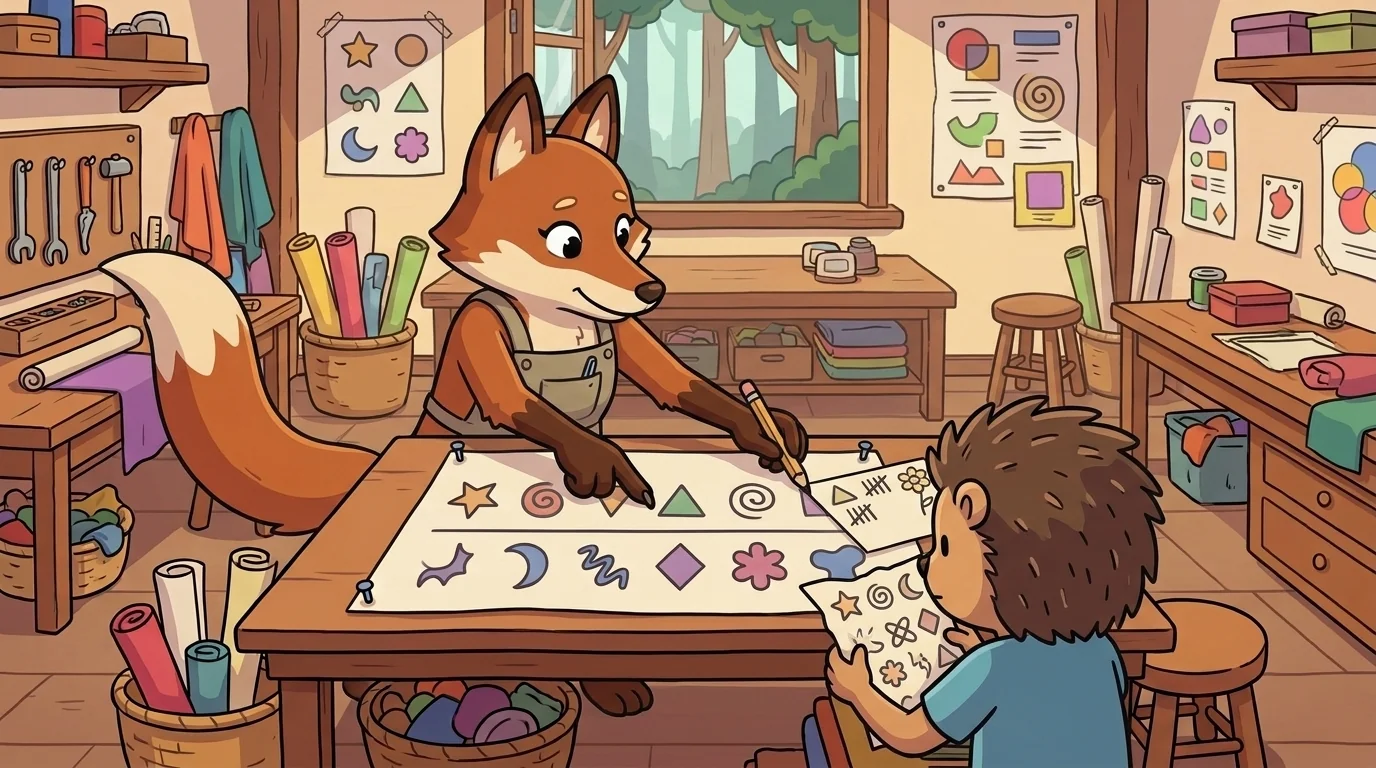
Mask's tidiest student, a hedgehog named Bram, wanted his code to be truly unbreakable. He built a beautiful matching-sheet, every stand-in unique, and disguised his message. "There," he said, satisfied. "Nobody can guess a sheet with that many choices."
"Nobody can guess the whole sheet," Mask agreed. "So they won't try." She took his scrambled message and tallied the shapes on a scrap of paper. "One shape shows up far more than the rest. In ordinary writing, one symbol always shows up far more than the rest too — the common one. So this loud shape is almost certainly that common symbol in disguise." She penciled in her guess, and a real word peeked through.
Bram's ears drooped. "But I picked such a clever sheet!"
"A clever sheet, yes," Mask said gently, not letting him feel foolish. "But a fixed one. That's the lesson, and it's a good one: how strong your code is depends entirely on how someone tries to break it. Guess the sheet blindly — you'd be here till the stars burned out. Count the shapes — you're in by supper." She tapped her nose. "Same code. Two different attacks. Only one of them works."
Bram thought about it, then brightened. "So if I want it stronger, I stop letting each symbol keep the same disguise."
"Now you're thinking like a code-maker," Mask said, and Bram sat up straight, proud of the idea.
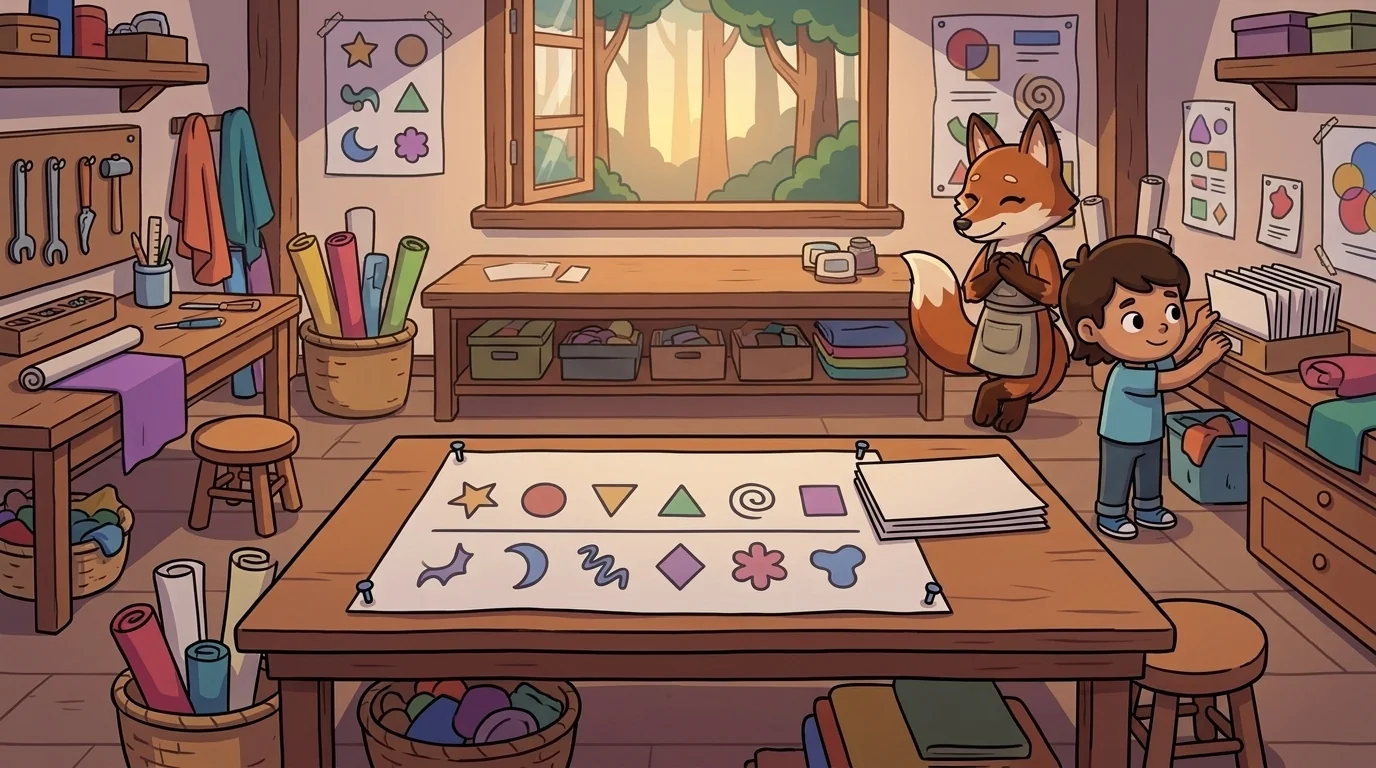
That evening Bram lingered by the shelf where the matching-sheets were filed, each in its own slot, and lined his own up neatly with the rest. There was a small, settling comfort in seeing every sheet squared away in its place — the same steady contentment Mask had felt as a kit, matching mask to meaning in the carving-shed.
Mask watched him from the doorway and felt it too, warm and quiet in her chest: not the thrill of an unbreakable secret, but the plain, restful gladness of things lined up exactly right, each in its own place, holding steady. She straightened one sheet that had slipped a finger's width out of line, and only then let herself go home.
The CipherForge ensemble
Mask is part of CipherForge's distributed-narrative cast. Each character embodies a different curricular primitive; together they teach the full subject.
-
Caesar
Caesar shift / monoalphabetic shift cipher
-

Vigenère
Vigenère / polyalphabetic keyword cipher (the Caesar-on-a-rotating-keyword pattern)
-
Echo Pair
Playfair digraph cipher (letters encoded in pairs through a 5×5 grid)
-
Rail
Rail-fence + columnar transposition ciphers (rearrange letter order without changing the letters themselves)
-

Tally
Number-based codes (A1Z26, ASCII, binary, book ciphers — any mapping that converts letters to numbers)
-

Sift
Frequency analysis + cryptanalysis-by-statistics (the cipher-breaking method, not a cipher itself)
-

Lattice
Modern cryptography fundamentals — XOR, public-key concept, hashing (the irreversible / asymmetric family)
-

Hollow
Hides a secret message inside something ordinary, so nobody even knows there is a message to look for.
-
Tome
Keeps a shared code-book where whole words stand for secret words, so only someone with the same book can read the note.